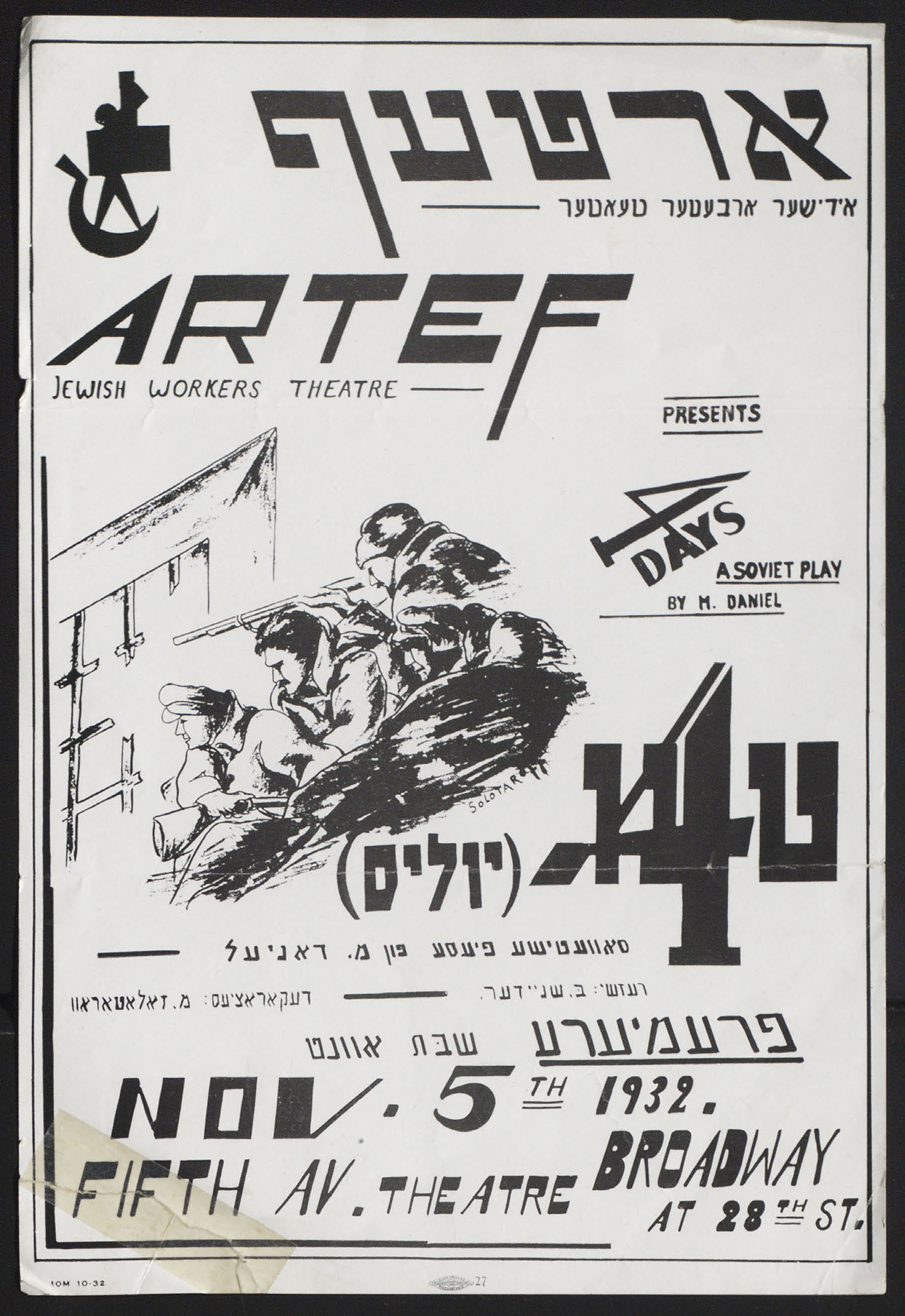
Begun in 1925 as a project of Young Workers League members, Artef (Arbeiter Theater Verband) grew into a central institution of radical culture during its 15-year existence. Combining political commitment with the highest artistic aspirations, the theater’s influence reached far beyond the Jewish left and was the training for a generation of actors, directors, and writers.
‘Conference of the Jewish Workers Theatre’ from Workers Theatre. Vol. 3 No. 6. May-June, 1933.
Artef, Jewish workers theatre conference plans important work conference for coming season.
The Artef Conference held Sunday, May 9th at Irving Plaza, was revolutionary in character and earnest in its discussion of plane for its future work.
Present at the conference were 110 delegates from 75 organizations with a total membership of 26,000. There were also a number of credentials presented from organizations whose delegates were not present. The report of Comrade Friedman, Secretary of the Artef, very ably brought forth the accomplishments and the shortcomings of the Artef in its past season. The financial report was made by Comrade Fishman. Following the reports an interesting discussion developed, in which a large number of delegates and members of the Artef Players Collective discussed the tasks of the Artef for the next season.
The reports of the majority of the delegates established the fact that the chief shortcomings of the Artef were, first, that the Artef failed in developing a repertory depicting the life of the American worker; second, that the Artef did not take part in the struggle of the workers through its strong propaganda weapon–the theatre. Comrade M. Epstein who spoke during the morning session, on the tasks of a proletarian theatre, And the specified tasks of the Artef, brought to light in a brilliant manner the development of the Artef in its past and also showed that the shortcomings of the Artef are partly due to the lack of aid from the workers’ organizations in building and strengthening their weapon, the Artef, as a means of drawing thousands of workers to us and at the same time strengthening our ranks. He also mentioned that the situation in the Artef is partly due to the fact that it mas no permanent location where it can perform, judging from the financial report which shows that throughout the theatre season the rent expenditures were over $6,000. The Artef, with such a large sun, and the aid of workers’ organizations, could maintain a theatre and in that way increase greatly the activities of the Artef.
Comrade M. Katz, who greeted the conference, received a tremendous ovation. In his greeting he compared the two systems in the world–the Soviet system, from where he had just come, and the American system in which we find ourselves. He also spoke of the tremendous role that theatre plays in the Soviet Union, and which the Artef should play here as a proletarian theatre.
Comrade Kramer, the former president of the Artef and one of its founders, greeted the conference, and spoke of the perspective of the founders of the Artef, and their hopes which are little by little coming true. Comrade H. Shapiro brought greetings from the League of Workers Theatres, congratulated the Artef on its aid to the Jewish agitprop workers’ groups, and pointed out the importance of developing the agitprop troupes, both as a weapon in the class struggle and as an aid to the Artef. He urged cooperation with the other workers’ stationary theatres in New York today.
A number of resolutions were accepted, demanding the freedom of Tom Mooney, the Scottsboro boys, for the Defense of the Soviet Union, and for the support of the Morning Freiheit and the Workers Theatre Magazine.
After the election of 25 delegates as an executive body, the conference called for 5,000 subscribers and builders for the Artef. The conference closed with the signing of the Internationale.
Workers Theatre began in New York City in 1931 as the publication of The Workers Laboratory Theater collective, an agitprop group associated with Workers International Relief, becoming the League of Workers Theaters, section of the International Union of Revolutionary Theater of the Comintern. The rough production values of the first years were replaced by a color magazine as it became primarily associated with the New Theater. It contains a wealth of left cultural history and ideas. Published roughly monthly were Workers Theater from April 1931-July/Aug 1933, New Theater from Sept/Oct 1933-November 1937, New Theater and Film from April and March of 1937, (only two issues).
PDF of full issue: https://www.marxists.org/history/usa/pubs/workers-theatre/v3n5-n6-1933-may-jun-Workers-Theatre-yale-mf.pdf
 Revolution's Newsstand