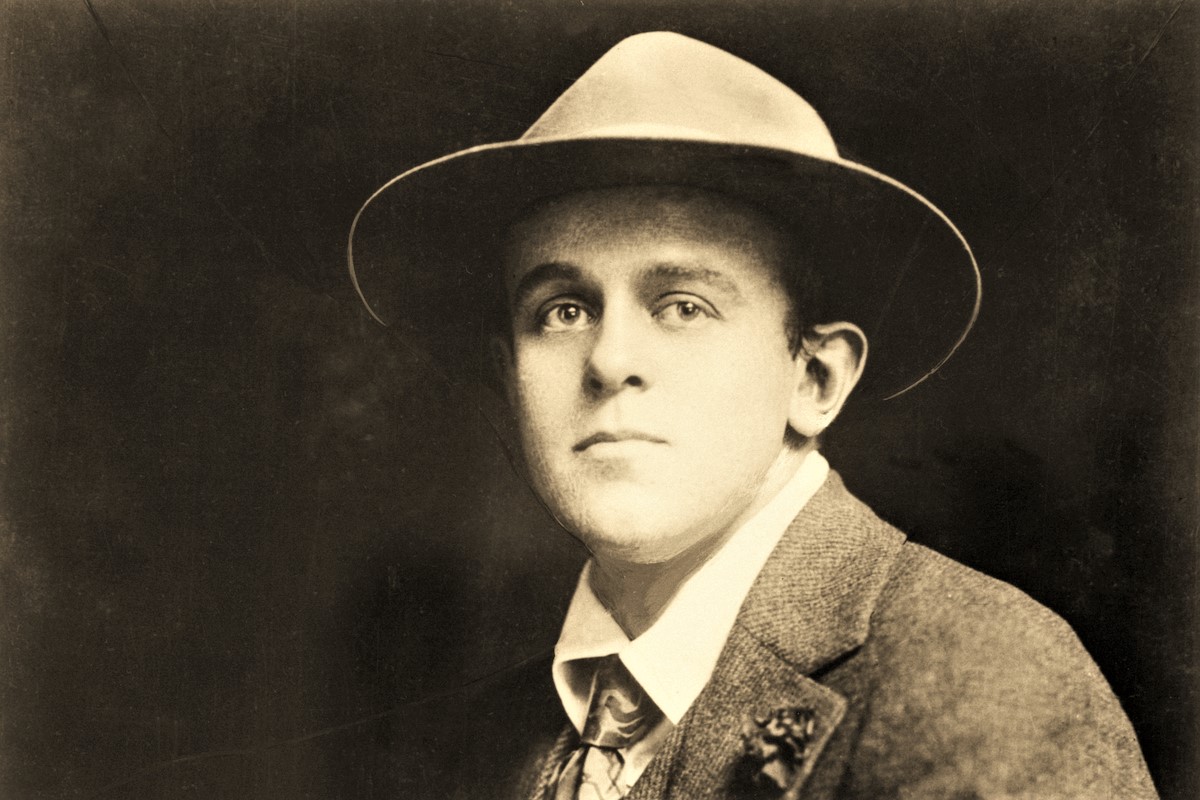
A chapter from Granville Hicks’ fine biography of John Reed finds him in increasing conflict with liberals over the entrance of the U.S. into the war, losing his position at the Metropolitan magazine, and transforming from a radical into a revolutionary.
‘John Reed and the Jingo Press’ by Granville Hicks from New Masses. Vol. 18 No. 3. January 14, 1936.
In the first eight months of 1917, the eight months before he sailed for Russia, John Reed’s principal concern, as this chapter shows, was the struggle against war. His experiences on the Western and Eastern Front, as described in preceding chapters, had both strengthened his awareness of the imperialist basis of the World War and intensified his hatred of warfare. Even after the entrance of the United States into the war, he continued his resistance, but he found it difficult to avoid pessimism and, as is shown in portions of this chapter that it was necessary to omit, he was often unhappy. John Reed had reached a point at which he knew very well that he wanted revolution, but he was far from certain that the working class would ever be ready to overthrow capitalism. Just at this stage of his development, he went to Russia, arriving less than two months before the ten days that shook the world. G.H.
THE METROPOLITAN for January, 1917, announced Reed’s proposed trip to China: “He will hold up the mirror to this mysterious and romantic country and we shall see its teeming millions and the big forces at work there. Imagine Reed in this rich ‘copy’ empire–the man of whom Rudyard Kipling said, ‘His articles in The Metropolitan made me see Mexico’.” Reed and Louise Bryant, securing their passports and a stock of letters of introduction, made all their plans.
On January 22, 1917, Wilson delivered his famous speech advocating peace without victory. The next day Bethlehem Steel announced a two-hundred-percent stock dividend.
A week later, Count Bernstoff informed the United States government that Germany was about to engage in virtually unrestricted submarine warfare and on February 3, the President announced the severing of diplomatic relations. That week Hovey wrote Reed that under the circumstances it seemed unwise to spend money on articles about China. “Whigham and I,” he said, “think that we had best put off consideration of your trip to China until we can see more clearly ahead. Meanwhile, is there anything in connection with the new situation you can suggest that we could do in place of it?”
There was nothing. The abandoning of the trip to China meant the end not only of one of Jack Reed’s romantic dreams but also of a very substantial reality, his profitable employment by The Metropolitan. Roosevelt’s policies had come more and more to dominate the magazine; socialism was forgotten and only preparation for war mattered. Whigham and Hovey had been, all things considered, uncommonly liberal, but they were responsible for a business enterprise with a heavy investment and growing profits and there were limits to their tolerance. Art Young had been called from Washington and asked to talk over with them his monthly letter and he knew that the end was near. Reed had been perfectly outspoken. He had said to Whigham, “You and I call ourselves friends, but we are not really friends because we don’t believe in the same things and the time will come when we won’t speak to each other. You are going to see great things happen in this country pretty soon. It may kill me and it may kill you and all your friends, but it’s going to be great.” After that, Whigham and Hovey realized that, for all his talents, John Reed was a liability to The Metropolitan unless a way could be found for him to utilize those talents in a corner of the world that presented no issues on which Metropolitan readers felt deeply. When they decided that they could not send him to romantic and remote China, they knew that he was no longer useful to the magazine.
There was a brief interval before the actual break, but nothing that Reed wrote appeared in The Metropolitan. He did an article on Samuel Gompers, a discreet article, careful neither to discredit organized labor nor to offend the A.F. of L., but at the same time intended to expose the inadequacies of Gompers’ leadership. It was a painstaking piece of work, with a documented account of Gompers’ life and the growth of the Federation. In the sections that described Gompers’ speech to the striking garment workers and his conversation with Reed, it had some of the restrained irony that made Reed’s article on Billy Sunday so effective. But on the whole it was weak because Reed could not say what he thought and could only hint at his real criticisms of the reformist bureaucrat. Hovey and Whigham were right: John Reed was no longer a Metropolitan asset.
He was slowly realizing that a decision had been forced upon him. For four years he had taken the side of the workers in their struggle against exploitation and he had become known as a radical; but radicalism had been only one of a vast number of interests. Now, in the months when the United States. prepared for entrance into the war, he understood that, if he was to be a radical at all, revolutionary change must be, if not his only interest, at least the center of his life. He told a friend that henceforth he would write nothing that did not express his hatred of capitalism, nothing that did not aid the cause of revolution. He was still a poet, but a poet whose immediate task was something other than the writing of poetry.
THE pacifists had begun their frantic struggle to prevent the declaration of war, but Reed, though he took part in it, knew that it came too late. Bernstorff had left and the House had voted the largest naval appropriations bill in history. LaFollette had killed the armed-ship bill in the Senate, but Wilson had proceeded to arm merchantmen without Congressional authority. The pro-Ally partisanship that Reed had deplored was fast becoming hysteria. More and more clergymen joined Newell Dwight Hillis, S. Parkes Cadman and Henry Van Dyke in preaching a holy crusade against the Huns. College presidents vied with one another in the coining of epithets for the Kaiser. The liberals were hastening to get in line. The editors of The New Republic had decided that, in Floyd Dell’s phrase, “a war patronized by The New Republic could not but turn out to be a better war than anyone had hoped.”
Reed kept on fighting. “I know what war means,” he wrote in The Masses and The Call.
“I have been with the armies of all belligerents except one, and I have seen men die, and go mad, and lie in hospitals suffering hell; but there is a worse thing than that. War means an ugly mob-madness, crucifying the truth-tellers, choking the artists, side-tracking reforms, revolutions, and the working of social forces. Already in America those citizens who oppose the entrance of their country into the European melee are called “traitors,” and those who protest against the curtailing of our meager rights of free speech are spoken of as “dangerous lunatics.””
Whose war is this?–he asked, and answered—
“Not mine. I know that hundreds of thousands of American workingmen employed by our great financial “patriots” are not paid living wages, have seen poor men sent to jail for long terms without trial, and even without any charge. Peaceful strikers, and their wives and children, have been shot to death, burned to death, by private detectives and militiamen. The rich have steadily become richer, and the cost of living higher, and the workers proportionally poorer. These toilers don’t want war–not even civil war. But the speculators, the employers, the plutocracy–they want it, just as they did in Germany and England; and with lies and sophistries they will whip up our blood until we are savage and then we’ll fight and die for them.
Reed, like most radicals, took some consolation in the overthrow of the Czar, but he was not deceived into believing that a significant transfer of power had taken place. He described it as a revolution created by intellectuals, business men and army officers, for the purpose of better organizing Russian capitalism and more efficiently carrying on the war. For this reason it had the approval of the commercial interests of the allied countries. He saw a possibility that it might open the way for a genuine revolution by the workers and farmers, but he scoffed at the idea that any particular importance could be attached to the abdication of the Czar and the consequent change in the form of government.
For the moment, Russia was less important than the last desperate fight against participation in the war. Now that it had become certain that President Wilson would call for a declaration of war, the pacifists could scarcely believe that what they had dreaded was at hand. Thousands of them poured into Washington as Congress opened, most of them frightened and confused, but still hoping. Reed joined them. LaFollette gave him a pass to the Senate and John M. Nelson, who also was to vote against the war resolution, a pass to the House.
But on the evening of April 2, when Wilson was addressing the joint session of Congress, Reed was not present. He was at a meeting held under the auspices of the People’s Council, a meeting to which thousands of pacifists and radicals had come from all over the East. The more liberal members of the committee had asked him to speak, but he feared that, as a radical, he would be denied the chance. Alice Potter, who had helped with the Paterson pageant and had been his strongest supporter in his project for a workers’ theater, offered a suggestion. With his approval, she assigned loyal friends to places throughout the hall and gave them their instructions.
When, as the hour grew late and Reed had not yet been called on, he gave her a signal, she rose and waved her handkerchief. Instantly there were cries from all over the hall, “We want Jack Reed!” David Starr Jordan, who was presiding, rose and said, “We will come to Mr. Reed in due time.” Another speaker was introduced and went on and on with meaningless phrases. Alice Potter again waved her handkerchief and again the cries came for Jack Reed. “Mr. Reed will speak if there is time,” Dr. Jordan announced.
As the clamor continued, a man entered the back of the hall and walked rapidly to the platform. Everyone was silent. The man reached the platform and they all, knowing well what they were to hear, gasped as he briefly told them that the President had called for war. Dr. Jordan rose, saying in effect, “We were for peace, but we will follow our country.” There were cries of “Jack Reed,” cries that were repeated throughout the audience. “There is no time,” Jordan said. The cries grew more and more insistent. Reed rose, stepped forward, raised his hand and said, “This is not my war and I will not fight in it. This is not my war and I will not support it. This is not my war and I will have nothing to do with it.” One man had refused to equivocate and courage sprang up again in hundreds of hearts.
Outside on the street, Reed bought an extra and read the eloquent phrases of the President’s message:
“We must put excited feeling away…We will not choose the path of submission and suffer the most sacred rights of our nation and our people to be ignored or violated. The wrongs against which we now array ourselves are not common wrongs: they cut to the very root of human life…Our object…is to vindicate the principles of peace and justice in the life of the world…We have no quarrel with the German people. A steadfast concert for peace can never be maintained except by a partnership of democratic nations…Only free peoples can hold their purpose and their honor steady to a common end and prefer the interests of mankind to any narrow interest of their own…We are now about to accept gauge of battle with this natural foe to liberty and shall, if necessary, spend the whole force of the nation to check and nullify its pretensions and its power…If there be disloyalty it will be dealt with a firm hand of stern repression…The day has come when America is privileged to spend her blood and her might for the principles that gave her birth and happiness and the peace she has treasured. God helping her, she can do no other.”
Wilson’s high moral tone sickened Reed and he fought to break through the fog of hypocrisy. He remained in Washington in order to testify at the House judiciary committee hearings on the espionage bill. He advanced, necessarily, the usual liberal arguments, reenforced by his own observations in the belligerent countries. At the hearing on the conscription bill, however, which took place two days later, he definitely committed himself. After describing conscription as undemocratic, he set forth the case for persons like himself who, without religious scruples against war in general, opposed this particular war. “I am not a peace-at-any-price man,” he said, “or a thorough pacifist, but I would not serve in this war. You can shoot me if you want and try to draft me to fight and I know that there are ten thousand other people–“
Representative Greene of Vermont interrupted: “I do not think we need to hear this gentleman any further,” and Representative Kahn of California added, “That kind of a man is found in every country, but we should be thankful that the country does not depend on them.” But the chairman insisted that Reed should be heard and he went on, reporting observations in England, France and Bulgaria. When he paused, Kahn ominously asked him for his address.
Representative Shallenberger inquired why he would not fight and Reed said that his experiences on five fronts and in the capitals of most of the warring nations had convinced him that it was a commercial conflict.
“I think,” said the chairman, “Mr. Shallenberger wanted you to state your personal reasons.”
“I was trying to state them.”
“It is not your personal objection to fighting?” Shallenberger asked.
“No,” said Reed, “I have no personal objection to fighting. I just think that the war is unjust on both sides, that Europe is mad and that we should keep out of it.”
What Reed did was no more than many others were doing, but such consistency had, nonetheless, become a rare virtue. And as the anti-war forces dwindled away, he found it difficult to keep from discouragement. It was easy enough to be personally brave, but it was difficult to find any basis for hope. The action of the emergency national convention of the Socialist Party in adopting a resolution against war helped a little to restore his faith in the party, but he was disgusted by the prompt desertion of such men as J.G. Phelps Stokes, Allan Benson, John Spargo, William English Walling and Harry Slobodin.
Of course his more respectable associates had already begun to shun him. He met a group of Harvard acquaintances in Washington and they were obviously uncertain whether to speak to him or not. Finally, with marked embarrassment, they shook his hand and went on with their talk about the war. “If I had the job of popularizing this war,” one of them said, “I would begin by sending three or four thousand American soldiers to certain death. That would wake the country up.” It reminded Reed of the day, a few weeks earlier, when he had overheard a young Plattsburger discussing in the Harvard Club the sinking of an American ship. “I must confess,” the Plattsburger had drawled, “that my ardor was somewhat dampened when I read that one of the victims was a Negro.”
Harry Reed had already volunteered. “I have done this,” he wrote his brother, “because I consider it my duty, not because I want to be a soldier or fight. I wish you could see a little more clearly just what the situation is in this country and how useless it is to try to buck what can’t be changed.” Mrs. Reed wrote, “It gives me a shock to have your father’s son say that he cares nothing for his country and his flag. I do not want you to fight, heaven knows, for us, but I do not want you to fight against us, by word and pen, and I can’t help saying that if you do, now that war is declared, I shall feel deeply ashamed. I think you will find that most of your friends and sympathizers are of foreign birth; very few are real Americans, comparatively.”
Reed was sorry to offend his mother, but he would not give up the fight. The New York Call printed his open letter to the members of Congress, attacking conscription in essentially the same words he had used before the committee on military affairs. He signed the call for an American Conference for Democracy and Terms of Peace. And he contributed more voluminously than ever to The Masses: an article in praise of La Follette’s fight against the armed-ship bill, a discussion of the progress of the Russian revolution, an attack on Charles Edward Russell. In a note called “Flattering Germany,” he wrote, “if it is continually flung in our faces that any man who speaks for freedom and justice is therefore pro-German, perhaps we’ll come to believe it after a while.” And in “The Great Illusion” he said, “It is the power of money that rules all countries, and has for many years. It is a cold economic force that fanned the fires which burst out in this war. The issue is clear, with these forces there is no alliance, for peace or war. Against them and their projects is the only place for liberals.”
HE continued to write a great deal for The Masses. In “The Myth of American Frankness” he wrote, “We are a rich, fat, lazy, soft people, we Americans. This characterization of us was invented by that prize exaggerator, Theodore Roosevelt, when he was press-agenting preparedness, and wanted to explain why the nations of the world would all invade the United States.” Wilson, he went on, had now borrowed the slogan, “as usual adopting Teddy’s idea three years late.” After giving figures to show that the rich had grown richer during the war and the poor poorer, Reed said, “We agree with Messrs. Root, Vanderlip, and Wood that the fat should be sweated, that the lazy should be forced to work. We even go so far as to venture an opinion that if those who could afford it should be forced to pay for this war, there would soon be peace. Meanwhile it is perfectly useless, we suppose, to remind these gentlemen that there is a limit to human endurance, even among a people as long suffering as Americans.” He quoted “our anarchist contemporary,” The Wall Street Journal, “We are now at war, and militant pacifists are earnestly reminded that there is no shortage of hemp or lamp-posts,” and informed the gentlemen of Wall Street that, if they were not careful, they might find themselves on the wrong end of the rope.
In briefer notes in the same issue, that for July, he commented on Gompers’ support of the war, listed some of the grosser attacks on freedom of speech and ridiculed the plan of the so-called “first fifty” to help the war by reducing luncheons to three or four courses and dinners to five or six. He quoted Thomas Jefferson’s remark, “The tree of liberty must be refreshed from time to time with the blood of patriots and tyrants. It is the natural manure,” and commented, “I submit that the tree of liberty being now very greatly in need of refreshments, there are a few ‘patriots’ about ripe for slaughter,” going on to list the profits of the coal trust, the railroads, the munition makers, and the manufacturers of flags.
In the August issue, under the title “Militarism at Play,” he began, “We always used to say that certain things would happen in this country if militarism came. Militarism has come. They are happening.” He described the systematic disruption of a meeting of the American Conference on Democracy and Terms of Peace. Hundreds of secret service men, some of them trying to disguise themselves as delegates, had been aided by soldiers and sailors sent to the meeting by their commanding officers. He also described the breaking up of Emma Goldman’s anti-conscription meeting, the raid on Socialist headquarters in the Twenty-sixth Assembly district and the invasion of a meeting at Arlington Hall. “Just wait, boys,” he warned, “until the crowd finds that clubs and butts and even bayonets, don’t hurt so much, and that there are too many heads to crack.”
It was inevitable, of course, that The Masses should be barred from the mails, along with fourteen other periodicals. “In America,” John Reed wrote in the September issue, “the month just passed has been the blackest month for freedom our generation has known. With a sort of hideous apathy the country has acquiesced in a regime of judicial tyranny, bureaucratic suppression and industrial barbarism, which followed inevitably the first fine careless rapture of militarism.” Describing the conviction of Emma Goldman and Alexander Berkman, the attack of soldiers and sailors upon a Socialist parade in Boston, the driving of Arizona strikers into the desert and the railroading of Tom Mooney, he pointed out that “law is merely the instrument of the most powerful interest and there are no Constitutional safeguards worthy the powder to blow them to hell.”
“Meanwhile,” he observed, “organized labor lies down and takes it–nay, in San Francisco, connives at it. Gompers is so busy running the war that he has time for nothing except to appoint upon his committees labor’s bitterest enemies. I suppose that as soon as Tom Mooney and his wife are executed, Gompers will invite District Attorney Fickert to serve upon the Committee on Labor.”
He also wrote an article for The Seven Arts, “This Unpopular War.” It said little that he had not said before, but it impressively brought together the observations he had made and expressed the emotions that had been roused in him in the trenches, behind the lines and in the cities of the warring nations. Everywhere he had been convinced that the masses of people did not want to fight; even in war-mad America he saw signs of an opposition that dared not express itself. How the people had been led to battle against their own common-sense judgments, why they had let themselves be betrayed, he could not explain. He only knew that, if they had been left to themselves, there would have been no war and that even at the moment, after three years of adroit pressure from schools, churches, newspapers, the masses, if they would have their way, would end the war.
In August, 1917, three years after his departure for the Western Front, Reed had no idea what he would do. He had deliberately thrown away his reputation with the editors of the paying magazines might at any moment be sent to prison because of what he had written against the war. None of this would have bothered him if he had been certain that out of the horrors of war would come the glories of revolution, but his faith in the working class was shaken. And then, on less than a week’s notice, he sailed for Russia.
The New Masses was the continuation of Workers Monthly which began publishing in 1924 as a merger of the ‘Liberator’, the Trade Union Educational League magazine ‘Labor Herald’, and Friends of Soviet Russia’s monthly ‘Soviet Russia Pictorial’ as an explicitly Communist Party publication, but drawing in a wide range of contributors and sympathizers. In 1927 Workers Monthly ceased and The New Masses began. A major left cultural magazine of the late 1920s and early 1940s, the early editors of The New Masses included Hugo Gellert, John F. Sloan, Max Eastman, Mike Gold, and Joseph Freeman. Writers included William Carlos Williams, Theodore Dreiser, John Dos Passos, Upton Sinclair, Richard Wright, Ralph Ellison, Dorothy Parker, Dorothy Day, John Breecher, Langston Hughes, Eugene O’Neill, Rex Stout and Ernest Hemingway. Artists included Hugo Gellert, Stuart Davis, Boardman Robinson, Wanda Gag, William Gropper and Otto Soglow. Over time, the New Masses became narrower politically and the articles more commentary than comment. However, particularly in it first years, New Masses was the epitome of the era’s finest revolutionary cultural and artistic traditions.
PDF of full issue: https://www.marxists.org/history/usa/pubs/new-masses/1936/v18n03-jan-14-1935-NM.pdf
 Revolution's Newsstand