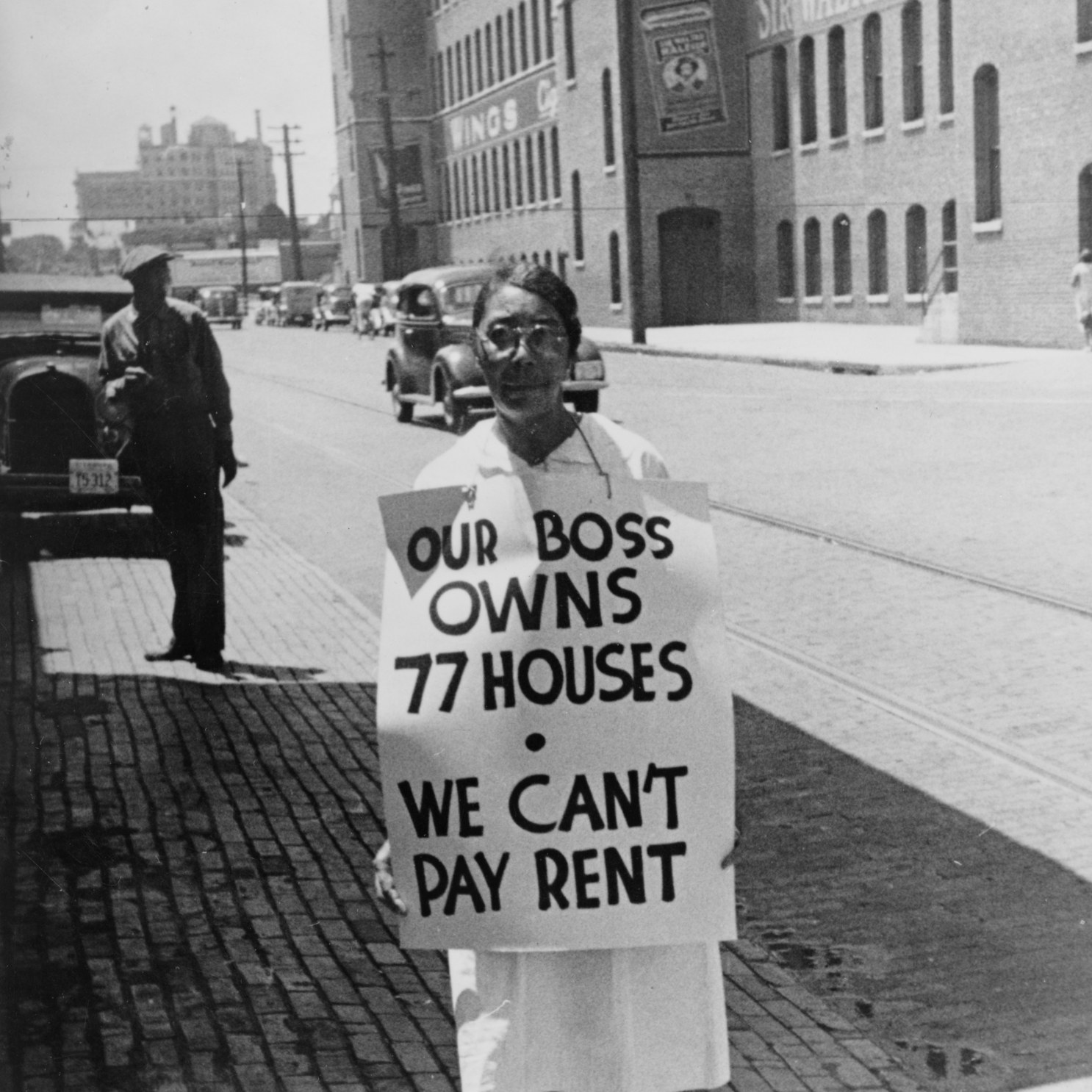
Huge tobacco corporations that control Richmond, Virginia lay-off thousands and the petty local capitalists force the city’s working class to shoulder every burden, including real hunger, of the economic crisis during the Great Depression.
‘Unemployment Grows in Land of Tobacco Leaves’ by William Taylor from The Daily Worker. Vol. 9 No. 205. August 27, 1932.
Richmond, Virginia Is Typical; Tax Schemes and Privately-Conducted Bread Lines
RICHMOND, the capital of Virginia is a glaring example of the serious unemployment situation that is developing in that state.
Here alone there are no less than 12,000 unemployed out of a population comprising 186,000 persons. The Negroes make up about one-third of the total population, but in the number of unemployed, the percentage of Negroes amounts to about 50 per cent.
TOBACCO IS MAJOR INDUSTRY
The major industry in Richmond, tobacco, is dominated and controlled by the American Tobacco Co., which is known here as the outstanding labor-hating outfit in the state, where women make $6 or $7 and men from $10 to $12 a week.
A recent report issued by the Richmond City Welfare Department states that unemployment is steadily increasing. From the same report it is evident that so far little is being done by the city administration to provide the unemployed with sufficient relief. The report shows that for the period from February 1. 1932, to July 21, 1932, the city spent the magnificent sum of $90.659.01, which averages about $3,400 per week. Of the above amount, the unemployed received $51,526.40 for work done, forced labor on the city parks and cemeteries.
RELIEF IS CUT DOWN
Relief is given to married men and women only. The men get one or two days work a week in accordance with the size of the family. For this they receive $2 a day in scrip. Only a few months ago the city used to pay the unemployed $2.40 a day, but since the Red Cross began distributing the flour donated by the Federal Farm Board (which does not cost the city a penny), the City Welfare Department used this as a pretext to cut the wages of the unemployed 40 cents a day.
Chamber of Commerce and real estate sharks demand reduction of real estate taxes. During the last few months the Chamber of Commerce and the Richmond Real Estate Exchange have organized a campaign to force the City Council to reduce the taxes on real estate 25 cents per hundred dollar valuation. The campaign is undoubtedly financed by the big bankers, and is conducted under the cover of helping the 15,000 property holders of the city.
Now what is in reality behind this demagogic campaign of the gentlemen representing the big business men of the city?
The truth of the matter is that many workers are losing their homes now not because they don’t pay their city taxes, but because of the bankers and the real estate sharks who hold their mortgages and securities and are closing in on them because of inability to meet their payments. These sharks now own and control thousands of homes in the city, and that explains why they talk so much now in favor of the reduction.
If anybody is entitled to a reduction in the real estate tax it is the small property owners of homes up to about $5,000, many of whom are unemployed now.
ROTTEN FOOD
Richmond, like every other capitalist city today, is blessed with a breadline. Twice a week, on Wednesday and Saturday (it will be only once a week during the month of August), one can see several hundred men and women colored and white, standing tucked up in a back alley on North Adams St. waiting for hours to get a mouldy loaf of bread, some rotten onions, and a few potatoes, and occasionally a small piece of salted pork.
On a number of occasions some of the bread was mouldy that the unemployed workers threw the loaves of bread out into the gutter and went hungry instead.
Very often it happens that half the workers are turned away without any food at all, and in most cost cases the majority of those turned away are the Negro workers.
A new regulation was introduced since August 3, calling upon all those that want to enjoy the pleasure of standing for hours in the breadline to obtain a letter from either a landlord, parson, or business man, stating that they actually need relief. Isn’t it wonderful?
BREADLINE ON PRIVATE BASIS
By the way, it must also be mentioned that the breadline is run on a private basis. A gentleman by the name of D.L. Owen, who used to decorate people’s homes before the crisis hit him hard enough, had decided to do something for the poor unemployed, and in order to obtain for himself a place in heaven (and spot cash on earth), is making constant appeals to the public for funds and food.
MUST ORGANIZE
The coming winter, from all indications, promises to be the most severe since the crisis began, and there is no earthly reason why the unemployed in Richmond, with the support of the employed and partially employed, could not organize Unemployed Committees of their own, like the workers in other cities throughout the country.
Build up a strong Unemployed Council. Work out a program of demands to provide the unemployed in the city with sufficient relief for the winter period.
The city of Richmond must find ways and means to appropriate at least $300,000 to make it possible for the unemployed to keep body and soul together, as human beings should.
The program of demands should be presented some time in September, when the new City Council takes office, and before the budget for 1933 is adopted.
The Daily Worker began in 1924 and was published in New York City by the Communist Party US and its predecessor organizations. Among the most long-lasting and important left publications in US history, it had a circulation of 35,000 at its peak. The Daily Worker came from The Ohio Socialist, published by the Left Wing-dominated Socialist Party of Ohio in Cleveland from 1917 to November 1919, when it became became The Toiler, paper of the Communist Labor Party. In December 1921 the above-ground Workers Party of America merged the Toiler with the paper Workers Council to found The Worker, which became The Daily Worker beginning January 13, 1924.
PDF of full issue: https://www.marxists.org/history/usa/pubs/dailyworker/1932/v09-n205-NY-aug-27-1932-DW-LOC.pdf
 Revolution's Newsstand