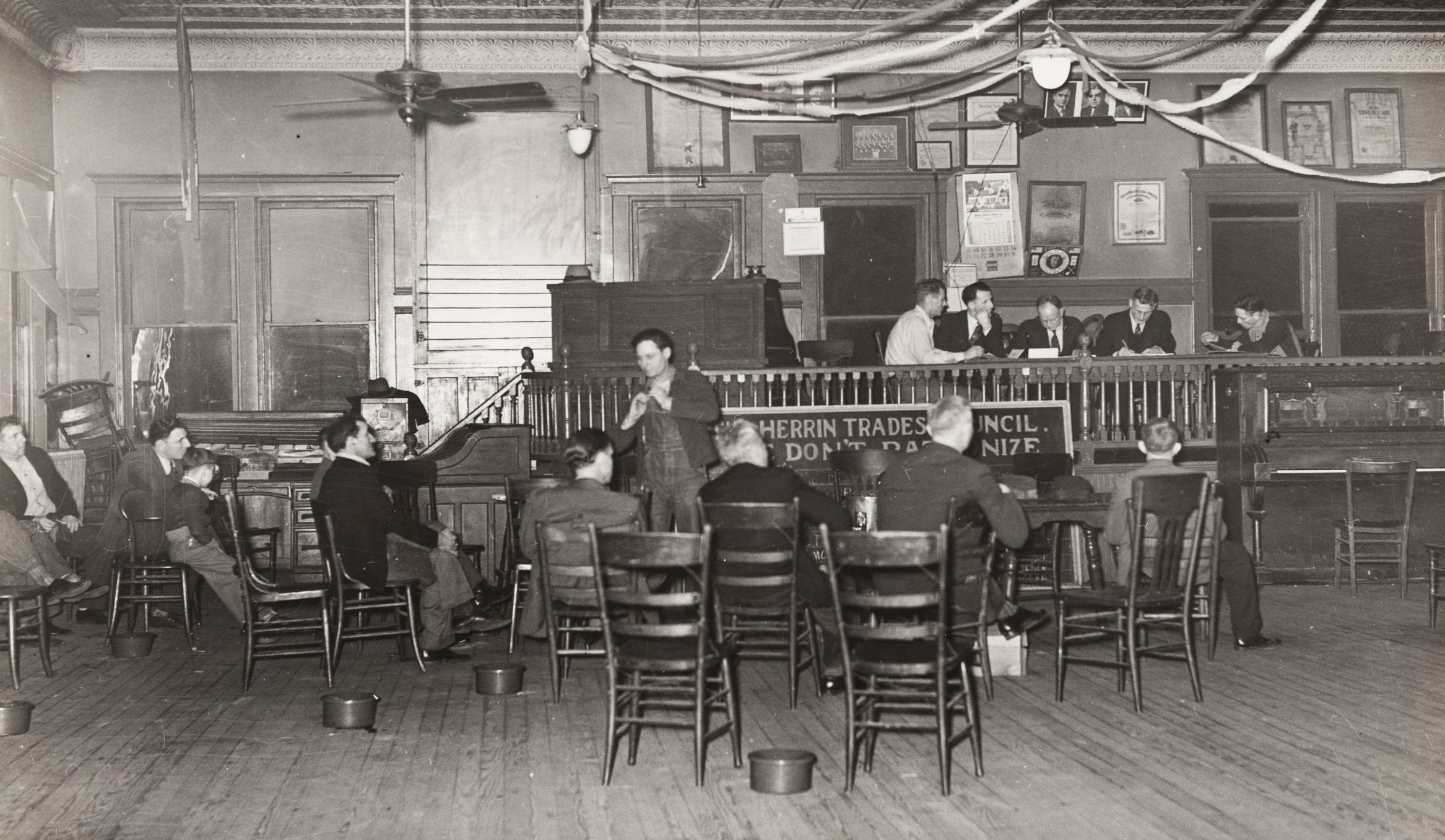
A town that would witness extraordinary violence in the 1920s, becoming a Klan killing ground, the southern Illinois mining town of Herrin had a strong Socialist presence in the Debs years. Here, they prepare to elect more candidates to local and state office, planning the 1910 electoral campaign.
‘Herrin Early in Socialist Campaign’ by M.A. Gurley from Chicago Daily Socialist. Vol. 4 No. 193. June 9, 1910.
Illinois Mining Town Plans Success for Fall Elections
Herrin, Ill., June 8. Preparations are already under way to enter the Congressional and Senatorial election in this district. We have only mapped out the method of conducting the campaign in a general way, which is not complete, and the minor details have not as yet been decided upon.
“First Step”
The first step of the campaign will be the party caucus, which will meet in this city, June 26, at which the party candidates to go before the primary will be selected.
At this meeting will be appointed the committees, place of meeting, etc. for the third annual county picnic, which we will hold in this county the last Saturday in September.
Picnic Starts Campaign
We have adopted the policy of starting the campaign proper with the holding of the picnic and we find that it brings good results from the fact that the Socialists from all over the southern part of the state and we get acquainted with each other and map out our plan of campaign, especially in those places which we have not already reached.
Another reason is that we secure several of the best speakers obtainable and send them over the district to wake things up a month before election. Another thing, they attract a large crowd of people that we could not reach any other way, and as the speaking is the only method of entertainment, if they stay on the ground they must listen to the speaking and will receive pieces of literature to take home with them.
Asks for Speakers
We have already made application to the state organization for speakers during the campaign and have invited Eugene V. Debs to be the speaker of the day for the picnic. While he has not refused to favor us with his presence, he has not accepted. He will be secured if possible.
At present it is impossible to estimate the amount of literature we will use in this campaign. The amount that we will use will largely depend on the working of the mines, and as the strike has already been on for more than two months and no indication of an immediate settlement, our local, which is almost entirely made up of wage slaves, in case of its continuing, would not be in position to buy as much literature as we otherwise would.
Literature Plans
The following plans of literature have been adopted. We have a large amount of literature left over from last campaign, which was bought for sale. We have decided to give this away early in the campaign and purchase an entirely new supply of later literature, which we will sell through the campaign, the profits to go into the county fund. We will also use several thousands of Daily Socialists, Appeals to Reason, Next Steps and other pamphlets for free distribution.
In Good Condition
We are going into this campaign in better condition than we have ever gone into one in the past. Two years ago when we entered the campaign, the only organization in this congressional district was a local of eight members in this city, and nothing practical had been done since the campaign two years previous.
Marion local was organized early to the campaign and we began work. A county caucus was called and we put a full ticket in the field. The first annual picnic was held, which was attended by several thousand people, and the campaign was started in earnest. A large number of speakers from other parts of the country were secured and this county was fairly well covered.
In this campaign we developed several local speakers who were successful in selling literature and raising funds to assist in paying out-of-town speakers. The vote was increased in this congressional district from 394 in the seven counties in 1906 to 483 in this county and 987 in the district.
Campaign Results
Since the campaign the comrades of this city and over the district fairly well have kept up a continuous fire which has brought about excellent results and to this city alone have elected two members of the township high school board, and the clerk of the city court and forced the other parties to unite to defeat our candidate for judge of the city court.
In the meantime the circulation of the Chicago Dally Socialist has increased from less than 10 to about 150, the “Appeal” to more than 200, and other Socialist papers in proportion.
A reading room has been established with several hundred volumes, in which can be found most of the best Socialist books and pamphlets. These have been widely read and several of the converts can be traced to this room.
Recent Elections
In our last election in this city, which was for judge and clerk of the city court, the candidate for judge received 258 votes while the clerk received 304 votes, electing him, and we are in much better shape than ever before in the history of the party in this part of the state to enter the campaign.
The miners have begun to realize all they have is a job and they are fast learning they don’t own this, and if the strike continues there will be several thousand miners who will bolt the old parties and unite with us to break the chains of wage slavery.
We will go into the campaign with the Intention of electing some of our candidates, and are going to put up fight to accomplish this. We are already preparing to use several local Socialists on the soap box in the campaign, and will organize them to secure the best possible results.
The principal work expected of them is to sell and distribute literature and raise campaign funds. One of the local speakers of the last campaign covered all his expenses, including livery hire and turned over to the county $16 to cover the other expenses of the campaign.
The Chicago Socialist, sometimes daily sometimes weekly, was published from 1902 until 1912 as the paper of the Chicago Socialist Party. The roots of the paper lie with Workers Call, published from 1899 as a Socialist Labor Party publication, becoming a voice of the Springfield Social Democratic Party after splitting with De Leon in July, 1901. It became the Chicago Socialist Party paper with the SDP’s adherence and changed its name to the Chicago Socialist in March, 1902. In 1906 it became a daily and published until 1912 by Local Cook County of the Socialist Party and was edited by A.M. Simons if the International Socialist Review. A cornucopia of historical information on the Chicago workers movements lies within its pages.
PDF of full issue: https://www.marxists.org/history/usa/pubs/chicago-daily-socialist/1910/100609-chicagodailysocialist-v04n193.pdf
 Revolution's Newsstand