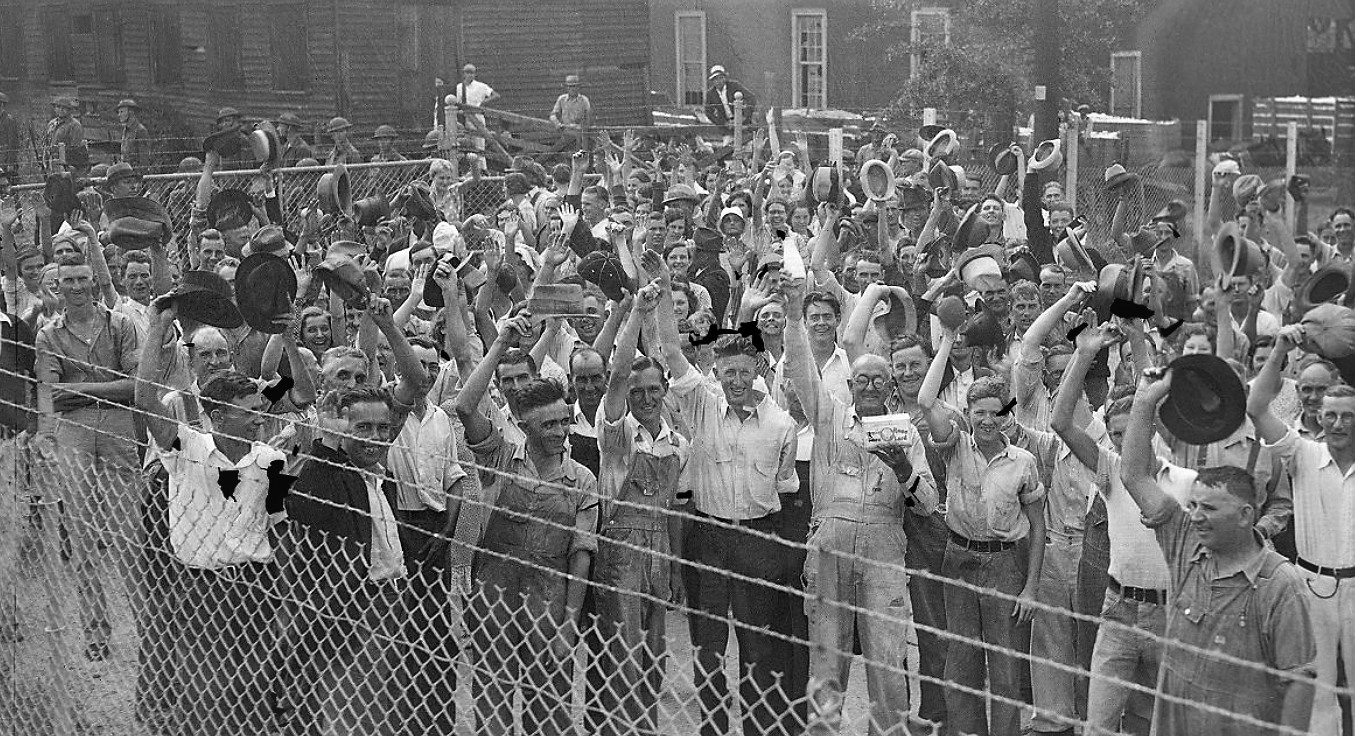
Karl Lore with a useful analysis of 1934’s Textile Workers Uprising, its impact on the A.F.L. and the role of the Roosevelt administration, which saw nearly one million workers strike with dozens killed and wounded, mainly in the South, in the late summer of that year.
‘Textile Strike—Flying Squads and Cold Steel’ by Karl Lore from Labor Action (A.W.P.). Vol. 2 No. 17. October 1, 1934.
The textile workers of the nation have risen, five hundred thousand strong. In every division of the industry and in every important center their flying squadrons, mass picket lines and the flaming courage with which labor fights in this year of 1934, have shut down the mills and stilled the roar of the looms. The soft soap of employer welfare and the cold steel of the National Guard have been equally helpless against the combined might of the textile workers on the march toward industrial freedom.
This strike means much to the workers of America. It has an importance far transcending the issue of unionism in the textile mills. Labor stands at the crossroads and the outcome of this supreme battle will have a great effect on the direction in which it will go. Relations between the trade union movement and the government will be profoundly affected by the way the struggle is conducted and by the final result. It will help to determine the type of leadership that will come to power in the organizations of labor. In a very real sense, it is the acid test. Will the workers’ organizations rise to this greatest of opportunities? Or will the chance be muffed, to become a red ink entry in the ledger of American labor history?
The Strike Decision.
The decision to strike came primarily as a result of the complete breakdown of the machinery of the N.R.A. in the Southern cotton textile fields. Sniping at wage standards was widespread everywhere of course, but in the South, chiseling and the stretch-out had become unbearable. A special Labor Board has been set up for the industry to deal specifically with the problem of the machine load. Great things were expected from it. The chairman was the well known liberal Robert Bruere. This was one of the gentlemen, in case you’ve forgotten, who was involved in the sensational “Kerensky” charges of Gary’s honorable educator Dr. Wirt.
But it was no go. The Southern textile operators clasped the board to their bosoms and when it was released, torn and bleeding, it was in no condition to control anything. The mill bosses took it over bodily and it became the instrument through which loom after loom was added to the weavers’ job. The stretch-out continued and grew worse. Workers in the mill towns began to revolt. Pressure for a general strike became irresistible.
North vs. South.
There was dissatisfaction in another quarter. Try as they would, the mill owners of the North were unable to do as good a job of chiseling as their brother exploiters in the South. Unionism was more strongly entrenched. They had already been saddled with a $1 wage differential by the textile code. When in addition, mill owners below the Mason-Dixon line began a further offensive against wage levels, ruin stared them in the face. In desperation, many of them saw a strong national union as the only agency which could standardize wages and save their lives in the merry round of competitive throat cutting. There is no doubt that many of the mill owning fraternity of the North, hate organized labor as they may, have been forced to accept the inevitable and have egged the unions on to a showdown with the sweatshop bosses of the South.
Political Implications.
When a basic industry is paralyzed by a general strike in these days of the N.R.A., it is bound to have serious political implications. This one is no exception. Coming as it does, at a very critical moment in the political life of the nation, it serves to throw a spotlight on fundamental class line-ups and on the efforts of the political powers-that-be to maintain their perilous seat on the lid of the boiling caldron of industry. General Hugh Johnson’s vicious attack on the striking workers and President Roosevelt’s readiness to send Federal troops into Rhode Island show the essential class sympathy and loyalty of this “labor loving” administration.
The textile operatives will find, just as the workers in steel and automobiles, that the promises of government agencies are a snare and a delusion and that labor wins what it is strong enough to force through its own strength.
Roosevelt Strategy.
There are those, however, who claim that in this conflict the national government will be forced to use a strategy different from that which it has used in previous, similar situations. A keen and well informed observer of the labor scene puts it in this way:
“The textile strike is not unwelcome to the administration. It gives the President and his advisers the opportunity to take stock, to estimate the line-up of forces. General strikes in steel and automobiles, industries which are the real backbone of the national economy, were dynamite. They had to be headed off at all costs. The danger in the textile industry is not so great.
“Furthermore President Roosevelt realizes that his hold, not only on the rank and file but on the union leadership is considerably weakened. There has been a great deal of dissatisfaction and a lot of grumbling in the labor movement. He faces, at the same time, an attack all along the line from the forces of extreme reaction. Heavy industry, chafing against even the mild restrictions of. the New Deal, is wheeling its heavy artillery into position. For the present, therefore, he needs the support of organized labor.
“Nor will he be able without the support of the labor leadership, to carry out his long-range program of bringing the trade union movement under the control and supervision of the government machinery. Under present circumstances Roosevelt cannot afford to let the textile workers suffer total defeat. They are a trump card in his political game. At some point in the fight he will have to step in and make some gestures for the union.”
It is certain that the administration has been fairly complacent about the textile strike. Its tactic of setting up an investigating committee after the strike had been called stands out in sharp contrast to the drastic steps taken to head off the steel and auto strikes when tremendous pressure was applied to kill the movement for a stoppage.
How About Labor?
How has the labor movement as a whole faced the situation? Officially the strike has the support of the American Federation of Labor and of the great national unions affiliated with it. A number of committees have been organized on which the chiefs of the Federation are prominent. Oily Matty Woll has made speeches and issued statements. But actual support has been extremely spotty and is likely to remain so. And when Francis Gorman, as head of the National Strike Committee of the U.T.W. called on workers in other trades for sympathetic action, he received for his pains, only the icy disapproval of the labor bureaucracy.
The labor skates are on the horns of a most perplexing dilemma. They realize full well that the eyes of the workers of America are on the struggle of the textile workers and that their own power and prestige will rest in large measure on their actions in this crisis. A successful strike in textiles, however, certainly means that the spirit of revolt will flame high in other places and that labor in many industries will take the field aggressively.
For the hotel lobby leadership and the swivel chair organizers, the prospect of many strike torn years ahead is one which they cannot face with any degree of equanimity. Further, reason the big shots in the great craft unions, the existence of powerful organizations in the mass production fields, built on an industrial basis, is sure to challenge their supremacy if not their very existence. The tide of revolt against the obsolete craft structure and policies of the Federation rises higher every day. The leaders of the building trades unions, the organizations of teamsters and machinists have no intention of digging their own graves. They’ll be damned if they do. All would be well were it not for the lurking fear that perhaps they will be equally damned if they don’t.
Few Unions Aid.
It is significant that the only real moves to aid the textile strikers have come from those union leaders who have spoken for a modernized trade union structure and practice. The needle trades unions, as always, have been the most generous, donating both money and organizers to the strike. The United Mine Workers chipped in a much smaller amount. The Typographical Union has organized a committee to devise ways and means of helping. The leadership of each of these organizations is known to be in favor of an industrial union structure for the A.F. of L.
A conference of all the heads of the International Unions which was scheduled to meet immediately after the strike call to take up the question of aid has been postponed until just before the opening of the A.F. of L. convention on October 1. And who can be blamed, at that time, if everyone is too busy with convention preparations to bother about the greatest strike that these United States has even seen? We will have before us the glorious example of the wealthy Brotherhood of Carpenters and Joiners, whose executive board, meeting in Florida in the winter of 1929, received a similar plea from the A.F. of L. for help in the great drive to organize the South which was carried on at that time and who placidly voted to receive the letter “as information” and contributed not a red cent to the cause of those who bled and died to plant the banner of unionism in the Southern mills.
The U.T.W.
A real national organization exists for the first time in the textile mills of America. One of the wonders of the modern world has been this resurrection of the United Textile Workers. The eagerness with which workers flocked into the ranks of a union known as one of the most conservative and discredited organizations on the labor scene, is something to think about.
But there can be no doubt that this union is today the only organization of textile workers worth paying serious attention to. The communist controlled National Textile Workers is in woefully bad shape and in a number of places has given up the ghost entirely and ordered its members to join the U.T.W. ranks. They still keep the framework of a national organization in the hope that should the strike end in chaos and confusion, it will be possible for them to split groups away from the United and reestablish themselves in the industry. Present indications are that it is a forlorn hope. The N.T.W. is doomed to die like a fizzled firecracker without even having had the satisfaction of a glorious and explosive end.
Independent Unions.
There have always been many independent unions in the industry. By and large they have played no part in the strike. Organizations like the American Federation of Textile Operatives, the Independent Sheeting Workers Union and the Loom Fixers Union in fact, voted to stay at work and played a strike breaking role. Throughout the South there has been extensive organization of “home unions,” local organizations, many of them established by the boss to head off genuine unionism, some of them by workers honestly suspicious of the U.T.W. and its record.
Will It Be Won?
Will this strike be won? Will unionism be maintained and extended? No certain answer is possible. But with all factors taken into consideration it is probable that organization is in the mills to stay. The spirit of the workers, their determination to have a hand in the shaping of their own destiny, their realization of the need for nationwide action, to win a better order of things for themselves and their children will win this strike. Should it fail the entire labor movement will have received a heavy blow and a set back that only years will overcome. But the workers of America will not let it fail.
There are a number of periodicals with the name Labor Action in our history. This Labor Action was a bi-weekly newspaper published in 1933-34 by AJ Muste’s American Workers Party. The AWP grew from the Conference for Progressive Labor Action, founded in 1929, and Labor Action replaced the long-running CPLA magazine, Labor Age. Along with Muste, the AWP had activists and writers James Burnham and Art Preis. When the AWP fused with the Trotskyist Communist League of America in late 1934, their joint paper became The New Militant.
PDF of full issue: https://www.marxists.org/history/etol/newspape/laboraction-cpla/v2n17-oct-01-1934-LA-Muste.pdf
 Revolution's Newsstand