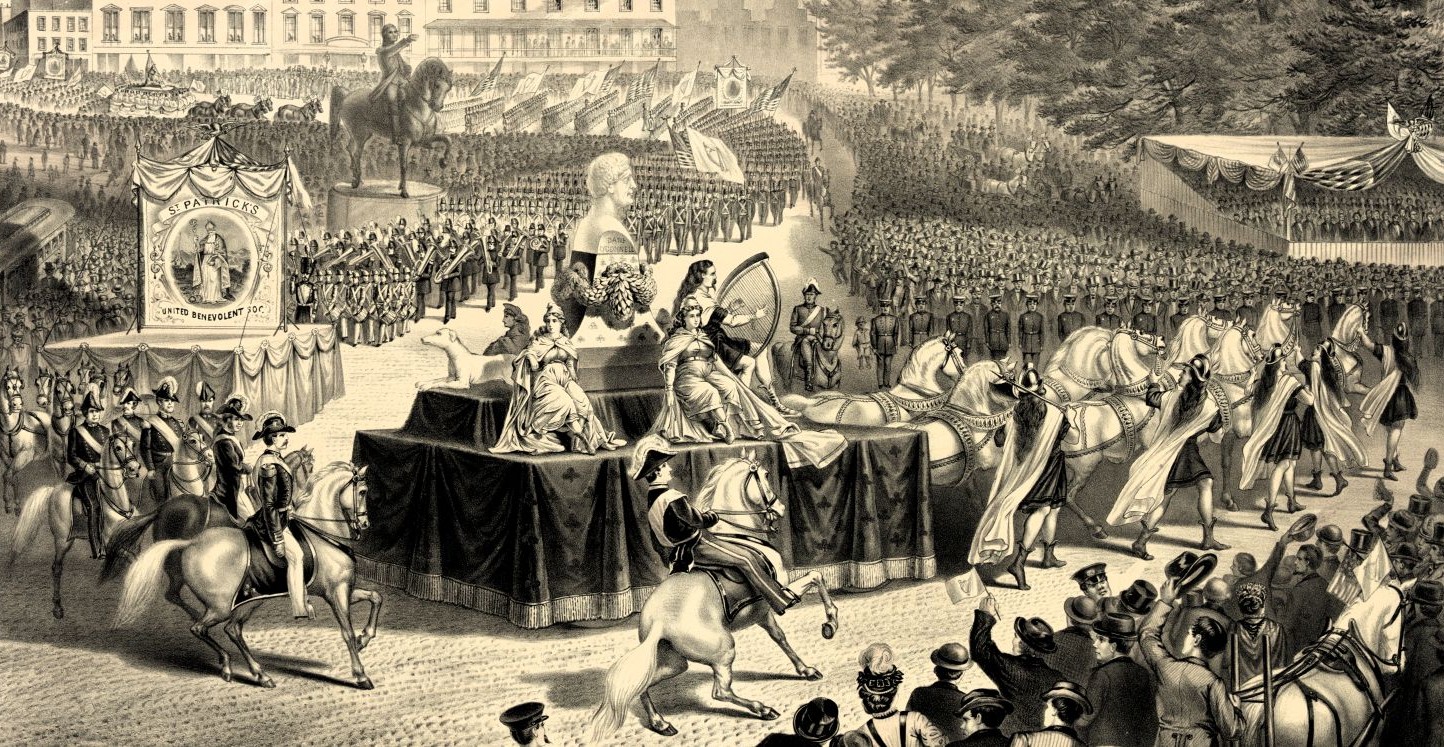
As only he could, T..J. O’Flaherty gives his own version of Ireland’s Saint Patrick story.
‘The True Story of St. Patrick and the Druids’ by Thomas J. O’Flaherty from The Daily Worker. Vol. 4 No. 55. March 18, 1927.
IRELAND is not yet free from the grip of imperial Britain, but what a calamity it would be for the Irish-American capitalist politicians if a St. Patrick’s Day came around without there being some legitimate excuse for pulling the lion’s tail. The president of the Irish Free State in a message to The World expresses the hope that every son and daughter of Erin in the United States will be true to their ancient patrimony. What their patrimony is beyond slaving for a living, we are at a loss to know.
As long as they keep thumping their chests and imploring Jehovah via the Pope for consolation, they may forget their misery in life and look forward to a nice little pair of wings when the grim reaper wields his scythe.
WHETHER the St. Patrick of the annual Fifth Avenue parade ever existed in the flesh is a moot question. Bruce Barton might do worse than write a book on: “The St. Patrick Nobody Knows.’’ In the early days of “scientific socialism” in Ireland anti-papal adherents of what went for socialism—as a matter of fact its proponents were left wing theosophists—oscillated between the theory that St. Patrick never existed or that he was a magician like the rest of the priests of that period.
Some radicals attributed all the woes of Ireland to the saint who, if reports be true, was a rather decent fellow and no blue nose reformer.
THAT he was a good politician is beyond question, granting that he is not a mythical character. It appears that he did not waste much time explaining the program and platform of Christianity to the heathen Irish. He stepped right up to the old druids and beat them at their own game. They were getting away with murder for generations. They had the masses buffaloed with their miracles. They could bring on storms at will, walk upon the waters and return to land with dry feet.
They could turn the rebellious into any kind of an animal that appealed to their conception of appropriate punishment. They were on the top of the heap and the populace had a mighty respect for the gods that could delegate so much power to their servants.
WHEN St. Patrick landed in Ireland the old druids smelled a rival. The easiest way to dispose of rivals in those days was to lop off their heads. But when the headsmen came along bent on saving Ireland from a bitter factional struggle, the alien saint, would drop to his knees and ask for divine assistance.
Then things would happen to his foes. Either the latter would be suddenly converted to a new faith or they would grow wings and become sparrows or pigeons. Then Jehovah would send a flight of hawks along and the druidic headsmen would soon be reposing in the innards of the carnivorous birds. Saint Patrick would then thank his god and the audience would swear allegiance to the envoy of the new deity.
THERE was no waste of time here preaching the philosophy of Christianity. Patrick delivered the goods. Having conquered everything in his path he finally ran into the big guns of the old priestcraft. “Now,” they said, “we will fix this upstart, who is out to rob us of our leadership.”
They challenged the saint to play at miracles with them. He accepted. He thought he was taking a chance but he had confidence in his leader. The druids rolled up their sleeves, spat in their fists and went to work.
Rods were turned into snakes, but no sooner would the serpents begin to make a bee line for Patrick than he would thumb his nose at one of them and lo, this snake would suddenly Grow to five times his original size and swallow all the rest. And after wrapping himself around his fellows he would cast longing eyes on the druids. The saint had easy sailing after this. It is time that a few diehards here and there clung to the old system for a while, but St. Patrick finally convinced them that they could have anything they wanted from him us long as they did not make any trouble. He was a good politician.
ST. PATRICK informed the Irish people of that time that there was nothing entirely new under the sun. A spiritual revolution had taken place in Ireland—that was all.
Whereas formerly the people worshipped rivers and trees, the sun and the moon, from now on they would worship a god who never came into undignified contact with his followers. After all, gods must insist that their followers do not get too familiar. Anybody could go and scratch his back against a fir tree and pretend that he was looking for spiritual satisfaction instead of physical relief. Here was a god that kept his distance and expected his followers to do the same. Furthermore on the ground of economy the new system was superior to the old.
TREES might be destroyed by fire or blown from their roots by the wind. Rivers might go dry, the sun might be eclipsed by a cloud, likewise the moon. This would cause the people to worry about the fate of their gods and the druids would be compelled to rise from their festive boards and sober up enough to sufficiently explain the phenomenon to their followers. Under the new dispensation there was no need for explanations since it was a sin meriting eternal damnation to ask the priest questions, once Christianity was accepted.
SO we are for St. Patrick. Long may he thrive. Furthermore he may have been revolutionist for all we know. Revolutions have a habit of happening in March. Spring is an intoxicating season and the people have a tendency to develop a fever for toppling things over when the trees begin to sprout and the birds begin to twitter in the fields. Here is a good idea. Let us prove that Patrick was either a revolutionist or the predecessor of the great magician Houdini. We are bound to win either way. Tammany Hall would never allow the 69th regiment to march in honor of a dead radical and it is not reasonable to expect that Tammany would care to play second fiddle to a man who was sufficiently well up in magic to be capable of stealing an election without having to resort to the crude device of stuffing the ballot boxes.
The Daily Worker began in 1924 and was published in New York City by the Communist Party US and its predecessor organizations. Among the most long-lasting and important left publications in US history, it had a circulation of 35,000 at its peak. The Daily Worker came from The Ohio Socialist, published by the Left Wing-dominated Socialist Party of Ohio in Cleveland from 1917 to November 1919, when it became became The Toiler, paper of the Communist Labor Party. In December 1921 the above-ground Workers Party of America merged the Toiler with the paper Workers Council to found The Worker, which became The Daily Worker beginning January 13, 1924.
PDF of full issue: https://www.marxists.org/history/usa/pubs/dailyworker/1927/1927-ny/v04-n055-NY-mar-18-1927-DW-LOC.pdf
 Revolution's Newsstand