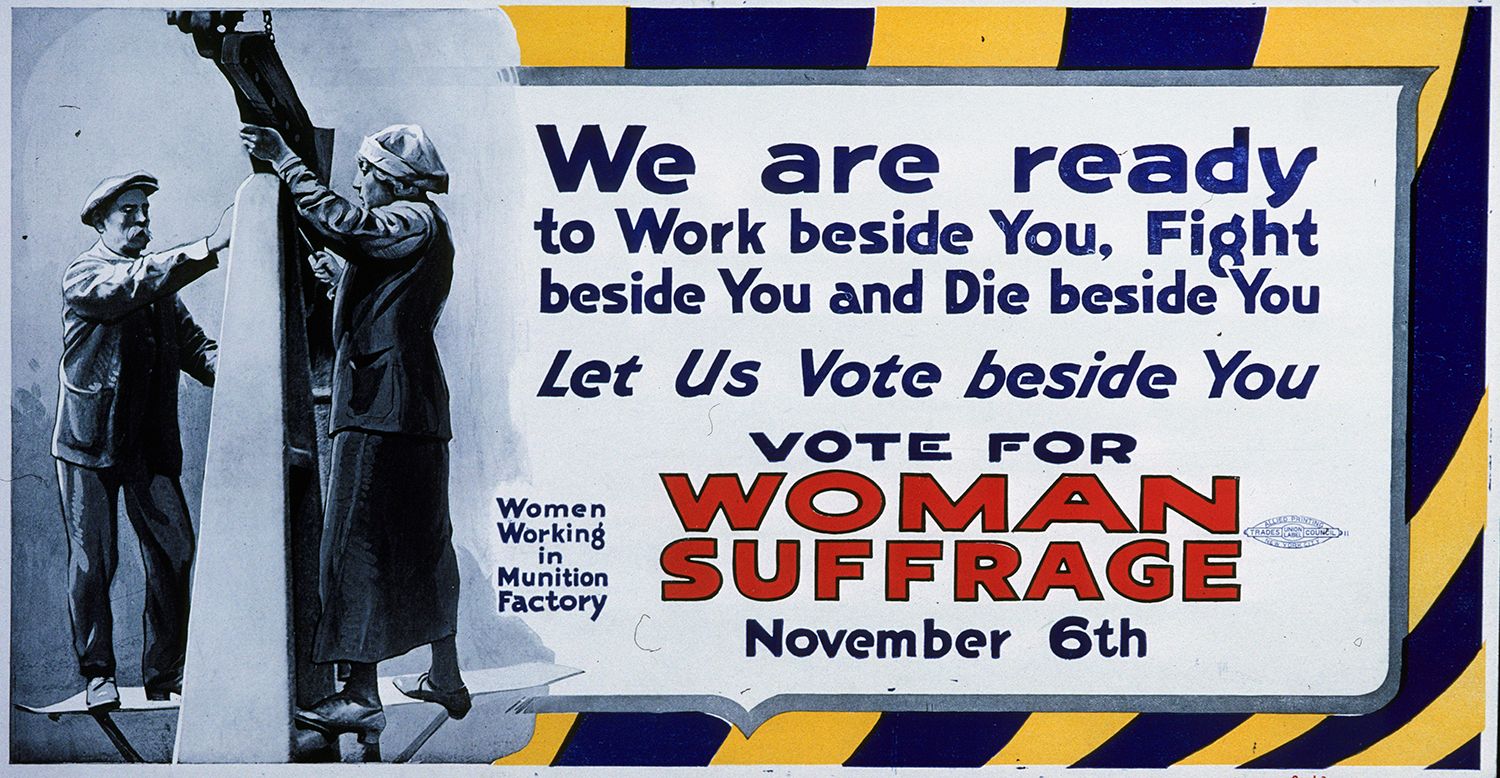
Vera Buch reviews how women’s organizations, including trade unions, were enlisted by the government in support of U.S. imperialism in the First World War, and how that mobilization became permanent.
‘Working Women Must Fight Jingoes’ by Vera Buch from The Daily Worker. Vol. 5 Nos. 338 & 339. February 1 & 2, 1929.
Must Not Allow Mobilization for Imperialist War, but Fight for Proletarian Revolution
The mobilization of American women in support of the last war which the American government conducted in 1917-1918 has a poignant lesson to the working class. It is a warning to us to realize the importance of the women, and to begin energetically the task of organizing and teaching the working-class women, so that when war breaks out again, they will be mobilized, not for the support of the imperialists, but for the fight against capitalism and for the victory of the proletarian revolution.
Women Under Gov’t Control.
Systematically, on a national scale, an apparatus was created, using the permanent bourgeois women’s organizations, which reached to the last corner of the country and dragged in not only the middle class women, but the working women and workers’ wives as well. Under the direct control and with the full support of the federal and state government apparatus, this organization of women penetrated not only the whole United States, but even the colonial possessions.
The imperialists fully understood the value of the women. They lost no time. Fifteen days after war was declared on Germany, on April 21, 1917, the mobilization was begun by the creation of a Women’s Committee of the Council of National Defense. This council had been organized by act of congress in August, 1916, and consisted of the secretaries of six state departments, plus an advisory committee of seven.
It was thus a direct appendage of the government, and its Women’s Committee, meeting in Washington as a sub-division of the council, was in the closest connection with the government center. Nine women were put on the committee, most of them heads of big bourgeois women’s organizations, such as the General Federation of Women’s Clubs, the National Council of Women, the National Women’s Suffrage Association, and others. Dr. Anna Howard Shaw was the chairman of the committee. Mrs. Carrie Chapman Catt was also a member. Later two other women were added, one of them the president of the International Glove Workers’ Union.
Within a few weeks, the Women’s Committee had formulated a plan of action which was sent out to well-known patriotic women in 48 states.
At once the organization work was begun. A temporary chairman was appointed in each state. Her first job was to call together a conference consisting of the heads of women’s organizations having a state-wide scope, and such individuals as she wished to represent unorganized women. Recognition was to be given to clubs, to religious denominations, to fraternal and philanthropic societies, to patriotic and protective associations. All the innumerable women’s organizations under bourgeois influence, which have had an extraordinary development in America, were thus at once systematically mobilized and thrown into action under the leadership of the Women’s Committee which got its orders and inspiration from the U.S. imperialist government.
Thorough Local Organization.
These state conferences were constituted as permanent groups. There were organized similar committees on a local scale in each county, city, town and village. In the cities, there were also ward organizations. When it came down to local groups, membership was no longer based upon organization, but any individual woman who could be brought in was eligible. Thus there was a possibility of getting those who had escaped membership in the permanent organizations, and of reaching each and every working woman and worker’s and farmer’s wife. The purpose uniting all these divisions was to see “that all necessary forms of patriotic service or of defense program as outlined by the Women’s Committee were actually carried forward.” In other words, the women were to be mobilized in the most thorough manner to sacrifice their all for the bloody duty of winning the war for Wall Street.
Departments were established in all divisions for the following fields of work: registration, food production and home economics, food administration, women in industry, child welfare, maintenance of existing social service agencies, health and recreation, education, liberty loan, home and foreign relief. The chairmen of the committees on food administration, women in industry and liberty loan were considered so important that they were appointed only in consultation with the Women’s Committee in Washington and worked directly with it. Not satisfied with mobilizing the women of the U.S., proper, similar organizations were created also in the Panama Canal Zone, in Porto Rico, the Philippines, the’ Hawaiian Islands and in Alaska. The work was carried out so efficiently that by June 15 six states were already thoroughly organized.
Jingoes Send Hot Air Barrage.
Simultaneously with creating and perfecting the structural apparatus for the work, there was sent out a barrage of sentimental, jingoistic propaganda for enlisting the woman’s moral support, for working them up into a patriotic frenzy in which they would be prepared to make any sacrifice. The women suddenly become very important in the eyes of government officials, they acquire qualities of zeal, heroism and intelligence unsuspected before.

Said President Wilson:
“I think the whole country has admired the spirit and the capacity and devotion of the women of the United States…The country depends upon the women for a large part of the inspiration of its life.”
And the secretary of war chimes in: “I think there is a certain significance…when a secretary of war says to the women that the success of the United States in the making of this war is just as much in the hands of the women of America as it is in the hands of the soldiers of our army.”
On August 2, 1917, the secretary of the navy declares:
“American women have always been ready to answer the call of service and have cheerfully undergone the untold sacrifices and burdens which war places upon them. They are already making sacrifices and enduring hardships with a spirit which commands our intense admiration.”
And listen to the secretary of the interior in June, 1917:
“Unless our women feel the greatness of the moral issues involved in this contest, and unless they have raised their boys to fight, if necessary, for the things for which we stand, the war cannot be won.”
And so on “ad nauseam.” In pulpit and press, in movie and school, in parade and mass meeting the campaign went on to drive the last working woman, the last workers’ and farmers’ wife into doing “her bit” to support the noble cause of defending imperialist profits.
Women Enormous Support to Gov’t
The actual concrete results of the campaign were of enormous help to the ruling class. After a few months campaign among the women for the saving of waste bread, the National Commercial Economy Board stated that enough bread had been saved each day to feed a million people. 8,350,000,000 worth of crops were raised by women in backyard gardens during 1917. And in the same year, $36,000,000 worth of garments made by women, says Mr. Davison, head of the American Red Cross, were sent to the troops abroad. This in addition to the many millions of dollars for relief purposes raised through the activities of the women.
The activities carried on by the various women’s committees were manifold. One of the first jobs was the registration of the women for service. The women were prepared by special letters and a message from the government. Some states and cities instituted classes to train women registrars. Within six months the national committees on registration received over 9,000 calls for women workers from firms holding government contracts for war materials. Then the food conservation drive. Every one remembers the garbage pail campaign. How a group of patriotic dames supposedly visited the home of Hoover then Food Administrator, to inspect its garbage pail—and behold, it was empty!—the implication being, I suppose, that the Hoover family ate up its garbage. The empty garbage pail was held up as the emblem of perfection to the American working class house-wife. She was supposed to cut out meat and wheat from her menu and scrimp on her already poor table so as to save the food for the army.
On May 5,1917 Secretary Houston of the U.S. Dept, of Agriculture issued a special appeal to the women of the country for food conservation and economy in the home. He appealed also to the “loyalty” of the working women. He said:
“Employed women, especially those engaged in the manufacture of food or clothing, also directly serve their country and should put into their tasks the enthusiasm and energy the importance of their products warrants.”
At one of the first national conferences called by the Women’s Committee of the National Council of Defense, Hoover, the new Food Administrator, gave a plan for enlisting the women in the first nation-wide campaign for food conservation.
In the Liberty Loan Drive, too, the women’s organization was invaluable to the government in putting over its plan for filching from the American workers their hard-earned dollars for the manufacture of armaments and munitions which would kill both American and European workers by the millions. Of course, here, many other important agencies were at work. Large firms made the jobs of their factory and office workers dependent upon the purchase of so many Liberty Bonds.
Poor workers, women included, pledged their earnings for months and years to pay for these. The Liberty Loan department of the Women’s Committee was instrumental in distributing 700,000 Liberty Loan primers and hand books to teachers and 1,500,000 special letters to farmers’ wives. It also assigned 1,600 women speakers to tour the country for the drive. It was no accident that in such working class centers as Pittsburgh and Alleghany Co. Pa., women subscribers to the loan were one-third of the total. Red Cross work also, that is, the making of surgical supplies and “comforts” for soldiers, was a principal activity of the women.
Not the least important of the activities of the Women’s Committee was a “patriotic education” campaign carried on chiefly among foreign-born women. In this the Women’s Committee cooperated with the Division of Immigration Education of the U.S. Dept, of Education in a gigantic nation-wide “America First” campaign begun on Sept. 1, 1917. Mrs. Carrie Chapman Catt was the chairman of the women’s committee on education.
“We propose,” she stated, “to begin a vast educational movement with lantern slides, movies, lectures and literature which will carry to the women of the nation the graphic story of the war. When the women understand, all will be fervently enlisted to push the war to victory as rapidly as possible.”
Women’s Bodies’ Special Work.
Besides the national apparatus built up by the Women’s Committee of the National Council of Defense, there were other organizations of women created especially for the war. In January, 1917 (three months before war was declared), there took place in Washington a Congress for Constructive Patriots.
A women’s session was held in which 500 women from all parts of the country took part. Here was organized the National League for Women’s Service with the jingoistic slogan, “For God, for Country, for Home.” This organization became a part of the general women’s war apparatus, its president being a member of the National Women’s Committee. The Red Cross had its Women’s Bureau organized in July, 1917, with Miss Florence Marshall as its director. This Women’s Bureau divided the country for work into 13 fields, with a 14th field for the American Red Cross in China, South America, Alaska and Persia.
The Red Cross mobilized the women so well for its work that in six weeks in the fall of 1917 women furnished 3,681,895 surgical dressings, 1,517,076 pieces of hospital linen, 424,550 articles of patients’ clothing, 301,563 articles of miscellaneous supplies and 240,621 knitted articles. The American Red Cross also formed a Women’s War Relief Corps in France. In April, 1917, was organized the National Congress of Mothers to do work among the soldiers in camps, later the Women’s Auxiliary of the Army and Navy League, which established a service school, and the Women’s Naval Auxiliary of the Red Cross.
Bourgeois Women’s Activities.
The apparatus of the Women’s Committee was a federated one, based chiefly on the existing women’s organizations, and also drawing into its local activities the un-organized women. The bourgeois women’s organizations were also active on their own account through special war-time committees or bureaus. Their activities were all directed by the central clearing house of the Women’s Committee. In June, 1917, the Women’s Committee called a conference, inviting heads of 200 women’s organizations. Over 50 responded to the call and took part in the conference. These organizations had already been active in relief work for the war in Europe and were now drawn into work for the American imperialists. The General Federation of Women’s Clubs (claiming a membership of 3,000,000) opened a Service Office in Washington and flung itself full force into the war. The Daughters of the American Revolution (claiming 1,000,000 members) had their War Relief Service Commission, the YMCA had its War Work Council, the National Women’s Christian Temperance Union had its Committee on Patriotic Service, the League of American Pen Women had its National Aid and Defense Committee, the Woodcraft Girls had their “Potato Clubs” with the motto “The Hoe Behind the Flag,” the Associate Collegiate Alumnae had their War Service Commission and so on.
Besides all these organizations, there were relief organizations too numerous to mention, formed for different sorts of relief, many of them directed by women and all of them depending upon women for their chief support.
Drew In Working Women.
Let us be clear just how the working women were drawn into all these organized activities. The members of the Women’s Committee and most of the membership of the women’s organizations mentioned above are wealthy or lower middle class women. But they drew in with them also the fraternal and religious orders which have a working-class as well as a middle class membership. Besides, all propaganda was carried to the working class women in the shops and in the homes. They were drawn into work in the village, ward and town committees. To put the thing in a nut-shell, the government used the bourgeois women to rally the working class women.
Let us be clear also, that the bourgeois women’s organizations by no means finished their activities with the close of the last war, but are, on the contrary, a permanent means for winning the working-class women for the support of imperialism. These organizations have actively supported the government within recent years in its war preparations. They have been lined up either for preparedness, that is, for direct support of war, or for pacifism, the disguised and even more dangerous means by which the war policy is being developed. The pacifist groups include ten important women’s organizations with a membership of millions, among them the General Federation of Women’s Clubs, the National Board of the YWCA, the Women’s Christian Temperance Union, the National League of Women Voters, and the National Women’s Trade Union League, and others. These have banded themselves together in a federation called the National Committee for the Cause and Cure of War.
This group has just held its fourth annual conference in Washington, under the chairmanship of Mrs. Carrie Chapman Catt, and this year it endorsed the Kellogg Peace Pact.
Jingo Groups.
The preparedness groups including thirty or more national women’s organizations are united in the Women’s Patriotic Conference, also holding its annual conference in Washington this January. This group is supporting the twin brother in disguise of the Kellogg Pact, namely the Cruiser Bill. This conference consists of the rankest jingoistic, ultra-patriotic outfits such as the Women’s Auxiliary of the American Legion, the Ladies of the GAR, the Daughters of the American Revolution, the Auxiliaries of the Spanish War Veterans, of the Sons of Veterans of the Civil War, of the Veterans of Foreign Wars, the National Society of Founders and Patriots and many others of similar character.

By means of these annual conferences, the national federated apparatus of the bourgeois women’s organizations is kept closely together and in good working order, so that when war is again declared, they will be ready with all speed to jump into the fray. In fact, we can say that for all practical purposes these conferences constitute a continuation of the apparatus created during the last war for mobilizing the women. Certainly we can feel sure that when the next war breaks out these organizations will be used again in a very similar way to that of 1917.
We are interested in the attitude and the activities of these organizations because they are linked up with the working-class through a part of their membership and still more through the daily activities which they carry out in the shape of social and charitable work among the “poor”—that is, among the workers—and through persistent “Americanization” work. We are interested because it is of the greatest importance for the working class to combat their influence on the working class women through its own propaganda and its own organizations.
In the last war, the working class was organizationally unprepared to stem the tide. Of opposition to the war there was plenty, both in instinctive proletarian revolt against the imperialist slaughter and in Marxian understanding of the true character of the war. But insofar as the women were concerned there was little if any effectual organizational resistance. Such organizations as supposedly represented the working women in reality betrayed them. The Women’s Trade Union League participated with the bourgeois women’s organizations in support of the war. Not a peep of protest came from them; they were content merely with raising a few feeble whining pleas directed at the government to protect the working women’s conditions. The jingoes in the last war had a clean sweep. So little stood in their way that they were able to mop up the whole country in one hysterical patriotic landslide.
Advance of Proletarian Women.
Since then, the working class has greatly advanced. New factors are to be met with today. The strength of the Soviet Union, the broad radicalization of the European masses, the beginnings of radicalization among the American workers, are significant developments.
The existence of Communist Parties, some of them very strong, in all important capitalist countries is an organizational factor of the highest importance. There is an increased understanding and appreciation of the role and importance of the women in all working class movements. There is in addition, even in America, the beginning of a working-class women’s movement.
There are women’s organizations of working-class aims and character which certainly are going to put up a resistance to the next world war.
Very significant was the protest organized in Washington the week of January 11 by representatives of ten working women’s organizations, with a membership totaling nearly 100,000, directed particularly against the Conference on the Cause and Cure of War. So well was this protest conducted that two of the women workers there very nearly broke up entirely the first meeting of this conference.
Present Tasks.
It must be fully realized, however, that the organized forces of the American working-class are yet small. All the greater is the need for maximum energy and exertion on the part of those who have to combat the war danger. All the more necessary for each and every working women’s organization, whether union, federation or club, to throw itself into the most active campaign, protesting by mass meeting and demonstration each new step in the imperialist war program.
Especially must agitation be carried on among factory women by means of delegate meetings and factory circles so that the campaign will reach the masses of unorganized women upon whom the ruling class will depend to produce the materials of war.
The coming celebration of International Women’s Day must be used this year as the focus of the fight against the war danger to rally the working women on a national scale.
The Workers (Communist) Party and all working women’s organizations must realize the need for this fight and must prepare themselves for this major task of today.
The Daily Worker began in 1924 and was published in New York City by the Communist Party US and its predecessor organizations. Among the most long-lasting and important left publications in US history, it had a circulation of 35,000 at its peak. The Daily Worker came from The Ohio Socialist, published by the Left Wing-dominated Socialist Party of Ohio in Cleveland from 1917 to November 1919, when it became became The Toiler, paper of the Communist Labor Party. In December 1921 the above-ground Workers Party of America merged the Toiler with the paper Workers Council to found The Worker, which became The Daily Worker beginning January 13, 1924.
PDF of full issue: https://www.marxists.org/history/usa/pubs/dailyworker/1929/1929-ny/v05-n338-NY-feb-01-1929-DW-LOC.pdf
PDF of issue 2: https://www.marxists.org/history/usa/pubs/dailyworker/1929/1929-ny/v05-n339-NY-feb-02-1929-DW-LOC.pdf
 Revolution's Newsstand