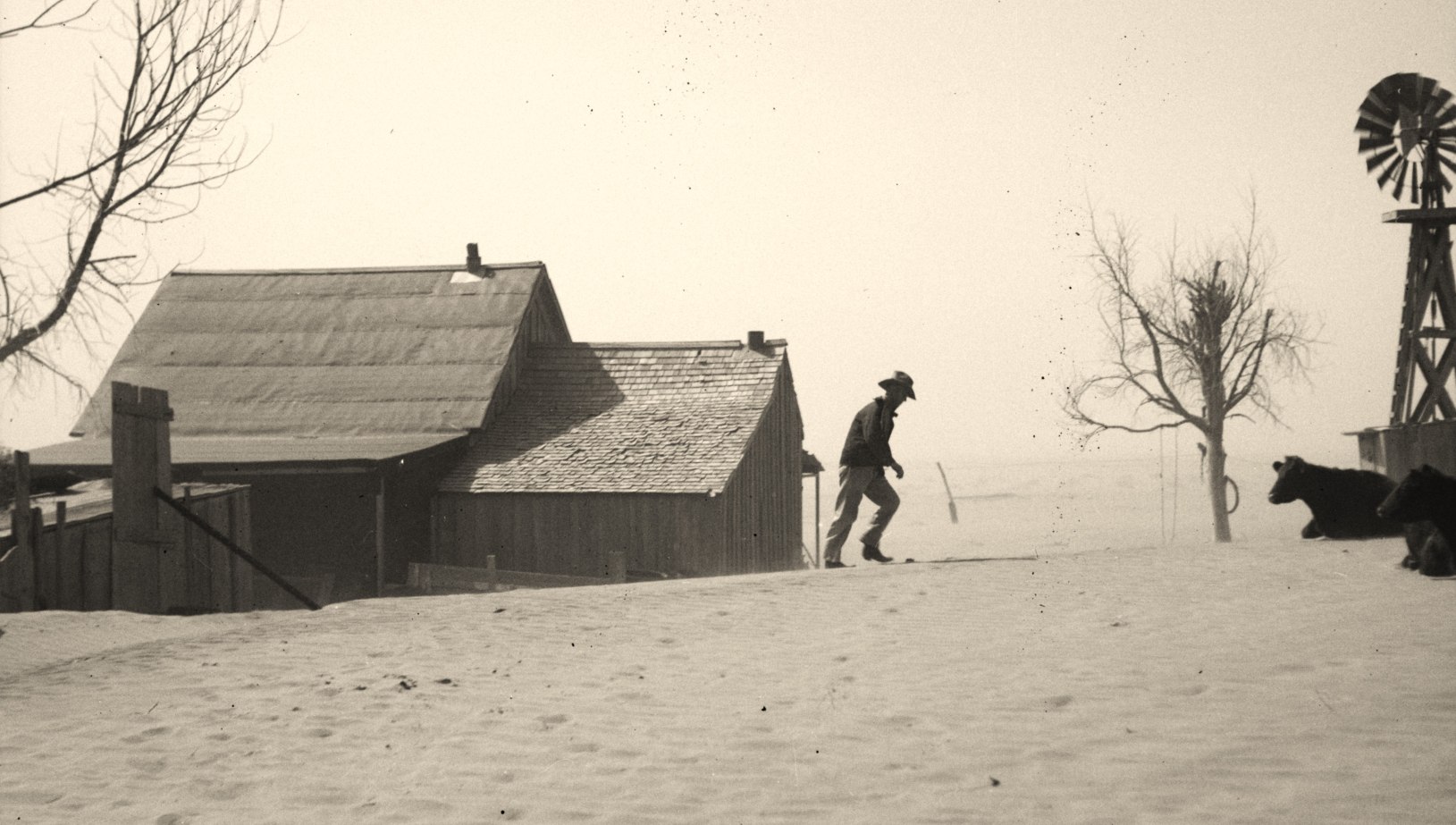
After five years of economic ruin and dislocation during the Great Depression, farmers and rural workers across the upper Midwest and Great Plains were doubly devastated by the Dust Bowl–a cataclysm of heat, drought, and locusts. A child and chronicler of that region, Meridel Le Sueur with a fantastic snapshot of the denuded landscape.
‘The Farmers Face a Crisis’ Meridel Le Sueur from New Masses. Vol. 20 No. 4. July 21, 1936.
MINNEAPOLIS, MINN. “On these rich plains there is enough stag, fish, and fowl and thick and lush grasses and rich prairie to feed a merrie populace, without heavie labors for many an age.”–Father Hennepin on the first voyage with La Salle down the Mississippi River.
FOR the last three days the temperature has swung at 103, 104 and 105 degrees. Weather bureau heat maps show this to be a prevailing temperature from the Central Mississippi river valley northwestward into central Montana, and stretching into the southwestern wheat and range territory and into the southeastern cotton belt. Already little pasturage is left between the Rockies and the Appalachian mountains, and water for stock and fowl and human is drying up hourly. The burning winds and high temperatures have left the ground as dry as powder; truck crops are burning up, small grains and wheat are gone, and if it had rained even two days ago the corn in Iowa might have been saved but it is too late now. Wide areas of the great plains are burning black. The drought is spreading rapidly to Wisconsin and northern Minnesota.
The air is bright and red hot, pressing on the middle states. You can hardly breathe; houses are shut tight and the hot wind of today blows up the dry unturfed dust and threatens a repetition of the terrific dust storms of two years ago which blew half of North Dakota into Ohio. Grasshoppers are so thick in some parts they frighten the horses. Aside from being burned by this strong sun, which is like a scorching touch on your skin, the fertile fields are being stripped, the standing crops mowed down by chinch bugs. Walking through the parched fields on one of their endless “surveys,” the agricultural committees and officials kick up hundreds of insects with every step. Flying beetles are eating up potato plants and in the Dakotas the tent caterpillars are so thick that trenches have to be dug to keep them out of the houses. Where the trenches weren’t dug soon enough, you can sweep them down from the walls.
The pasturage gone, cattle are being moved. In South Dakota alone 700,000 head of cattle and 100,000 head of horses must be shipped some place where there is pasturage. Wyoming is shipping 400 to 500 carloads of stock a day. From Fargo come reports that 85 percent of the cattle in that state has reached the starvation point and must be shipped immediately to other pasturage or sold for beef. Feed is exhausted and pedigreed cattle are nibbling the last of the grass stubble around rapidly drying sloughs. Stockmen are wiring county agents for immediate transportation for cattle, warning that a delay of even one day might prove fatal. Humans too are being shipped like cattle. The Resettlement officials prepared to move at least 200 families out of North Dakota. Don’t ask them where to. Ducks are invading the towns in North Dakota looking for water after leaving the dried-up lake bottoms.
TO understand the impact of this heat affairs you must keep in mind that the Middle West has never recovered from the A.A.A. program and the drought of 1934, when hundreds of heads of pedigreed cattle were buried in lime pits or sold to the Federal government at low prices to keep the price of meat up; that previous to this the rich land of the Middle West has been cruelly and shamelessly used by the wheat speculators. “Wheat to win the war” forced settlers of range land to break the buffalo-grass stands that could survive any drought, growing thick and close and intermingled, holding down the soil. The plowing up of this native grass pulverized the ground so that now it dries quickly and blows and piles to the roofs of barns and drifts off to the mountains with the prairie winds, leaving hardpan that won’t be fertile again for a thousand years.
Conservatively, 50,000,000 acres have been destroyed by water erosion and the result of too intensive cultivation, 150,000,000 seriously damaged by other neglect and carelessness, and the present drought will add thousands of acres more to the wastage of our rich middle-western homelands. Since 1930, 1,400,000 farms have been lost and more will be lost now. The 1934 drought prevented any surplusage of feed, and the 1935 crop was gobbled up by creditors, so the farmer was on the bare ledge before the thermometer went up last week and killed what small hope he’s ever had.
Before this heat wave 46,000 families in North Dakota were in dire need of aid because of the drought–and 45,000 more in South Dakota. North Dakota scarcely exists as an economic state; in some counties over 90 percent of the farmers are on relief. This condition is tragically repeated everywhere in the spring wheat areas, the southwestern great plains.
In Iowa they are appealing to officials for poisoned bait for grasshoppers and to God for rain and day after day the sun strikes hot on the fields and you can see the corn curl on itself and hear the ground blister and crack and night after night the moon hangs pale in the scorched air and you seem to smell flesh scorching; and from the unpainted mortgaged precarious farmhouses look out the eyes of hungry children and of men and women, their faces burned from the spring labors, which now will come to less than nothing.
AND the federal, state, and county officials make reports, plan surveys, make speeches, belittle the fatality of what has happened as if words could cover the perfidy of that wolfish speculation which is responsible for this.
Before making a “survey” of the drought area, Secretary Wallace also addressed a class in Contemporary Thought at Northwestern University, saying delicately: “Of course it is premature to say that our weather has definitely changed, but if we had during the next seven years weather as freakish as that which we have had during the last seven it may well be that the people of the United States will call on the Federal government in no unmistakable terms to aid them in making certain profound adjustments.” Certainly a subtle and beautiful use of dangerous language. Tell that to a farm woman in North Dakota who knows that at this pace her children will be dead not in seven years, but seven months.
And now the U.S. Commodity Credit Corporation calls its loans on corn which expired July 1 and which, according to present reports, will not be extended. Loans on corn sealed in the cribs were made between December 1, 1935, and March 31, 1936, maturing on July 1, 1936, at 4 percent. Farmers borrowed 45 cents a bushel, and at the peak the loans totaled approximately $14,000,000 on about 31,000,000 bushels. These loans on corn were advanced by the local banks and the Commodity Credit Corporation. The purpose was to prevent heavy offerings on a feeble market.
The ability to pay diminishes every hour as the season’s corn withers this afternoon on its stalk. Government officials said they would not force sales for the purpose of collecting loans for some time.
The thousands of farmers this afternoon are looking at their many mortgage papers with fear. My great-grandfather surveyed most of Illinois, and now the land is mortgaged to the bankers to the tune of ninety-four dollars for every tillable acre.
I SAW carloads of cattle coming into the yards in South St. Paul. Railroads are making rates for shipment of cattle from as far west as Big Horn and Yellowstone counties on the Burlington, from Dodge Round up on the St. Paul. I saw the beasts looking out of the cars, already lean.
Don’t be surprised at the price of pork chops and lamb chops now. Losses of early lambs were heavy this year; weather and feed conditions were unfavorable. Even before this drought in Kansas and Oklahoma, the supply at the end of April had become seriously short, the old feed was exhausted due to the month of thirty-below-zero weather in the Mississippi Valley making heavy feeding necessary. Bad weather came in March and April, the farrowing season in the corn belt, so early pigs were lost with the result that the number of hogs was one-third less than in 1933. Sheep have been rapidly decreasing for two years and the price per head, of course, has jumped from $2.91 two years ago to $4.31 last year and $6.38 in January. It is frightening to anticipate what prices it can leap to now.
The bankers call for a support of the price structure of live stocks. Asked if the Surplus Commodity Corporation (a “surplus” when half the farmers and their families haven’t tasted meat since they reduced the cattle in the last drought) would buy up the cattle if they moved into market too fast, Secretary Wallace said he didn’t know that either, but that it would take thirty or forty millions to handle the cattle situation alone in the corn belt if the drought continues. That was two weeks ago. The drought has continued. Asked about buying feed for farmers, fattening and preserving the cattle, he said it was no use to buy hay to feed the cattle to save the meat because then the government becomes a purchaser and puts up the price for private buyers so they can’t buy the feed to feed the cattle to get the meat, to get the price to get more meat. The President, however, said that if there was a sharp drop in prices as a result of dumping on the market due to the drought, the government would probably take the “surplus” livestock off the market.
The idiocy and contradictions of a decaying system can hardly be more tragically and ironically expressed than by these awful and pompous imbecilities, with the workers and farmers as “capital” and the great rich fertile valley of the Mississippi, once the fertile bread basket of the world, lying in the heart of America in its thick, lush buffalo-grass prairies, the pawn of mad men.
HARRY HOPKINS, Federal Works Progress Administration chief, after a day of conferences with governors, staff members, and members of farm organizations including the Holiday, cut through W.P.A. red tape, promising 25,000 work in ten days or less. He said, “There is no need for any surveys. I have complete authority to move today. Our organization is ready to function. There is no need for surveys. We will do whatever needs to be done to take care of the people whose incomes have been destroyed by the drought. We know where the needy families are. That’s no problem. All we have to do is say the word and they can go to work. And that word has gone forth. We haven’t any limit to the amount of money which will be spent. We will spend the amount which will be necessary to take care of the people.” And to the Liberty League and Republican cry of waste he answered: “Nonsense. I take the position that the drought is a national responsibility. People of the Northwest helped create the wealth of the nation and when disaster such as the present drought strikes, I believe they are entitled to a return of some of that wealth.”
the meantime farmers are not mistaking words for action, or promises in a campaign year for acts. The Farm Holiday Association, fresh from its national convention in St. Paul, announces a series of mass meetings in Minnesota to discuss with the farmers possibilities of withholding seed and feed loan payments to government until the end of the drought emergency. The newly elected national president, John Bosch, wired Roosevelt to stop crop reduction. “The nation’s welfare is seriously jeopardized,” said Bosch, “prices are skyrocketing. Producers and consumers must pay the bill. Crop reduction should be abandoned.”
At this writing farmers are at work already under the still scorching sun on P.W.A. work assigned principally to water conservation projects. Twenty-five thousand were expected to be on the payrolls by this week.
But these men are farmers and proud of it, and they want to farm. They are not builders of roads or dams. They are skilled workmen and are demanding they be taken care of as farmers and protected by the government as such.
Said one farmer from North Dakota at the Holiday convention: “We’re at the cross-roads of history. We don’t want to be railroaded through. We don’t want to fold up like a jackknife. There are some things solemn and dear to us. This is a grave situation. Where are we to stand upon the future?”
The farmers are in no mood for dilly-dallying. Up here they say, when the Holiday gets ready to do something, “The farmers are on the march.”
AS I type this, the following comes over the radio: “Grain prices hot in wild trading today on the grain markets. Prices on wheat shot up to the pegged limits at the opening today. Rye prices shot up and barley and oats were up the pegged limit, flax jumped the full limit also. Butter prices went up today $264 a car, marking a gain of $1,650 a car from the season’s low in April.
“It is 3:30 Central Standard Time by courtesy of the Bulova watch company and the temperature is 102 degrees in the shade, hot winds increasing.
“No one selling wheat this afternoon, ladies and gentlemen, since the heat grip still holds and greater profits are expected.”
This speculation in suffering and death can’t go on always.
The New Masses was the continuation of Workers Monthly which began publishing in 1924 as a merger of the ‘Liberator’, the Trade Union Educational League magazine ‘Labor Herald’, and Friends of Soviet Russia’s monthly ‘Soviet Russia Pictorial’ as an explicitly Communist Party publication, but drawing in a wide range of contributors and sympathizers. In 1927 Workers Monthly ceased and The New Masses began. A major left cultural magazine of the late 1920s and early 1940s, the early editors of The New Masses included Hugo Gellert, John F. Sloan, Max Eastman, Mike Gold, and Joseph Freeman. Writers included William Carlos Williams, Theodore Dreiser, John Dos Passos, Upton Sinclair, Richard Wright, Ralph Ellison, Dorothy Parker, Dorothy Day, John Breecher, Langston Hughes, Eugene O’Neill, Rex Stout and Ernest Hemingway. Artists included Hugo Gellert, Stuart Davis, Boardman Robinson, Wanda Gag, William Gropper and Otto Soglow. Over time, the New Masses became narrower politically and the articles more commentary than comment. However, particularly in it first years, New Masses was the epitome of the era’s finest revolutionary cultural and artistic traditions.
PDF of full issue: https://www.marxists.org/history/usa/pubs/new-masses/1936/v20n04-jul-21-1936-NM.pdf
 Revolution's Newsstand