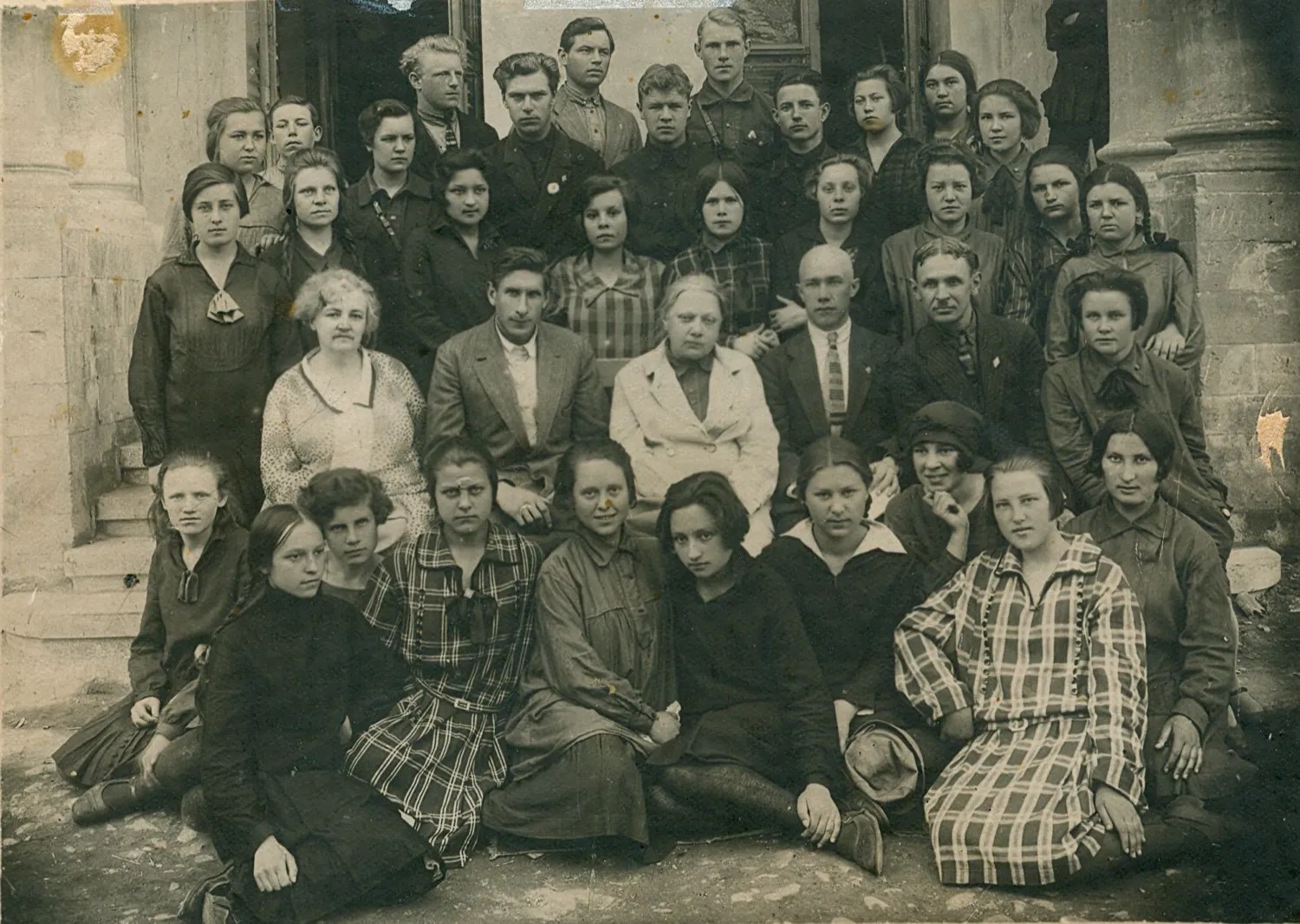
Krupskaya was a central figure both in theorizing the new education and implementing its practice in the Soviet Union’s first decades. Here, she speaks to the accomplishments and continuing difficulties in providing a universal education to Soviet workers, peasants and their children.
‘The Polytechnical School’ by Nadezhda Krupskaya from Communist International. Vol. 8 No. 16. September 15, 1931.
In Tsarist Russia (within the borders of the present R.S.F.S.R.) elementary education in 1914 embraced only 4,402,752 children, whereas in 1931 the number had increased to 9,980,605, i.e. by 5,577,853: We have now come very close to universal education. The October Revolution aroused in the masses a tremendous thirst for knowledge. The schools were organized on new principles. They became Soviet co-educational schools; schools at which rote-learning and drill methods have been eliminated and where the children are taught to understand life and to organise it. However, during the world war and the civil war and the destruction that accompanied them, the schools passed through an extremely difficult period. They were occupied for military purposes, as hospitals, were burnt down by the Whites and others were occupied by various economic organisations that had nowhere else to go. In the school year 1923-24, we began to see signs of progress: the schools began steadily to advance. But unprecedented progress in the education of children from 8 to 12 years of age made itself evident at the beginning of last year, and to-day we are already on the eve of universal compulsory education on the four-year school system.
In the five years from 1933 to 1937 universal compulsory education must be extended to all children from the ages of 7 to 15 (the elementary school will become an eight-years school).
To European countries universal education within the limits of a four-year school may seem a very modest achievement. But for our country with its vast agricultural population, its enormous distances and its numerous nationalities that were degraded and oppressed by the Tsarist Government, the first steps were particularly difficult. The tempo displayed during the last year shows that matters will now proceed much more rapidly. The broad masses of the population are now participating in the construction of our schools and their activities are being organised. The masses are growing, they are craving for knowledge. Illiteracy is being rapidly liquidated. The Cultural Campaign did what it would have been impossible to do by ordinary methods.
But it is a question not merely of abolishing illiteracy. Knowledge is needed by the masses for the remoulding of the habits of life, for training them in habits of work. And so we find working men and women, collective farm workers of both sexes zealously and stubbornly educating themselves in every kind of school and taking every kind of educational course. The masses have devoted themselves to the conquest of knowledge, and in view of the rapid growth of the industrialisation of the country and the collectivisation of agriculture, there is not the slightest doubt that we shall achieve universal education on the eight-year school system within the period indicated.
But the chief thing for which we are now striving is the quality of our schools. The Soviet school is a co-educational school and is Soviet through and through; no religious schools exist. The Soviet school is associated with its surrounding environment in the most intimate manner. This association between the school and the surrounding environment in our country, where Socialism is being built up, is of great significance, The systematic study of conditions of environment occupies an important place in the curricula of all our schools beginning from the lowest class. And this study is not merely a book study. The whole point of the matter is that the school is carrying out socially useful work and the children, within the limits of their capacity, collectively participate in Socialist construction. The school, therefore, not only provides the knowledge required for the construction of Socialism, but also inculcates the capacity to apply this knowledge to the facts of life and trains the children in profound habits of organisation.
The children take part in the spring sowing, agitating and other useful work. They also take part in the elections to the Soviets, carrying notices around and reading newspapers aloud to the illiterate. The children are taking a tremendous share in helping to liquidate illiteracy; those who are able to teach their mothers and their sisters do so. The children canvass for subscriptions to the various loans launched. They collect utilisable waste; they take their place in the front ranks of the fight for the collectivisation of the farms and the fight against those who absent themselves from work. In this work the children develop, learning to speak, make speeches and become fighters.
Our children are bold; they say what they think; they will say it to a Red director, to their teachers and to a conference of scientists. At a meeting of working men and working women of the Kalinin Textile Mills in Moscow a young fellow of 12 came forward and said: “We have our children’s collective farm and our fruit orchard, which were given to us so that we should take care of them. But a gang of hooligans broke through the fence, crept into our collective farm and organised drunken parties. To us school children, pioneers, that means nothing: we are intelligent and it does not influence us. But in our orchard young children of pre-school age play and they have begun to play at being drunkards. That will not do, comrades. You have got to help us to repair the damage to the fence as quickly as possible.”
At the Krasny Bogatyr Works a young fellow, eleven years of age, came forward and said: “At ceremonial meetings the director of our factory and the whole board make promises to help the school. But what are the facts? We are building a rabbit house and we need nails. But what do they say when we ask for them: ‘We shall not give you a single rusty nail! What do you think of that?’”
The children attend a conference of scientific workers and make passionate speeches to the effect that the scientists must help them in their studies, and that they, on their part, would help the scientists in their work. For you see, the scientists must seek the support of the masses. The conference was deeply moved.
There are still very many shortcomings in our schools, but they are already developing active fighters for Socialism.
During the past year we have achieved very good progress.
Having made a careful study of what Marx, Engels and Lenin said regarding the necessity for polytechnical education, having studied what is being done in the industrially advanced countries (U.S.A., Germany, etc.) in respect of training children in working habits, we, at the very commencement of the work of building the Soviet school, realised the necessity of introducing polytechnical education. But it was impossible in the early years to create polytechnical schools on a large scale. Owing to the general economic destruction we were able to organise only a few experimental schools, which were, it is true, interesting enough, but which were placed in exceptionally favourable circumstances. Aye, and even these schools very often began to slip into the path of mutual help. However, the great thing is that into the curriculum were introduced labour methods, the history and the organisation of labour as the organising kernel of education. But that, of course, was not sufficient. Now, however, when mills and factories are springing up everywhere, when the tractor is ploughing our fields, when a wide network of tractor and machinery stations has been created, when labour at the collective farms is being organised on new lines, when the regions of universal collectivisations are increasing, when the enthusiasm for construction on the part of the masses is growing, when we have Socialist competition and when shock methods of work are becoming prevalent everywhere—we have the conditions which make possible the creation of polytechnical schools on a mass scale in the spirit of Marx and Lenin.
A year ago the First All-Russian Congress on Polytechnical Education was convened.
That Congress was a turning point: the schools entered on the path of polytechnical education. A number of very important questions were discussed at this Congress.
Following the Congress, the Council of People’s Commissars passed a decree providing that each of the factory seven-year schools should be attached to a particular factory. The factories are obliged to help the schools in the teaching of polytechnical methods; they must assist in equipping the school workshops and must admit children of the sixth and seventh classes to work in the factory to gain practical experience. The same has been done in respect of the village seven-year schools: they are being attached to machinery and tractor stations and to Soviet and collective farms. This measure has been of tremendous importance as it has enabled the school to become closely associated with the factory. The manager of the school is appointed from among the workers. The children have been given access to the factory. But they are not merely children; they are our students, carried away by enthusiasm for construction, taking the work of the laboratory closely to heart, whether it works badly or well and whether its programme is being fulfilled. The children help to the best of their ability in organising the work. The modern Soviet factory, with its systematic organisation, exerts its influence on the children. For instance, as an heritage from the pre-war days, machines were not provided with the necessary safety screens, but as soon as the children appeared the machines were screened. The interest displayed by the children and their criticisms are taken to heart by the workers.
Working men and women have been brought closer to the school: they interest themselves in its work, help in introducing polytechnical methods and in equipping the school workshops. This winter a series of conferences of workers were held devoted to questions of polytechnical education. A number of very interesting suggestions were made.
Children’s conferences on polytechnical questions were held in all districts, and the children showed great enthusiasm for polytechnical methods. Only the sixth and seventh classes are allowed to work in the factories, but all the children are enthusiastic. They have all been seized by the desire to master technique.
The teachers have also been affected by this enthusiasm. We have known instances, when on their rest days they go to work at the factory; they attend the production conferences, and the workers’ meetings, and in consequence, feel themselves drawn closer to the workers through which they have obtained a better understanding of the children of the workers. Teachers’ conferences on polytechnical questions were also held.
There have been some very interesting investigations of factory seven-year schools attached to textile mills, iron and steel works and of collective farm schools attached to machinery and tractor stations. The investigations were carried out by workers from the factories, the school managers, promoted workers, the teachers and the scholars. These investigations were organised by the Society of Marxian Pedagogues.
Of course, all this is only a beginning. We still have to give much thought to the question how to improve the organisation of the work of the children in the factories; the school workshops must be equipped along new polytechnical lines; the labour programmes must be tested in practice; theory and practice must be associated in the most intimate fashion; we must revise the method of teaching in a number of subjects; the work of the schools must be planned better; we must carefully guard against the schools slipping into the path of vocational education; we must teach labour organisation; re-arrange the material in a number of subjects taught, etc., etc. All these questions are being studied by the scientific institutes of experimental pedagogues headed by the Institute of Child Polytechnical Labour (Moscow, Lubiansky Proezd, No. 4). This Institute was organised only this year but is already undertaking very interesting work. It would be very good if foreign comrades interested in polytechnical education would write to the Institute giving their views on the subject. Their suggestions would be of value to us.
The Soviet polytechnical school will follow the path pointed out by Marx and Lenin and will undoubtedly play no small part in the cause of Socialist construction in the U.S.S.R.
The ECCI published the magazine ‘Communist International’ edited by Zinoviev and Karl Radek from 1919 until 1926 irregularly in German, French, Russian, and English. Restarting in 1927 until 1934. Unlike, Inprecorr, CI contained long-form articles by the leading figures of the International as well as proceedings, statements, and notices of the Comintern. No complete run of Communist International is available in English. Both were largely published outside of Soviet territory, with Communist International printed in London, to facilitate distribution and both were major contributors to the Communist press in the U.S. Communist International and Inprecorr are an invaluable English-language source on the history of the Communist International and its sections.
PDF of full issue: https://www.marxists.org/history/international/comintern/ci/vol-8/v08-n16-sep-15-1931-CI-grn-riaz.pdf
 Revolution's Newsstand