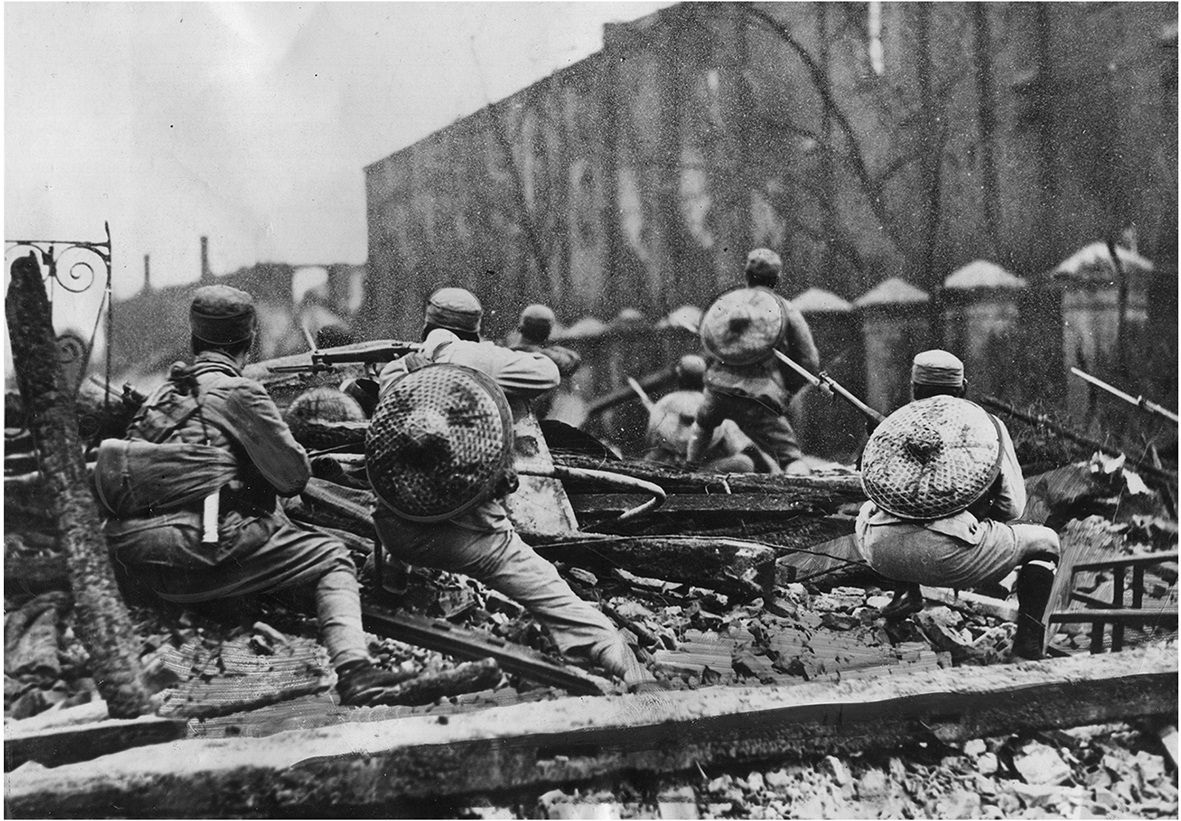
The September, 1931 Japanese invasion of northern China and the setting up of it Manchukuo state was quickly followed by January, 1932’s ‘Shanghai Incident’ in which Japan’s military launched a brutal invasion on the Chinese sections of the city and pushed the Nationalist 19th Route Army from the China’s, and the entire Pacific’s economic center, the ‘open city’ formally under British dominance. Those events created a new war of national liberation and shifted the focus of China’s First Civil War between the Koumintang and Communist forces; made Japan the predominate imperialist power in China, giving it access to badly needed raw materials for expansion; and, arguably, began the Second World War. This document from a leader of the Japanese Communist Party analyzes those events, the response of various forces in Japan, critically reports on the work of Japanese Communists against the war, and their tasks going forward.
‘The Rapacious War of Japanese Imperialism in China and the Tasks of the Japanese Proletariat’ by Aki from Communist International. Vol. 9 Nos. 4-5. March 15, 1932.
I.
“…In Japan and Russia the monopoly of armed force, vast territories or special facilities for plundering foreigners, China and others, partially compensate, partially replace the monopoly of the modern, newest finance capital.” (Lenin, First Russian Edition, Vol. XIII., page 78.)
The late Prime Minister of the Japanese Government, General Tanaka, in his famous memorandum to the Emperor of Japan of July 25, 1927 (see Vol. VIII., No. 22 of the “Communist International” for 1931), wrote:
“In order to conquer China, we must first conquer Manchuria and Mongolia.” (Page 735.)
“With all the resources of China at our disposal, we shall pass forward to the conquest of India, the Archipelago, Asia Minor, Central Asia and even Europe.” (Page 735.)
“If we look into the future of Japan we have to admit the inevitability of war with Russia on the fields of North Manchuria.” (Page 739:)
“If we wish, in future, to gain control over China, we must crush the United States, i.e., behave towards the United States as we did during the Russo-Japanese war.” (Page 735.)
Now the present Prime Minister Inukaia in his New Year greetings (1932) has not forgotten to emphasise his point with the diplomatic cynicism customary among imperialists:
“If in this case (i.e., in the case of Manchuria coming under Japanese occupation—A.) we do not solve all the questions before us, it may happen that the territory of Eastern Asia will be left to itself and a wave of unrest seize the land, so that our nation will in the long run have to evacuate from the mainland. This on no account must be allowed to happen.” (italics mine A.).
Japanese Imperialism in Manchuria and Inner China is now doing what General Tanaka proposed to the Emperor four years ago.
Japanese Imperialism was always renowned for its intense aggressiveness. The Sino-Japanese and Russo-Japanese wars are proof of this, not to mention the military invasion of China on the Occasion of the Boxer Rising, the annexation of Korea, her “patronage” of China during the world war, intervention in Siberia, etc., etc.
In all these cases, Japanese Imperialism mercilessly annihilated millions of toilers with the help of Japanese militarists and misguided soldiers. The Japanese Imperialists had no hesitation in using both cunning and mass murder. The ease with which they use aggressive, militarist methods of expansion, is due to several peculiarities of the country’s historical development, as well as to the peculiar facilities they have had until quite recently of mercilessly robbing China. Japan, as an imperialist Power, lacks capital, iron, oil, coal, chemicals, etc. The Japanese internal market is very small and the purchasing power of the downtrodden workers and peasants, whose standard of living has been reduced to that of the toiling masses in the colonies by the bourgeoisie and landlords, is insignificantly small. The economic crisis has increased this poverty and suffering a hundredfold, and brought about a further diminution of the internal market.
Japan’s effort to become a mighty, independent Imperialist country, and, in consequence, to make sure of a basis for raw materials and an extensive colonial market, and to consolidate this base on the Continent of Asia both strategically and in the military sense, is being met by resistance on the part of the largest imperialist plunderers (first and foremost the United States) and revolutionary action on the part of the rising revolutionary movement in China. These have been the characteristic features throughout all stages of Japanese imperialist aggression, especially recently in connection with the deepening of the crisis.
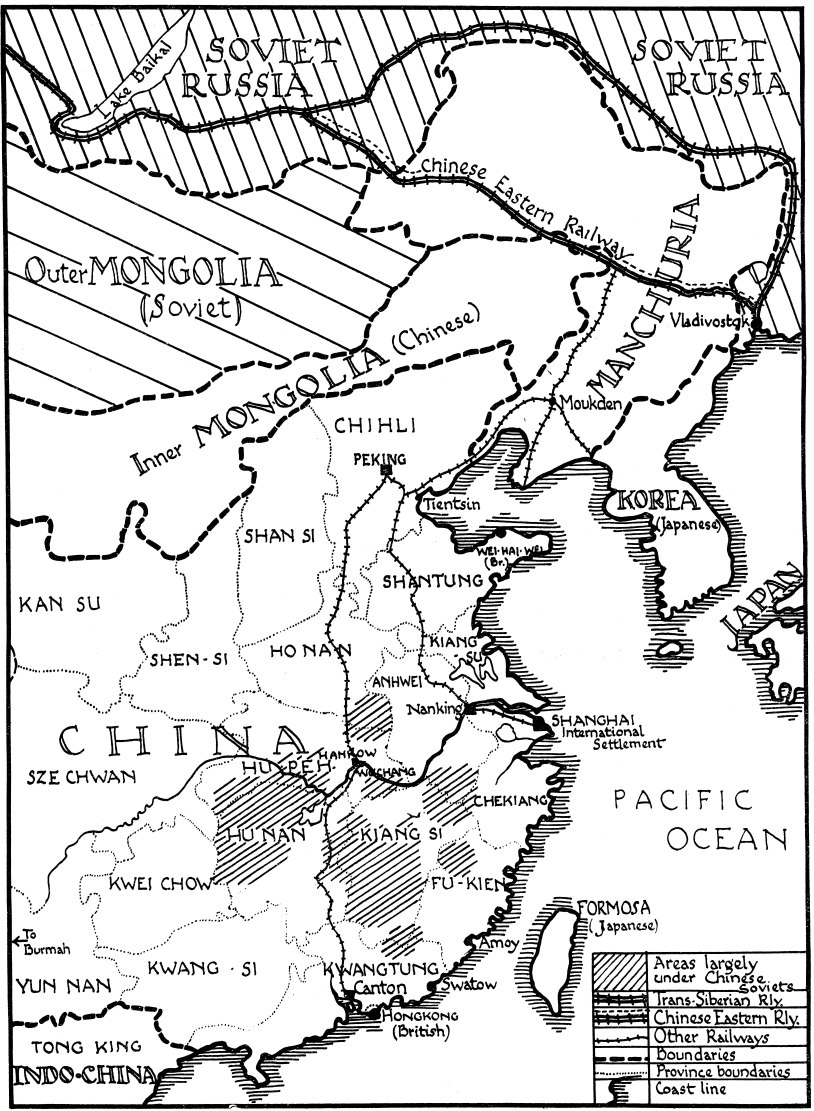
Japan is waging a rapacious war for plunder in China. It is bombarding Shanghai, Nanking, Swatow and other places. To do this it has concentrated its best naval forces in the river Yangtse. It is pursuing its extensive aim of finally annexing Manchuria and Mongolia and instituting control over inner China. Its operations in the basin of the river Yangtse are directed against the Chinese Soviets.
The desires of Japanese Imperialism are also, without doubt, directed towards Siberia, through North Mongolia and the Chinese Eastern Railway. Thus we find that in spite of the extreme intensification of the contradictions existing among the imperialist Powers in connection with the military invasion of Central China by Japan, the menace of war against the U.S.S.R. and the Chinese Soviets on the part of Japanese Imperialism is not only not removed, but increases every day. From the beginning of the occupation of China there have been many facts to prove this as, for instance: the regular reinforcement of the place d’armes for an attack upon the U.S.S.R., and systematic acts of provocation to force the U.S.S.R. into war; the refusal to accept the proposal of the U.S.S.R. to enter into a pact of nonaggression and, finally, the advance of a large army into North Manchuria along the Chinese Eastern Railway.
At the same time, recently, especially in connection with the advance of Japanese imperialism upon Central China where the interests and contradictions of the imperialist Powers—Japan, the U.S.A., England and France—are closely interwoven, there is rapidly growing up the danger of war between the imperialists for the partition of China, mainly between Japan and the United States of America. Preparations in this direction are taking place, not only along the lines of diplomatic notes and protests, but, what is more to the point, along the lines of the concentration of mighty armed forces in the direct neighbourhood of the area around which the conflict is taking place (the maneuvers of the American fleet off the Hawaiian Islands). The imminence of war among the imperialists in the Pacific Ocean is obvious.
The political system of Japan—the domination of the military-bureaucratic, police monarchy operating on the basis of a dictatorship of the bourgeois-landlord bloc—corresponds with the aggressive character of Japanese Imperialism.
The fear of a mass revolutionary movement and the need for waging war in circumstances of intensifying crisis and class war has brought about the creation of an openly aggressive Cabinet—the Cabinet of Inukaia, the direct successor of the policy of General Tanaka, which has instituted closer contact with the militarists. There is a régime of arbitrary, military and police dictatorship reigning throughout the country.
Even stronger guidance is now being given to the plan for waging this rapacious war to a finish.
II.
The economic crisis throughout the world and in Japan has played the most important part in hastening on the seizure of Manchuria by Japanese Imperialism; in other words: the intensification of antagonisms among the imperialists, increased preparations for war by the latter in face of the ever-growing apprehension concerning the increasing strength of the U.S.S.R., the Chinese revolution and the sharpening of the class struggle inside Japan.
As a result of the economic crisis, the volume of industrial output has fallen by 30 to 70 per cent. in the main branches of Japanese industry; during 1931 as compared with 1930 the figures for foreign trade show a drop in exports of 22.3 per cent. and in imports of 21.5 per cent. Japan’s trade with China has rapidly fallen from showing an active balance of 10,429,000 yen in June, 1931, to a passive balance of 807,000 yen in October of the same year, and it has now almost ceased altogether. In every respect the inner market has shrunk enormously. Last year there was a bad harvest: the rice harvest was 17 per cent. less than that of the previous year.
As soon as the occupation began the economic crisis in Japan became still more acute. At the moment of occupation the financial system of Japan was already in the throes of crisis. The gold fund is rapidly decreasing. At the beginning of the occupation of Manchuria it was about one billion yen, and by February of the same year it had fallen to 400 million yen. The gold standard has been abolished and the yen immediately fell by 30 to 35 percent. Asa result of this the actual wages of the workers and clerks have dropped considerably. The prices of goods of primary consumption rose between November and December as follows: Rice, 10 per cent.; cotton materials, 10 per cent.; sugar, 3 per cent. The prices of agricultural machinery and fertilisers increased to the same extent. Meanwhile, the financial magnates were able to make the following profits merely by speculating on the yen: Mitsun, not less than 50 million net income; Mitsubishi, 15 million, etc. Wages during last year alone dropped no less than by 35 per cent. There are two-and-a-half million unemployed. The indebtedness of the peasantry is rapidly growing, five million yen being the amount of the debt to the banks and credit institutions. The poor and middle peasantry are groaning under the burden of rent and taxes. In the Northern regions of Japan there is a ghastly wave of famine. The peasants are ready to sell their daughters for a mere song in these parts, sometimes for ten yen.
In spite of the terror on the part of the military and the police, and the treachery of the social-fascists, the unrest among the toiling masses, first and foremost the workers, is increasing and frequently develops into spontaneous revolts against their exploiters and the police. The number of industrial disputes has increased from 1,420 in 1929 to 2,289 in 1930 and 1,420 for the first half of 1931 alone (as against 728 for the first half of 1930). The number of conflicts in the villages between the peasants and landlords is also growing steadily:
January-October, 1929—1,002
1930—1,238
1931—1,501
Disputes in industry occur mainly as a result of dismissals (25 per cent. of the total number of disputes were of this kind during the first half of 1931), in consequence of wage cuts (23 per cent.) and so on; the peasantry rise up against the landlords foreclosing on the peasants who rent from them, and clashes of this kind occur in increasing numbers each year: Between September and October, 1929, 327 out of 1,002 conflicts; in 1930, 530 out of 1,238; in 1931, 881 out of 1,501. The struggles themselves and the methods used became considerably more acute towards the end of last year. During several strikes, which were accompanied by bloody conflicts with the police, there was barricade fighting against the police detachments (Sumitomo, Husimi-Seifu. and so on). There were even frequent cases of the peasantry attacking police stations.
This state of unrest has penetrated into the ranks of the petty-bourgeoisie in the towns. In 1931 a wave of strikes swept through almost all the higher educational institutions of Japan. It is therefore no accident that on the eve of the occupation of Manchuria, the municipal elections were made use of by government officials and the bourgeois-landlord party, and the social-democratic press concentrated all its energy upon working up public opinion in favour of the forthcoming intervention, and at the same time for a fight against Communism. Without doubt they had hopes of the war rousing the chauvinistic spirit of the masses, and imagined that this would not only stop the revolutionary unrest, but would at the same time isolate the vanguard of the proletariat from the other sections of the toiling masses. All this served the hidden motive for hastening on this imperialist war of plunder.
From the beginning of the occupation of Manchuria, the reaction in Japan has been increasing considerably. The capitalists and landlords have conducted a frantic attack upon the standard of living of the working class and the peasantry; they have broken down the resistance of the workers and peasants by means of military and police terror.
The insolence of the hired bands of nationalists knows no limits. On their own initiative they are allowed to organise unhindered hunts for revolutionary workers and peasants. All protests against this rapacious war are met with flogging, arrests, tortures and murder of their participants.
Yet in spite of this wave of terror, the strikes continue. The masses, who at first were carried away by the chauvinistic agitation which was carried on, are now gradually awakening and beginning to raise their voices in protest against exploitation. The strike struggle has in particular become strong since November of last year. Between October 31 and November 20, according to incomplete information of the Association of Class Collaboration, the Kio-chio-kaia, about thirty-five more or less important strikes broke out. The number of disputes continues to increase. During the leatherworkers’ strike a bloody conflict took place near the town of Himedzi between the strikers and the police. Five hundred of the inhabitants of the town joined in with the strikers and the strike developed into a pitched battle. In another case, during a conflict which occurred between the police and strikers (450 of them) from a chemical fertiliser works in Asaki, the families of the strikers all took part in the fighting.
On January 30 this year several dozens of workers were wounded in a struggle which took place between the woodworkers who were on strike and the police in the Wakyama Prefectorate. Cases of this kind are becoming more and more frequent.
The spontaneous wave of unrest among the unemployed is also increasing. This year in particular there have been more and more fights between the unemployed and the police. The movement of the unemployed is becoming more revolutionary. Furthermore, the peasant masses have swung very considerably to the left. The bad harvest, famine, and the unbearable burden of rent and taxation, together with the present war have hit the peasant masses very considerably. The reactionary mode of dealing with the fighting masses by means of police and military methods makes the struggle all the more acute. In the Tochigi Prefecturate, on September 19 last year, 500 peasants made an attack upon the police in order to set free their comrades from among the youth who had been arrested. In Niigata, on October 3, 350 peasants attacked the police station, where building operations were being carried on by the local authorities, and a real fight took place against the police. The reason for this attack was the fact that the landlords had taken away the land of a poor peasant with revolutionary leanings. In the districts where famine is rampant, the peasants are demanding complete liberation from the payment of rent, or at least that the amount of rent be lowered by 60 to 70 per cent.
On January 9, in Tochigi, a battle took place between the peasants and nationalists from the “economic party,” who were defending the landlords in their attempt to take the land away from the peasants. Asa result three nationalists were killed and ten mortally wounded.
The facts given above are only a tiny part of what is going on throughout the country. The bourgeois press remains silent on the national unrest, and this was especially so when the occupation of Manchuria began. But all these facts show that this rapacious war which is making the economic crisis more acute, and increasing the offensive of the owners and landlords against the workers and peasants, and the bloody terror of the police and militarists and the treachery of the social chauvinists—(all of which is connected with the crisis)—has not been able to stop the masses of Japan from swinging over to the left. Among the common people unrest has increased and has developed in many cases into bloody clashes and pitched battles against the apparatus of violence of the Police-Monarchic Government.
The continuation of war and our persistent struggle against it will have its effect upon the masses who have been deceived by chauvinistic agitation; it will destroy the illusions which are to be found among certain sections of the toilers that the road of imperialist war will bring any improvement in their standard of living.
The vanguard of the Japanese proletariat, in spite of the fact that it is still young and has made numerous mistakes, is leading the masses along the road of a revolutionary way out of the crisis and war. The ruling classes are increasing their repression. Arrests follow arrests. There are ever more frequent cases of large batches of strikers being arrested, and even of whole village populations. Now the troops are being brought up to take part in repressing the population. The whole revolutionary movement has been driven underground. After every demonstration and every strike against war, the prisons are filled with new tens and hundreds of revolutionary workers and peasants.
III.
During the preparatory period of occupation, when the Japanese Communist Party called upon the workers, peasants and rank and file soldiers to fight against the approaching intervention, Japanese social-fascism of all shades gave its full support to the ruling class in order to put down the revolutionary movement and to prepare for this rapacious war. Japanese social-democracy has now become an integral part of the apparatus of the police and militarist monarchy.
During this period they organised their section of the Amsterdam International (Rodo-Kurabu) under the slogans: Down with Communism; down with the revolutionary trade union movement; down with the Comintern, the Profintern; and in favour of the International Labour Office.
A joint party of centrist and “left” social democrats, the “Rono-Taisiu-to” has been formed with “Down with the Japanese Communist Party” as its slogan.
The social-fascists are now not only smashing the workers’ strikes, but handing over militant fighters among the workers to the police (the workers from the Sumitomo works, etc.). They urged the workers, who were prepared for an active struggle, to engage in methods of passive resistance, such as refusal to take food and to sleep; (one or two were even persuaded to commit acts of “heroism,” like sitting in the factory chimneys to prevent the boiler fires from being lighted). Thus they have weakened the resistance of the workers and their determination to fight against the owners and police.
The social fascists, together with the police, organised raids upon the Communists and revolutionary workers and peasants; they handed over lists of the revolutionary workers and peasants to the police and helped to arrest them. For instance, the “left” social fascists gave away to the police all the names of the left delegates to the Congress of the Peasant Union “Dzen-ho.” In the same way last year many revolutionary delegates were betrayed at the Congress of the Tramwaymen’s Union—”Toko.” For the same purpose a spying organisation has been organised, with the following slogan: “Dictatorship of the proletariat headed by the Emperor”; this has been organised with the help of the police authorities and organs of the Civil Court. It calls itself the “Workers’ Section of the Japanese Communist Party.”—(!!)
Immediately before the occupation of Manchuria, when the municipal elections were taking place, the social-monarchists of all shades were very generous in their promises to the workers and peasants. But not a word was said, of the forthcoming occupation of Manchuria, of which they were aware long before the elections. Declaring that all the forces of the workers should be concentrated around the election campaign, they broke up all struggles of the workers and peasants. By helping to cultivate parliamentary illusions among the masses, by preventing the masses from struggling, they made it possible for the capitalists, landlords and generals to prepare for the annexation of Manchuria and Mongolia, without any interference. This rapacious war has revealed more than ever before the imperialist nature of Japanese social democracy. Japanese social democracy of all shades is the initiator and active collaborator in waging this war.
Since the war began, it has not only engaged in strike breaking activities against the workers and interfered adversely in the conflicts among the peasantry; it not only betrays the revolutionary elements among both workers and peasants to the police, but it is agitating among the masses in favour of the war, depicting it as a war on behalf of “Socialist Japan.”
The General Secretary of the Social Democratic Party, Akamatsu, immediately after the occupation of Manchuria by Japanese troops, wrote:
“Intervention in Manchuria is not imperialist, because even in Socialist Japan it would be necessary to wage war for raw materials required by our industry, and these raw materials at present are in the hands of America, England and Russia.”
One of the leaders of “left” social democracy–Rokotaisu-to, member of the Matsudani Parliament, who was sent by his Central Committee to “investigate” into the events in Manchuria, declared in Mukden as follows:
“The Manchurian events are not the same as the usual wars of the capitalists, but a war to solve the national problem.”
It now transpires that Akamatsu is in direct touch with the militarists, and that the money required for “investigating” the Manchurian events was assigned from special funds of the special department of the General Army Headquarters by order of Matsudani.
“Japan,” the well-known monarchist newspaper, writes as follows:
“The sudden turn which events have taken in Manchuria has to a considerable extent awakened national feelings, which have been dormant up to now. The Rono-taisiu-to party which carried on its election campaign under the slogan: ‘Down with the imperialist,’ is now somewhat embarrassed and has war, removed its mask; and the Social-Democratic Party has once and for all gone over to the side of those who defend our rights and interests in Manchuria and Mongolia.”
At the Congress of the left Social Democratic Party “Tono-taisiu-to”, a resolution was passed against the Communist Party of Japan.
But the question of the declaration of Matsudani and the miserable, demagogic resolution on the occupation were removed from the agenda by request of the police.
The slogan which brings them all together at present is that of “State Socialism” under the despotic dictatorship of the Monarch and the militarists, and “Socialist control over the rights and interests of Japan in Manchuria and Mongolia.” The last slogan was passed at the January Congress of the Syakai-minsiu-to. These social-imperialists, with their lying phrase about “Socialist control,” justify the annexation of Manchuria and their own participation in the rapacious war against China and the U.S.S.R. They are specialising more and more in acts of provocation. The same paper, “Japan,” writes:
“They (i.e., the social-imperialists–A.) have begun to say in a sort of falsetto: People, are you ready to give up Manchuria to Russia?”
But they do not limit their activities to declarations now. The Rights are organising patriotic demonstrations and meetings under democratic and, at the same time, downright chauvinistic slogans. They organised demonstrations of this kind under the following slogan: “Down with speculation upon the rate of exchange; all profits from speculation to be given to the war and soldiers at the front.” And the “Lefts” offer direct assistance to the rights in the form of a “united front of proletarian parties.” Quite apart from the united front which exists among all social-imperialists, these Right and “Left” social-imperialists recently organised a joint parliamentary committee, which was participated in by the general secretaries and members of Parliament, for the purpose of coming to an agreement on patriotic activities and the distribution of parts. Here it was found that the usual verbosities of their Western collaborators about the republic, parliamentarism and “democracy” were too revolutionary for the Japanese social-fascists. They support the domination of the bourgeoisie and landlords and the hangman régime of the military-police monarchy.
At the January Congress, the president of the Central Committee of the Social-Democratic Party, “Syakai-Minsiuto” Abye made the following declaration: “We are faithful supporters of the monarchy.”
However, over the heads of the treacherous social-chauvinist leaders, a revolutionising process of the workers and peasants still under their influence is going forward rapidly. The entire local organisation of the “Left” social-fascist party “Rono-Tayusiu-to”–in Nagano province left this party on December 4 and joined the revolutionary movement. There is considerable unrest in the fortress of the centrists–the Dzenkoku-domei (National Federation of Labour)–among the rank and file, who are indignant at the activities of Rodo-Kurabu, affiliated to the Amsterdam International. At the end of last year during the Congress of this amalgamation a split occurred on the basis of differences on the question of amalgamation with the Rodo-Kurabu. The “left” reformist leaders tried to prevent the membership from swinging to the left, but the influence of the revolutionary trade union opposition grows rapidly. The left wing in the “Dzen-ho,” the Peasant Union, is also gradually squeezing out the right wing. The majority of the local organisations of this union are already under the influence of revolutionary forces.
IV.
The Japanese Communist Party foresaw the danger of this rapacious war even before the occupation of Manchuria.
On July 6 (in connection with the appointment of the most reactionary politicians to big positions: Count Uchid as President of the South Manchuria Railway, and General Ugaki as Governor-General of Korea), the Central Committee of the Communist Party of Japan sounded a warning in its central organ, the “Sekki” (Red Flag), in an article entitled “Fight against preparations for war by Japanese Imperialism.” The article runs as follows:
“The Minseito Government has appointed a new President of the South Manchuria Railway and Governor-General of Korea…this will be a change in the direction of our policy in Manchuria and Mongolia…and the other party of the imperialist bourgeoisie “Seiyukai” has put forward just such an active policy, that of Tanaka, but with certain amendments; for it has accused Sideharu (the late Minister of Foreign Affairs) of maintaining too moderate relations with Russia and China…the entire bourgeois press is agitating for the restoration of the idea of the peculiar nature of Manchuria and Mongolia, as vitally necessary to our country.” (!)
“At a meeting of army commanders…the following decision was made: That in view of the policy of the State regarding the defence of our rights and interests in Manchuria and Mongolia, in order to hasten on military action in case of the need for hurried operations–divisions or corresponding units to be despatched to Korea from inner Japan.
“The strategy of Japanese Imperialism, with whomsoever it is fighting, consists, in the first place, of occupying Manchuria and Mongolia. The Japanese imperialists declare this quite openly, and in actual fact are already hastening on preparations for an armed invasion of these countries.
“They are openly agitating in favour of war! Refuse to give a single sen (about a farthing) for war purposes! Not a soldier must be despatched!
“Workers and peasants! Refuse to pay taxes, including the blood tax (conscription) for this imperialist war, for the defence of the interests of big finance capital of Mittsui, Mittsubischi, Sumitomo, etc. Refuse to act on behalf of the imperialists! Let us give all our strength to free ourselves from the capitalist yoke!”
The Central Committee of the Communist Party of Japan in the columns of “Sekki” at the same time called upon all revolutionary workers, poor peasants, soldiers and peoples in colonial and semi-colonial countries, to begin an extensive campaign of agitation and propaganda without delay in the factories and in the villages under the slogan of “Convert the war against the U.S.S.R. and toilers of revolutionary China into a civil war against the Japanese imperialist bourgeoisie; against imperialist war, for the defeat of the Japanese imperialist government, for the victory of the allied army of the proletariat and poor peasantry.”
The Communist Party of Japan emphasised the extreme importance of agitation and propaganda among workers in munition factories and transport, and also among soldiers, sailors and young workers and peasants.
As for the events in Van-po-syan in Manchuria, when the Japanese imperialists provoked the Chinese into mass murder of Koreans and then set the Koreans against the Chinese (all this to justify their own proposed occupation of Manchuria), the Communist Party of Japan issued its manifesto of July 16 to Japanese, Chinese and Korean workers and peasants, in which we read the following:
“In order that Manchuria and Mongolia shall become a colony, in order to prepare military intervention against the U.S.S.R., Japanese imperialism is seeking to strengthen its military and police régime in Manchuria and Korea…”
“Down with counter-revolutionary armed intervention of Japanese Imperialism against the U.S.S.R. and the toilers of China!”
The party’s preparations for the campaign on August I proceeded on the same lines. Up to August 1 in several localities there had been conferences in which mass organisations had taken part. In several workshops meetings and small gatherings of the workers had been conducted. By August the repression on the part of the authorities had increased; already several hundred active workers and peasants had been arrested. But on August 1 the Party managed to organise several strikes in metallurgical works, textile factories, and among the building workers), and to organise demonstrations in Tokio and Osaka, as well as in a few villages, where the agricultural workers and poor peasants took part. The infuriated police retaliated against all these exposures and manifestoes of the Party, as well as its organised campaign, by instituting mass arrests of revolutionary workers and peasants. On August 28 over 1,000 persons were arrested in Osaka, Hiogo and Kioto, and later several hundred workers and peasants were arrested in Tokio.
But these mass arrests did not stop the fight against the war danger.
On August 29th, the anniversary of the annexation of Korea, the Japanese Communist Party appealed to the workers and peasants as follows:
“Japanese imperialism is increasing its military forces in Korea and Manchuria for the purpose of a new imperialist war.
“The Japanese proletariat must organise a determined struggle against this imperialist policy of aggression.”
Despite all the arrests and other forms of repression, the Japanese Communist Party and the Young Communist League, as well as other revolutionary organisations, were able to organise Youth Day in September under the following slogans: Down with armed intervention; Down with the imperialist war; Defend the Chinese Revolution; prevent the despatch of troops to Manchuria and Korea; down with the Social-Fascists.
During the days which preceded International Youth Day, while preparations for it were being made, meetings and strikes were organised in several workshops and factories. In Tokio 13 delegate conferences of workers and unemployed (including men from seven metal works) were arranged in two districts. Demonstrations on International Youth Day took place; and as a result of this struggle the ranks of the Communist Party, and the Young Communist League of Japan have been refilled with active workers and poor peasants.
On September 19, 1931, when a ring of Japanese troops surrounded Mukden, the Japanese Communist Party issued the following manifesto:
“Comrades, workers, peasants and soldiers! The Japanese Imperialist Army occupies Mukden. The Japanese imperialist bourgeoisie has taken the first step towards occupying Manchuria and Mongolia. This is not a case of “defending justice”; neither is it a “casual incident,” as the bourgeoisie asserts. It is nothing but a well-considered reactionary piece of provocation against the toiling peoples of China and Japan, as well as against the toilers of the U.S.S.R. It is an adventurous attack of barbarian plunderers, of despicable murderers.
“Forward against Manchuria! Forward against revolutionary China! Forward against the U.S.S.R.! These are the war cries of Japanese Imperialism, the armed initiator of reaction in the Far East …
“Comrades, workers and peasants! The Japanese bourgeoisie, which is passing through a period of unprecedented crisis and is on the verge of bankruptcy, is seeking a way out of the crisis in this adventure in Manchuria. Capitalism can be saved only by sacrificing and ruining the broad masses of exploited toilers.
“Dear comrades, exploited toilers! The bourgeoisie and landlords have already deprived you of work and bread, of land and freedom! War on their behalf, in the interests of the bourgeoisie and landlords will be further torture to you and final ruin. Fight against the fatherland of the bourgeoisie and landlords! Offer strong resistance against all the military acts of the fatherland of parasites and murderers! “Workers engaged in war industries and transport! Refuse to transport a single soldier, a single gun, to the front! Stop producing arms and ammunition! Workers, peasants and unemployed of all Japan! Organise strikes and mass demonstrations against the war and on behalf of your own demands!
“Soldiers at the front! Fraternise immediately with the Chinese soldiers! Boldly extend your hand to the Chinese proletarian!
“Soldiers in the barracks! Pass a decision that not one of you will go to the front, and that you are all against defending the fatherland of the bourgeoisie and landlords!
“Comrades, workers, peasants and soldiers! form an alliance with the Chinese workers and peasants and rise up and fight in the name of revolutionary solidarity!
“We demand the immediate evacuation of the army from Mukden and of all other occupied territory! The immediate withdrawal of the Japanese army and warships from China and Manchuria! Refuse to transport a single soldier! Resist all the military actions of Japanese imperialism and Chinese reaction! Fight against the new danger of imperialist war! Help the Red Army! Defend the U.S.S.R.! Down with imperialist Japan! Forward to Soviet Japan!”
This manifesto opened a new page in the struggle of the Japanese proletariat against the plunderous adventure of Japanese Imperialism in the face of martial law, chauvinist calumny and the foulest treachery on the part of social- fascism.
When occupation of Manchuria began, leaflets against war were distributed throughout the metal and chemical works in the suburbs of Tokio and Yokohama; resolutions of protest were passed in some shops.
The workers who are on strike in the textile factories of Tatenshi and Yamada tried to organise a demonstration against war. In Hoyama during the short period between September 17 (beginning of intervention) and September 28, there took place six peasant conferences against war; on October 7, in connection with the anniversary of the death of the General Secretary of the Japanese Communist Party, Comrade Vatanabe, who was killed by the police butchers on Formosa Island in 1928, large demonstrations took place throughout Japan, in Tokio over 500 workers took part in the demonstrations, and over 1,000 in the meetings. At the same time there were many delegate meetings being held. All these forms of activity took place under the slogans of “Down with the rapacious war!” and “Down with Social Fascism!”
On October 16 the revolutionary wing of the trade union movement organised a strike in the aeroplane works which was contracting for the Ministry of War.
On the 14th anniversary of the October Revolution, there were mass anti-war demonstrations and meetings in Japan. In Tokio 400 railwaymen, printers and unemployed demonstrated on the Kudan street and 500 workers and revolutionary students demonstrated before the railway terminus. In dozens of workshops, factories and labour exchanges there were meetings and demonstrations. Over 1,000 revolutionary students organised demonstrations. Meetings and demonstrations took place in Osaki, Kanahova, Toyama and other parts, with the active participation of the poor peasants of the agricultural districts. All these demonstrations took place under the following slogans: “Do not allow military intervention against the U.S.S.R.”; “Defend Revolutionary China”; “Convert the imperialist war into civil war”; “Down with Japanese Imperialism”; “Long live the solidarity of workers and peasants of the Pacific Coast.”
The revolutionary struggle of the workers and peasants against war is beginning to evoke a response from the troops. For instance, ten soldiers were arrested for revolutionary activities in a detachment of telegraphists before being despatched to Manchuria from Tokio. There were also arrests in the Himedzin division. In a division which was sent to Manchuria via Korea many soldiers were also arrested, and even two officers, and so on. In all these cases the military authorities reported these mass arrests as the result of the men in question distributing Communist Party leaflets and carrying on verbal agitation among soldiers with revolutionary inclinations.
According to information from the Japanese and Chinese press, an entire company of Japanese troops in Manchuria were shot for refusing to go into action against the Chinese. The unrest goes further, spreading among the Japanese military units in Shanghai and Manchuria. According to information to hand, on February 8, a large number of Japanese refused to fight against the Chinese troops. Over 200 Japanese soldiers were arrested and despatched back to Japan.
The Chinese and Japanese Communist Parties issued a joint manifesto, calling upon the Japanese and Chinese workers and peasants, as well as the proletariat of the whole world, to begin a joint struggle against Japanese imperialism and Kuomintang reaction, in defence of the U.S.S.R., the Chinese Soviets, in support of the Chinese Red Army and the Chinese and Japanese proletariat who are fighting against the rapacious war of Japanese imperialism.
Over two thousand Communists are languishing in Japanese prisons to-day. For over three years the case against them has been going through the preliminary stages. Until quite recently everything went on behind closed doors. But as a result of the stubborn fight of the accused, they have gained their point and the case is now going on publicly. During the trial our comrades, despite torture and threats to increase the sentence against them, are using every possible opportunity of energetically revealing the true nature of the war, and agitating in every way against it.
V.
In spite of the daring and courage shown by the Communist Party on the anti-war front, there are, nevertheless, many shortcomings and mistakes on this question in the work of the party organisations. The chief are as follows:
1. In the anti-war manifestoes of the party as also in all its agitation and propaganda, there is insufficient attention given to the main enemy in present conditions: absolutism, the bourgeois-landlord monarchy, which is the mainstay of political reaction and all the survivals of feudalism in the country.
The party in its underestimation of the agrarian question does not sufficiently bring out its agitation and propaganda against the landlords, does not understand all the importance of mobilising the peasantry, and chiefly the middle peasants, for this struggle. This is particularly so in the work among the soldiers (peasants in the main) where it is of exclusive importance in the work of fighting against the war.
The Japanese monarchy is organising this plundering imperialist war at the expense of the many millions of the toiling masses in Japan, and in the interests of the Japanese bourgeoisie, landlords and other exploiting elements. In the interests of war the monarchy uses every kind of violence, attacks the workers and peasants who are fighting against the offensive of the capitalists and landlords, drives the soldiers and sailors into fratricidal battles at the front, increases the burden of taxation, etc. We must explain all this carefully and publicly to the toiling masses; explain it so that the masses will understand the direct connection between their ever-increasing poverty, the arbitrary actions of the police and the war, on the one hand, and the monarchy as the chief culprit in the whole affair, on the other hand. It must be explained that they can free themselves from poverty and arbitrary acts on the part of the authorities, from their present distress and from the war, only by overthrowing the monarchy and setting up a workers’ and peasants’ government. All the struggles of the masses, and in particular anti-war activities should, be directed skillfully and class-consciously against the organs of violence of the monarchy (against the police, the imperialist army, the courts of law, etc.), and against the monarchist system in general. There is considerable disparity between the work against the war and against the monarchy in the general activities of the Japanese Communist Party. This disparity must be removed with all despatch.
2. The slogan of fraternising among the soldiers, which is correct in the case of war between imperialist armies, is incorrect when it is a plundering attack of imperialist Japan upon colonial China which is enslaved and oppressed by Japan. The Communists cannot call for fraternisation between the armies of the imperialist robber and its colonial prey; they must call upon the soldiers of the imperialist army to return from the front en masse, to refuse en bloc to fight against the Chinese.
The Japanese soldiers themselves have reached this attitude towards the war against China quite spontaneously. We have proof of this in the refusal of the soldiers to fight and their demand that they be returned to their native land.
3. In fighting to defend Soviet China, the Communist Party should put forward the slogan: “For Chinese Independence.” The Communists of Japan should not forget their task of fighting against their own imperialism for the national liberation of all oppressed peoples.

4. Insufficient connection is maintained between the anti-war struggle and the fight for partial demands of the masses. This rapacious war is taking place side by side with a deepening of the economic crisis and an increased offensive on the part of the exploiters against the working class and toiling masses. In time of war all forms of real mass struggle for partial demands take the shape of anti-war activities and, with skillful leadership on the part of the revolutionary organisations, they can develop into a conscious mass anti-war struggle. For it is clear that the strikes of the workers in munition factories and transport for their partial demands brings the masses up against the question of putting our slogan into action: “Not a single gun to be produced for the war”; “not a single soldier to be transported to the front.”
The party should develop the struggle for partial demands, and link it up with the anti-war struggle, thus: the fight against dismissals, against wage cuts; for an immediate, all-round increase in wages, and institution of the seven-hour day; against increases in prices for goods of primary consumption; for the immediate payment of unemployment benefit to unemployed and starving peasants by cutting down the enormous State expenditure on the war, by curtailing the large subsidies which are being presented to capitalists and landlords, and cutting down expenditure on the upkeep of the Emperor’s household and bureaucratic officials; for lower rents, cheaper gas and electricity and other forms of municipal charges; complete exemption of unemployed from these charges; for non-payment of land-rents; wholesale cancellation of the indebtedness of the toilers to banks, landlords and moneylenders; against the ferocious terror of the police and the army; for complete freedom of organisation, strikes and demonstrations for the toilers, etc.
We must organise strikes, protests, sabotage; the conveyers must be held up and demonstrations made in the works themselves, at the factory gates and in the streets; sabotage must be made in the form of bad work for low wages; strikes in separate workrooms, in special crafts; meetings and demonstrations of the unemployed at the labour exchanges, municipal buildings, large food shops and governmental food warehouses; immediate cultivation by the peasants of lands confiscated from the landlords’ estates; group and mass organisation of non-payment or delay in paying land-rent, taxation, arrears of payment, etc.; according to the existing situation and the relation of forces, these activities to be linked up and directed in every way along the lines of a class-conscious, anti-war struggle. All true preparations for a mass political strike and demonstrations are of exclusive importance now.
It is absolutely essential that economic and anti-war work among the transport workers and munition workers should be increased considerably.
5. Underestimation of mass forms of struggle (sectarian work in practice).
Sectarian work in practice could be seen during the preparatory period of occupation, in the fact that the Communist Party was unable to make use of the municipal elections, as they might have been used, for the purpose of developing a wide agitation and mass struggle. The party underestimated the importance of this campaign and did not use it in the interests of extensive political agitation among the masses. The struggle was not sufficiently extensive, insufficient attention was paid to the task of creating a united front from below with the reformist and unorganised workers and peasants.
Mass forms of struggle must be developed more widely, for instance: general meetings of workers and peasants, the formation of committees of action elected by the workers themselves, delegate conferences of workers and peasants. Where these organisations already exist or are in the process of formation, they cannot be called mass organisations, since very frequently these conferences and demonstrations are attended by revolutionary elements alone. This is where we find very serious sectarian work in practice. This fear of the broad masses must be fought most determinedly.
Patient work must be done of an explanatory, mass nature, in order to fight against the chauvinistic tendencies amongst workers and toilers; we must carry on our mass international work against these bourgeois influences among the proletariat. The whole party must condemn all forms of support to imperialism in this war of plunder, which take the form, for instance, of the serious mistake made by certain units which, under the pretext of the “danger of becoming divorced from the masses,” gave their support to the campaign to collect money for the soldiers” of the army of occupation, which was organised by the authorities.
The first essential condition for a successful struggle against the war is the launching of a mass struggle on the basis of the united front tactic from below.
The work of unmasking Social-Fascism goes forward very slowly. Japanese Social-Fascism has unmasked itself in the present adventure of Japanese imperialism more obviously than ever before. The social-fascists are giving their entire support to this war and in its interests they break strikes, hand over the revolutionary workers and Communists to the police, etc., and so forth. But alongside of this, we have considerable unrest among the workers and peasants of the social-fascist parties. This gives us a favourable opportunity of unmasking the social-fascists on the concrete cases of treachery committed by them. The united front from below against the imperialists and social-imperialists should become the basis of the work of unmasking social-fascism throughout Japan.
6. There is not sufficient work done among the soldiers and sailors, and the work itself is unsystematic. Individual cases of the soldiers refusing to obey orders and of expressions of sympathy towards the revolutionary movement are gradually becoming more frequent and this means that a favourable situation for our work among the soldiers and sailors is rapidly approaching. The party should carry on this work systematically and not as each occasion arises. Special attention should be paid, in this anti-war agitational work, to the daily needs of the soldiers and sailors and their lack of civil rights, and also to such demands as the immediate recall of troops from China; soldiers refuse to fight; desert the front, but don’t give up your arms; set up soldiers’ committees; and at the same time to carry out the slogan of fraternisation. In view of the special circumstances of this war, in which it is necessary to defend the national independence of enslaved China against Japanese imperialist aggression, the slogan of fraternisation must be linked up with the other important slogan, i.e., the call to the Japanese soldiers to leave the front must be linked up with the demand for the withdrawal of Japanese troops from China. The same sort of work should be carried on by the party in the associations of the army reserves and the official youth leagues, which are the mainstays of reaction, where many workers and peasants are strongly influenced by the chauvinistic ideology of the Japanese generals and higher officers.
7. The anti-war work among the peasantry is still very weak, and lags behind the growing revolutionary feelings of the mass of peasantry. The peasantry are bravely fighting; they are struggling desperately for the land against the police and hired bands. We have not yet made use of the enormous revolutionary possibilities of the peasantry. The question of land-rent, of taxation, and of the land must be linked up with the question of the struggle against war.
The party must carry on special work in those districts where army units are being despatched to China, and also in the famine areas.
8. Methods of agitation and propaganda used are still very abstract. The anti-war leaflets and literature published by the party and other mass organisations are still very abstract and unreal. Literature must be issued, in which the nature of this war of plunder will be given in a live and popular way to those workers and peasants who are still not class-conscious. All mass newspapers, periodicals, leaflets, etc., should be made as understandable as possible, should be written in a simple language, which is understood by the masses, should bear the stamp of concrete facts. It is absolutely essential that literature should be produced which will explain and convince the workers and peasants, on the basis of facts, of the necessity of defending the U.S.S.R. and the Chinese revolution.
9. There must be a relentless struggle against right and “left” opportunism in anti-war work. All vacillations inside the party in decisive moments like the present cause considerable harm to the revolutionary movement. A fight must be waged against the slightest manifestations of opportunism.
The party must on no account allow itself to lose the opportunity of leading the mass struggle of the workers and peasants and of carrying on determined work in the army and the fleet. The party will be able to develop the peasant mass anti-war campaign only by means of self-sacrificing, determined, patient work.
10. Organisational work in the factories and the army barracks must be developed considerably, and close connections made with the revolutionary movement of China, Korea and Formosa.
The sooner the party is able to live down all the weaknesses and shortcomings mentioned herein, the sooner will it be successful in the anti-war struggle of the workers and peasants of Japan, headed by the Japanese Communist Party, to convert the imperialist war into a civil war for the overthrow of the power of the landlords and bourgeoisie, for the overthrow of the military, police monarchy, for the setting up of a workers’ and peasants’ government.
The ECCI published the magazine ‘Communist International’ edited by Zinoviev and Karl Radek from 1919 until 1926 irregularly in German, French, Russian, and English. Restarting in 1927 until 1934. Unlike, Inprecorr, CI contained long-form articles by the leading figures of the International as well as proceedings, statements, and notices of the Comintern. No complete run of Communist International is available in English. Both were largely published outside of Soviet territory, with Communist International printed in London, to facilitate distribution and both were major contributors to the Communist press in the U.S. Communist International and Inprecorr are an invaluable English-language source on the history of the Communist International and its sections.
PDF of full issue: https://www.marxists.org/history/international/comintern/ci/vol-9/v09-n04-05-mar-15-1932-CI-riaz-orig.pdf
 Revolution's Newsstand