
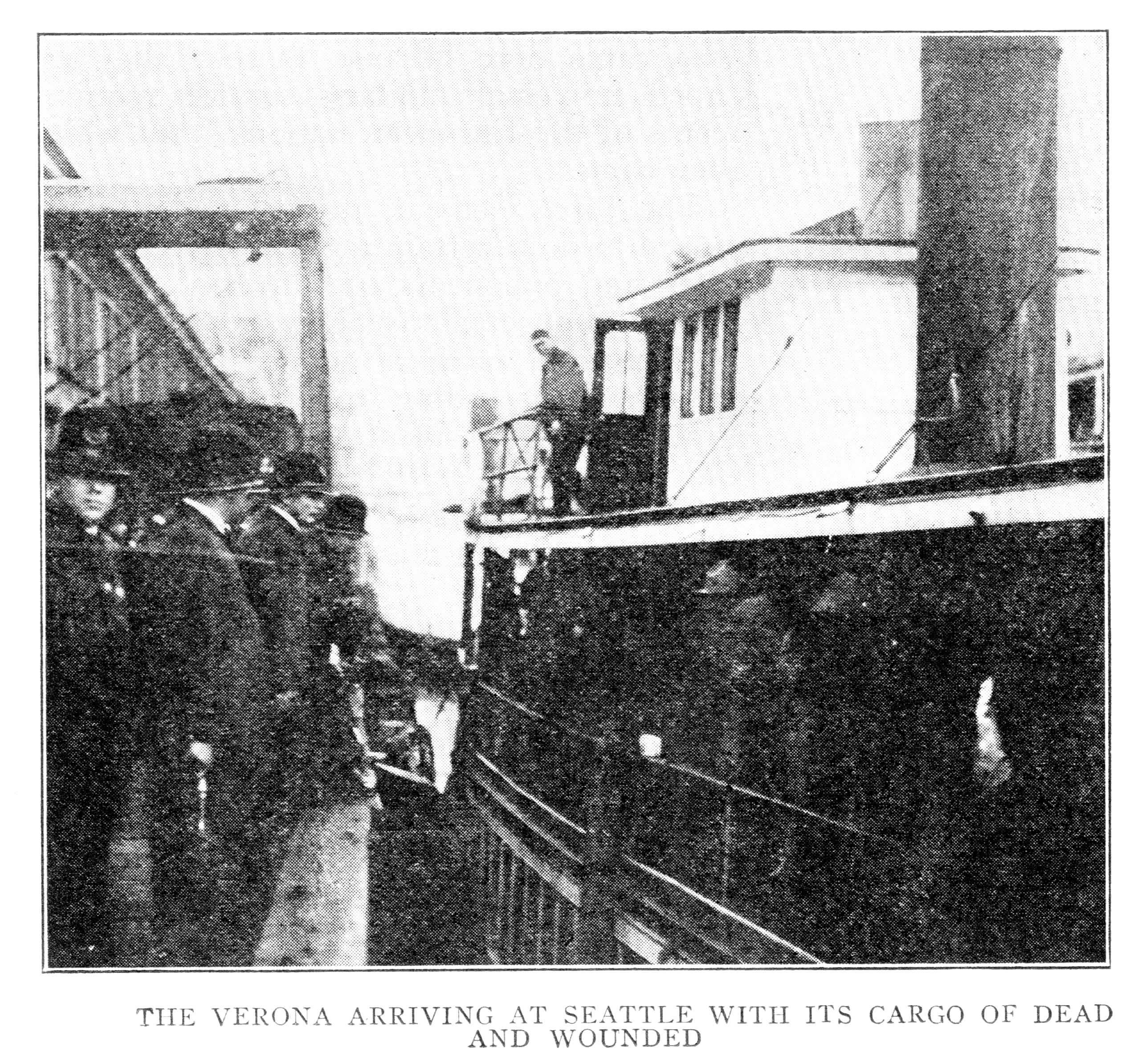
The full text of Flynn’s enraged speech before 5,000 workers at Seattle’s Dreamland Rink on January 21, 1917. The mass meeting, fund-raiser, and dance was held by the Everett Defense League in support of the seventy-four I.W.W. prisoners held for murder in the wake of November 5, 1916’s ‘Everett Massacre’. At least five wobblies died that day, potentially a dozen more drowned, and another thirty were wounded in the culmination of a long confrontation between workers and area lumber bosses. Hundreds of armed thugs attempted to prevent the landing of of I.W.W. activists from Seattle onboard the Verona as it docked in Everett; the I.W.W. defended themselves and two gunthugs were also killed, with two dozen more wounded.
‘Constructive Murder’ by Elizabeth Gurley Flynn from Industrial Worker. Vol. 1 (new) No. 47. March 3, 1917.
A Segment, a Miniature of What Labor is Enduring Everywhere, All the Time; Everett’s Outrage is Part of World Wide, Hell Deep Conflict Between Those Who Own and Those Who Produce; Everett Fight Represents Your Life and Liberty; A Powerful Lecture by Elizabeth Gurley Flynn
We are here this afternoon to present to you the workers’ side of the Everett situation, the side that, as yet, you have probably heard little or nothing of. The newspapers have given you the Everett business man’s position, they have presented to you the views of the sheriff and the Commercial Club, and possibly a good many of you believe on the 5th day of November a dangerous armed mob of I.W.W.’s invaded the city of Everett; that the citizens, to protect their wives, their children and their property were compelled to resort to violence, and you may have a sneaking admiration for the citizens of Everett. That is exactly the impression that the newspapers desired to convey to you.
Who Owns the Newspapers?
There is no such thing in America as a free press. Newspapers are supported, not by their circulation, but by their advertisements. The business department dictates the editorial and news policy of every paper, and they are quite unwilling to publish anything in their news columns or comment editorially in a manner that is against the interests of their supporters. The advertisers are big lumber companies, coal companies, department stores, street railways, gas and insurance companies. Naturally, they are not inclined to have any sympathy with, or use for, organized labor.
Everett, Part of a Tremendous Conflict.
The Everett situation, tragic as it is, is nevertheless, only a segment, only a miniature, of what the workers are enduring everywhere all the time. Everett is expressive of the class struggle that is now going on thruout the world; Everett is but a part of that tremendous conflict between the forces of labor on the one side, and organized capital on the other.
The year 1916 has been particularly marked with open conflicts, open battles in that struggle; it has been a year of bloodshed, both on the European battle fields and the labor battle fields of America.
Starting in the far east, on the shores of the Hudson River, where the statue of Liberty out in the bay casts her gleaming light into the very windows of the workers’ homes, in the plants of the Standard Oil Company in Bayonne, New Jersey, the representatives of twenty-five nationalities, working ten, twelve and fourteen hours a day for an average wage of less than two dollars, came out on strike. They were not organized. It was a spontaneous outburst of rebellion against intolerable conditions. The workers had reached the point where they have decided that it is better to starve fighting than to starve working. So they came out in this great revolt and notice was served upon them by the company and by the legal authorities “Either you go back to work or we will kill you in the street.” They not only said it, but they actually attempted it. The organized forces of private guards, deputy sheriffs and uniformed police went down the streets firing at every visible man, woman and child. A young Polish girl put her head from a second story window and they pierced her forehead with bullets. She died instantly. An Italian working man, who was not even a striker, was stopped on his way from work and when he ran in terror there were forty-two bullets put into his fleeing body. The Standard Oil Company has given over a half million dollars to Dr. Alex Carrel in France to investigate cures for wounded soldiers but there are no “cures” for wounded workers on the battle fields of labor.
The Battle of Steel.
Coming westward to the backbone of the continent, we find the United States Steel Corporation holding rich iron ore, deposits in Minnesota, employing ten thousands miners at an average wage of $2.50 per day-miners who take their lives in their hands, going down to the darkness of the earth to wrest from nature the raw material that is used in the manufacture of steel and iron; miners who were in rebellion against a condition so intolerable that they were expected to close their eyes to the insults offered their wives and daughters by the mine captains as the price of holding their jobs.
They came out on strike and their strike endured all summer. Over five hundred were arrested, hundreds were clubbed by the four thousand special guards of the steel corporation. Two miners were killed and after a long, hard summer’s ordeal, they went back to work again. The bitter grip of a Minnesota winter descended upon them and they decided it was wiser to return to work, but they served notice that they were going to strike again in the springtime.
A Matter of Profits.
The employers of this country fight bitterly and with determination every attempt of labor to organize because they know with the body of workers organized that tomorrow it will be another ten per cent and next year it is quite likely to be another ten per cent. It starts a process that the employers do not look upon with very great complacency. But employers have organized. The other day in New York City an association known as “The Industrial Conference Board” was formed. It represents twenty thousand employers who have on their payrolls seven million workers and who have in their banks eight billion dollars. They served notice upon labor, the I.W.W., the A.F. of L. any form of organized labor, that they are determined, to enforce the open shop policy and that they will fight to the limit to protect themselves against what they are pleased to call “the tyranny of organized labor.” The Industrial Conference Board is actually the I.W.W. of the employers, they have no illusions as to the brotherhood between capital and labor. They know there is no such thing. They know that the lion and the lamb will never lie down together unless the lamb is lamb chops inside the lion.
They are quite frank, quite open and aboveboard, in their unqualified opposition to the forces of organized labor. They are the kind of employers that it is far more preferable to deal with than the one who covers over, his opposition with all sorts of glittering platitudes. This board does not consist of any one group of employers; the textile mill owners, the coal operators, the big railroad corporations, all of the various industries are combined into one solid organization. They have inscribed upon their banner: “An injury to one employer is the concern of all.” They ask, “Are you in business,” and if so, you are eligible to membership in this Industrial Conference Board.
Meaning of the Open Shop.
Their particular scene of battle at the present moment is the Pacific Coast. The Pacific Coast is supposed to represent that region of the country more progressive, more liberal more in the forefront of human affairs than any other section of the country, but I would call your attention to the very disagreeable fact that there has not been a single labor case ever won on the Pacific Coast. There has never been a group of labor leaders on trial on the Pacific Coast but what have been convicted and given the limit and it does not matter what organization they belonged to. The employers, if they can enforce this open shop policy here, intend to sweep Eastward and hope to carry all before them. On the manner of the opposition, the character and the strength of the fight that is put up here, depends largely what the other workers will have to face in the future.
The open shop program means much. It is usually put forth by a lawyer, very rotund, very prosperous looking, red in the face (sometimes purple) and often baldheaded, (I suppose that is because they think so much), and it is usually presented on the score of liberty. They love liberty so much that they stand for the open shop. They say “The poor workingman, He is forced to join labor organizations, his personal liberty, his right to make terms with his employer, is curtailed by being compelled to join a labor union.” I can’t work up very much sympathy with the fellow who is compelled to join a labor union; the fellow who is compelled to take higher wages and, in spite of himself, must work in a cleaner, a safer factory and eat better food and wear better clothes,–it’s too bad about him. We can’t just lie awake nights worrying about this fellow. As a matter of fact, they are forced to join labor unions, but it is not thru the kind of force that the employers’ association tells you of.
The Force that Makes I.W.W.’S.
There was a young boy who belongs to the I.W.W arrested for vagrancy and brought before a judge in Montana. That is the charge they make against the migratory worker when they have no jobs open for him. The judge said to this boy, “Do you belong to the I.W.W.?”
“Yes, your honor, I do.”
“Well, you are a nice, clean-looking young fellow; I am surprised that you should line up with that gang. How did you ever get there?”
“Well, your honor, I was forced to join the I.W.W.”
“I knew there was something behind this,” said the judge. “You were forced, were you? My boy, you tell me all about it. I will see that these people will never force another young boy into their organization. You tell me all about it.”
The boy replied: “Your honor, I do not think you could do anything about it.” “Don’t be afraid now; tell me all about it. I will send them all to jail.”
“Well, your honor, I was forced to join the I.W.W. all right but it was long hours and small wages that forced me to join.”
I do not know whether the judge sent the culprits to jail or not. Those are the real forces that make men join labor organizations. It is not the words of a speaker, it is not the reading of a paper. Words, printed or spoken, must give expression to something that is already within the heart and mind of the worker is born within him. It is because the life of the worker is such that individually he is completely helpless, dealing with the employer individually.
Starting in San Francisco, there are labor men on trial there for their lives. Many working men ‘do not know it is a labor case. They think it has something to do with preparedness parade, or with anarchism, they do not know it is a labor case, that workingmen who have been active in the union movement of San Francisco, have this case framed up against them in the most outrageous manner by the dominant economic powers of the state of California. I suppose after these brothers have been hung then labor will begin to wake up and realize that it was a labor case.
Our Little Tea Party.
The second round of the battle is on in the state of Oregon under the guise of the Anti-Picketing Law. If a man goes out and asks another working man not to take his job he will be eligible to a state prison’s term. A prominent lawyer, speaking for this anti-picketing law said in these terms, “You must give us this law or there will be trouble in the state of Oregon. There will be episodes here like our little ‘tea party’ at Everett.” Imagine referring to this tragic affair as “our little tea party at Everett!”
The Everett situation is the third round. It goes back to over a year ago when the shingle weavers wages were reduced. There were bad times and the shingle weavers accepted it under the condition that when the good times returned the wages would return also. Nothing of the kind happened. The orders came in, the price of shingles went up but nothing was said about the wages until finally the shingle weavers declared a strike. They are not affiliated with the I.W.W. They are a part of the American Federation of Labor. They declared a strike and fought out their battle for many months; and then mill after mill settled their strike until finally Everett remained the only point of combat. Then the struggle centered around the Jamison Mill and the pickets who went down around that mill were met one day by Sheriff McRae and his deputies. They were searched and everything that might be used for self-protection was taken from them whether it be a pocket knife, a can of tobacco or a shingle; and then the armed strike breakers were permitted to swoop down upon this group of pickets and beat them into insensibility. Men were taken to the hospital as a result of the brutality. They were beaten with guns, clubs and rubber hose. You may not understand the purpose of the rubber hose. It is to inflict upon the victim just as much torture but to leave no visible mark. The club or the gun leaves a blue or black mark, but a rubber hose leaves no mark or scar and the deputy can say afterwards. “He never got hit, I never did a thing to him.”
A Man for Whom There Can Be No Excuse.
As a result of that affair the I.W.W. meetings on the street corner naturally became protest meetings. The I.W.W. were not speaking there in connection with the shingle weavers. They had been holding meetings there before. They were trying to organize the lumber-jacks, but when this outrage occurred, naturally they talked about it. They were there to talk about working-class conditions, not about China or the moon or futurist art. They were there to talk about their own people, so naturally they talked about things that were happening to them in Everett. They talked about Sheriff McRae. Sheriff McRae is the kind of man for whom there is no excuse or no justification. You could understand the son of a rich man, educated at an Eastern University, whose entire youthful environment and circumstances were such as to create antagonism to labor, arming himself and deputy strike breakers and sending them out against pickets. But Sheriff McRae was a shingle weaver, he was elected to office by the shingle weavers, he had been a union man, and was at one time secretary of a union. He is the man who sent his armed deputies out to invoke this punishment upon his fellow workers. He is a Judas who sold his class for a few pieces of silver and for a few drinks of rotten booze.

It is quite within the realm of possibility to say that Sheriff McRae’s courage was of an artificial quality. He not only deputized regularly paid officers of the law, but he also deputized members of an organization known as the Commercial Club. Commercial Clubs are ostensibly for the purpose of improving the town, getting better lighting systems, better pavements, advertising the town all over the country, getting the poor wage slaves in the East to come out here and try to live on a small piece of land on the hillside and raise “skookum apples.” But this Commercial Club was not that alone. For every business man who held membership, the lumber companies bought memberships in blocks of twenty and distributed them among their employes and they used the business men as a mere cats-paw on the floor of the Commercial Club. They worked up a condition of sheer hysterics against the I.W.W. The I.W.W is the natural scapegoat–the bugaboo of America. Everything that happens, be it a tornado or fire in the back yard, or the theft of the Persian cat, is blamed upon the I.W.W. It is quite fortunate that they have the Kaiser to blame for the European war or we would have been in for that. The I.W.W. has been misrepresented, vilified and abused until there is not one person out of ten who actually knows what the I.W.W. stands for.
Creating Hysteria.
So these Commercial Club members worked up this hysteria in Everett. They said, “The I.W.W. are going to blow up the town, they are going to burn down the town.” The I.W.W. was something that became a nightmare to them, they were afraid to turn off their lights at night lest that an I.W.W. would bounce out from under their bed or out of the clothes closet. It was very easy, after this hysterical condition had been produced to make the men arm themselves to protect their wives and children and everything against the I.W.W. Sheriff McRae utilized these hysterical people as deputy sheriffs, he gave them the power and the weapons of deputy sheriffs and they broke up the meetings of the I.W.W. The speakers were arrested. One man, James Rowan, was reading excerpts from the Report of the Industrial Relations Commission, a committee appointed by President Wilson and authorized by Congress to investigate industrial affairs–he was reading from that report when McRae came along and said: “You can’t get away with that kind of stuff in Everett.”
He continued reading and they arrested him and took him to jail and then a group of deputies took him to the outskirts of the town and his hands and feet were held by four armed men, the shirt was torn from his back and he was beaten into insensibility. There was no flesh left whole on his back after he had been beaten with leather whips.
Legalizing Lawlessness.
Naturally after that thing happened, public indignation ran high among the workers. The authorities then passed an ordinance in Everett to legalize their illegal conduct, forbiding the I.W.W. the right to speak on a certain corner. They didn’t need to say I.W.W., because they permitted everybody else to talk there. The Salvation Army came out and made their little talks. They were talking about a heaven in a future world, but when the I.W.W. came out to talk about the hell that existed in Everett, they were stopped. Col. Hartley was out there at one time talking; he spent one hundred thousand dollars to advertise himself as the nominee for governor on the open-shop ticket. He spoke there and without interruption, but as soon as the I.W.W. attempted to exercise the same privilege, they were taken to jail, soften they were not tried at all, but turned into the hands of a mob of armed Commercial Club members and driven from the town. This thing continued indefinitely and the I.W.W. felt that they would not be self-respecting men and women if they did not fight to the limit against this unwarranted discrimination.
So the fight was on all summer long. A group of men went to Everett on a little boat called “The Wanderer.” Twenty men and the captain were taken from the boat, arrested and tried for unlawful assembly–I believe this is a nice charge they prefer against you to cover anything you did not do. They were found guilty and sentenced to thirty days, but they were taken from the jail and thrown into the hands of the vigilantes, beaten and sent back to Seattle. There was another group who went on the 29th day of October. They were also arrested but were not even accorded the courtesy of a trial. There were 41 men in this group who went there to protest against the things that had happened there. Two hundred armed vigilantes who met these forty-one men. Brave men they were–five armed vigilantes to one worker–armed with guns, clubs and rubber hose. They loaded these forty-one into automobiles, and took them outside the city. As one of the deputies expressed it: “Whenever we get them outside the city limits, it is not going to be any black eye to the city of Everett.” They took these men from the automobiles and threw them on the highway. Then the vigilantes lined up in five groups and compelled each one of those forty-one boys to run the gauntlet between these two groups. They were beaten, kicked, clubbed, abused and vilified in methods that are indescribable. They were left there for dead, their money was taken from them. They would have been compelled to walk back to Seattle if passers-by had not taken mercy upon them. Many of them had to go to the hospital when they arrived here There were pools of blood on the highway and working men on their way to work the next day saw the blood-soaked hats that were left by some of these victims. Naturally, after this occurred the members were full of indignation. They felt that now they must win free speech in Everett in order to satisfy their own self-respect and their own manhood and they called another meeting. The spirit of the I.W.W. is invincible, the spirit of the I.W.W. is to always go back. They called a meeting for the 5th of November. It was called thru the medium of a public gathering in the I.W.W. Hall, perfectly open and above-board, nothing secret or conspiratory about it. Other unions besides I.W.W. decided to join and newspapers were invited; circulars were printed and distributed. Do you suppose if the I.W.W. intended to go up there as an armed, attacking party, that they would have invited the citizens of Everett to meet them?
The Story of the Murder.
In pursuance of their plan, two hundred and sixty of them took passage on the Verona. She was crowded to her capacity and thirty-nine more went on the Calista. They bought return tickets. They went that bright sun-shiny morning, over the blue waters singing songs of labor, songs of discontent, songs that were grave and songs that were gay. They went as to a holiday. They little expected that before the day was over some of them would be cold in death. When they arrived quite near Everett they saw that the hillsides and the docks were black with people. As they grew closer they distinguished the groups, those on the hillsides were citizens and those on the docks were the members of the Commercial Club, armed with high-powered rifles. The Verona came into her slip (she was not chartered by the I.W.W. She is a regular passenger boat between Seattle and Everett). She lay between two outstanding piers. She is a little flimsy boat and she was lower down than the piers. On both piers were groups of armed men. As the Verona drew towards one side to dock. Sheriff McRae stepped out and said. “Who are your leaders?”
The I.W.W. boys were all gathered along the railing and some said, “We have no lead–.” Sheriff McRae then said, “You can’t land here.”
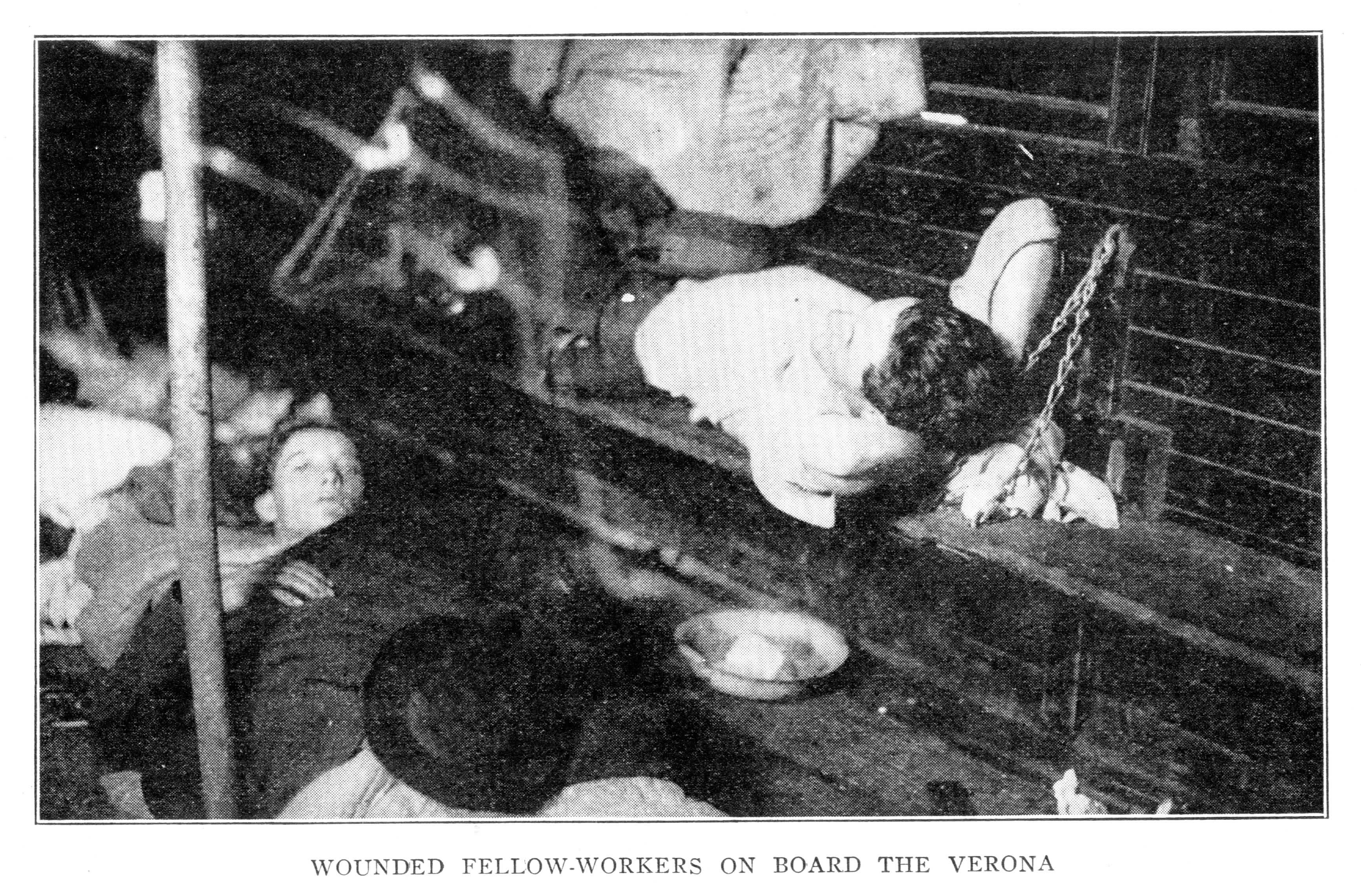
“Yes, we are. We are going to have a meeting here.” There was some argument back and forth Finally Sheriff McRae raised his hands, a gun in each, and he said: “You are not going to land here,” and as if the raising of his hand were a pre-arranged signal, a volley of sharp, snappy shots rang forth from those high powered rifles. At first the men on the boat thought it was a blank fire until they saw their comrades falling around them. There were over one thousand shots fired within five minutes. They went over the boat and thru the boat as if she were made of paper. There were dozens wounded. One man who is not an I.W.W., but a citizen of Everett, was wounded six times, one wound in the arm, which paralyzed it so it will be of no further use to him.
The Toll of the “Open Shop.”
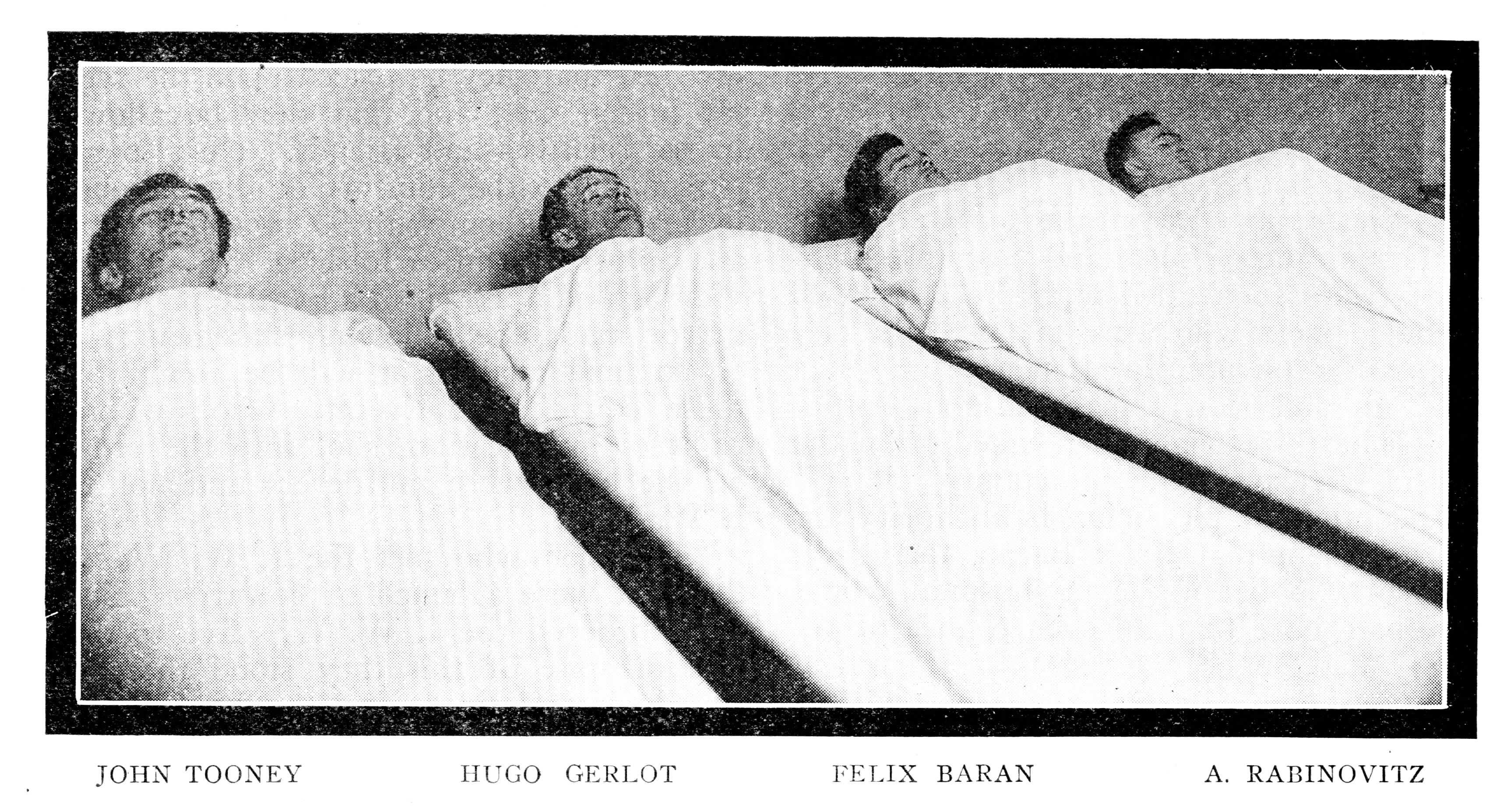
When this tragic climax occurred the captain drew the boat out and started back for Seattle with her cargo of two dead and many wounded. There were three dying. Two men had fallen overboard, if not more; the sheriff had been shot in the back of the leg. I don’t know how a brave soldier could be shot in that position. An officer of the Washington State National Guard, Curtis, and a deputy named Jefferson Beard, were also killed. There are conflicting reports as to how Curtis died. The way he was shot and the kind of bullet with which he was shot has led even the authorities to believe that he was shot by one of his own friends and the I.W.W. men are not charged with his murder. You can understand that it was quite possible when men were firing from inside of the pier, outside of the pier and directly opposite the pier, they were also firing at each other, and it is our opinion that they not only killed our fellow workers but they killed their own people as well.
When the boat drew out they had a long agonizing trip of two and a half hours, without any bandages or anything to relieve the suffering of the dying and the wounded. Two men died on the return trip. One was a young college boy from New York, Abe Rabinowitz. He came out here to study Western conditions. He was shot just behind the ear and as his life ebbed away he asked to be lifted up so that he could sing the words of the Marine Transport Workers song: “Hold the Fort,” and he died with those inspiring words on his lips.
When the boat approached Seattle they met the Calista and the captain of the Verona megaphoned to the captain of the Calista, “For God’s sakes, turn back or you will get killed in, Everett.” They turned back and together they approached Seattle. When the Calista docked, every I.W.W. man on her was arrested and charged with unlawful assembly and she had never even reached Everett!
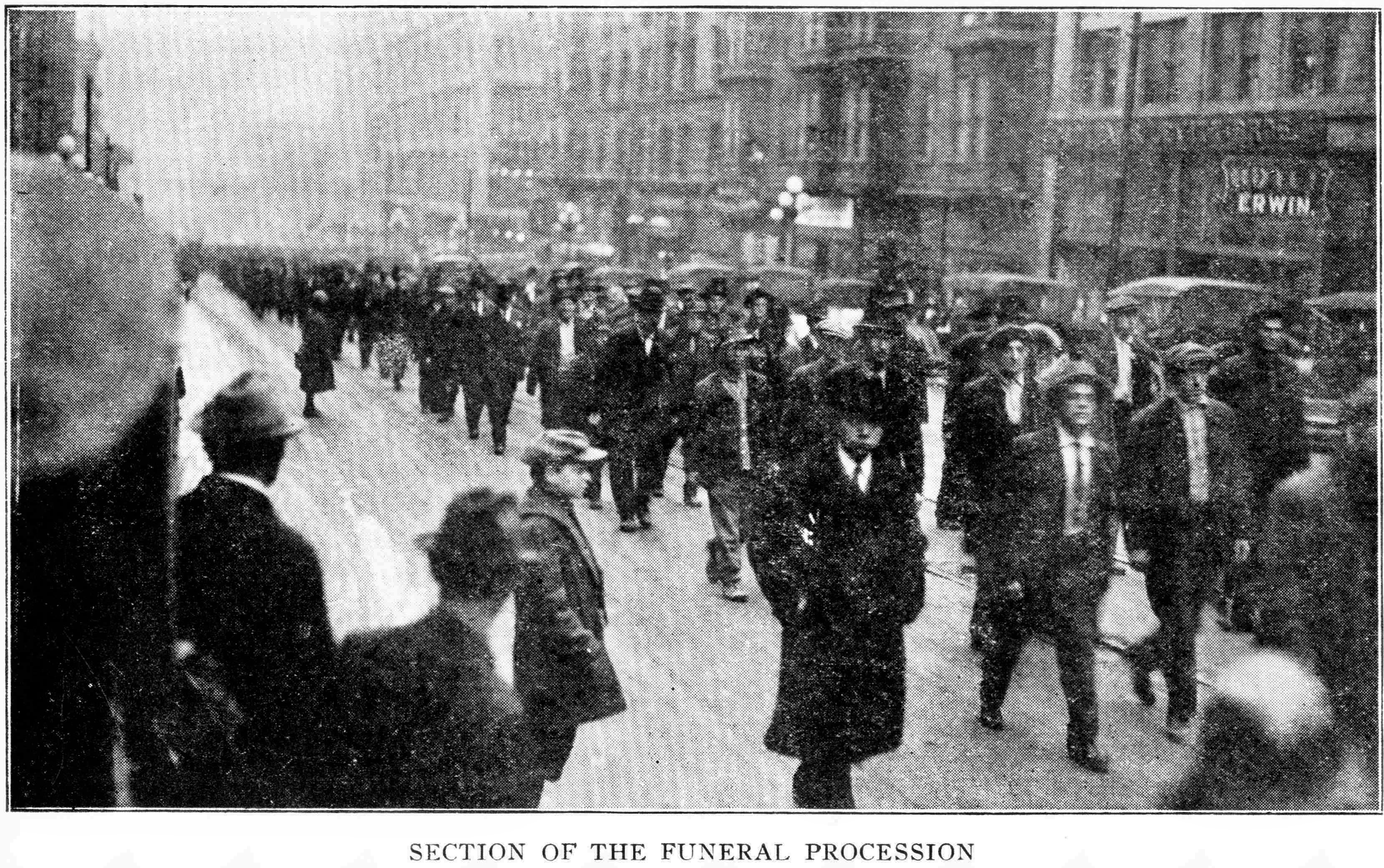
The wounded on the Verona were taken to the City Hospital, the dead to the morgue and the rest were put in jail. The dead were held in the morgue from Sunday afternoon until Thursday before their bodies were turned over to either their union or their families. The bodies were actually in a state of decomposition before they were given over for a decent burial.
The wounded were laid out on the operating tables in the city hospital. Some of them wounded many times, one man had nine, bullets in him, another seven bullets, each one of them had some bullets in their bodies; yet no anesthesia was used on those men. The bullets were taken from their quivering bodies without ceremony. Whether it was the rush or whether they did not care if I.W.W.’s lived or died, I do not know.
Constructive Murder.
The rest of the boys were taken to jail–and seventy-four are now charged with murder. I have been really sifting out all sorts of reasons, trying to discover just why these men are in jail. What have they done? They are charged with murder, but their real crime is that they did not get murdered, that they were lucky enough to escape. They who risked their lives are now accused by their would-be murderers, of murder. They are charged with what is called “constructive murder.” The technical charge is the death of Jefferson Beard, but “constructive murder” is to set in motion a train of circumstances that leads to a murder. That affects every one of you in labor activities. Suppose after this meeting two men go out and quarrel over the subject, it becomes vicious and one kills the other. Do you realize that under this legal technicality the speaker, the chairman and the audience, are chargeable, with “constructive murder” because they have set in motion a train of circumstances that led to a murder? You may believe this a mere theory, Let me tell you there are two members of the I.W.W. who are serving life imprisonment in the Folsom Penitentiary. They were working in a hop field in California when the bop pickers went out on strike. They held a meeting attempting to organize the workers. They were speaking from the dancing pavilion when the sheriff, prosecuting attorney and a mob of deputies drove up and fired. Between these two speakers and the deputies was an enormous crowd. Some of the strikers fired back. The speakers were arrested. They were not charged with killing any one but they were charged with setting in motion the circumstances that made the murder possible; holding a meeting,–that constituted the circumstances. They were found guilty and sentenced to life imprisonment and Ford and Suhr are in the Folsom Penitentiary today.
I was in the textile workers’ strike in Lawrence when a girl striker was shot. The two leaders of the strike, Ettor and Giovanetti, were arrested and it cost the labor movement sixty thousand dollars and the men ten months’ imprisonment, before they were freed of the charge. They were accused of the murder of that girl worker, because they set in motion “the circumstances”–the strike, which made her death possible.
Represent Our Lives and Liberties.
I am appealing for these men, not only for what they are, but for what they represent. They represent our lives and liberty. If they can be sent to the penitentiary for a living death, or if capital punishment is restored to this state, they can be sent to the gallows, it means that organized labor in the state of Washington must accept the law and order of Sheriff McRae. Sheriff McRae’s law and order puts a man’s life into the hands of cruel, petty officials. If you believe in the kind of justice he represents, you do not need any judge jury, or jail. All you need is a big, six-foot, broad-shouldered sheriff with a gang of plug-ugly deputies to back him up with high-powered rifles!
Represent Migratory Workers.
These seventy-four men represent the migratory worker, the element that while necessary, is ferociously exploited in this Western country. They are the men who fell the timber, they make the rivers navigable, they are the ones who build the mighty bridges and traverse the mountains with the railways. They are the ones who help harvest the food supply of the world. Upon their backs rest the pillars of our industrial world. They provide the raw material with which thousands of other workers are kept busy. They are driven from pillar to post; as the seasons come and go they must also come and go. They are homeless, no family ties, no opportunities for anything other than labor, yet they are young and strong, they want good homes, good food, and good clothing. They want the good things in life just as much as any other member of the human race and they are organizing in the I.W.W. today to get them. They are organizing to secure for themselves the joys that their labor has made possible and if the workers are not entitled to the best there is, I would like to know who is? If the people who have made the wonders of the world cannot enjoy them, who else should enjoy them? These migratory workers are organizing for better wages, for shorter hours, for all the good things of life, The prisoners in Everett are giving their liberty; they are crowded together, seventy-four of them, where there are accommodations for about twenty-five, eating small and poor rations. We can’t give back the breath of life to those whose lips are now stopped with dust, but we can help these seventy-four living. We can vindicate the dead by saving the living.
The Industrial Union Bulletin, and the Industrial Worker were newspapers published by the Industrial Workers of the World (IWW) from 1907 until 1913. First printed in Joliet, Illinois, IUB incorporated The Voice of Labor, the newspaper of the American Labor Union which had joined the IWW, and another IWW affiliate, International Metal Worker.The Trautmann-DeLeon faction issued its weekly from March 1907. Soon after, De Leon would be expelled and Trautmann would continue IUB until March 1909. It was edited by A. S. Edwards. 1909, production moved to Spokane, Washington and became The Industrial Worker, “the voice of revolutionary industrial unionism.”
PDF of full issue: http://iw.applefritter.com/Industrial%20Worker/1917/1917%201%2027%20IW.pdf
 Revolution's Newsstand