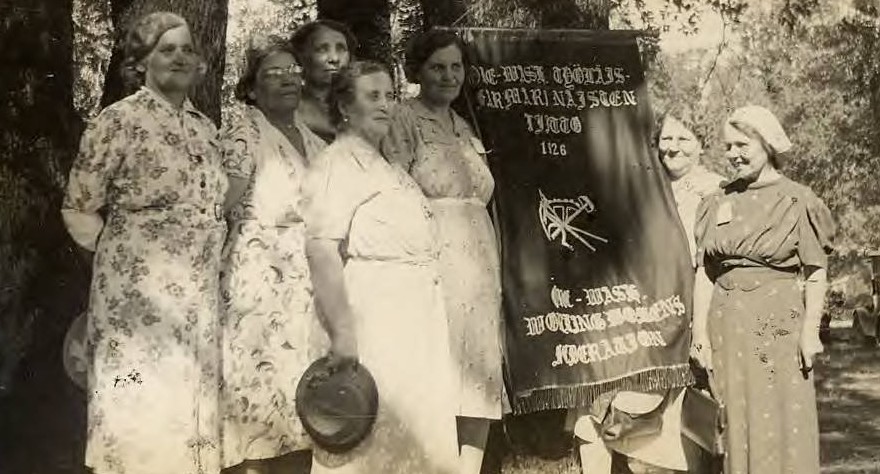
Finnish women were a bedrock female constituency of the Socialist, and later Communist, movements with the Finnish Language Federations of those parties having, by far, the largest percentage of women members of any bodies connected with movement.
‘Finnish Women On the Job’ by Evi Suvanto from Working Woman. Vol. 5 No. 5. May, 1934.
The Finnish Working Woman’s Club Organization has begun a very wide campaign against war and fascism all over the United States. This campaign includes preparation for the International Women’s Congress in Paris this summer. Every one of the 3,000 members in the 203 clubs is involved in this work.
We have pledged to raise the sum of $400 to finance the American delegation. This sum was divided among all the clubs.
In New York the clubs have entered into competition with the United Councils of Working Class Women. They have set themselves the following quotas, by which they will check their work: concentration on two factories-metal and textile, to build the struggle against war, by holding open air and shop gate meetings before these factories, selling anti-war literature, issuing special leaflets, etc. This work will be done jointly with the Women’s Councils. Also they will get 50 new members for their own organization, 25 new members for the American League Against War and Fascism. They will secure 50 new subscribers for Tyolaisnainen (Working Women) and 50 new subscribers for the “Working Woman” magazine. In addition these 14 clubs are active in the general campaign in New York for the preparation of the regional conference on July 7th, which will elect the delegates to Paris.
In Duluth, Minnesota, our clubs are participating actively in arranging the regional conference for the end of June. They are reaching the Finnish Women’s Cooperative Guilds, church societies, and farm women from Minnesota and Wisconsin. This conference will elect at least one of the American delegates to Paris. The leadership of the Guilds is categorically opposed to our united front proposals, but we hope that members will disregard their stand and will come along.
From the Astoria, Oregon, cannery workers and housewives comes a pledge to spread this movement among their fellow workers and neighboring farm women. Their campaign will include the getting of 25 new members into their organization, 25 new readers for their paper and 20 for the “Working Woman.” They have invited many other organizations in their territory to a conference where they will organize the work.
This work in which we are engaged amongst the Finnish working and farm women, is very important. We know that the Finnish bourgeoisie together with the American ruling class, is doing everything in their power to checkmate the rising radicalization wave amongst the Finnish workers in this country. They are building all kinds of bourgeois women’s clubs, societies, etc., in order to draw the working class women under their influence so that the bourgeoisie would be able to conduct its war preparations and further develop fascization.
We must be on guard and mobilize all the working-class women amongst the Finns in America to fight war and fascism. Through our organization and activity we are in the best position to do this work and carry the struggle against the offensive of the capitalists together with the entire working class of America, under the leadership of the Communist Party of the U.S.A.
The Working Woman, ‘A Paper for Working Women, Farm Women, and Working-Class Housewives,’ was first published monthly by the Communist Party USA Central Committee Women’s Department from 1929 to 1935, continuing until 1937. It was the first official English-language paper of a Socialist or Communist Party specifically for women (there had been many independent such papers). At first a newspaper and very much an exponent of ‘Third Period’ politics, it played particular attention to Black women, long invisible in the left press. In addition, the magazine covered home-life, women’s health and women’s history, trade union and unemployment struggles, Party activities, as well poems and short stories. The newspaper became a magazine in 1933, and in late 1935 it was folded into The Woman Today which sought to compete with bourgeois women’s magazines in the Popular Front era. The Woman today published until 1937. During its run editors included Isobel Walker Soule, Elinor Curtis, and Margaret Cowl among others.
PDF of full issue: https://www.marxists.org/history/usa/pubs/wt/v5n05-may-1934-partial-WW-possibly-R7524-R1-neg.pdf
 Revolution's Newsstand