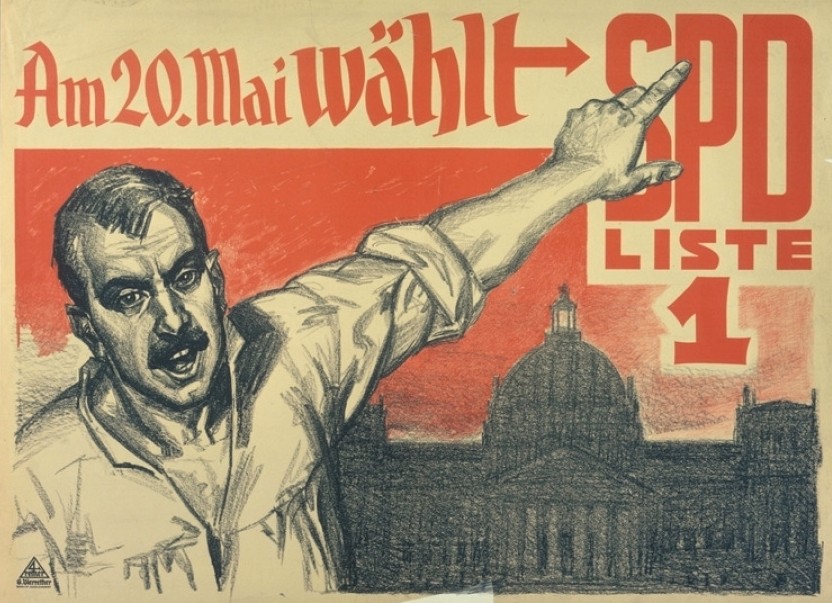
A major article from Roy analyzing the betrayal that was the Socialist-led ‘Grand Coalition’ government formed after the 1928 German elections. That year saw a big swing to the left with the Communists and Socialists, by far the largest party in the Riechstag, securing over 40% of the vote, while the fascists suffered a disaster, with the Nazis falling to 2.6%. Instead of a Left government, the SPD sought to block the rise of the Communists and opted to formed a ‘Grand Coalition’ with the Centre Party and Liberals, dashing the hopes of the left-moving workers. Collapsing in eighteen months, the 1930 election saw a massively emboldened Nazi Party win 20%; In less than five years the Nazis would take absolute power.
‘The Crisis of German Social Democracy’ by M.N. Roy from The Daily Worker. Vol. 5 Nos. 317, 322, 332. January 8, 14, 25, 1929.
The German social democratic leaders created the theory of coalition, as against the Marxian view that the road to Socialism lies through the revolutionary overthrow of the capitalist state and dictatorship of the proletariat. They thoroughly negatived the Marxian conception of the state as the organ of class dictatorship.
They, led by Kautsky, maintained that the characteristic feature of the last stages of the class struggle is not armed conflict between the bourgeoisie and the proletariat, ending in the suppression of the former by the latter, but a period of coalition governments, during which period the political power would gradually and peacefully pass over from the bourgeoisie to the working class through the operation of parliamentary democracy.
Correctness of Marxian Theory.
Even before the Russian Revolution, Lenin theoretically combatted and exposed the counter-revolutionary nature of the Kautskyan conception of the state. The Russian Revolution and the general unmasking of democracy after the war proved the correctness of the Marxian theory of the state. Nevertheless, the social democratic leaders still held the masses bound by the spell of parliamentary democracy, and promised to guide them to Socialism through coalition.
Germany is the home of the social democracy theory of coalition, and it is in Germany that the theory has been put to test only to be exposed for what it really is–counter-revolutionary. Coalition with the bourgeoisie has been practiced by the social democratic leaders in many countries, in different forms. Even in the opening years of the present century a Millerand in France and a John Burns in Britain sat in capitalist cabinets.
Coalition a General Policy.
But it was not till parliamentary democracy completely broke down as result of the world war, that coalition with the bourgeoisie became the general social democratic policy. Even then, there was common form of coalition. For example, in Britain it takes a very different form which should be separately treated. In Germany, however, the coalition has been and is being practised in the classical form, so to say. And the policy of coalition has not brought the working class nearer to Socialism; but it has at last landed the German socialist democratic party in a severe crisis, the result of which will be the liberation of the masses from the influence of reformism. And the crisis in the German social democratic party represents the crisis of social democracy as a whole throughout the world.
Latest Coalition Cabinet.
After the general election May 20, a coalition government was formed with a social democratic “head of the government” frankly accepted the dictation of the bourgeoisie at least on three occasions whenever vital issues of class interests were involved.
Firstly, under the pressure of the big bourgeoisie (to have the party representing the heavy industry enter the coalition) the social democratic ministers were freed from all responsibility to their party; secondly, the social democratic ministers supported the construction of the new German navy cynically violating their principal election pledge; and thirdly, they co-operated with the industrial magnates in the latter’s attack upon the metal workers of the Ruhr.
In all these three cases, together with many more of comparatively minor importance, the erroneousness of the social democratic conception of the state was exposed. It became clear that, under parliamentary democracy, the state remains an organ of bourgeois dictatorship, notwithstanding the participation of a working class party in the administration of its affairs.
Betray Workers.
It also became clear that social democratic ministers of a parliamentary democratic state cannot in the least promote or defend the interests of the working class (even if they sincerely want to do so); on the contrary, they can but aid the bourgeoisie to stabilize their power. Coalition is not the way to Socialism; it is a weapon of the fight against Socialism.
The eyes of the social democratic workers, not only in Germany, but throughout the world, who honestly believed power by exploiting the possibilities of parliamentary democracy, should be opened by the experience gained in Germany during the last six months.
Ruhr Sell-Out.
Let alone the vital question of political power. Even the immediate economic interests of the working class cannot be guaranteed under a coalition government. When, three months ago, the rank and file of the party demanded that the social democratic ministers should withdraw from the coalition government, were they obliged to approve of the construction of battleships, the ministers replied that it would be impractical to do so, for by the control of the state-apparatus it was possible to make valuable economic and social acquisitions for the working class. Presently, about a quarter of a million metal workers were locked out in the Ruhr. The employers demonstratively refused to abide by the verdict of the social democratic minister of Labor about a small increase of, wages in keeping with the cost of living.
The coalition was in a crisis which was overcome by the readiness of the social democratic ministers to act as the administrators of the capitalist state, against the workers, in support of the employers. As long as the bourgeoisie own and control the means of production in a given country, the state is the organ of their power, and must do their bidding. As the minister of this state, the social democrat must take his orders from the bourgeoisie and thus betray the workers. And the bourgeoisie cannot be deprived of their ownership and control of the means of production so long as they remain in possession of the state-power.
Open Counter-Revolution.
The super-class theory of state, and the policy of coalition, however, are not error on the part of the social democratic leaders. If these were honestly mistaken, experience would have taught them before long, for they are not stupid. They purposely elaborated the theory and formulated the policy with the object of diverting the proletariat from the path of revolution.
As conscious and consistent counter revolutionaries, the social democratic leaders do not hesitate, when necessary, as in Germany today, to act openly in defence of the capitalist state. And when they finally are obliged to do so, the eyes of their followers are opened. The revolt of these against the treacherous leaders indicates the crisis of social democracy. Failing to deceive the masses by reformist illusions, the social democratic leaders join hands with the bourgeoisie in stemming the rising tide of revolution by wielding the state-power as members of coalition governments.
The action of the German social democratic leaders during the last six months clearly shows that their policy of coalition is dictated exclusively by the desire to hinder the revolution. One even need not be a Marxist to have this appreciation of the social democratic leaders. The bourgeoisie also find in the social democratic leaders enemies of revolution. For example, dealing with the resolution of the social democratic minister of the interior, Severing, to use summary power for liquidating the struggle in the Ruhr on the terms of the employers, the famous German liberal journalist, George Bernhard wrote: “a reasonable exercise of the state-power always aids evolution, which hinders revolution.”
Swing to Left.
Let us chronicle the facts characterizing the application of the policy of coalition. The last general elections held in May returned the social democrats as the single largest group in the Reichstag as well as in the Prussian Landtag. The balance of power inside the national, Prussian and several other state parliaments distinctly inclined to the reverse. The nationalist predominance was replaced by a swing to the left.
Out of the 25 millions (in round numbers) votes cast in the Reichstag election, 12.5 millions were given to the two working class (social democratic and Communist) parties. The remainder was distributed among the six leading bourgeois parties. While all the bourgeois parties without exception lost, the votes polled by the social democratic and Communist Parties were nearly 2 million more than in the previous election in 1924. The German nationalist party (monarchist, represating mainly reactionary landed interests) lost 30 seats.
The people’s party (predominantly monarchist, representing heavy industry) lost 12 seats. The centre party (catholic, representing industry) lost 7 seats. The democratic party (republican, representing liberal intelligentsia and the urban petty bourgeoisie) lost 7 seats. The fascists were practically swept off the board. On the other hand, the social democratic party gained 49 seats more; and the Communist Party 10.
In view of the fact that the popular verdict given in the election was decidedly anti-monarchist (the monarchist nationalist party lost nearly two million votes and 30 seats, the fascists practically disappeared from the parliament) the Weimar coalition should be the constitutional government, if a coalition it must be. But the republican scruples of the social democratic leaders are not so exacting in their relation with the bourgeoisie, as they are when a revolutionary situation has to be met from the working class point of view.
To save the capitalist state, the social democratic leaders not only betrayed the working class voters; they even violated their cherished goddess of republicanism. At the behest of the monarchist president of the republic, Hindenburg, the social democratic leaders agreed to enter into coalition with the quasi monarchist peoples’ party.
Big Industry Dominant.
The peoples’ party, in spite of its defeat at the polls, dominates the political life of the country, not by virtue of its lingering homage to the decayed and discredited monarchy, but because it is the party of heavy industry. Through the policy of Gustav Stresemann, the leader of the peoples’ party, Germany has regained her position inside the constellation of imperialist states (the League of Nations). Stresemann is the father and promoter of the policy of “west orientation” in German foreign relations, as against the former tendency of a rapprochement with the U.S.S.R. to resist the domination of Entente imperialism.
In view of this record of his, in addition to the fact that his Party represents the heavy industries closely connected with international trust and finance, Stresemann should conduct the foreign policy of any German government which wanted to defend the present order of things. And Stresemann would not enter a government except to dominate it in the interests of heavy industry and international trust-capital. So, the composition of the coalition was determined neither by the social democratic chancellor, nor even by the outcome of the election. It was dictated by the big bourgeoisie, through the monarchist president and the convenience of international finance.
Complete Surrender on Program. Next, the social democratic ministers surrendered themselves completely to the bourgeoisie on the question of the program of the government. Indeed, the social democratic minister had little to say about it, unless they were prepared to go out of the coalition, and travel the road of revolution. By their firm determination to shun that road themselves, and to mislead the working class away from it, the social democratic leaders had tacitly agreed that the program of the coalition government should be the promotion of the interests of the new German imperialism.
Masters of the situation, Stresemann and his party of heavy industry took the offensive. They refused to enter the coalition, unless the social democrats agreed to the subversion of the republican government of Prussia. These gave in, agreeing in principle to the recognition of the Prussian government from a Weimar coalition into a grand coalition.
Act as “Individual” Socialists.
To free themselves from the responsibility to the party, the social democratic ministers accepted the suggestion of Stresemann that the members of the government should act not as representatives of their respective parties, but as individuals, pending the settlement of controversial questions as regards the composition and program of the coalition. The result of this arrangement was presently felt, particularly in relation to the construction of new battleships. The representative of the bourgeois parties in the coalition, of course, persistently defended the interests of their class; whereas on every controversial issue the social democratic ministers availed themselves of the freedom of responsibility to the party to betray the class whom they pretended to represent in the government.
Betray 9,000,000 Workers.
To cover up their surrender on essential questions concerning the policy of the government, the social democratic ministers desired to have four points of minor importance settled. They had to do something about their election pledges. The points they raised were about (1) amnesty for political prisoners; (2) Legislation making the day of the adoption of the Weimar constitution a national holiday; (3) Educational reform; and (4) Construction of battleships. None of these are remotely connected with the burning economic demands of the working class, not to mention the realization of socialism. Nevertheless, even these points were not conceded by the bourgeois parties. Except partial amnesty, no agreement could be reached on the other items.
In deference to the sentiments of the not negligible monarchist elements among its supporters, the peoples’ party, and even the center party, would not commit themselves as regards legislation about a republican national holiday. Still, the social democratic leaders did not hesitate to betray nine million working class voters for the bourgeois republic! The catholic center party was opposed to educational reform freeing the schools from the domination of the church.
Cruiser-Building Crisis.
But the first shock to the coalition, throwing the social democratic party in the throes of an unprecedented crisis, resulted from the controversy on the construction of new battleships. The previous government, in spite of the opposition of the social democrats, had decided to build four armored cruisers replacing the old ones left to Germany by the Versailles Treaty.
On the insistence of the bourgeois parties the settlement of the controversy over the construction of the battleships, together with all the other controversial questions, major or minor, were postponed until the grand coalition would be definitely constituted in the autumn after the republican government of Prussia had been adulterated with monarchist leven. So, the social democrats entered the coalition unconditionally, on the terms dictated by the bourgeoisie, even by the monarchists.
Permit Warship Building.
Presently, the bourgeois minister of defense, a general of the old army, demanded the sanction of the government for the actual construction of the battleships, in spite of the fact that the settlement of this question had been postponed on the insistence of the bourgeois parties. The minister of defense made his demand on the ground that the decision had been made by the previous parliament, and the financial provision in the previous year’s budget. The social democratic ministers were placed in a very awkward position. The previous parliament had decided to construct the battleships against their opposition. Then, to oppose the construction of new battleships was one of the main slogans in the election. Besides, nobody with the slightest regard for the interests of the German working class can approve of the expenditure of money for the construction of new battleships, when the money could be employed to reduce the heavy tax upon wages. Nevertheless, the social democratic ministers agreed to the construction of the cruisers, cynically violating their election pledges, the expressed anti-militarist sentiment of the working class and their own profession of disarmament and pacifism. They could not do otherwise, unless they were prepared to abandon the policy of coalition, and thereby cease to be social democrats. Their refusal to agree should be followed by their resignation, which would mean a return to the political crisis to solve which the coalition was formed.
Cynical Deception.
The whole social democratic party and the masses were enraged by the action of the social democratic ministers. The demagogic talents of the leaders, the maneuvering ability of the party bureaucrats and power of persuasion of all, had to be taxed to the extreme to prevent that the revolt of the masses went beyond-control. In opposition to the Communist demand for a referendum, the social democratic ministers declared their intention to ask the Reichstag to prohibit the construction of all battleships.
By his maneuver they deceived the social democratic workers who were persuaded not to support the Communist demand for referendum. Their refusal to submit the question to a referendum revealed the hypocritic and demagogic nature of the dramatic move of the social democratic leaders bringing the following motion before the Reichstag: “The Reichstag prohibits the construction of all battleships.” It was a foregone conclusion that the motion would be defeated in the Reichstag, as except the social democrats, Communists and perhaps a few democrats, all would vote against it. And precisely for this reason–the surety of its defeat–did the social democratic leaders table the motion. If they really meant to have the construction of battleships prohibited constitutionally, they would have supported the Communist demand for referendum.
The result of the election revealed that the roots of parliamentary democracy were decayed. The composition of the new Reichstag was such as made the formation of a majority government impossible without violating the verdict of the electorate. In the election, the voting had been clearly on class lines. In casting their votes by millions for the social democratic and Communist candidates, the working- class, even a certain section of the petty bourgeoisie, had expressed their will to fight the policies of capitalist stabilization. They wanted a government which would protect and promote the interests of the working class.
This was a repudiation of the policy of coalition; for those wishing to defend working class interests could not enter into coalition with the advocates of capitalist rationalization which had been realized and was to be further carried on, at the expense of the working class. The lessons of the election were: first, the rejection of the policy of coalition by the working class, and second, the inapplicability of parliamentary democracy in a situation characterized by sharpening class struggle.
Insurmountable Crisis.
After the election it became evident that the capitalist state was far from being stabilized. On the contrary, capitalist stabilization, effected through rationalization, had further accentuated the class conflict–which contributed to the decay of the bourgeois democratic state. Judged by the composition. of the newly-elected Reichstag, the parliamentary democratic state is no more stable than it was in the revolutionary days of 1923. Indeed, it is less so, in spite of superficial appearances. Today, without the social democrats, there cannot be a government having a majority in the Reichstag.
This political crisis would be insurmountable within the limits of parliamentary democracy, should the social democrats act according to the will of their electors. The result of the election placed the social democratic party before two alternatives, namely, (1) either to make parliamentary government impossible, thereby beginning the struggle for the revolutionary overthrow of the capitalist state, or (2) to enter into coalition with the bourgeoisie to help the stabilization of the capitalist state.
Saviors of Capitalist State.
The social democratic leaders, however, had their course previously decided. They are hostile to revolution, and, therefore, were only too eager to assume the responsibility of forming a coalition government which would steer the ship of the capitalist republic out of the troubled waters of a political crisis fraught with revolutionary possibilities. What else could they do? The other course would be to join forces with the Communists in a determined opposition to the possible conflict of bourgeois block with a very precarious majority, causing a permanent parliamentary crisis. The inevitable result would be dissolution of the Reichstag and new elections before long.
In the new election taking place under such circumstances, the social democrats and communists would be sure to be returned in still greater number. With a possible working class majority in the Reichstag, the social democratic leaders would have no more excuse for delaying the enforcement of the Socialist program. The illusions of parliamentary democracy, with which the social democratic theorists have misled and betrayed the masses for years, would, in that case, be rudely shaken.
It would become clear that there is no gradual and peaceful way between bourgeois democracy and Socialism. The two are mutually exclusive. The bourgeoisie would begin the civil war. They would not have their property, power and privileges taken away by acts of parliament. As intelligent people, the social democratic theorists anticipated long ago such a sharpening of the situation. And, in order to hinder the development of the class struggle to such a pitch, they formulated the policy of coalition.
Afraid of Revolution.
The counter-revolutionary purpose of coalition was still more revealed in the process of its formation. The theory that coalition government can serve as the instrument for the realization of Socialism makes one expect that the social-democrats, while entering them, would make conditions guaranteeing the promotion of working class interests. But the social democrats entered the present coalition government (as all of them do everywhere) on the terms dictated by the bourgeois parties. The latest instance in Germany is the worst, for all the bourgeois parties had been heavily beaten at the polls. Fear of revolution, anxiety to save the capitalist republic, obliged the social-democratic leaders to forego their electoral triumph, to betray the nine million voters.
Not Even Republicans.
The first stage of the negotiation for the formation of the coalition cabinet was concerned with its composition. Should it be a Weimar coalition or a grand coalition? The former is a cabinet based upon the parties that unconditionally accept the republican constitution of Weimar. The latter includes the people’s party, which has never adhered fully to republican principles.
Why were the social democratic leaders opposed to submit the question to referendum? For the same reason of their fear for the sharpening of class struggle into an open revolutionary civil war. To endorse the construction of the battleships violating the expressed will of the masses, to refuse to submit the question to referendum while making a dramatic gesture in opposition to it, to mislead, deceive and betray the masses by all means–all these are in the logic of the policy of coalition.
In the last referendum forced by the Communist Party on the question of the expropriation of the estates of the ex-princes, over fourteen million votes were cast in favor of expropriation. In view of the fact that in the general election over 13 million votes had been cast for the social democratic and Communist candidates, it could be reasonably expected that the referendum on the question of battleships would secure 18 million votes–the required two-thirds of the entire electorate.
This calculation could be made on the certainty that considerable petty bourgeois pacifists would also vote for the referendum. The social democratic leader opposed the referendum as impractical; but they were against it really because of the almost certainty of its success. The casting of the required number of votes against the construction of battleships will again expose the instability of the bourgeois state. In that case, not only the social democratic ministers, but the entire government must resign or the constitution of parliamentary democracy should be scrapped. In either eventuality the political situation would be acute. A new general election under such an atmosphere of class struggle would return more social democratic and Communist candidates, thus rendering the formation of a parliamentary government still more impossible. Bourgeois democracy would stand naked in its real nature–capitalist dictatorship–as in the revolutionary year of 1923.
Fear C.P. More Than Bourgeoisie.
The only thing for the working class to do in that situation would be to pay the bourgeoisie in their own coin-to replace unmasked parliamentary democracy by the dictatorship of the proletariat. If the situation were allowed to develop in such a revolutionary direction, if the sharpening of the class struggle were accelerated by bold tactics, then the Communist Party, as the most active and resolute vanguard of the proletariat, would win the confidence of the masses, and in the decisive moment lead them in the open attack upon the capitalist state, in spite of the social democratic leaders.
To avoid such a development of the situation was the burden of social democratic policy at that juncture. Some of them, in moments of carelessness, indeed, said they were opposed to the construction of battleships, but they did not want to play into the hands of the Communists. And in order not to play into the hands of the Communists, that is, in order not to act according to the logic of class struggle, they supported every demand of the bourgeoisie.
Reichstag Comedy.
The debate in the Reichstag on the social democratic motion about the prohibition of the construction of battleships, was a comedy. The social democratic party recommended the prohibition of the construction of battleships; but its representatives on the coalition government endorsed the construction! If the social democratic motion were anything but a demagogic trick to deceive the masses, the social democratic ministers should have logically resigned from the government, or been expelled from the party.
Just when the social democratic leaders were staging the parliamentary comedy to whitewash their shameless betrayal of the working class, the advocates of neo-militarism added a touch of piquancy to the situation. The minister of defense, openly supported by Hindenburg, challenged the social democratic motion with an insolent offensive. He threatened to resign, if the money required for the construction of the projected battleships were not sanctioned all at once. On the evening of the debate in the Reichstag, Hindenburg called the social democratic chancellor, Herman Mueller, to inform him that he “would not tolerate the Reichstag to interfere in his first effort to rebuild the German navy.”
State Above Class.
The Reichstag rejected the social democratic motion; and the social democratic finance minister, Hilferding, readily footed the bills of General Groener. That is how coalition works. The social democratic ministers voted formally for the motion of their party; but remained in the coalition government after the motion was rejected. The country above party-state above class,–this is the essence of the theory and practice of coalition.
Hardly had the social democratic party and its policy of coalition re- covered from the shock of the cruiser controversy than they were entangled in a new crisis more deep- seated than the former. The iron and steel magnates of the Ruhr refused to abide by the finding of the social democratic minister of labor regarding wages, and locked out 200,000 workers.
Ruhr Betrayal.
Their action was an open challenge to the authority of the state. The function of the state is to defend the interest of the ruling class. If it attempts to function otherwise, the ruling class would not tolerate its interference. This was made clear by the Ruhr steel barons. It became evident that as members of a coalition government the social democrats could not even defend the most immediate economic interests of the working class. Even that is closely connected with the question of power. During the cruiser controversy, the social democratic leaders had asked their followers not to press the demand for the resignation of the social democratic ministers, for by the control of the state apparatus much economic and social gains could be made for the working class. The Ruhr lock-out and its subsequent development proved that as members of a coalition government the social democratic leaders do not acquire the least power to defend or promote the interests of the working class. On the contrary, they act as the administrators of the bourgeois state at the orders of the bourgeoisie, to protect and advance capitalist interests.
Socialists Took Orders.
The lock-out continued for five weeks. The coalition government was in a ridiculous position. For practical purposes, it did not exist. The representatives of the bourgeoisie on the government dictated, and the social democrats acted on their orders. It was not a coalition, but a purely bourgeois government. The bankruptcy of the theory of coalition could no longer be concealed. A government under parliamentary democracy can never be anything but an instrument of capitalist dictation. Representatives of a working class party can enter it only to serve the interests of the bourgeoisie and betray the workers.
Finally, the peoples’ party, representing the Ruhr magnates, threatened to break up the coalition, unless the social democrats would liquidate the resistance of the workers. The social democrats were in a desperate condition. Not only their policy of coalition, but the very political existence of their party was at stake. The debacle of their theory and practice of coalition would liberate the masses from their influence. The rank and file of the social democratic party would go over to the Communist Party en masse.
Bulwark Against Communism.
To save the coalition government was, therefore, the main concern of the social democratic leaders. When the Ruhr conflict had brought the coalition on the verge of a break-up, Stresemann, speaking in the Reichstag, said that coalition was the bulwark against Communism. In other words, in the period of sharpening class struggle, coalition of the social democrats with the bourgeoisie is a useful weapon against the working class striving towards Socialism. In the critical moment the most authoritative spokesman of the German bourgeoisie reminded the social democratic leaders of this quintessence of their theory of coalition.
Severing Acceptable.
After a conference with the social democratic chancellor, Herman Mueller, the employers declared their readiness to accept the arbitration of the social democratic minister of the interior, Severing. Obviously, they made this declaration upon Severing’s having undertaken to arbitrate on their terms. Severing’s record in the Ruhr struggle of 1921 is alone sufficient to inspire the confidence of the capitalists.
At that time, Severing, as the Prussian minister of the interior, cooperated with counter-revolutionary militarists in suppressing the workers. He was so ruthless against the workers that the monarchist leader Kapp desired to have him as a member of his counter-revolutionary cabinet.
In the revolutionary year of 1923, Severing also played a role which made him a favorite of the bourgeoisie. When the record of Severing is known, it can be understood how the employers accepted the arbitration of one social democratic minister after they had initiated the struggle by refusing to abide by the finding of another.
The latest decision of theirs is not a surrender, as the social democratic coalitionists would have the workers believe. On the contrary, it is a complete victory on their part. They have obliged the social democratic ministers to enforce upon the workers their (employers’) conditions. It is a public secret now that the general line of Severing arbitration will be the acceptance by the employers of the wage award of the social democratic minister of labor in return for the prolongation of working hours and worsening of labor conditions.
Bourgeoisie Need Coalition Now.
As the coalition is also useful for the bourgeoisie (Communism is no less a menace for them than the social democrats), they do not want to make the position altogether impossible for the social democratic ministers. These must be helped to save their faces before the workers and maintain their influence upon the masses. Otherwise, they would cease to be worthy of being ministers of the capitalist state. The last arrangement is made with this purpose.
But even the members of the social democratic party now see through the game. More than 50 per cent of the locked-out workers are under Communist leadership. It is certain that they would not accept the arbitration of Severing without the greatest possible resistance. Even the social democratic trade unions in the beginning flatly refused to bind themselves beforehand to accept the finding of their leader. Through the machinery of trade union bureaucracy the opposition was formally overcome; but the spirit of the masses is not changed by a resolution of the bureaucracy.
Crisis in Socialist Party.
The crisis in the social democratic party, the difficulty of the task undertaken by the social democratic ministers, are recognized even by the bourgeoisie. Commenting upon the arbitration arrangement, the bourgeois liberal, George Bernhard, writes: “It is not at all easy for Severing to intervene personally in the Ruhr affair. He will lose his popularity among the workers, and perhaps, in consequence of that, have difficulties inside his own party. Nevertheless he has decided to travel the difficult road, for he knows that in the interests of the state it is necessary.”
There cannot be any more damaging criticism of the theory and practice of coalition than this complimentary remark of a bourgeois journalist. As a minister of the bourgeois state, the social democrat must act against the interest of the working class. Events of the last six months of coalition government have been slowly but steadily driving this fact home among the masses that still follow the social democratic party. The result is a crisis of social democracy which becomes deeper and sharper every day, by every act of treachery of the leaders.
C.P. Will Lead Final Battles.
The exposure of the real meaning of the policy of coalition will free the masses from the illusion of parliamentary democracy. With this illusion will also go the social democratic cant of gradual and peaceful advance towards Socialism. The correctness of the Marxian theory of state, revolution and dictatorship will be vindicated before the masses, who will then fight the last battles for Socialism under their only leader, the Communist Party.
The Daily Worker began in 1924 and was published in New York City by the Communist Party US and its predecessor organizations. Among the most long-lasting and important left publications in US history, it had a circulation of 35,000 at its peak. The Daily Worker came from The Ohio Socialist, published by the Left Wing-dominated Socialist Party of Ohio in Cleveland from 1917 to November 1919, when it became became The Toiler, paper of the Communist Labor Party. In December 1921 the above-ground Workers Party of America merged the Toiler with the paper Workers Council to found The Worker, which became The Daily Worker beginning January 13, 1924.
PDF of full issue: https://www.marxists.org/history/usa/pubs/dailyworker/1929/1929-ny/v05-n317-NY-jan-08-1929-DW-LOC.pdf
PDF of full issue 2: https://www.marxists.org/history/usa/pubs/dailyworker/1929/1929-ny/v05-n322-NY-jan-14-1929-DW-LOC.pdf
PDF of full issue 3: https://www.marxists.org/history/usa/pubs/dailyworker/1929/1929-ny/v05-n332-NY-jan-25-1929-DW-LOC.pdf
 Revolution's Newsstand