As in the U.S., the years before the First World War saw a new industrial unionism and waves of intense class struggle in Britain. One of the sharpest fights was the 1911 Liverpool general transport strike led by Tom Mann. Rose Strunsky writes from the front line.
‘The Strike of the British Transport Workers’ by Rose Strunsky from International Socialist Review. Vol. 12 No. 4. October, 1911.
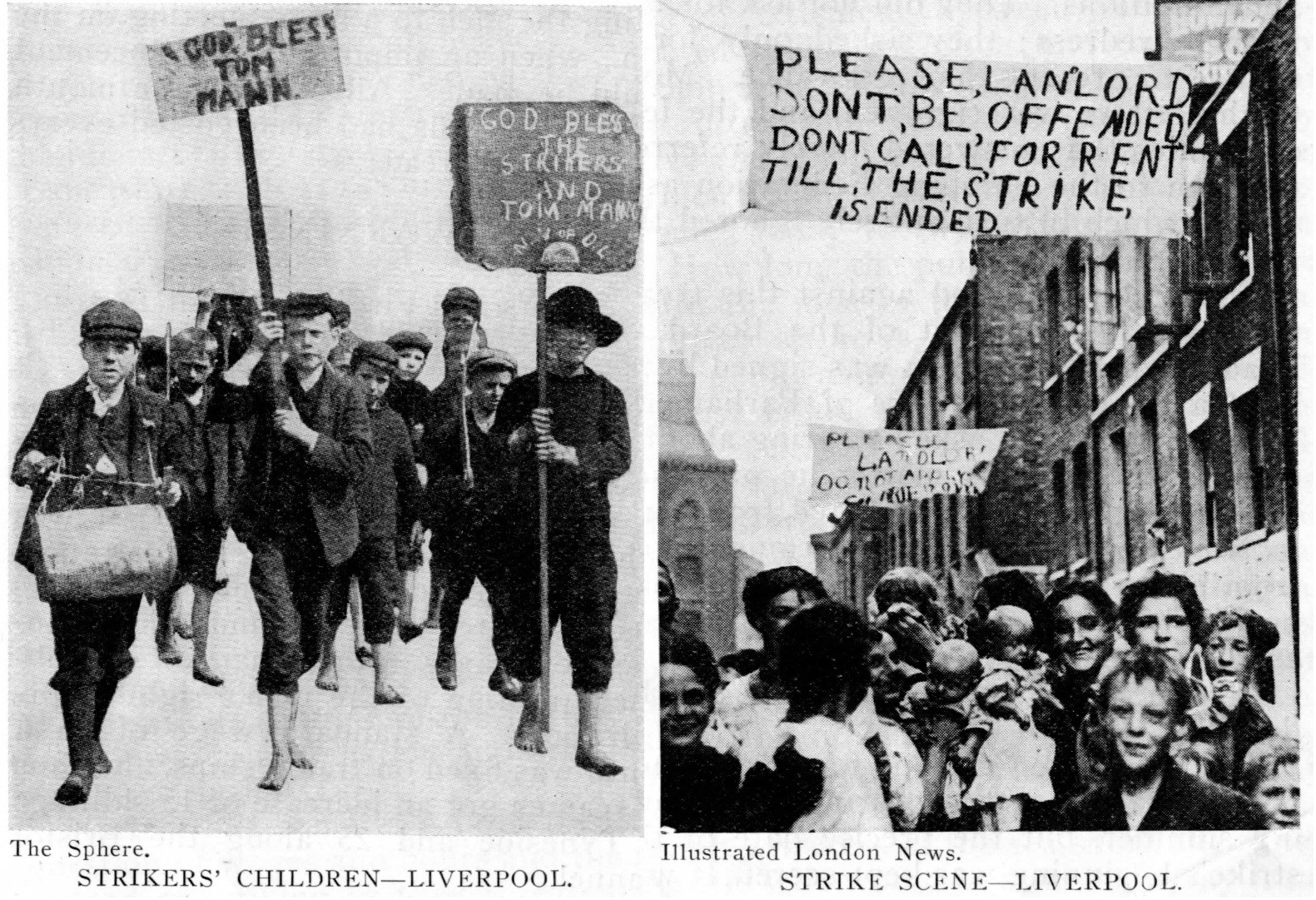
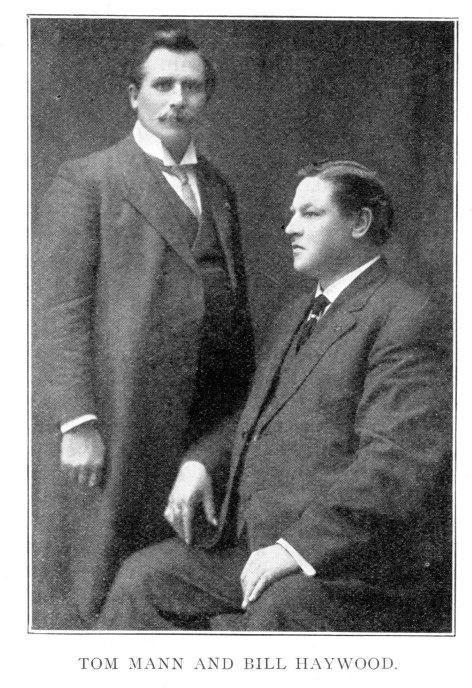
A NATIONAL strike, of British Railway workers! This is the ultimatum of the council of railway deputies now sitting in London. Translated it means a general strike of British transport workers. In this there is a denouement of far greater importance than the demands and results of the struggle itself. As we walk along the streets of Liverpool, there is a new word on the lips of the workers; “Industrial Solidarity.” Tom Mann the leader of the strike in letters to the press, in speeches, in committees or in mass meetings, begins and ends each message with the words “Industrial Solidarity.”
Its meaning is significant. It is a recognition of the interdependence of every section of industry. It is the growth of industrial concentration, on the one side into trusts and corporations, on the other into industrial unions as opposed to the old sectional trade and craft union. Because of the strength and size of the two opposing forces and the vast battlefield it covers, the struggle takes on gigantic proportions.
The very beginning of the transport strike proves the anti-sectionalism of the fight. It was planned exactly two years ago on August 13 in a saloon on Worth street in New York City. The reason for this is clear. In New York one can get of an evening about 3,000 British seamen from the Anchor Line, the American, the White Star, the Atlantic Transport and the Cunard lines. A meeting was organized by the general treasurer of the British Seamen s Union, Mr. T. Chambers, with the men from the Lusitania. It was not to organize the men of the Cunard Line against their company that this meeting was called, but to organize all the British seamen against all the British companies. The companies were united in a federation; there was solidarity there to ignore any request made by the men; the men therefore felt the need of solidarity upon their side. The union thus formed soon outgrew its small quarters and used the rooms of the American Seamen’s Friends Society and the Catholic Seamens’ Mission to hold their meeting.
A year later the organization made its first move. In July, 1910, they sent letters to the shipowners individually and as an association asking them to consider certain grievances concerning hours, pay and conditions. They did not ask for immediate redress; they asked only for a chance to present their grievance. Most of the letters were ignored, and the few companies that answered merely referred the men to the Shipping Federation as a whole, which in turn entirely ignored the request.
The union appealed against this treatment to the president of the Board of Trade and their petition was signed by at least a hundred members of Parliament. The president was asked to bring about a conference, and this matter he promised to attend to. The men waited from July to November. Finally there came a note from him, saying that the Federation had positively declined to discuss the subject, and he ended the note by declaring:
“I fear that nothing further can be done.”
The union then decided to call the men out on strike sometime during the following summer, but the precise date of the strike’s beginning was kept secret. It was fixed for June 14th, and three days before handbills were distributed in every port, calling the men to a mass meeting on the 14th, when an important announcement would be made. All through the month of May, placards had been posted everywhere, which read:
WARNING!
Sailors and Firemen—Wait For The Signal!
On the 14th of June the meetings were held and the strike declared. The big passenger lines immediately recognized the unions, and their boats ran; it was with the tramp ship owners that most friction occurred. The unions had decided to center their demands on the increase of wages rather than on the abstract question of the men’s right to organization. A standard wage oi is a month was fixed on tramp ships and thus the seamen got an increase of 15 shillings on Tyneside and 25 along the Bristol Channel.
In Liverpool there was an increase oi 10 shillings a month. This gives the men from £4 to £6.10 a month, the latter being the pay of the firemen on the express mail boats.
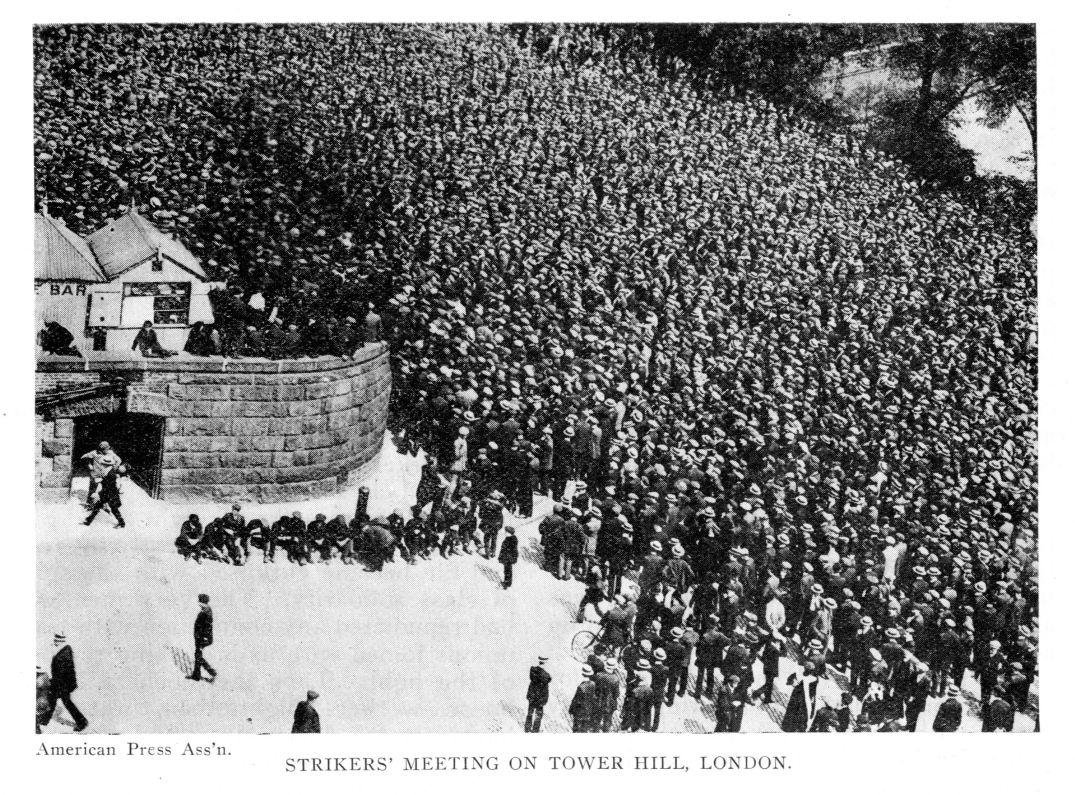
It is not difficult to see how, out oi the British Seamen’s strike, arose the General Transport strike now going on. For the seamen to win their fight expeditiously and thoroughly, there was necessary the support of all other water transport workers. For this reason the strike of the dockers and the coal heavers was called. These men refused to load or unload ships upon which the seamen were on strike. It was the feeling of industrial solidarity with the seamen that sent them out, both union and non-union men. The dock workers, once out, lent themselves readily to organization and m three weeks their union increased from 8,000 to 29,000 men. By a strike they could kill two birds with one stone; they could help the seamen and at the same time demand redress for their own grievances.
The Liverpool owners promised to have all difficulties with the men adjusted by August 1st. When the new rate-schedule was handed in, a long and complicated document, it was found that 700 dockers had no increase of wages whatever and the coal heavers of the north end of Liverpool had not had their grievances settled. Meanwhile the freight handlers of the Great Northwestern and Lancashire and Yorkshire Railways had refused to handle goods that were to be shipped to the Liverpool docks. Then the railway porters joined them. This strike which was begun in sympathy with the Liverpool dockers and which was really an outcome of the seamen’s strike, soon took on a character of its own. For four years all the railway workers composed of the amalgamated Society of Railway Servants, the Associated Society of Locomotive Engineers and Firemen, the General Railway Workers Union and the Signalmen’s and Pointsmen’s Society had been suffering under, what they described as the vexatious attitude of the railway officials towards conciliation and arbitration agreed on in 1907.”
Matters had come to a head then on a question of wages and hours and the men instead of striking as they threatened to do, agreed to place their grievances before a conciliation board which was to last for seven years. The men found that what the Railway Companies meant by meeting the men at a conciliation board was that each individual porter or guard who wanted an increase in wages or a reduction of hours was to make his appearance in person ‘before this board. But if the man did so he was forthwith dismissed. The companies would not meet the men as a body and all requests on their part for a conference were ignored in the same manner as the shipping companies ignored the seamen.
Even the capitalistic press and public opinion seem pretty much in accord that the men’s grievances are real. The average wage of an expert engineer is 38s 10d or $9.50 a week. This is the highest wage paid. The rest reduces itself to an average of 21s or $5 and goes as low as 14s, 8d, or $3.50 a week. These figures are taken from a report dating over a period of eleven years and there has been no increase in the wage while the rise in the cost of living has been going on steadily. Also the average working day is from nine to twelve hours, but the official report shows a 1.10 per cent over-time which makes a great increase to the already long day.
In Liverpool the dockers, though all but 700 were back at work, felt it their duty not to handle goods which would ordinarily be handled by the railway goods men. This brought matters to a head here. Mr. Sanderson of the White Star Line acting as chairman of the shipowners committee in the absence of Mr. Booth (the ship owners federation had been dissolved by the seamen’s strike), sent out an ultimatum which said that:
“Unless peace is restored on the waterfront and all striking men pre back at work on Monday, August 14tb. there will be a lockout of all the port’s cargo workers.”
The leaders were anxious to avert this and all the men went back to work except 200 of the discontented dockers and the coalheavers. This was done with the hope of an early settlement with the railway companies. However, at noon Monday, despite the workers going back, the dockers were paid and the lock out declared. In retaliation the strike committee threatens to call out a general transport strike of the Mersey district which means calling upon the seamen to strike again.
Meanwhile there turned out to be no early settlement between the Amalgamated Railway Unions and the Railway Companies and the Unions have sent out an ultimatum on their part that they give the companies twenty-four hours in which to meet the men. This was extended today to twenty-four hours more.
How long the public sympathy will go with the men in the event of a national railway strike is a question of duration. The public as usual stand it good-naturedly just as long as the results of it do not fall too heavily on its shoulders. But already through the seamen’s strikes and the disturbances at the ports, business is unsettled, the mills cannot get raw material, and the loss of cargo spoiling at the docks and freight yards is enormous. A national railway strike coming upon this would affect every one rich and poor alike, the mill hands, the small business men, the suburbans who use the railway to come to the city for work and the holiday makers at the sea shore and other resorts who would be stranded away from home, for the month of August and early September is the summer season in England.
As to Liverpool itself there is an uncanny quietude about the city. Here and there groups of men and women talk in undertones. Long companies of Scots Greys and Warwickshires parade in the street, sent to help convey cargoes of coal or meat. The people are sullen at this display of military. Last night we stood at a corner watching a company of cavalry escort five wagons of coal. A silent crowd watched the procession. “They have 2,000 soldiers here to escort several tons of coal through a peaceful city,” said a man standing next to us, bitterly, “and they said 20,000 soldiers would put down the Boer War!”
The papers had had large headings of “Rioting of Strikers in Liverpool,” but so far every “one questioned here about this has denied it. We even asked the police if there had been trouble from the strikers. “No,” said they, “it is the sectarians.” The “sectarians” by way of explanation, are the Orangemen on one side and the Catholics on the other, who improve every opportunity to shower bricks at each other. It was against such a mob that the shooting of Tuesday the 15th occurred and not against the strikers. The truncheon charge of Sunday was absolutely unwarranted. The police dashed out without any warning from the Lime street railway station and attacked a
peaceful meeting of citizens held in the square and began beating men, women and children over their heads and shoulders with their truncheons. They had assembled to congratulate themselves on the supposed victory of the dock strike but when they learned that the fight was still on, they began to read a set of resolutions, when the truncheon charge took place.
Peaceful as the city seems now, there is a nervous expectancy in the air, which the magistrates have translated into forebodings of evil. Large placards of WARNING stare the passerby in the face, urging citizens not to walk the streets except on business and not to loiter along the principal thoroughfare. The City is crowded with extra police from Manchester, Huddersfield and Birmingham, and at every other crossing soldiers bivouac with their horses as in a beleaguered city.
Thus there has suddenly sprung up a strange new power in the midst of quiet England—the united worker. How much he will do, or how much he is able to do will depend on the consciousness of his strength.
“Tell them in the International Socialist Review,” said Tom Mann, “that for the sake of the deliverance of the workers, we are fighting on the principles so often expressed by them, that of industrial unionism.”
And the Fight has begun!
Liverpool, Aug. 17
The International Socialist Review (ISR) was published monthly in Chicago from 1900 until 1918 by Charles H. Kerr and critically loyal to the Socialist Party of America. It is one of the essential publications in U.S. left history. During the editorship of A.M. Simons it was largely theoretical and moderate. In 1908, Charles H. Kerr took over as editor with strong influence from Mary E Marcy. The magazine became the foremost proponent of the SP’s left wing growing to tens of thousands of subscribers. It remained revolutionary in outlook and anti-militarist during World War One. It liberally used photographs and images, with news, theory, arts and organizing in its pages. It articles, reports and essays are an invaluable record of the U.S. class struggle and the development of Marxism in the decades before the Soviet experience. It was closed down in government repression in 1918
PDF of full issue: https://www.marxists.org/history/usa/pubs/isr/v12n04-oct-1911-ISR-riaz-ocr.pdf
 Revolution's Newsstand