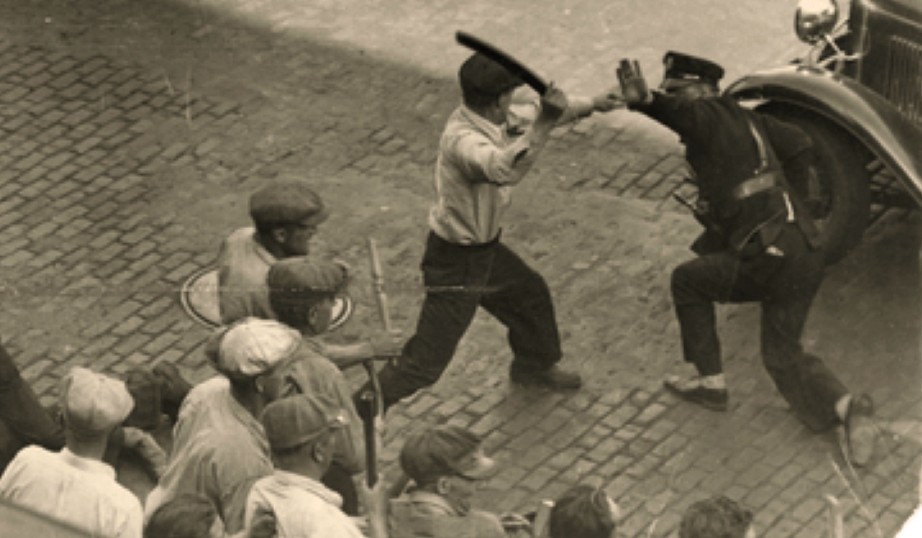
1934 was a turning-point year for the U.S. labor movement, with four massively consequential strikes reshaping the nation’s political landscape. One of those was in Minneapolis. After a ten-day strike, on May 25, 1934 operators and Teamsters Local 574 came to an settlement which won union recognition, non-discrimination and other demands bringing thousands of new workers into the organization. Here Cannon responds to the criticisms of the settlement by others on the left. Shortly after this, the strike would resume and intensify lasting through August.
‘The Minneapolis Strike–An Answer to Its Defamers’ by James P. Cannon from The Militant. Vol. 7 No. 24. June 16, 1934.
Discussion of the Minneapolis strike is on the order of the day throughout the labor movement. And for good reason. Among all the attempts that have been made by unorganized workers, in the present strike wave as well as in the one which preceded it last year, to establish new unions, compel their recognition by the employers and protect their members against discrimination, the example of the Minneapolis truck drivers stands out preeminent.
In the brief space of a few months’ time the Minneapolis truck drivers, the great majority of whom had never belonged to a labor organization before, were brought together into a union; they carried on a 10-day strike which electrified the workers everywhere by its militancy and efficiency of organization; they settled the strike at the peak of its strength and came out of the struggle with a solid union of approximately 7,000 members, recognized in writing by the employers as the representative of the workers.
The story of how that organizing job was done must be a subject of absorbing interest to workers everywhere, especially to those who have yet to establish unions firmly and enforce their recognition—and that is the overwhelming majority of those who have attempted to organize since the inception of the NRA, to say nothing of the millions who still remain entirely unorganized.
It is no more than natural, also, that the Stalinist quack doctors of trade unionism whose “patients” always die should manifest an agitation bordering on the St. Vitus dance over General Drivers’ Union No. 574. Here’s a strike that wasn’t wrecked, here’s a new union that is still alive and going strong after the strike. “Something must be wrong!” shouts the chorus of revolutionary chiropractors. “It never happened this way with us. We always break the backbone! of every strike or union we get our hands on.”
And, since things turned out differently in Minneapolis the people who never conducted a strike to a successful conclusion anywhere, who do not today exert a leading influence in a solidly established union anywhere—these people want to discuss the “shortcomings” of the Minneapolis strike, to draw the “lessons” and avoid similar “deviations” in the future. Very well, gentlemen. In the course of a general exposition for the benefit of those who seek to build the labor movement, a comparison of the Minneapolis methods and results with methods and results which you recommend, will be especially illuminating.
First, let us get a general picture of the situation—as it was and as it is today. The long depression in the labor movement had been felt in Minneapolis with exceptional force. Organization was narrowly restricted to certain skilled crafts. Morale was low. Reaction and pessimism were dominant. The truck drivers and! associated workers, who occupy a position of special importance in this center of distribution for the Northwest, were without benefit of organization.
Barring the ice wagon, milk and brewery drivers nothing existed for years except a skeleton organization. Today Minneapolis is a union town, as far as the trucking industry is concerned. Drivers appear everywhere with their union buttons proudly displayed. The spirit of the workers has been revived and the entire labor movement has been strengthened by the example of the drivers. The conditions have been created for a general organization drive which ought to sweep thousands of workers into the unions.
This remarkable transformation appears as a miracle of organization. From outward manifestations, it was all accomplished in two swift strokes—the coal drivers’ strike in February and the general drivers’ strike in May. But such is not really the case. Behind the coal strike there was a long and patient campaign of organization conducted according to a systematic and far-seeing plan. This February strike was conceived as the strategic link in a bigger chain of organization.
The coal strike was well prepared, carefully planned in every detail. It struck the town like a tornado and swept to victory in three days. Thus the foundation was laid for the May strike. As the deadline set for this action approached, the bosses, remembeing the militancy of the February fight, tried to head off the strike and avoid recognition of the union by “voluntary” wage increases.
In the meetings of the Citizens’ Alliance (the bosses’ organization) held on the eve of the strike–as reported to the union officials by a sympathizer the leaders of the bosses urged and insisted that substantial increases of the miserable wages be made forthwith for the purpose of disorganizing the union campaign and defeating the demand for recognition of the union. On this point the bosses and the workers saw eye to eye–each side understood the question of the union to be paramount. The manoeuvre was defeated. The union officials, with the membership behind them to a man, put the recognition of the union as the first and fundamental demand.
Were the union leaders and members, perhaps, mistaken in centering the fight around the question of union recognition and directly related issues–no discrimination and seniority rights–as certain scholastic wiseacres and unsuccessful labor organizers maintain? Not at all. They were a thousands times correct. It is self-understood that. the struggle for economic demands is indissolubly joined with the fight for a union, but the union is the instrument of the fight and the guardian of the economic concessions. Every worker who joins the union understands this instinctively. The worker wants an improvement in his conditions, but he wants also security in his job while fighting for these improvements. That is what the formula “recognition of the union” means concretely.
The Minneapolis strikers expressed it in their own language as “protection”. They wanted the union to protect them against discrimination, against arbitrary firing, against the damnable “merit” system. In this attitude they were at one with every group of workers entering the organized struggle for the first time. They aspired to build a union to compel the boss to recognize and deal with it.
How the Strike Was Organized
For that they fought. And what a magnificent fight! In Minneapolis was to be seen what reservoirs of working class solidarity and courage can be tapped when the rank and file is fused with an honest, competent and trusted leadership. The whole working class of Minneapolis acclaimed the strike as a model of organization as well as of militancy. Transfer the Minneapolis method to Detroit and Pittsburg! Then you will see the real resurgence of the labor movement!
Even the class enemy gave grudging testimony to the efficiency of the organizers and the soldierly discipline with which they imbued the strikers.
“Even before the official start of the strike at 11:30 p.m. Tuesday”, reported the Minneapolis Tribune on May 16, “the ‘General Headquarters’ organization set up at 1900 Chicago Avenue was operating with all the precision of a military organization.
“Before him on a desk, Farrell Dobbs, in charge at headquarters, had a list designating all the places in the city to be picketed and the time set for start of picketing. As the picket groups left for their posts, the list was checked.
“Days before the strike started, Mr. Dobbs said, picket captains had been selected, sizes of picket crews had been determined and all spots to be picketed had been designated. All that remained when the time came for moving the picket crews was to assign the squads, varying in number according to needs at the various picket places, load them in trucks or cars, and send them on their ways.”
The pickets went “on their ways” so effectively, and they attracted to their support such a wide section of other workers, some of whom came out in sympathy, that the employers found it advisable to recede from their stiff-necked position and deal with the union. On Friday, May 25, ten days after the beginning of the strike, a settlement was made and the men returned to work.
When is the Time for Strike Settlement?
The resolute course of the union leaders in recommending the acceptance of the settlement has raised an extremely interesting and important question before the advanced and militant workers who followed all the developments at Minneapolis with the utmost attention. In the history of the American labor movement the radical and revolutionary workers have been distinguished by a singular one-sidedness in regard to strike and trade union strategy. They led and organized many a militant strike, but seldom succeeded in maintaining a stable union. There is little to go by, in the way of previous experience, to aid the modern militants in determining how and when to settle strikes. Their predecessors did not settle any.
And yet, if we really aim to get into the labor movement and influence it permanently from within, all the year round and not merely during strikes–and this is the fundamental task of the present-day militants–this problem must be solved. The leaders of the Minneapolis strike faced it without hesitation. Those who really want to learn something about the art of building unions, leading them through strikes and keeping them intact afterward ought to study this phase of the Minneapolis struggle particularly.
Those who merely want to throw mud, to scream and show their own impotence and ignorance, will not learn anything from the experience under review, or from any other experience for that matter. Nevertheless, they also serve the cause of progress indirectly. By holding their arguments and criticisms up to the light the education of others can be aided, as temperance used to be taught by the exhibition of the “horrible example”.
What the Strike Settlement Means
Every strike settlement is a compromise in the sense that it leaves the bosses in control of industry and free to exploit the workers. The best settlement only limits and, checks this exploitation to a certain extent. Realistic leaders do not expect justice from the capitalists, they only strive to extract as much as possible for the union in the given situation and strengthen their forces for another fight.
Right at the present time, when the great problem and task of all the unions of newly organized workers is to establish a permanent status and to compel recognition–a task that remains yet to be accomplished for the great majority of the new unions, for nearly all of them in fact–the Minneapolis settlement, itself manifestly a compromise, stands out high above any other of which we have direct knowledge. Those who have secured better settlements for new unions since the inception of the NRA–old established unions obviously stand in a different category–have a certain special right to criticise the Minneapolis leaders. But, first, it is necessary to find the leaders who did better. Who are they, and where are they? Are they, by: any chance, the leaders of the St. Paul packinghouse “strike” or the New York Taxi strike?
Here is what the Minneapolis settlement says on the questions of union recognition, discrimination and seniority rights, quoted from the official text printed in the Minneapolis papers, May 26:
“All members of the General Drivers and Helpers Union No. 574 in dealing with employers may be represented by the officers of such Union, and no discrimination against representatives shall be made because they are officers or agents of said Local Union No. 574; and such firms shall deal with such representatives when duly selected as accredited representatives of these employees. “In the hiring or discharging of employees hereafter, no employer affected hereby shall discriminate against any employee because of membership in said Local Union No. 574.
“In the hiring and discharging of or laying off of employees, seniority rights shall prevail, except for just cause.”
Recognition Enforced to the Letter
In these sections of the agreement the main demands of the union were! complied with in written form. And what is more important, they were carried out in practice in the days immediately following the end of the strike. Every case of discrimination in the rehiring of the workers–there were about 50 out of 5,000, according to the report made to the union meeting three days later–brought a committee of union officials to the office of the firm complained against. In not a single case did the employers refuse to meet the union officials and to adjust the complaints.
That is “recognition” enforced to the letter by a union that stands intact and ready to fight again if necessary. Where is there a new union anywhere in the United States which secured a clearer and more. definite recognition since the inauguration of the NRA and began to enforce it the very next day? Against these gains must be put down on the other side the fact that the union agreed to submit the wage demands to arbitration and to accept the results. This, the union had offered early in the strike on the condition that the union be recognized. The arbitrating body is not the Regional Labor Board, but is to consist of two members of this board, two employers and two representatives of the union, plus a seventh member to be selected. This body is also to arbitrate and decide individual disputes regarding the seniority clause.
This is a serious concession which the union officials felt it necessary to make under the circumstances in order to secure the recognition of the union and consolidate it in the next period. It is a big concession, but by no means a fatal one. It is a concession that has been made by many unions. It is somewhat ironical that the Furriers Union, the one Stalinist organization having direct relations with the bosses up till recently provided, in the agreement, for arbitration by an “impartial chairman”.
An adverse ruling of the board of arbitration would undoubtedly galvanize the union membership for action again. The boat will meet under the direct impression of the 10-day strike and with the consciousness that the union is strong and militant.
That, in our opinion, is the fundamentally decisive feature of the results of the Minneapolis strike–the indubitable establishment of a new union where none existed before. All the plans of the leaders and organizers were directed to this end as the first objective in a long campaign. The struggle was centered around this issue and was crowned with success. On that basis further steps forward can be made. To speak of such an outcome as a “defeat” is simply absurd.
The labor movement of Minneapolis has been restored to new life by the emergence of Local 574. The working class of the entire country | has been inspired by a new example and enriched by a fresh experience which constitutes a real contribution to the burning question of trade unionism. Honest and loyal workers everywhere will acknowledge an indebtedness to the group of Minneapolis militants at the head of Local 574 who organized this magnificent movement, steered it through the strike and the settlement and still remain at its head. The work they have done already is bound to influence future developments of the left wing labor movement on a national scale. And they are not finished yet.
As was to be expected, the Stalinist specialists in the art of losing strikes and breaking up unions are bitterly disappointed with the Minneapolis situation. It was also to be expected that they would work overtime to discredit the strike and the union and blacken the names of the organizers and leaders. But even those who understood, especially those with sensitive stomachs, could not avoid a slight feeling of nausea at the instrument chosen for the present job and the dirty self-befouling methods assigned to him in executing it.
For the “Minneapolis job” the collective Browders, with a perverse cruelty, summoned the wreck of what was once a revolutionist and a man named William F. Dunne and offered him the opportunity to restore himself to grace and favor. He took the job of slandering the Minneapolis movement and all connected with it, and it must be said he did a dirty job as he was required to do.
That side of his articles are of no particular interest in themselves and can well be passed over. What is important and worthy of discussion is the fact that, in the course of his attacks, he exposes a conception of the trade union question, as he has learned it in recent years in the school of Browder-Stachel, which throws a searchlight on the present-day tactics of the Stalinists in contrast to ours. We can only welcome the opportunity to discuss the contrasting viewpoints on the basis of a concrete demonstration of one of them. That the discussion takes place on our ground–this in itself is a fact which helps to explain the meaning of the differences. In next week’s issue I hope to take up the main thesis of the Dunne articles on the Minneapolis strike and demonstrate its falsity and, consequently, the falsity of all the tactics prescribed on the basis of this thesis.
PDF of full issue: https://www.marxists.org/history/etol/newspape/themilitant/1934/jun-16-1934.pdf
 Revolution's Newsstand