
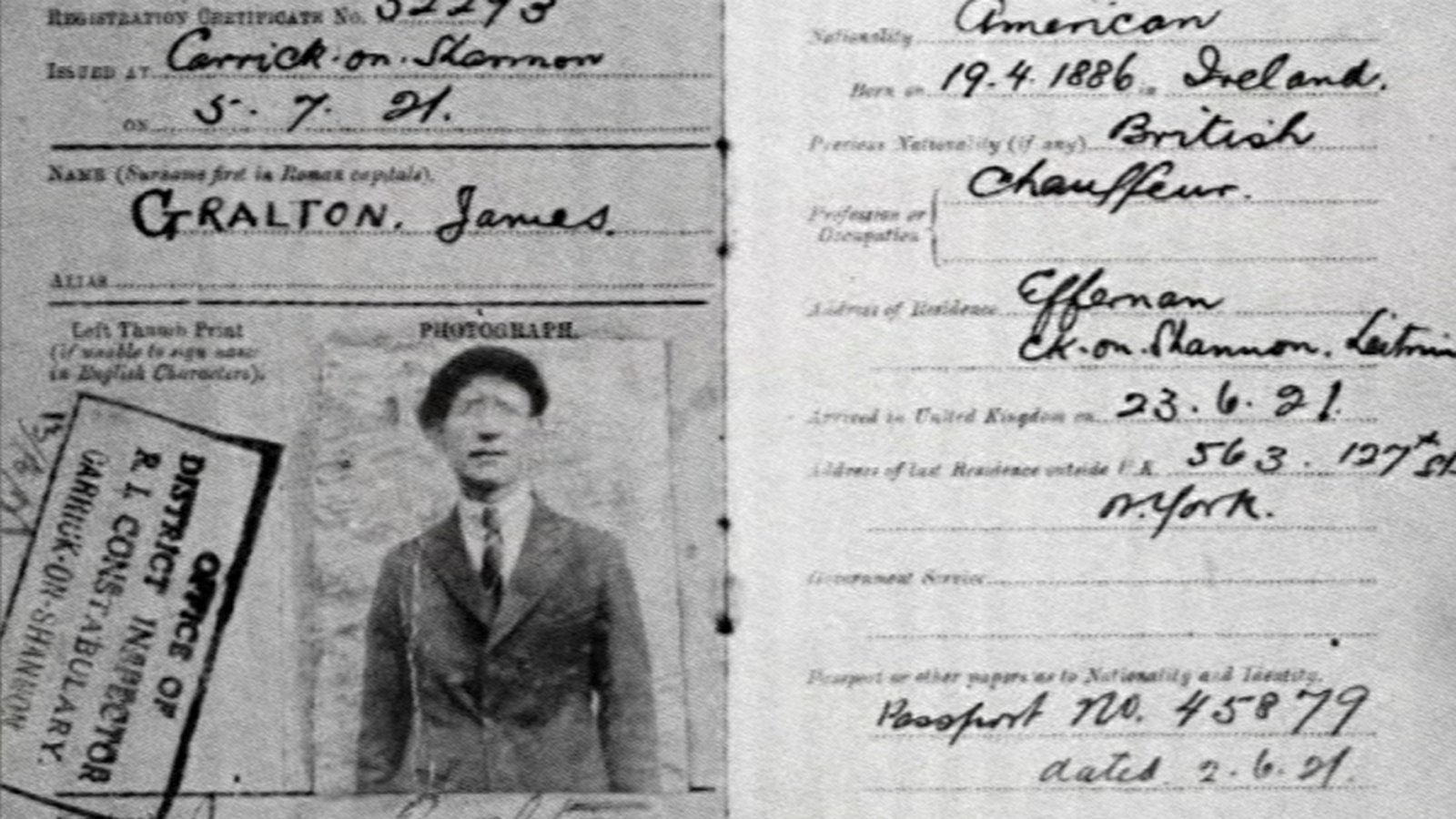
Priceless interview with former I.R.A. guerilla and deported Irish Communist Jimmy Gralton on his arrival to the U.S. after being evicted from his native land by De Valera’s ‘republican’ government. In part one, he tells of his history and that of the fight against Leitrim landlords during the Irish Revolution, in the second part he talks about the current situation in Ireland and the welcome unity of Protestant and Catholic unemployed workers in Belfast. Garlton was the subject of Ken Loach’s film ‘Jimmy’s Hall.’
‘Jimmy Gralton, Deported Red Leader, Fought Betrayal of Irish “Free State” to England’ by Martin Moriarty from the Daily Worker. Vol. 10 Nos. 208 & 209. August 30 & 31, 1933.
I. Fight on Landlords Roots Communist Party in Ireland, Says Gralton
Deported Red Leader Fought Betrayal of Free State to England By Organizing Farmers To Resist Evictions, Seize Land
NEW YORK. The roots of Communism are laid in Ireland, Jim Gralton, deported from his birthplace by the Free State Government of Fianna Fail, says.
“The workers and working farmers are reading the writings of James Connolly, Ireland’s Socialist martyr murdered by the British for leading the 1916 insurrection. The workers are reading the writings of Lenin. There’s unemployment, people are hungry. So they’re curious about the tactics of the leaders who brought about the First Workers’ Republic.”
Gralton says you must go back to 1921 and 22 to understand his deportation.
In 1921 he had returned from America to fight with the Eighth Battalion of the South Leitrim Brigade, Irish Republican Army, against Britain’s black and tans. Then the Republican war was sold out by the Free Staters. The compromise gave the big capitalists concessions, rich farmers gratefully accepted a few crumbs from the bankers’ tables. The workers and small farmers–they who bore the brunt of the fighting–were left stranded, their fate in every previous Irish insurrection. The Sinn Fein opposition led by De Valera fought the treaty. De Valera attracted the support of the poorest farmers and town laborers, but his was more the platform of a discontented middle class.
“We’ll back De Valera in the fight against the treaty,” Gralton told his neighbors. “But we’ll have to do more than that. We’ll fight the treaty by resisting evictions and taking over the land ourselves. Republican leaders won’t go that far. So the workers and small farmers must fight for something for themselves.”
“The workers and small farmers must fight for something for themselves.” To the cattle ranchers, the big land-grabbers and the priests who supported them, this program was “the demon of Communism, the anti-God campaign.”
There were evictions, laborers were hungry. In Gralton’s neighborhood–the Gowel area–there were republican arbitration courts. These were “rebel” courts which ignored British laws during the trouble. Eviction cases were tried by these courts. “But the decisions they handed down on eviction cases were more like decisions handed down in line with the old British property laws.
“We brought 400 people to a public meeting, fired the judge and secretary and set up a workers’ court. Our program was for breaking up the big estates and giving the land to the poor farmers; no rents; no rates; no evictions; re-instatement of evicted families.
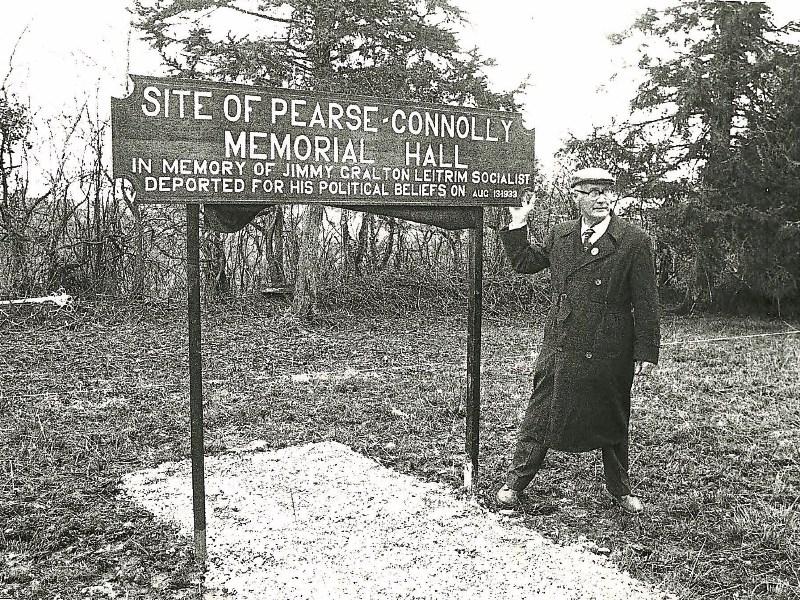
“We had a Direct Action Committee to enforce that program. We built a hall with volunteer labor, Pearse-Connolly Hall, to replace a hall burned down by the ‘tans. The priests bitterly opposed us. They warned their congregation to keep away from the hall. But we had a mass movement. The poor people supporting us were devout Catholics, but they refused to listen to the priest when he preached ranchers’ politics from the altar.”

THE Committee swept into action. An evicted family was re-instated on the land of a notorious grabber. Soldiers–they were later the local nucleus of the Free State Army– commanded the eviction-resisters to halt. The priest accompanying the soldiers warned the 300 people backing the committee to turn back. The soldier’s officer, with his rifle at the trail, said:
“The first man crossing the ditch to the land will be shot.”
“If you take your hand off the point of balance of that rifle,” Gralton warned him, “you’ll be with St, Patrick forthwith.” The crowd swarmed past the soldiers over the ditch. The land was re-claimed.
A cattle ranch was broken up, the land made public property. “Mr. Vaugh,” the Direct Action Committee said to the owner, “we’re after taking over this land you’ve held for these many years. You took the land away from the original owners by force. The force is on our side now.”
There was a fierce pulpit-campaign against the workers’ courts. Priests denounced the courts, Pearse-Connolly Hall, and the leaders from the altar. Gralton was arrested, held for ten days. The courts still carried on, but the Free State Army was getting stronger and stronger. Military broke through the barbed wire surrounding the hall, seized the building and mounted Lewis guns to hold it. Many workers and small farmers were arrested.
“We had few arms then. Local I.R.A. leaders had gone over to the Free Staters. They had had charge of the dumps where we hid our arms during the truce. Before they sold out they collected any guns not yet in the dumps. I held on to a Thompson machine gun as long as I could. In the end I had to surrender it.
“Many of us were on the run now. We had cleaned up most of the land-grabbing affairs and I could see our usefulness was coming to an end. We escaped from the encircled area there had been orders to shoot us at sight.
“We reported to Rory O’Connor, then in charge of the four courts in Dublin where the I.R.A.–the steadfast republicans–were quartered. Civil war hadn’t begun, but it was easy to see it coming. We asked O’Connor if he could arrange for the Third Western Division, which had remained republican, to support our group in Leitrim. We wanted to organize a flying column to fight the treaty and take over the land. “We want to carry out James Connolly’s program,” I said to O’Connor.
“We know O’Connor was a brave man. Free State thugs knew him as their uncompromising enemy when they took him from a prison cell and murdered him with Joe McKelvey, Dick Barrett and Lian Mellows in the civil war. But O’Connor didn’t understand the class issues of the republican war. He told us: “You’re just a mob.”
“We offered to stay in the Four Courts to take part in the fighting we expected. O’Connor said no. This would be a bread of the truce, he said, they were just after sending home the South Tipperary Brigade who had also volunteered to stay in the Four Courts. So I came to America. Soon after the Four Courts were fired on. The civil war began.”
Two years ago Gralton’s brother died. Jim had to go home to take care of the small farm.
The crisis had paralyzed Ireland, as it had paralyzed the whole capitalist world. Emigration was clogged up. There were no more remittances from exiles in America. And now, in Leitrim, as in every county in Ire- land, there were the Irish Revolutionary Workers’ Groups, pointing the way to the Irish Workers’ Republic, building the Communist Party. Of course, Gralton joined the Groups. Pearse-Connolly Hall was re-opened. To the ranchers and priests, resisting evictions was criminal in 1922. But the same program, strengthened now by an open Communist Party–this aroused the most savage hatred of the cattle-men and their clerical agents.
Direct Action Committee Defies Soldiers and Priests, Cleans Up Land Grabbers, Fires Judge and Sets Up Workers Court
THE old lies about the Soviet Union tripped off the priests’ tongues. “But though many people were fooled into believing those lies, many followed us,” Gralton says. The poor people said this: The same priests told lies about the Irish Republican Army boys. Why, they could tell lies about Russia as well. And what’s wrong for the workers to have dances and classes in Pearse-Connolly Hall? What’s the sin in advocating a higher standard of living for the Irish workers and poor farmers?
“The priests’ campaign was carried into the schools. Children of parents who attended the hall were boycotted by teachers. My niece, who I went to the convent school, was told by the nuns that if she went to the hall she’d have to leave the class. She left the class.”
There was now intimidation of Communists and sympathizers by armed bullies incited by the ranchers and the priests. Refused a license for a rifle, Gralton armed himself with a shot-gun and home made bombs. He was forced to hide at night.
Pearse-Connolly Hall was shot up by thugs. On Christmas eve it was bombed and burned to the ground. Gralton was served with a deportation order. No trial. No charge. He was, the government considered, “a menace to public welfare.”
“I thought I had a right to live in the country I was raised in. escaped and took to the hills. The priests said the people were opposed to Communists. But poor people–devout Catholics–looked after me. The roads were painted with signs like “Down with imperialist coercion! Justice demands a trial for Gralton! Up Communism! Deport the ranchers!
“Local relief workers demanded a wage raise. They also demanded the deportation order be cancelled. I stayed six months in my own county–that proves the people were with the Communists, otherwise I would. have been informed on long ago. But the case was attracting attention all over the country. It raised the question of Communism for Ireland. People are finding out about Communism now. The Communists are the only party giving the poor people a lead. They’re the most feared and hated group–hated by the British imperialists and Irish capitalists–in Ireland.
“Many Irish workers and farmers are reading Marx and Engels on the Irish Revolution; the Irish Case for Communism; all of Connolly’s works; the writings of Lenin.
“Do the workers and farmers follow the news from America? Yes. They know about Tom Mooney of course. They know it was a frame-up, just as the British framed the leaders of the Land League in Parnell’s days. They were interested in the case of Pat Burke, the young Irish unemployed organizer deported from the Coast back to Ireland. His case happened about the same time I went on the run. One capitalist government deporting an Irish worker to Ireland-the other capitalist government deporting an Irish worker to America.
“Irish activities in America mean a lot to the people at home. Especially since the crisis. Before the crisis, boys and girls returning to Ire- land on vacation from America used to tell their friends what a grand country America was.”
II. Irish Catholics and Protestants Unite for Strikes and Relief Struggles
American Crisis Cuts Off Support of Many Relatives of Irish-Americans; Turn Their Thoughts Toward Soviet Union
DO the workers and farmers follow the news from America? “Yes,” says Jim Gralton. “They know about Tom Mooney of course. They know it was a frame-up, just as the British framed the leaders of the Land League in Parnell’s days. They were interested in the case of Pat Burke, the young Irish unemployed organizer deported from the coast back to Ireland. His case happened about the same time I went on the run. One capitalist government deporting an Irish worker to Ireland—the other capitalist government deporting an Irish worker to America.
“Irish activities in America mean a lot to the people at home. Especially since the crisis. Before the crisis, boys and girls returning to Ireland on vacation from America used to tell their friends what a grand country America was.
“The old folks used to get money from their relatives In America. It was propaganda for the capitalist system, you might say. Every Sunday at Mass you used to be able to clothes, sent home by the exiles. You don’t see that so much now. The money hasn’t been coming from America since the crisis. The people don’t look to America for a lead anymore. They know there’s unemployment there. And that brings them around to thinking about Russia, where there’s no unemployment.
“So the bosses, knowing the discontent, peddle more lies about the Soviets. The same old lies—people living like animals in a compound, children taken away at birth and given to the state.”
RELIGION is not so successful these days as a trick to keep the workers of the North and South divided, Gralton reports. Divide and rule, that essential imperialist technique! was always practised In Ireland.
“Once the Protestant and Papist get together it means goodbye to the British interests in Ireland”, an old pro-British archbishop said over a hundred years ago. Of course the British boss—and the Irish Catholic and Protestant boss—knew the truth of the warning. They inflamed “religious” antagonisms. Falls Road is the Catholic section of Belfast. Sandy Row, the Protestant. Years ago it was not safe for an Orangeman—a protestant loyalist—to go into Falls Road. It wasn’t safe for a Catholic to go near Sandy Row. Members of the same trade union were at each other throats—“religion” was the issue.
But now? Gralton says the old hates are dying, and the Belfast relief fight last year was one great teacher. British machine guns did not distinguish between the Protestant and Catholic workers’ stomachs. For the workers fought together for relief. They won it too—relief scales were tripled.
“The Catholic working women in Falls Road scolded their menfolk like this: ‘ls that all you’re doing against the police? Haven’t you built the barricade yet? Why, the protestant folk over In Sandy Row are ahead of you—get busy!’
“And in Sandy Row the Protestant working-women scolded their men like this: ‘The Catholics are putting up a better fight against the soldiers than you are. Get busy!’
“Catholic workers who had fought with the I.R.A. and Protestant workers who had served with the B. Specials—auxiliary crown forces in Ulster during the trouble—both reported to the strike committee for active service. They did fine work when they helped throw up the barricades and fought side by side against all the forces of the state—police, soldiers, armored cars, machine guns, for three days.
Hunger Marches and Relief Strikes Rally Poorest–Dublin’s Jobless Win Cash Relief and 25 Per Cent Increase
“HOW about the conditions of the farmers. Take the case of the 18 families in our townland. There were three stores, all trying to live off each other. Every family has relatives in America. That doesn’t mean a thing now. In so-called normal times the heads of the families would sow the crop, keep the children away from school to get the crop in. while they went across to Scotland and hired out for farm work there.
“No use going to Scotland now. Even if the farmers did get work, wages are so low they can’t clear travelling expenses. Some families might buy a couple of pounds of bacon now and again. Many live mainly on spuds when the crop’s good.
“Six of these old people are old-age pensioners. Two are blind pensioners. Some get a little outdoor relief, though you must have a pull with the priest or with one of the big men on the County Council to get that. One parts’ that did spy work against our committee got the blind pension though he wasn’t quite blind—the ranchers’ reward. Another man seemed favorable to us. He attended the hall and lost his blind pension. Now he gets on 12 or 14 shillings a week relief only.
“There are hunger marches in Ireland too. When Cork City discontinued its tramway service a workers’ delegation marched all the way to Dublin. 162 miles without a lift. They forced a hearing on the case with the ministry.
“There are strikes on relief jobs everywhere. Sometimes they take the form of strikes against bringing in people from outside the parish to work on the job. Or they may be strikes against the crushers, the machines that break stones faster than men can. In some cases local authorities have been forced to take away the machinery.
“Dublin’s unemployed used to get relief in kind, They put up a good fight, now they get cash relief with 25 percent increase.
“That’s how the roots of Communism are being laid in Ireland. I know the workers and farmers are not interested in an independent republic like America—the old cry a few years ago. They’ll fight for a workers’ republic, That’s why they’re reading the works of James Connolly. That’s why they’re reading Lenin, building up the Communist Party of Ireland.”
The Daily Worker began in 1924 and was published in New York City by the Communist Party US and its predecessor organizations. Among the most long-lasting and important left publications in US history, it had a circulation of 35,000 at its peak. The Daily Worker came from The Ohio Socialist, published by the Left Wing-dominated Socialist Party of Ohio in Cleveland from 1917 to November 1919, when it became became The Toiler, paper of the Communist Labor Party. In December 1921 the above-ground Workers Party of America merged the Toiler with the paper Workers Council to found The Worker, which became The Daily Worker beginning January 13, 1924.
PDF of full issue: https://www.marxists.org/history/usa/pubs/dailyworker/1933/v10-n208-aug-30-1933-DW-LOC.pdf
PDF of issue 2: https://www.marxists.org/history/usa/pubs/dailyworker/1933/v10-n209-aug-31-1933-DW-LOC.pdf
 Revolution's Newsstand