
Issues arrive over the differences in building the Party and revolutionary unions at the same during the T.U.U.L.-led National Miners’ strike of 1931. Two contributions from the Pittsburgh region.
‘Party Building in the Miners’ Strike’ by A. Markoff and Leo Thompson from Party Organizer. Vol. 4 No. 7. August, 1931.
Building the Party in the Mine Strike Area by A. Markoff
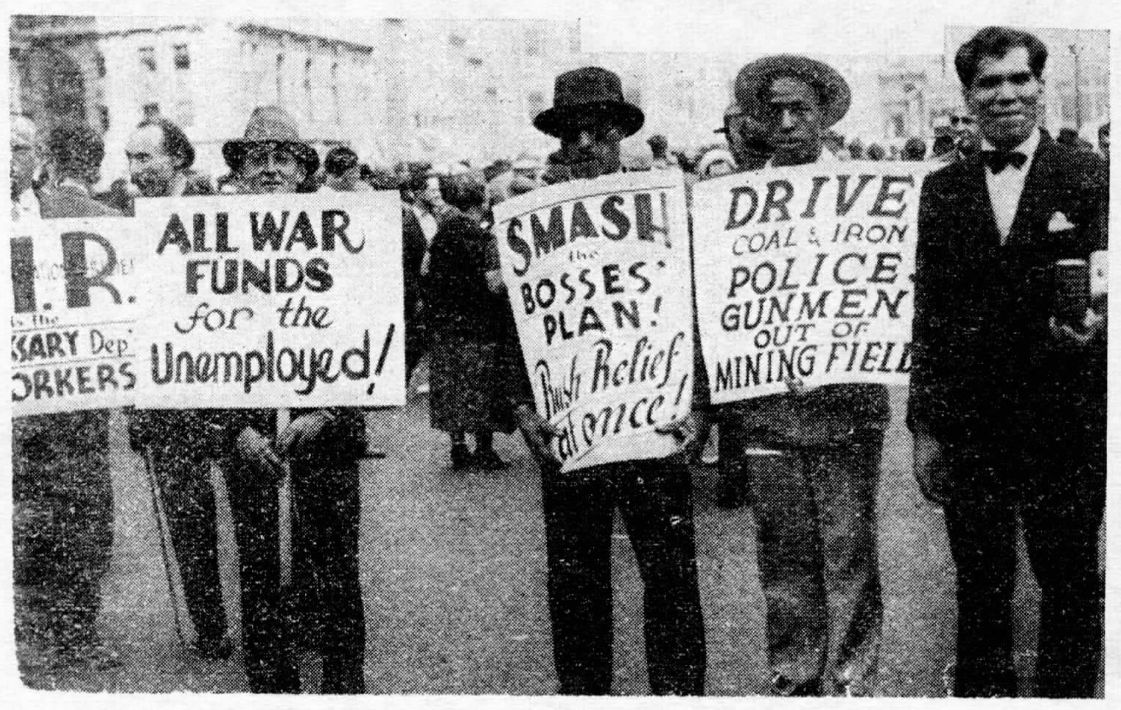
A STRIKE situation such as the present coal miners’ strike in Pennsylvania, Ohio and West Virginia offers the greatest opportunity for the building of the Communist Party, for a mass recruitment into the Party from the ranks of the striking miners.
While this is clear to the majority of our active Party members, there are wrong tendencies manifesting themselves here and there. One of the tendencies is to wait till the strike is over to build the Party. This tendency is incompatible with the basic functions of the Party and arises only out of lack of understanding of the role of the C.P. in the present strike as well as in all struggles of the working class.
The other tendency is one of extreme cautious approach to the strikers. Some comrades say that we must be very, very careful as to whom we recruit and therefore present an orientation of months of propaganda, of careful selection, etc.
Such a view is a result of bad training, of non-confidence in the masses—we must reject it. In this period of struggles, the Party must be built rapidly.
Here we must guard against the other extremes where comrades working in the field are carried away with enthusiasm and begin wholesale recruiting, without even explaining the difference between the Party and the Union.
One more point in connection with this is the opinion that a union field organizer during the strike must not build the Party at the same time for fear that he will become known as a Communist and the Union will be branded a Communist union.
To these we can say this: a Communist, a member of a Communist Party is first and foremost a Communist, no matter what work he is engaged in; that the first thing to be considered is the building of the Party. Does that mean that he should build the Party in preference to the Union? No. At this time when the N.M.U. is leading such an important struggle—the building of the Union is of prime and paramount importance. But one cannot successfully build the N.M.U. or lead the strike without at the same time building the Party nucleus, which is one of the strong pillars of the Union and the strike. The successful building of the Party nuclei in the strike area means the firm consolidation of the strike forces; it means the strengthening of the Union.
Who is to Build the Party?
To this question there is one categoric answer—the field organizer, and every member of the Party active in the strike must build the Party nuclei. The organizer is the one who is constantly in contact with the striking miners. He is in touch with especially the most developed, the most militant elements, those who are on the various committees,—the strike committee, the relief committee, the picket committee, etc. It is a simple matter to discuss the immediate problems of the strike binding it up with the immediate experiences explaining the role of the state with which every miner is in daily contact in his experience on the picket line, in the brutal attack of the state forces, etc.
Through these simple talks with individual miners, we prepare them, make them ready to accept the Party. When three, four, or five individuals have been thus prepared, they are called together and a talk is given explaining the role of the C.P., in the strike, the relationship between the N.M.U., and the C.P.; the conception of the class struggle, etc. This is done in an elementary way, using language which the miner understands. The talk should not be too long, and must be as concrete as possible, always bearing in mind the strike and illustrations arising from the experiences of the miners. My personal experience was that I find the miners extremely interested; they often show their approval by interjections here and there during the talk.
Questions may and may not follow the talk. The miners, at first, are slow in asking questions. It is up to the speaker then to ask them questions, to make them express themselves as to what is their opinion about the Party, the Union, the strike, etc.
By formulating the questions simply, the workers will be drawn into the discussion.
At this first meeting it is best to sign them up, to fill out the application blanks. It is also advisable to give them literature “Why Every Worker Should Join the Communist Party” or a similar pamphlet.
Unfortunately our Party is poor in such literature. We have many pamphlets published, but the language is inaccessible to the average worker. The day for the next meeting is decided upon and the workers are asked if they think it would be advisable to bring some more active workers, whom they know to be reliable, whom they would like to have in this group.
In every one of my meetings the miners suggested one or another and at the next meeting I had three or four more miners present who joined the Party at that meeting. For example: at one meeting of five miners who were recruited into the Party several days before, five more came invited by the first five and thus a nucleus of ten was formed; at another meeting four miners newly recruited brought three more, and so on.
At the second meeting if new comers are present a short introduction must given explaining what the Party is, what it stands for. These workers have been already talked to by the first group, so the ground is prepared and all that is required is the clarification of some of the problems which are not as yet clear.
At this meeting we also take up the structure of the Party, we explain what the nucleus is, what position it occupies in the strike, in the mine, in the Union, the relation to the higher organs, such as the Section Committee, District Committee, the Central Committee. Something should be said about the Communist International. Then the organizational form of the nucleus is discussed, we elect a Buro of three consisting of an Organizer, a Secretary and a third comrade who for the time being is charged with taking care of the Daily Worker distribution and literature.
We must guard here against formalism. These workers cannot immediately understand such offices as Agitprop Director, Industrial Organizer, etc. The tasks outlined must be simple. The Secretary is told that his duty is to take care of the membership books as far as stamps are concerned, he is to get stamps and supply them to the members; he should keep a record of the decisions (minutes), etc.
Likewise we explain to the Organizer his duties and so on. We must bear in mind that usually the best and most active workers in the strike are the first to join the Party. These workers are already charged with many responsibilities and cannot be over-burdened. Therefore it is necessary to make the organizational structure of the unit simple.
The idea of working as a fraction within the strike committee, the relief committee, etc. can also be explained at this meeting. A regular meeting date must be agreed to. Also the conception of discipline can be introduced. I found that it is very easy for the workers to understand the meaning of discipline. The struggle itself teaches them the necessity for discipline.
Training of the New Members
The training of the new members recruited in the present strike presents a special problem. We cannot apply methods used in units of New York, Chicago, etc. Many of the miners are foreign-born, and do not speak English well; others, born or reared in this country have had little opportunity, if any, for education. We, therefore, must go slowly with the theoretical training. The training, at least for the first two or three months should consist in taking up the current topics and presenting them in the light of the Communist conception, linking up the subject with the immediate struggles of the miners and other workers, using plain workers language.
Should we organize classes for the new members in the strike area? My opinion is that we should not. My experiences in the field convince me that regular classes are not the thing at the present time in the strike situation. Later, when we have a number of members trained in the units, classes can be and should be established on a section scale, but at present the training must be done at the unit meetings. We can also train the workers outside of the units by getting together a large group of striking miners and talking to them on a topic which concerns them or reading aloud articles from the Daily Worker. For example, the Lamont Conference in Washington with the mine operators; the Doak Conference with representatives of the U.M.W.A., the war danger, Scottsboro, etc. This paves the way for the organization of a Party unit. The following fact will illustrate this point. I spoke one day to a group of miners in the N.M.U. relief headquarters. I spoke about the strike, the picketing, linked it up with the recent arrest of 230 strikers, where the federal immigration inspectors became active, discussed the oppression of foreign-born workers, the activities of the C.P. against deportations, introduced the war danger and August First. Some comrades warned me not to mention the C. P. My talk where the Party was placed as the leader of all the workers had its effect. Several days later, the Org. Secretary of the Pittsburgh District succeeded in establishing a nucleus of ten members: all these were present at the meeting mentioned above. The striking miners understand and accept our Party if it is placed in the proper light.
Another important method of training our new members is to give them literature and ask them to read it together.
Mine Papers
It is my opinion that we can have a number of mine papers launched shortly. It is necessary to suggest to the nucleus at the third or fourth meeting that a mine paper be started. The members respond readily. Two mine papers are in preparation at the present time. The articles are to be written by the miners themselves. The District should have them mimeographed and give them to the unit for distribution.
In the Pittsburgh District as a result of the strike many nuclei are established. Every week more nuclei are being organized and the membership of these nuclei grows. But these nuclei must receive the closest attention of the Party leadership. Comrades must be assigned to meet with them regularly at least for the first two or three months. Neglecting these newly formed units of the Party will lead to rapid disintegration.
Building Party Units in the Coal Strike Area by Leon Thompson
THE building of Party units in the coal strike is one of the main tasks of our comrades in the Pittsburgh district. Unfortunately, because this job was sorely neglected until now, the strike had to face tremendous difficulties that would not exist were Party units functioning in the field prior to the strike.
It is no exaggeration to say that the overwhelming majority of the difficulties in the strike are mainly due to the lack of a conscious organized motivating force— the Communist Party units.
In the last two weeks a turn was begun and the District Committee has succeeded in establishing 5 new units in our Cannonsburg-Washington section. In the first period of the strike without Party units and members, it was very difficult for the comrades to systematize our work in the strike. We had no departments in the strike committees, our picket lines were weak and spontaneously formed, our relief work met with numerous complaints, etc.
But with the first beginnings of newly organized Party units, the strike situation itself always reflected improvements in all these different phases of strike activity. Although we did not have fully developed Party units, we at least had a fresh energetic core of the best fighters among the miners in the Party who could be used to organize and reinforce picket-lines, who are sent out to speak at mass meetings, organize strike committees at various mines, take charge of relief work, organize demonstrations within very short notice, break up the U.M.W.A.’s mass meetings, etc.
For example, in Meadowlands where we have a Party unit of 6 (although still loosely organized) and where we still have many obstacles to overcome—the work is much more satisfactory that in those mining camps like Cuddy (near Westland mine) where we have no Party unit. The same is true in Washington, where a small core of 3 Party members is able to push the miners to more consistent activity. In spite of only having 3 comrades there, still the workers realize that the Party is their leader.
How were these units organized? The Party does not repeat the same mistake made in the past, that is, by an indiscriminate mass circulation of application cards. This merely boils down to a mass signature campaign. What we must do (and are trying to do) is to lay the basis for a real mass recruiting drive in the coal fields on the basis of our present contracts in the numerous strike committees. In our section, none of 5 new units have more than six or seven members. But they already are doing considerable good work in pushing and leading the miners in the strike and recruiting new members. In Meadowlands, for example, I sent out a new Party member to Bishop to organize a local union of the N.M.U. and to make connections for the Party. The same comrade organized a Youth Section of 15 and a Miners’ Children’s Club of 33. In another instance, we learned that the Pittsburgh Coal Company was shipping 300 strike-breakers on a train to Montour mine No. 10. I immediately got in touch with the new Party comrades there who at once organized a strong reception committee, which succeeded in turning back a good percentage. In Washington, where we held a mass hunger march of about 20,000 miners and steel workers, the Party is following up the hunger march by daily house-to-house distributions and sales of 100 Daily Workers. At the present time, the main work of the Party units is to push the August First Anti-War Demonstrations, four of which will be held this year in our section, that is, in Washington, Cannonsburg, Hill Station (Montour No. 10) and Cuddy (near Westland mine). All other units get rid of their Daily Workers, selling about 75% of them and giving out the rest free. This kind of work lays the basis for mass recruiting to follow.
However, we must give more attention to small details, draw these new Party members into concrete leading work in the strike, raising their prestige among the miners. These new Party units must be the basis for functioning Party fractions in the N.M.U. that will give daily leadership to the work in the strike and after the strike is over, at the same time steadily recruiting the best miners into the Party.
The Party Organizer was the internal bulletin of the Communist Party published by its Central Committee beginning in 1927. First published irregularly, than bi-monthly, and then monthly, the Organizer was primarily meant for the Party’s unit, district, and shop organizers. The Organizer offers a much different view of the CP than the Daily Worker, including a much higher proportion of women writers than almost any other CP publication. Its pages are often full of the mundane problems of Party organizing, complaints about resources, debates over policy and personalities, as well as official numbers and information on Party campaigns, locals, organizations, and periodicals making the Party Organizer an important resource for the study and understanding of the Party in its most important years.
PDF of issue: https://www.marxists.org/history/usa/pubs/party-organizer/v04n07-aug-1931-Party%20Organizer.pdf
 Revolution's Newsstand