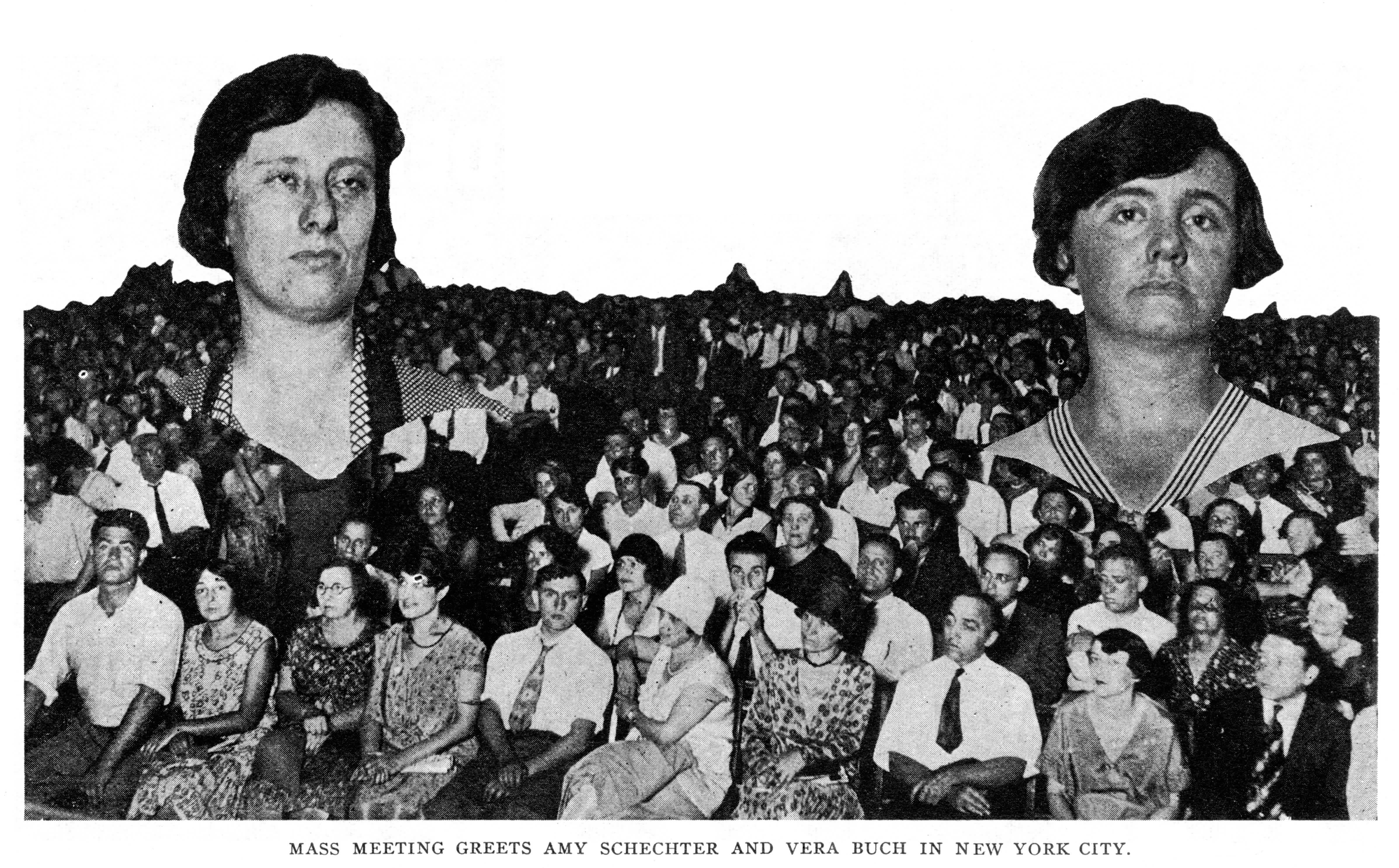
Vera Buch with strong criticism of Communist Party tactics during her and her comrades’ life-and-death court case in 1929. The first substantial strike of the new ‘Third Period’ T.U.U.L. unions, the National Textile Workers Union led a strike against the Loray Mill in Gastonia, North Carolina with the Workers International Relief setting up a tent colony, and the International Labor Defense providing legal support. An intense and dramatic struggle with Communist Party activists, notably women, playing central roles. Worker militants and Party members (including leading trade union figures Amy Schechter, Fred Beals, and Vera Buch) faced charges connected with the shooting death of a thug sheriff. Facing potential execution, the Gastonia defense first ended in a mistrial, later several of the strikers were convicted and sentenced to long terms of imprisonment. Others, like Fred Beal, jumped bail and went to the Soviet Union.
‘The Gastonia Trial One Year After’ by Vera Buch from Revolutionary Age (C.P.—Majority). Vol. 1 No. 13. May 1, 1930.
Comrade Vera Buch, the author of this critical retrospect of the Gastonia Trial one year after, is one of the original defendants in the trial. She is not yet a member of the C.P. Majority Group but is in opposition to the false line of the Party from viewpoint generally like ours. The secondary questions in the above article in which Comrade Buch differs from our viewpoint will be evident to every reader of REVOLUTIONARY AGE. Ed.
With appeal of the Gastonia case now being heard, predictions are rife as to an unfavorable outcome.
The prison walls are casting their shadows already over seven young men of the working-class. Was everything done to save these boys from conviction, in the first place? What is was the case conducted is more, in a revolutionary manner, that is, was the widespread interest in the case used to acquaint as many people as possible with the real oppressive nature of the government under which they live and to move the working-class further towards a revolutionary path?

Today the “leaders” of the Communist Party who were responsible for the methods of conducting the Gastonia case are carrying out on all sides policies of reckless adventurism. In the name of the “third period” real crimes against the working class are being committed. That the conduct of the Gastonia case was such a crime we do not wish hastily to declare. He would be a poor revolutionist who would not consider the tremendous power lined up against the workers in such an affair as the shooting of chief of police. The bourgeoisie will go to any length whatever to defend its own. But on the other hand, the workers are not always foredoomed to defeat even in the face of the most crushing legal opposition. The workers too have weapons which if correctly used, may be able sometimes to prevail.
“Red” Publicity–Liberal Policies
The Party publicity on the Gastonia case was of the most lurid nature. Nothing could have been more “red” than the Daily Worker on Gastonia last summer and fall. But in actual fact, pacifist liberal policies were in control.
Let us first consider the central slogans of the case. There was a difference of opinion among the Communist groups. The Trotsky-Cannon group and also the C-P Majority Group claimed that the slogan of “Smash the Frame-up!” should be the chief slogan. The Communist Party also had this slogan at first. Later the frame-up slogan was dropped entirely and the main slogan became the one put forth by Wm. F. Dunne: “Defend the right to self-defense!”
The argument was that “frame-up” was an out-of-date slogan belonging to the period of A. F. of L. struggles. Furthermore, that in the Gastonia case there was no frame-up, the workers actually did shoot and kill the chief of police. It was a suicidal slogan as far as the trial was concerned, and the reckless use made of it before the trial seriously endangered our lives–as for example, when Dunne came drunk into our cell one day last summer and declared in a loud the thick voice, that his only regret was that there had not been more Communist organizers with guns in their hands on June 7! (which, by the way, has now become “May 9 to be precise!” See Dunne’s article in the Daily Worker of April 19.)
Remember that the charges were murder and conspiracy to murder. Also that the prosecution had no direct evidence as to whose shot killed Aderholt and only the flimsiest proof of conspiracy. Yet in these circumstances with the electric chair threatening sixteen, the Gastonia Labor Defender actually declared that it “did not deny” that the union guard had killed Aderholt and–“defending the right to self-defence”–that they had the right to kill.
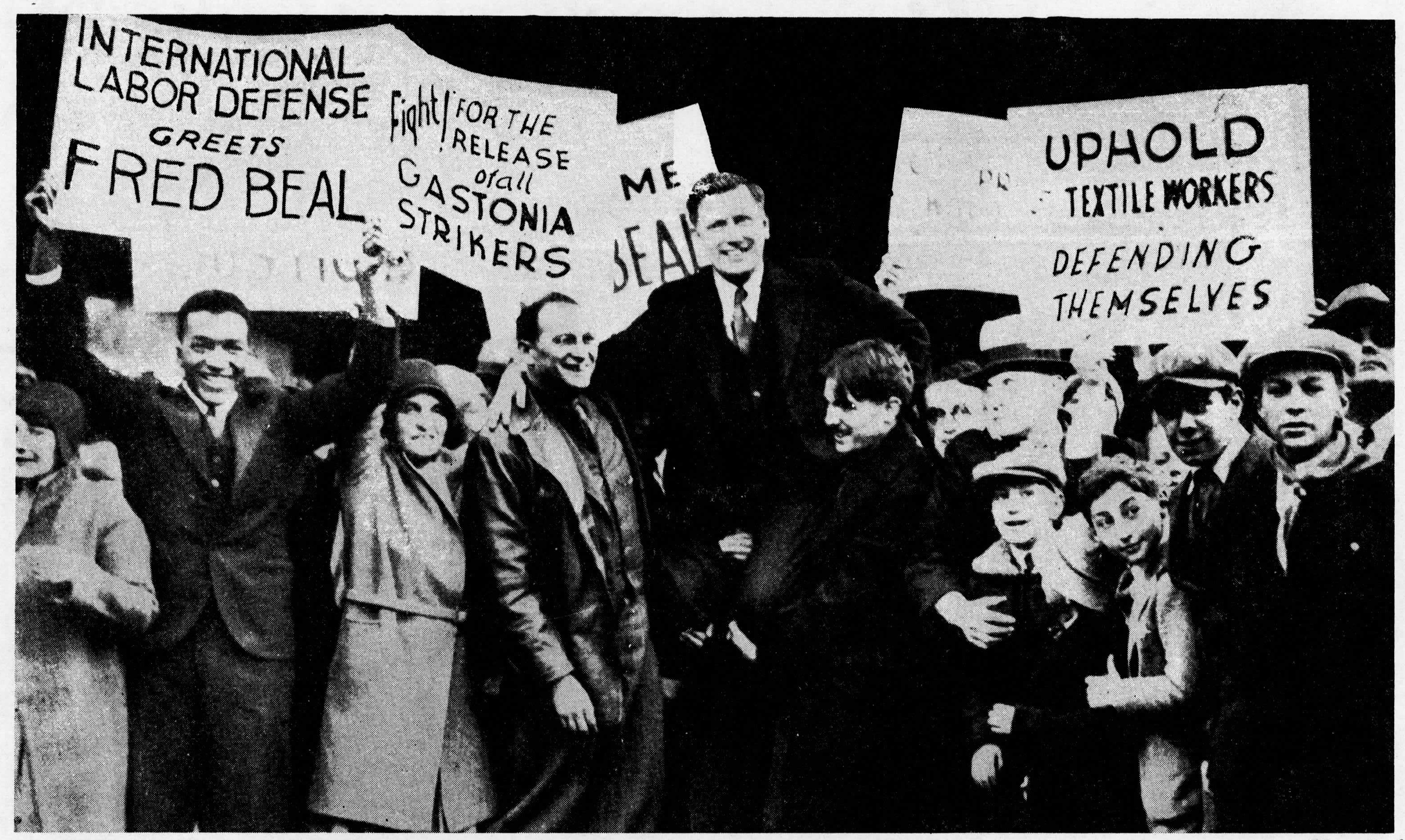
This slogan could not mobilize the widest sections of the population or even of the working class. But by that time the “third period” had hit the Communist Party in the form of a brainstorm so that it had become the order of the day to make-believe that the whole working class was on the verge of an armed struggle for power. This being the case, naturally, the working class would readily support southern workers on trial for an armed clash with local police.
Stripped of all its wild, exaggerated dressings, the slogan of “self-defence” amounts only to this, that any citizen has the legal right to shoot an intruder into his home. But any liberal will go to great lengths to uphold this right. Thus it was simply plain liberalism that Bill Dunne and Co. were defending!
In all the hysterical hullabaloo about guns, the main issue was lost sight of. The main slogan should have been “Defend the right of workers to organize and to strike!” This, with the basis of the awful conditions of the Southern textile workers and their valiant resistance against capitalist rationalization combined with the worsening of workers conditions everywhere and their increased will to struggle, would have made the broadest appeal. The slogan “Build Workers Defence Corps!” was in order for the southern workers whose every effort to organize is met with armed fascist bands. The frameup slogan should have been retained. There were enough elements of frameup in the case to warrant its use. The frame-up slogan, however, should always be a secondary one. It is a narrow slogan emphasizing the legal machinery of the state, rather than the everyday oppression of capitalism which hits all the workers. Hence it is really not much better as a principal slogan than the Party slogan “Defend the right of self-defence!”
These correct slogans were advocated by Comrade Weisbord before he was driven out of the South and his advocacy of them was made part of the vicious frame-up under which he was finally expelled from the party. Several important questions raised here which can only be mentioned in this article, as for example whether it was correct to maintain the Loray strike as long as we did, with only a handful of workers outside, whether we should have kept an armed guard under these circumstances, also as to whether the formation of armed guards of workers and armed clashes with the police are in order in all parts of the country today.
“Only Communists Can Defend Communists”
Proclaiming a period of “sharp working class offensives” to be at hand, the Communist have. Party leadership thrown the policy of the united front of the workers and their sympathizers against the capitalists to the winds. There was not even the realization, apparently, that the sympathy of various strata of the population both nationally and locally for the Gastonia case, should have been mobilized. Even in North Carolina, the whole population outside of the mill workers was not a frenzied fascist mob thirsting for blood of the defendants. On the contrary, there was much sympathy both latent and active. Had defence conferences been organized, the farmers’ jury sitting in had judgement over our boys might have a different story to tell. Many professional people, and middle class elements, too, would have rallied. But as it was even such sympathetic liberals who did come offering help were openly rebuffed or oggled at suspiciously as “spies”. As for the Negro masses, all the hollow boasting of the Daily Worker about “black and white fighting shoulder to shoulder” cannot alter the fact that no attempt to reach them was made. The inclusion of Negroes in the Labor Jury was a good gesture, coming late, but mere gestures do not win the masses. On this basis it was no wonder that the mobilization of support was not on the widest but instead on the narrowest possible scale.
“Don’t Irritate the Prosecution!”
All thought of rallying the other strata of the population having been cast aside by the Party officialdom one might expect that at least the working class would have been mobilized to exert the powerful pressure of mass demonstrations and strikes. “Only the mass action of the working class can save the Gastonia defendants.” How many times these words were bandied about in press articles, leaflets, speeches! As a matter of fact the working class demonstrations in were very weak throughout county. In the scene of action, Gastonia and Charlotte, they were abandoned completely.
A demonstration and parade in Gastonia at the opening of the trial was discussed and rejected. The lawyers were opposed to it. It would “irritate the prosecution,” would arouse our enemies.
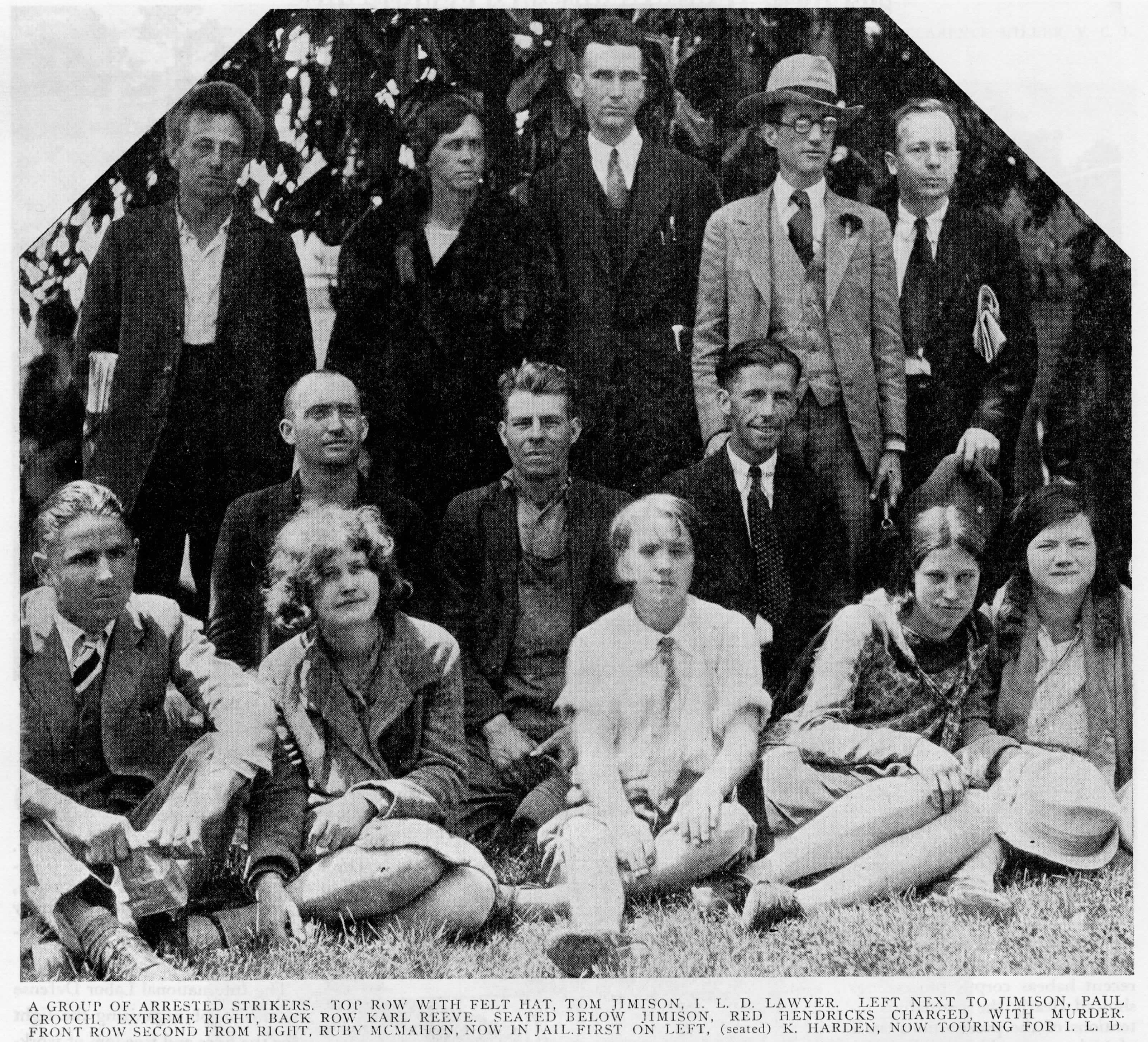
The workers themselves, of their own initiative, thronged the court house that day, and spontaneously gave an impressive demonstration of solidarity, which if organized, could have been multiplied one hundred fold. There was never a demonstration held in Charlotte during all the weeks of the trials there.
All suggestions of a of a mass protest strike were sneeringly turned down. The conviction was allowed to pass by without sign to express the bitter disappointment and rage of the workers of the whole territory. The working class was obliged to take this blow lying down. And since the conviction agitation has been practically dropped. Are we relying upon a Georgia U.S. Senator to win the appeal?
Thus while the Daily Worker painted highly colored pictures of stark class battles, in fact there went on all sides a quiet capitulation to liberalism–“This must not be a propaganda trial.” This was true of the trial itself as well as of the agitation accompanying it. A trial of Communists must be fought bitterly every step of the way not only with a view of freeing the defendants, but with a view of bringing forth in the most powerful way the terrible oppression against which the workers have rebelled.
But here, since the right of “self-defence” had become paramount, and since lawyers, not Communists were allowed to control the trial, testimony on technical points tended to predominate. The defence showed very little cleverness in evading the court’s orders against propaganda. With the ears of the whole country turned towards that court room in Charlotte, there was no statement made there as to the aims for which the Communist organizers were struggling. Perhaps this was due to lack of trust in the defendants’ ability to explain their ideals, for the only attempt the Party made was to try to get the State to put Bill Dunne on the stand as an “expert” on Communism! Some testimony on the work of the Pioneers was the nearest approach to such a statement of ideals by any defendant.
Nor was much brought out of the awful conditions of the southern mill workers the very basis of all this tremendous struggle. Such facts as the as the workers did manage to give on the stand regarding their miserable wages, their overwork, their bayonetting and clubbing appeared to come as a result of their own ingenuity rather than of direction from defence counsel.
Other minor errors were made. The Gastonia trial was a golden opportunity for the working class but it was an opportunity lost.
Demoralization
The Gastonia case occurred at time of crisis of leadership in the Communist movement. We who did the work in the field had to go upon the firing line with the general staff in a state of protracted demoralization at the center. The chaos and strife in the Party leadership showed itself in really criminal neglect and to the toying with a situation dangerous lives of the organizers. It was a real crime to have removed Comrade Weis- bord, for factional reasons from the field where he had gone at once after the shooting. It was a crime to have permitted “President” Reid to flee to Rhode Island to “look after his real estate property.” (Ellen Dawson was recalled for a trial at the same time). It was a crime to have sent no union representative to replace these comrades from June 10 to the middle July, with the trial coming off July 29! (Frenzied talk about “mobilize the workers” went on apace meanwhile). It was a crime to leave the I.L.D. work in the hands of one so notedly dilettante as Juliet Stuart Poyntz, with the result that the real preparation of the case was left till the eleventh hour.
But worst of all was the political crime, the failure of the Communist Party to appear in this most important situation. The Party was buried under the towering weight of other organizations. Two tiny little meetings in Charlotte were all that could be found of it, and even these Dunne carried out only under pressure from other comrades in the field. No wonder that no Communist slogans were introduced, no wonder that today the Party membership in the South is nil.
What is needed now for the Party members as a whole is to prick the airy bubble of “Southern achievements” and to make a real appraisal of the situation. This will be for them a step towards demanding what the movement needs so much–Communist leadership.
Workers Age was the continuation of Revolutionary Age, begun in 1929 and published in New York City by the Communist Party U.S.A. Majority Group, lead by Jay Lovestone and Ben Gitlow and aligned with Bukharin in the Soviet Union and the International Communist (Right) Opposition in the Communist International. Workers Age was a weekly published between 1932 and 1941. Writers and or editors for Workers Age included Lovestone, Gitlow, Will Herberg, Lyman Fraser, Geogre F. Miles, Bertram D. Wolfe, Charles S. Zimmerman, Lewis Corey (Louis Fraina), Albert Bell, William Kruse, Jack Rubenstein, Harry Winitsky, Jack MacDonald, Bert Miller, and Ben Davidson. During the run of Workers Age, the ‘Lovestonites’ name changed from Communist Party (Majority Group) (November 1929-September 1932) to the Communist Party of the USA (Opposition) (September 1932-May 1937) to the Independent Communist Labor League (May 1937-July 1938) to the Independent Labor League of America (July 1938-January 1941), and often referred to simply as ‘CPO’ (Communist Party Opposition). While those interested in the history of Lovestone and the ‘Right Opposition’ will find the paper essential, students of the labor movement of the 1930s will find a wealth of information in its pages as well. Though small in size, the CPO plaid a leading role in a number of important unions, particularly in industry dominated by Jewish and Yiddish-speaking labor, particularly with the International Ladies’ Garment Workers’ Union Local 22, the International Fur & Leather Workers Union, the Doll and Toy Workers Union, and the United Shoe and Leather Workers Union, as well as having influence in the New York Teachers, United Autoworkers, and others.
PDF of the full issue: https://www.marxists.org/history/usa/pubs/revolutionary-age/v1n13-may-01-1930.pdf
 Revolution's Newsstand