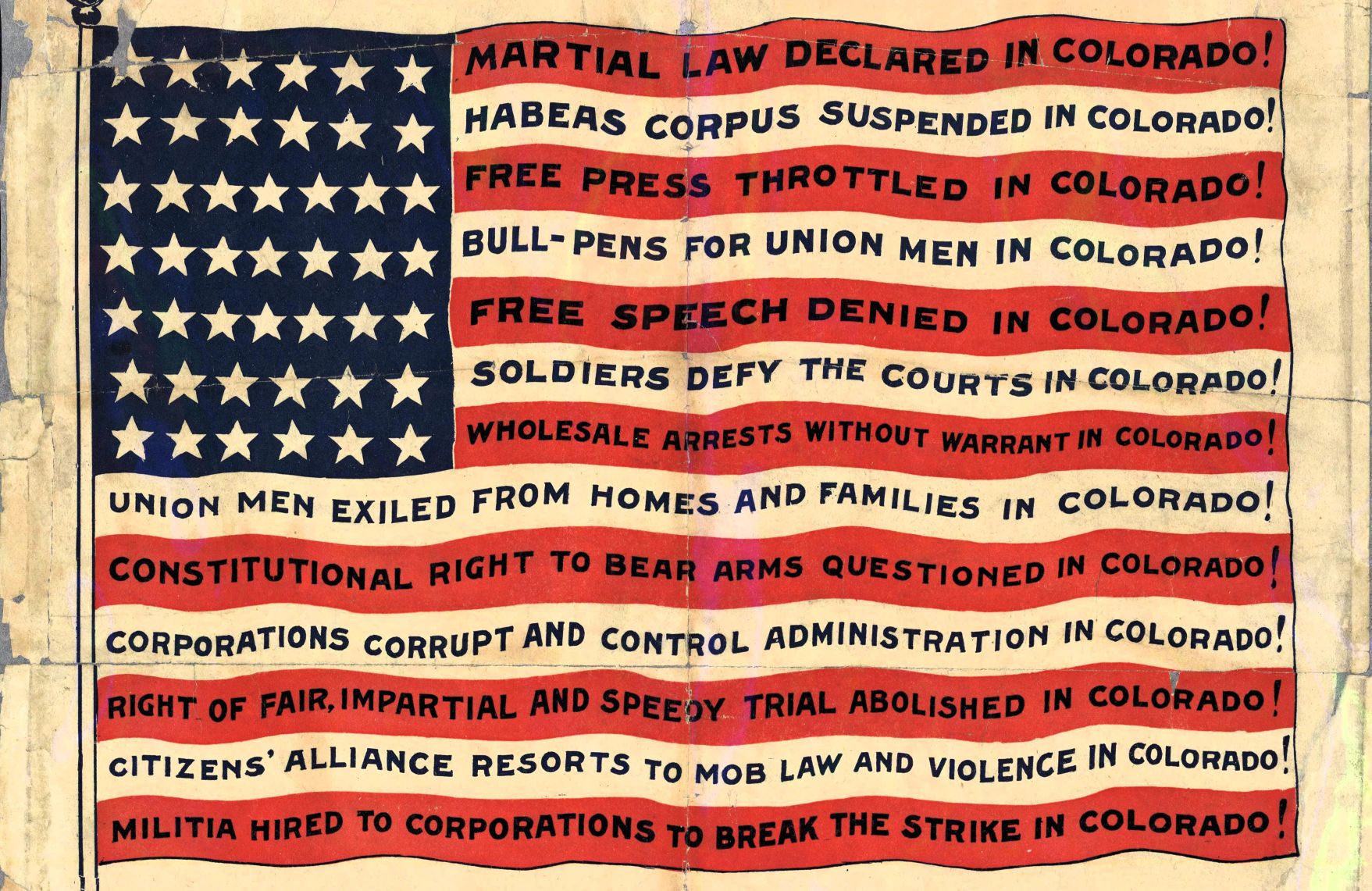
The American Labor Union, a federation founded by the Western Federations of miners as an industrialist competitor to the A.F.L., call union members across the country to the colors as martial law is declared in Colorado in an attempt to crush the miners strike there. A defining struggle of the early 1900s which brought Bill Haywood to national prominence and helped instigate the I.W.W.
‘Martial Law Declared: A Call to Action’ from American Labor Union Journal. Vol. 2 No. 11. December 17, 1903.
A CALL FOR ACTION
The Fierceness of the Class Struggle Is Becoming More Pronounced-Precedents Are Being Established for Future Use A Time for Men With Red Blood in Their Veins to Come to Support of Their Brethren.
Martial law has been declared in Cripple Creek, Colo. The town is in the hands of the soldiery. Captain McClellan occupies the mayor’s office. A press censor has been sent from Denver, and no news will hereafter be permitted to reach the outside world unless it has the approval of the militia officers. Fred Wakeman, a militiaman, was arrested as a spy, and will be court-martialed and may be shot for treason, BECAUSE HE HAD A UNION CARD IN HIS POCKET. At Telluride, Colo., thirty-eight men, members of United Mine Workers and Western Federation of Miners, have been arrested as vagrants and fined. Sentence was suspended, however, ON CONDITION THAT THEY GO TO WORK. The courts endeavored to force the men to scab.
The women of Cripple Creek have petitioned the president to protect a helpless community against the creature of the mine owners who occupies the executive chair in that state.
The conditions which now exist in the Centennial state are almost unbelievable to those who hug to their breasts the fond delusion that the government of Washington and Jefferson still lives.
The founders of the republic strove to establish, in theory at least, a government of the people. Today in Colorado it is a government of mine owners. As was done in the Coeur d’Alenes, so it is proposed to do in Teller county.
The action of the militia authorities in the case of Wakeman shows plainly that they understand the situation, if the working class do not. The possession of a union card, by Wakeman, is to be made the basis of a charge of treason against the government. Who is the government? Inferentially, then, the mine owners are the government.
Was the militia sent to maintain order, or to coerce workingmen? If to maintain order, why is not a peaceable union miner entitled to equal consideration with a peaceable mine owner!
Miners have been dragged from their beds without warrant of law. They have been thrown into jail or bull pen without trial and held there in resistance to civil process, and finally the rights of the people of an entire community have been suspended and complete unrestricted power, of life and death, over them has been assumed by a group of persons notoriously in the pay of men whose interest in Colorado is confined to the dividends they get out of it.
Workingmen, we must look the situation squarely in the face. The determined line-up of the western capitalist and against the working class began in Idaho; precedents are being built up today in Colorado for use in future struggles.
The fight has not yet started in Montana, because of political conditions, but the money powers of this state hate the Western Federation of Miners with the malice of hell, and when conditions permit, they overlook no chance to weaken it.
The miners throughout the land, from the Dominion of Canada to Old Mexico, have stood loyally by the heroes of Cripple Creek. Again and again have they responded with a dollar assessment or a day’s pay, and not a complaint, for they realize if Cripple Creek ends in defeat a blow will have been struck which will wipe out western unionism and drag the workingman of the Rocky Mountain states down to the condition of a Mexican peon.
The present is no time for rhetorical flights or vain recriminations. Capitalism, by the votes of workingmen, has been placed in control of the powers of government, which they are using to crush the unions to which we must look for bread. We must use such power as is still left us to prevent human rights and privileges from vanishing from the face of the earth.
The conditions which today confront the working class in Colorado must arouse every man who has a drop of red blood in his veins to action. “Is liberty dead!” In the light of recent experiences, the answer must be, yes. It is the duty of the working class to resuscitate it.
Who, when reading of the heroic action of a Hale, who regretted he had but one life to give, or of an Emmet, who went, scornful and unflinching, to the block, or of a Bruno, who gave his life for opinions’ sake, has not been fired with a desire to emulate these noble examples? Who, when reading of the heroic struggles of past ages, has not wished that he, too, might have lived at such a time and been enabled to give a proof of his manhood? The struggle now almost upon us calls for higher devotion to principles, a greater nobility of purpose, than any recorded struggle of the past. It is easy to die in the van of battle, cheered on to action by the cries of the multitude, sustained by the thought that one’s name may live in the minds of a grateful people.
To undergo the ignominy of arrest; to suffer the brutalities of bull pen confinement; to be paraded throughout the nation as a criminal; to risk the possibilities of a blacklist; to oppose, unarmed, bare hands, against the bayonet and the bullet of a gang of Hessians, requires a degree of heroism never dreamt of by many of the men we now revere. Yet this the miners of Colorado have done and are doing today.
To deny one’s self needed clothing or food; to refuse one’s family some of the little luxuries of life; to dig down in the almost empty pocket to find the dollar to maintain the boys who are struggling for “a fair day’s wage for a fair day’s work,” requires a kind of heroism, too, and this the miners of the west have done and are doing.
Must one portion of the working class bear the burden alone? The Cripple Creek region is one of the citadels of unionism, and there capitalism has massed its powers to do us to death. Shall the working people of this nation stand as spectators while our brothers are engaged in a death grapple? It is time for action. The dollars of the capitalists must at this juncture be met with the dollars of the working class. There is blood on their coin, while ours have been sanctified in sweat and suffering. Readers of the Journal, forward to the breach. Whether you are a native of Nova Scotia or of Florida, of New Jersey or California, it is YOUR battle the miners are fighting today. Support our champions by every means in your power. With right and justice on our side, the dimes of the working class are more effective than the gold eagles of plutocracy,
Were the Journal in the “Peabody Belt” the editor would land behind the bars for having penned this article. Peabody’s sphere of influence may speedily extend until it embraces this paper; when such treatment as was accorded the Victor Record may be served out to us, but until this happens we will continue to sound the call to action.
American Labor Union Journal was the official paper of the ALU, formed by the Western Federation of Miners and a direct predecessor to the I.W.W. Published every Thursday in Butte, Montana beginning in October, 1902 before moving to Chicago in early 1904. The ALU supported the new Socialist Party of America for its first years, but withdrew by 1904 as the union and paper grew more syndicalist with “No Politics in the Union” appearing on its masthead and going to a monthly. In early 1905, the Journal was renamed Voice of Labor, folding into the Industrial Workers of the World later that year. The Journal covered the Western Federation of Miners and the United Brotherhood of Railway Employees, as well as the powerful labor movement in Butte.
PDF of full issue: https://www.marxists.org/history/usa/pubs/american-labor-union-journal/031217-alujournal-v2n11.pdf
 Revolution's Newsstand