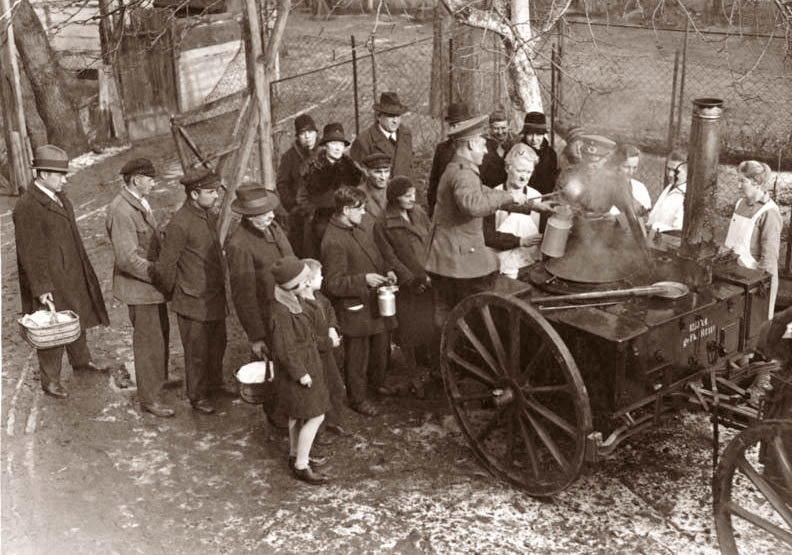
Walking the streets of Berlin, Scott Nearing observes the reality of the post-war reparations regime imposed on Germany by the Allies; who pays and who does not.
‘Reparations’ by Scott Nearing from New Masses. Vol. 6 No. 12. May, 1931.
I.
The sound of hob-nailed shoes on the frosty pavements breaks the winter morning silence. It is six o’clock. I leave my room and walk through the blue darkness of German city streets.
I cross under the railroad tracks and pass a butcher-shop and a bakeshop where workers wives are already buying their day’s provisions. At a distant corner under a street lamp moves a procession of dim figures. They emerge from the shadow, flit through the circle of light and then disappear into the shadow again. I join this procession of workers.
Across the dimly lighted street there is a woman with a child. She is poorly protected against the penetrating cold; over her head is a scarf and her hands are bare. The child is more warmly clothed. He is about two years old, and his little legs move reluctantly at half-past six of a cold winter morning. I leave the stream of workers and walk slowly along behind the mother and child.
For a time the two go on together; the high childish voice sounding incessantly, the mother answering in monosyllables. The child stops beside a lamp-post; the woman who is several steps in advance, turns and calls. There is a discussion. Again reluctantly the child goes on with his mother. Time after time this procedure is repeated as the two make their way through the gloom.
At length they turn into a lighted entrance over which there is a sign: Day Nursery. I stand in the shadow and watch. Woman after woman leaves the line of hurrying workers, and goes into the day nursery with her child. Some of the children are as old as five or six. Some are infants in baby carriages.
I step into the circle of light thrown from the doorway and look at my watch. It is twenty minutes of seven.
Another block—the factory. A Siemens factory, one of a chain belonging to the great German industrial Siemens concern.
Towards the open gateway is pouring a steady tide of workers, men and women. Some come on bicycle. Most walk; their hobnailed boots clattering and echoing through the street. They loom out of the semi-darkness, pour into the factory maw and are swallowed up, while their places on the street are taken by other hurrying forms.
At five to seven the crowd is thinner. Here and there a few stragglers are making a rush for the gate. Lights flash up in the factory windows. A bell rings. Belts begin to move, pulleys whir. There is a buzz of machinery. It is seven o’clock. More than three thousand men, women and children are at work.
II.
The Siemens interests have issued an annual statement. Their total sales between 1929 and 1930 have fallen 6 percent—from 850 to 800 million marks, but there have been important retrenchments that have resulted in an increase of net earnings. The usual dividends have been paid.
How were these retrenchments made possible? The report does not give all of the details, but with a 6 percent decrease in total business there has been an 18 percent reduction in the number of workers. A regular phase of Siemens policy is to increase output while they decrease workers. In 1924-25, the Dawes Plan year, the Siemens interests employed 112 thousand workers and did a total annual business of 500 million marks. 1929-30 the number of workers employed was 113 thousand while the business done was 800 million marks. Thus for each worker the increase in business done was about 60 percent.
The Siemens interests have employed another means of retrenchment. On November 1st of 1930 they cut wages 2 percent. On February 1st 1931, they again cut wages—5 percent. The workers are producing more but they are getting less.
Another item in the Siemens Report, of particular interest to workers outside Germany, deals with exports. During this last year of hard times and world economic crisis, while the total amount of Siemens business decreased 6 percent, the exports of their products rose more than 8 percent. Wage-cutting and speedup in Germany are having their effects on international markets. Siemens are underselling their competitors in the world struggle for imperial wealth and power.
III.
Allied Imperialists drew up a Treaty in 1918-1919 based on the slogan: “Germany must pay!” Ever since the Treaty was signed, one of the chief tasks before French, British, and other imperialist statesmen has been the collection of reparations.
The huge burden loaded by the Allies upon Germany could not be paid in money nor could it be paid in goods collected at one time. It could be met only if Germany sold more goods than she bought, year after year, for half a century. To sell these goods in the world market, the masters of Germany must lower their costs of production, either by increased exploitation of the workers, or by reducing the profits of the German exploiters.
Since both German economy and the German state machinery are in the hands of the exploiters, it is obvious that they would do their best to avoid meeting reparations payments out of their own pockets, and to load the burden on the workers. Even though the German exploiters should wish to meet the demands of the Allies by reducing their profits, they could not do so.
Under a system of capitalist economy, if profits are reduced in one country, the capital from that country will flow to neighboring countries where profits are higher, thus making capital so scarce at home that the interest rate must rise and restore profits to their former level. German exploiters cannot be made to pay. The cost of reparations must therefore be met by wage-cuts, speed-up, and lowered living standards for the workers. And these lowered working-class standards in Germany must drive down the working-class standards in the capitalist countries with which German exploiters are in competition.
This process is very apparent all over Germany. Not only in the Siemens plants but in the entire German industry, wages are being cut, workers are being speeded-up, increasing quantities of goods are being exported and relatively high profits are being paid.
And so reparations demands are being met not by the exploiters of Germany, but by the German masses. During the Revolution of 1918 the German workers failed to wipe out the capitalist imperialism and join the workers of the Soviet Union in their program of Socialist construction. Today they are paying the penalty—carrying on their backs the burden of reparations.
Berlin, Germany
The New Masses was the continuation of Workers Monthly which began publishing in 1924 as a merger of the ‘Liberator’, the Trade Union Educational League magazine ‘Labor Herald’, and Friends of Soviet Russia’s monthly ‘Soviet Russia Pictorial’ as an explicitly Communist Party publication, but drawing in a wide range of contributors and sympathizers. In 1927 Workers Monthly ceased and The New Masses began. A major left cultural magazine of the late 1920s and early 1940s, the early editors of The New Masses included Hugo Gellert, John F. Sloan, Max Eastman, Mike Gold, and Joseph Freeman. Writers included William Carlos Williams, Theodore Dreiser, John Dos Passos, Upton Sinclair, Richard Wright, Ralph Ellison, Dorothy Parker, Dorothy Day, John Breecher, Langston Hughes, Eugene O’Neill, Rex Stout and Ernest Hemingway. Artists included Hugo Gellert, Stuart Davis, Boardman Robinson, Wanda Gag, William Gropper and Otto Soglow. Over time, the New Masses became narrower politically and the articles more commentary than comment. However, particularly in it first years, New Masses was the epitome of the era’s finest revolutionary cultural and artistic traditions.
PDF of full issue: https://www.marxists.org/history/usa/pubs/new-masses/1931/v06n12-may-1931-New-Masses.pdf
 Revolution's Newsstand