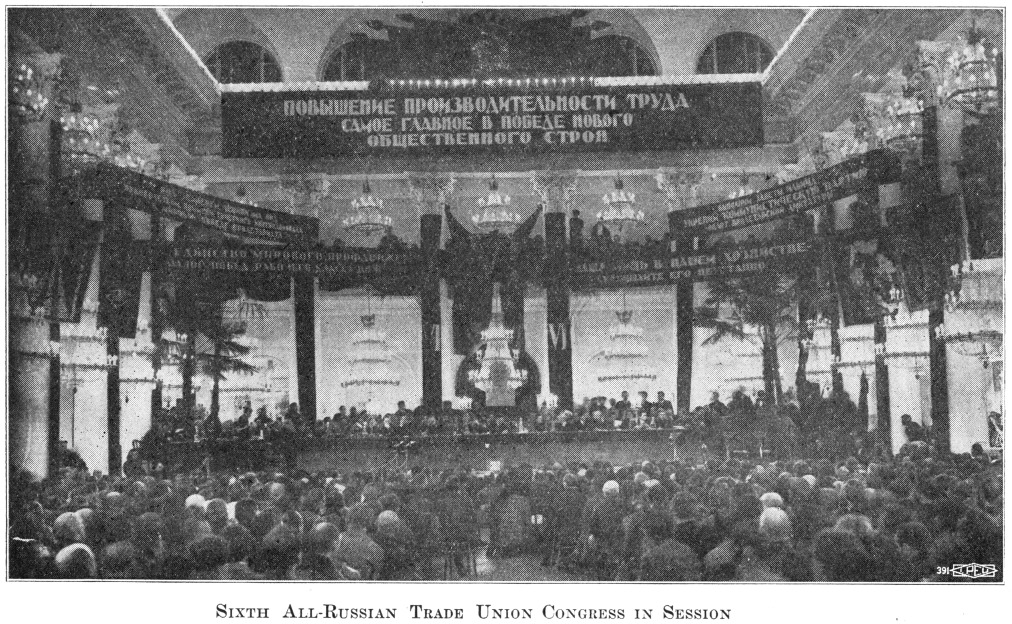
The N.E.P.-era Congress is addressed by Rykov, Tomsky, Losovsky, and visiting British delegates in this report from Charles Johnson, T.U.E.L. representative to the gathering.
‘The Sixth Trade Union Congress of the U.S.S.R.’ by Charles E. Johnson from Workers Monthly. Vol. 4 No. 4. February, 1925.
THE Sixth Trade Union Congress of the Union of Socialist Soviet Republics assembled at the time when the economic conditions of the proletariat of the Soviet Republics had been thoroughly improved; when the international position of the U.S.S.R. had been greatly strengthened and when on the other hand, a new wave of reactionary forces was rising and sweeping against the working class of the world.
The desire of the Russian workers to create the United Front with the workers of all other countries in the struggle against the capitalist offensive stands out prominently in all the decisions of the trade union congresses. Unfortunately, however, thus far all the attempts towards bringing together and uniting the trade union movement have ended in failure, of course, owing to the treacherous disruptive policy of the yellow bureaucrats, especially those of Germany.
Nevertheless, Comrade Zinoviev, addressing the Sixth Congress in the name of the Russian Communist Party, and analyzing the world situation in his usual masterly manner, again emphasized the necessity of the united trade union movement, saying in part as follows:
“We have been and are today true pupils of Lenin, members of the Communist International, and we firmly adhere to our positions. And remaining at our fighting posts, without any diplomacy we extend a helping hand to the organized trade union movement of the world and say: ‘Let us unite on elementary principles, on the A.B.C. of the struggle against the bourgeoisie that is advancing with such unheard of insolence and unanimity.’ Yes, without fear of being mistaken we say: ‘The time will come when in spite of everything we shall form a United International of Trade Unions, and the British workers will not be among the last of those who together with us will map out the course of final emancipation and freedom for the workers of the world.’”
That this statement and appeal is not an empty phrase but rather based upon reality can be substantiated by the very fact that lately a leftward tendency has been developing among the British Trade Union Movement and, despite the Ramsay MacDonalds, Clynes, etc. the British and Russian trade unions have established connections and friendly contact. Further, the cordial reception given to the Russian trade union delegation at the recent British Trade Union Congress and the tremendous ovation received by the British Trade Union Delegation at the Sixth Russia Congress serve as striking illustrations of friendship.
Above all did the speeches of the British delegates make it certain that this new friendship will bear fruit, especially those of Ben Tillet and A.A. Purcell. Paying tribute to Lenin, Tillet said:
“Passing the mausoleum today, I thought there was great significance in that structure where lies the relic of one of the greatest men we have ever known. I think Lenin was the greatest man in his attack upon the capitalist system, he was a still greater man in holding you together. It does not lie with Lenin now, but with the principles he taught, it lies in your soul, in your brain, to carry on that work, for the world looks to you. May your message be overpowering, and may your example bring the people of the world together in a mighty brotherhood of men.”
Comrade Purcell asserted:
“I can say that our British working class has greater appreciation of international work, and knows more of Russia today as a result of our agitation, and can appreciate the work of the Russian workmen far, far better today than they did in the days previous to the General Election. Our adherents have been growing numerically until now we can count 5,500,000 voting solidly for the candidates of the working class despite all lies and calumnies. Again, be that as it may, the time has come when there must be international unity, and when I say that, I believe that the real basis of international unity must be a definite Anti-Capitalist class organization and not any general form of unity.”
“More and more, I repeat, our working class in Britain, is beginning to recognize the importance of international solidarity and, I think, I am uttering their view when I say that our own General Council of the British Trade Union Congress will do its utmost to see that the Russian Trade Union movement is brought within the sphere of the international mosaic. Our first step is to get some agreement as to the basis, to get the parties together and to come to some form of common agreement. I say that we cannot leave them out of account, it would be absurd to attempt to leave Russia out of any type of international organization. It would be like having Hamlet played, without Hamlet acting in the play. Our task is that of the British Trade Union movement, and our mission is, that of mediators. You must try to meet as far as you can our desires to come together under the international flag. We, on our part, will do all we can in that direction. If Amsterdam cannot do it, then, we, of the British movement, are convinced that it will be our task to force on this unity ourselves.” (Prolonged applause)
Thus the question of the international unity of the trade unions of the world became the central issue of the Sixth Congress of the Trade Unions of the U.S.S.R. Of course, the question of the practical measures necessary to establish unity in the international trade union movement and to organize, in accordance with the decisions of the Comintern and of the R.I.L.U., a United International, arose in its full scope.
Comrade Losovsky, reporting on the unity of the international trade union movement, faced this question squarely when he stated that we are fully aware of the deep gulf dividing the Communists from the Amsterdamers, but that we still urge the calling of an International Congress on the most democratic principles and we tell the Amsterdamers:
“Should you prove to be in the majority at the congress you will direct the affairs, and we–the minority–will fight for influence over the masses. Should the R.I.L U. adherents come out victorious, however, the entire working class would be considered as a single army, and the Executive Bureau as the fighting proletarian staff directing this army.” He also emphasized that unity, to be achieved, depends upon the carrying out of the following slogan: “Into the factories and shops, to the masses, and again to the masses. For the broken trade union movement of the world can be welded together only through the pressure of the entire labor movement. And one of the most effective methods of promoting unity is to establish agreements and joint committees between the trade unions of the various countries.”
The approchement between the two most important sections of the world trade union movement–Russia and Britain–Losovsky reiterated, marks the beginning of a new era in the creation of organic unity of the world labor movement, especially since the projected international is to draw in the workers of the colonial and semi-colonial countries.
After brief discussion in which besides the Russians, also the members of the Executive Bureau of the R.I.L.U. and the representative of the French Unitary Confederation of Labor participated, Comrade Tomsky, in the name of the Presidium of the Congress, read the following resolution:

“In view of the fact that the speedy bringing about of unification in the international trade union movement possesses a historic significance for the whole world–especially in view of the approaching period of fresh bourgeois imperialist reaction, in many of the most important countries–the Sixth Congress considers it is its duty, on its part, to do absolutely everything in its power to help in this matter.
“The Sixth Congress considers it is its duty to meet half-way the measures undertaken by the Hull Congress of the British trade unions and is glad to confirm that with its decision, according to the declaration of the Delegation of British trade unions at present in Moscow, it will be satisfying the desires of the overwhelming majority of the British workers.
“In order to co-ordinate the activities of the British and Russian trade union movements, in the matter for fighting for unity, the Sixth Congress will give all powers to the All-Russian Central Council of Trade Unions, after negotiations on this matter with the General Council of the British Trade Unions, jointly form an Anglo-Russian Commission, the task of which will be to co-ordinate the actions of the trade union movement in both countries in their struggle for the unity of the international trade union movement.
“The Congress proposes that the All-Russian Central Council of Trade Unions should immediately set to work to carry this into effect, while taking into consideration the Congress’s earnest desire that said Commission should be formed not latter than January of 1925.
“Likewise the Congress charges the All-Russian Contral Council of the Trade Unions to take all steps which it will find necessary in the interests of the unity of the international trade union movement”
“The Sixth Congress notes with pleasure the declaration of the British Trade Union Delegation at present in Moscow, to the effect that it considers this step as very expedient and that it will defend and advocate it before the British Trade Unions and their General Council. In such a co-ordination of the activities of the British and Russian (U.S.S.R.) Trade Unions for the attainment of unity, the Sixth Congress sees a true guarantee for the success of the international unification of the trade unions and a strengthening of the fraternal relations between the workers of Great Britain and the workers of the U.S.S.R.
“The Congress holds that in following this example the trade union organizations of other countries will, on their part manifest the necessary activity for the realization of unity.”
You see then, declared Tomsky, that so far we have made a very modest beginning in the matter of reaching the objective we have set ourselves. We are fully aware of the fact that unless the German, French, Italian, Czecho-Slovakian, Polish, Austrian and the trade unions of other European as well as non-European countries are made to take up the fight for the establishment of unity, there can be no talk of a genuine international unity of the trade union movement.
The problem of the unity of the international trade union movement can in no way be settled by the question of the mutual relationship as between the All-Russian Central Council of the Trade Unions and the Amsterdam International. The realization of unity will only be rendered possible provided all organizations embraced by the R.I.L.U. enter into the make-up of the future new united international of trade unions.
Comrade Tomsky further declared that the struggle for unity must be closely interwoven with the struggle against imperialist wars, intervention, Fascist reaction, the capitalist offensive, the Dawes plan, which aims at the enslaving the German workers to the Anglo-American capital.
In making this move the Russian unions point out that the R.I.L.U. had repeatedly declared its readiness to lead the trade union movement out of its state of isolation, for which purpose a world trade union congress should be convened on an equitable basis where the trade unions affiliated to both the R.I.L.U. and Amsterdam should be represented.
The Sixth Congress of the Trade Unions of the U.S.S.R. unanimously approved Comrade Tomsky’s statement and adopted the resolution without a dissenting vote.
True, this agreement is still subject to ratification by the General Council of the British Trade Unions. There will, of course, be found plenty of opponents among the British trade union bureaucrats and it goes without saying that such arch-reactionaries as Wm. Green, Grassman, Jouhaux, etc., will apply themselves to the utmost to prevent its going into effect. It is doubtful, however, whether they will be successful in disrupting and sabotaging the agreement, as the Left Wing lead by Purcell, Hicks, and others has the sympathies of the overwhelming majority of the British Trade Union members and, we are inclined to hope that Purcell will prove a man of action and will translate his words and promises into effective deeds.
It is clear, in any case, that an acute struggle between the Left Wing and the Right Wing of the Amsterdamers is inevitable. This struggle will bring ideological clarity and strengthen the organizational solidarity of the militant elements both in England and elsewhere, affecting even politically and organizationally backward America. On the whole, this is a serious event, which will undoubtedly give added impetus to the problem of world’s labor unity.
The Left Wing of the British Trade Unions still has a quite confused ideology; it is a mixture consisting of stern class war fighters and pacifists. The latter tendency is on the decline, class-conscious tendency is growing numerically and gradually drifting towards the Communist position. Consequently, I believe, that the Left Wing and the National Minority movement of Britain, lead by Comrade Pollitt, will fight together, which of course, will accelerate the drift of the Purcell’s Left Wing further to the left.
The second most important and attractive issue at the congress was the state of the Soviet economy. In reporting on this question Comrade Rykov pointed out that the peasantry represents the basis of the entire Soviet economy and that the economic life of Soviet Russia can develop only through cooperation between the proletariat and the peasantry, which is of mutual benefit to both and that the prosperity of the proletariat depends upon the prosperity of the peasantry.
Citing much statistical data to illustrate the increase of cultivated area, horses and cattle among the farmers, Rykov showed that farming has moved far ahead during recent years and that this upward tendency continues unabated. This does not mean, of course, that there are no more poor in the villages or that the peasants have their needs fully satisfied.
As regards industrial production, approximately 50 per cent of the pre-war level has been reached. Metal is still at the lowest point. In 1921-22, only ten million pig iron was produced; in 1923-24, production rose to 40 million poods, while during 1924-25, the production program provides for 60 million poods. Compared with pre-war production, this amounts to only 20 per cent, however. The chief difficulty in rehabilitating the heavy industry lies in the fact that its regeneration cannot be brought about merely through the demand of the market, for it was fostered during the old regime by huge governmental orders for railways bridges, etc. The present condition of the country does not make it possible, as yet, to embark upon such large scale construction work.
The most difficult problems with which Soviet government has had to grapple, Comrade Rykov stated, were first the price fixing policy, and second, the stabilization of the currency. The failure to solve these problems would lead to a political break between the peasantry and the working class. However, thanks to the lowering of prices, the industries are now unable to fully meet the demand of the peasantry, whereas last year, when the prices were very high, there was practically no demand and the industries found themselves in a blind alley.
However, this victory would not be certain had it not been backed by a stabilized currency. Since the introduction of stable money the city and the village have become firmly connected by the medium of exchange. Our balanced budget without any paper currency emission, represents both a good and bad factor. A good factor because in it lies the guarantee for the stabilization of the currency; it is bad because We are forced to hold in abeyance a number of absolutely undelayable needs.
However, all these tremendous achievements would have been impossible without the cooperation and support of the trade unions.
Comrade Tomsky, chairman of the All-Russian Trade Unions, reported that the unions have been frequently reproved for their wage policy, as their decision to support the policy of the stable currency adversely affected the material conditions of the workers; the unions, however, made this sacrifice quite consciously. Comrade Tomsky also touched upon the fact that some unions began to take too much interest in commercial activities, in the formation of business companies, in advertising, etc., but that these tendencies were nipped in the bud. The All-Russian Central Council of Trade Unions also fought against any merely formal approach towards the new problems and against all bureaucratic tendencies. Though the trade unions know that they are a school of Communism, still not all of them have fully realized the essence of this idea. The unions sometimes forget that they are organizations of workers of various political views. It is still indisputable that the connections with the masses have been strengthened, as is shown by the existence of 35,000 shop committees with an active membership of 120,000 men.
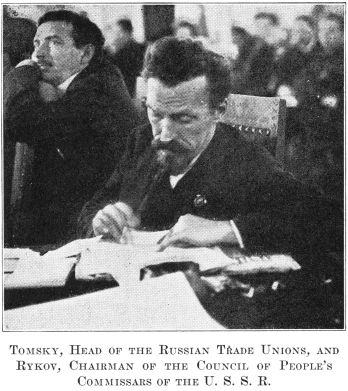
At the time of the Fifth Congress—1922—the Russian unions had 4,547,000 members; on July 1, 1924, the membership stood at 6,036,000, which amounts to 92 per cent of all the workers. Practically 80 per cent of the organized union membership pay their dues individually.
For the two years since the Fifth Congress the wages have increased on an average of 63 per cent. The present general average wage level equals 75 per cent of the pre-war level. It should be pointed out that the wages have already overtaken the growth of productivity. Therefore, further raises of wages depend upon further productivity increases.
The congress unanimously noted the economic improvement in the conditions of the workers and endorsed the general policies of the A.R.C.C.T.U., as affecting the stabilization of currency, wages and productivity.
The congress also decided to strengthen the connections with the local unions; to give more attention to the cultural work; to strengthen the participation of the unions in the reconstruction work of the Soviet industry and to render all possible assistance in raising productivity. The congress called the attention of all the unions to the necessity of raising the activities of the workers organized in the villages, of creating strong union nuclei in the villages and strengthening the primary organs of the land and forest workers’ union, which will be one of the best means of strengthening the union (smitchka) with the peasantry. The Congress also decided it necessary to strengthen to the utmost the work among women and the youth, and to proceed further with the organization and solidification of the working masses.
The report of the Credentials Committee showed that the Congress was attended by 1,045 delegates, 853 of them having decisive votes. The national composition of the delegates was as follows: Russian, 66.6 per cent; Jews, 14.4 per cent; Ukrainians, 7.3 per cent; White Russians, 3.5 per cent; Letts, 1.5 per cent; Georgians, 1.1 per cent; Esthonians, 0.5 per cent; Tartars, 0.5 per cent; Ossetins, 0.2 per cent, etc.
The Sixth Trade Union Congress received a report of the persecutions showered upon the labor militants in the capitalist countries, and sent them hearty greetings, expressing the conviction that nothing can save the capitalist system and that the hour of the proletarian victory throughout the world is drawing near.
The chairman of the Congress announced that Comrade Dudileaux was instructed by the French Unitary Confederation of Labor to invite a delegation of the Russian unions to the coming congress of the Confederation.
The Congress heartily thanked the Confederation for the invitation, and sent cordial greetings to the French proletariat; the A.R.C.C.T.U. was directed to appoint a delegation in order to strengthen the friendship and fraternal relations between the workers of the two countries.
The final act of the Sixth Trade Union Congress was to honor Comrade Tomsky in a very warm and friendly spirit on the occasion of the twentieth anniversary of his revolutionary activities.
The chairman of the Congress announced its session closed after a brief address urging fidelity towards the teachings of Lenin. The Congress closed to the singing of the “International.”
With music and revolutionary songs the delegates left the richly and impressively decorated hall, merging with the tremendous throng which surrounded the building, listening in spite of the very late hour, to the speeches made audible with the aid of an amplifier.
All in all, the Sixth Congress of the Trade Unions of the U.S.S.R. has been conducted in the most democratic and business-like fashion. There were no appointments, but elections right along the line. And whoever wanted the floor got it without difficulty, in marked contrast to the A.F. of L. gatherings. The overwhelming majority of the delegates came direct from the shops, mines, etc., and it was wonderful and pleasant to note their keen participation in the debates on all matters; their determination and clear-cut action on all problems confronted. Here the Trade Union Congress was busy finding ways and means to entrench and extend their Soviet state, their control and reconstruction of industry and to clip the wings of the remnants of the bourgeoisie and make it work.
The Workers Monthly began publishing in 1924 as a merger of the ‘Liberator’, the Trade Union Educational League magazine ‘Labor Herald’, and Friends of Soviet Russia’s monthly ‘Soviet Russia Pictorial’ as an explicitly Party publication. In 1927 Workers Monthly ceased and the Communist Party began publishing The Communist as its theoretical magazine. Editors included Earl Browder and Max Bedacht as the magazine continued the Liberator’s use of graphics and art.
PDF of full issue: https://www.marxists.org/history/usa/culture/pubs/wm/highres/v4n04-feb-1925-6-gra-WM.pdf
 Revolution's Newsstand