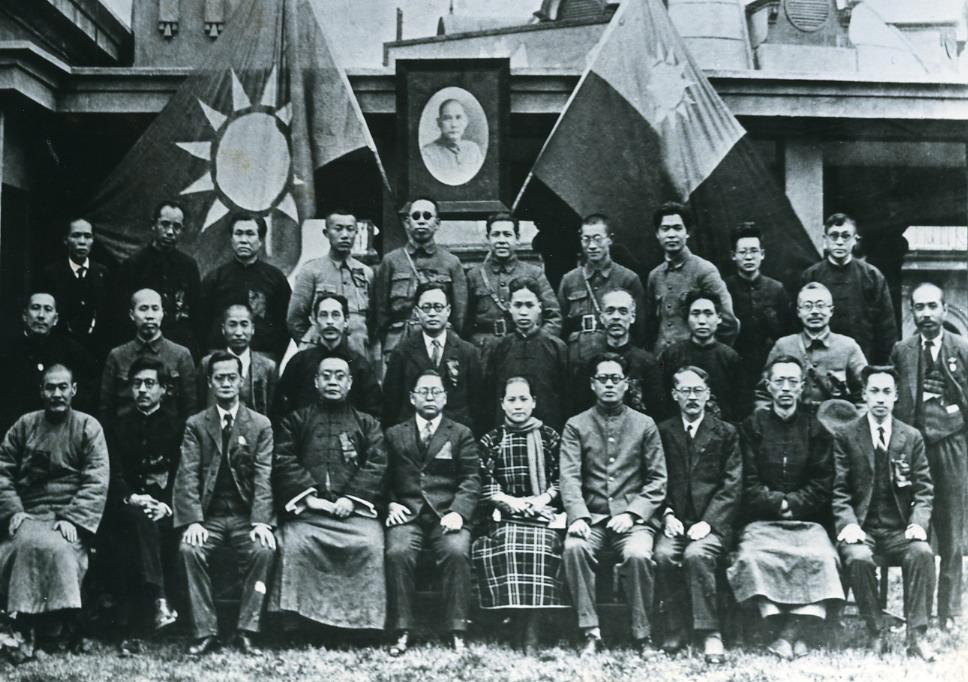
A key Comintern resolution coming at a crucial time, and after sharp debate, on policy in the Chinese Revolution. Those debates, because of events on the ground and the Opposition yet to be expelled, peaked in 1927. Bukharin’s leadership of the Comintern saw an accentuation of the International’s orientation to the Koumintang, now without Sun Yat-sen, and a sharp disagreement, mainly though not exclusively, from the United Opposition. In April of that year anti-imperialist confrontations in Nanjing and imperialist military intervention signaled both greater strength of the anti-imperialist movement, and imperialist resistance to China’s growing unification movement. Worried over militant and left ascendancy the KMT Right under Chaing-Kai-Shek turned his former allies. In April his Nationalist Army approached Shanghai against the militarist clique in control. Communist and Left KMT forces staged an uprising in the city to wrest control before the National Army entered. As it entered, it shot down its former allies by the thousands and the KMT split between Left and Right. The Left KMT regrouped in Wuhan, including members the Communists, and set up a rival Nationalist base. Shortly after this resolution was passed, on July 15, 1927 the Left KMT Wuhan government, under military pressure from Chang, turned on their Communist allies purging them from the government and outlawing them. The First United Front, a policy central to the Comintern’s larger political perspectives in the mid-1920s was not just over, but a disaster in which thousands of the best Communist fighters in China were killed.
‘Resolution on the Chinese Question’ from International Press Correspondence. Vol. 7 No. June 16, 1927.
1. The Significance of the Chinese Revolution.
The Plenum of the E.C.C.I. places on record that recent events have entirely confirmed the point of view of the Communist International concerning the Chinese Revolution, and are a brilliant confirmation of Lenin’s predictions as to its international role.
The great Chinese Revolution is becoming more and more an enormously important factor directed against the whole system of international imperialism and its principal world centres.
On this account the policy of Social Democracy and of the Amsterdam International is direct abetting of imperialism. This policy is aimed at veiling the meaning of the Chinese Revolution and of imperialist intervention; it is a policy of platonic slogans and pacifist half-measures, merging into the direct justification of the criminal war against the Chinese Revolution (Thomas, MacDonald & Co.).
The E.C.C.I. declares that the international significance of the Chinese Revolution becomes all the greater since the counter-revolutionary war of strangulation, conducted by the imperialists against the Chinese people, the concentration of imperialist armed forces in China (the foreign warships and troops, the practical occupation of Manchuria by Japan, the practical seizure of the principal ports by Great Britain and the United States, etc.) is accompanied by provocative actions against the Soviet Union and by the maturing of mighty conflicts within the anti-Chinese imperialist front which, at the present stage is united.
Consequently, only by the despicable role generally played by Social Democracy which is actively taking part in the ideological preparations for the war and only by its bourgeois pacifism, which conceals its social imperialism, can the position of Social Democracy and the leaders of the Amsterdam International on the question of the Chinese Revolution be explained.
The Communist International holds that a party or organisation which calls itself labour, and which refrains from conducting a most determined struggle against intervention in China, which lulls the vigilance of the working class and advocates passivity on this question, objectively (and sometimes subjectively) assists the imperialists. These parties assist imperialism not only in strangling the Chinese workers and peasants, and thus helping to strengthen the imperialist system, but help it in its preparations for war against the Soviet Union and for world war in general.
The Executive Committee of the Comintern imposes upon all Sections the obligation actively to support the Chinese Revolution and to put up an active fight against intervention in China by mobilising the masses, organising masses resistance to the despatch of troops, arms, etc. The Executive Committee of the Comintern imposes upon all its Sections the obligation to explain to the broad masses of the proletariat and the toilers generally the international meaning and significance of the Chinese Revolution, the connection between counter-revolutionary intervention in China and the preparations being made for new wars and with the domestic crusade against the working class (anti-trade union Bill in England, the Military Laws in France, the Fascist terror in Italy, etc.).
The Executive Committee of the Comintern believes that it is necessary at the same time to conduct persistent work to expose the policy of Social Democracy and of the Amsterdam International which are sabotaging every step taken actively to counteract the imperialists and their government.
2. The Crisis in the National Revolutionary Movement and the New Situation in China.
The E.C.C.I. places on record that the progress of events in the Chinese Revolution has confirmed the estimation of the driving forces of the revolution made at the last Enlarged Plenum. The E.C.C.I. particularly places on record that the progress of events has entirely confirmed the forecast made by the VII. Enlarged Plenum concerning the inevitable abandonment of the united national revolutionary front by the bourgeoisie and its desertion to the counter-revolution.
This process was expressed in the counter-revolutionary coup d’etat by Chang Kai-shek and a number of other generals, the formation of the Nanking Government and the se- cession of the Right Wing of the Kuomintang who have formed their own counter-revolutionary organisation and claim it to be the Kuomintang.
Chang Kai-shek’s coup has created a new general political situation in China and a new alignment of the principal class forces in the country. The Chang Kai-shek coup signifies a fundamental re-grouping of classes, and consequently the tactics of the Comintern must be based on these new circumstances. Any attempt to base tactics on the possible compromise with Chang Kai-shek or with the Right wing of the Kuomintang would be nothing less than direct capitulation to Chang Kai-shek and open betrayal of the interests of the Chinese Revolution.
The principal cause for the treachery of the bourgeoisie and of it military leader, Chang Kai-shek, was the growing mass movement of the working class and of the peasantry, and the increasing pressure of the combined forces of international imperialism. Scared by the development of the mass movement and its revolutionary class demands and slogans, the bourgeoisie inevitably had to prefer and did prefer a deal with the imperialists and militarists rather than the further development of the revolutionary struggle. By this the bourgeoisie placed itself outside the ranks of the revolutionary front. Notwithstanding partial defeats and the counter-revolution brought about by Chang Kai-shek and Co., the revolution has passed to a higher stage: the bloc between the bourgeoisie, petty bourgeoisie, the peasantry and the proletariat has collapsed and is beginning to be transformed into a bloc between the proletarian, the peasantry and petty bourgeoisie, in which the proletariat is assuming an increasingly leading role.
The stage of the Chinese revolution which has now closed was marked by the existence of two camps: the camp of foreign imperialism, feudal militarists and the compradore section of the big bourgeoisie on the one hand, and the camp of the national revolutionary bourgeoisie, the peasants, the artisans and the workers on the other. In this stage there was a tendency for the two camps to break up into three: the national bourgeoisie tending to separate itself and oppose the “Left bloc” of the proletariat, the artisans and the peasants.
The present period is marked by the existence of three camps: Chang Kai-shek is already shooting down the workers and peasants, but is still fighting against the Northern militarists.
The logic of the struggle, however, is converting these three camps into two, but into two new camps in so far as the big bourgeoisie (led by Chang-Kai-shek and Pei Chun-chi & Co.) must inevitably line up more and more closely with feudal reaction and foreign imperialism. This process will become accelerated.
The crisis in the Chinese revolution in the present combination of social class forces indicates and proves that the completion of the bourgeois democratic revolution against feudalism (including the agrarian revolution) and the conclusion of the struggle against imperialism (i. e., the realisation of national liberation) can be brought about only in the struggle against the bourgeoisie which has become counter-revolutionary. A consistent struggle for national liberation not only does not run counter to the development of the mass movement of the workers and peasants or to the demands of the agrarian revolution, but directly presupposes the growth of the movement of the widest masses of the rank and file.
The E.C.C.I. believes that the tactics of the bloc with the national bourgeoisie in the period of the revolution which has now passed, were absolutely correct. The “Northern campaign” alone, accompanied as it was everywhere by the growth of the trade unions, peasant leagues and peasant committees, and by the growth of the Communist Party of China, is sufficient historical justification of these tactics.
The E.C.C.I. believes that the Presidium acted correctly in simultaneously giving instructions to expose Chang Kai-shek, to seize the important strategical positions in the apparatus of the government and of the Kuomintang, to isolate the Right Wing of the Kuomintang, to take the orientation towards the masses, etc., etc.
The E.C.C.I. also approves the attitude adopted by the Presidium immediately after the Chang Kai-shek coup which was first indicated in the manifesto of the Communist International, issued immediately following the coup.
The E.C.C.I. again emphasises that the Chang Kai-shek coup and the radical re-grouping of classes of which it was the expression, must serve as the starting point for the whole of our future tactics, which must exclude unity, compromise or agreement with the bourgeoisie which has betrayed the national revolutionary movement and has become an active counter-revolutionary force.
The E.C.C.I. affirms that the line of policy of the Social Democrats and of Amsterdam concerning the “internal” questions of the Chinese Revolution, logically follows from its attitude towards the policy of imperialism in China.
The “Left” Social Democrats in words “defend” the Shanghai workers, but in fact, by erecting a Chinese wall between the social revolution and the bourgeois-democratic revolution in China, and in fighting against the vanguard of the Chinese workers, the Communists, they are combating the hegemony of the proletariat in the national revolution and consequently favour the victory of the bourgeois imperialist bloc.
Official Social Democracy and Amsterdam are steering a course more and more towards supporting Chang Kai-shek and in favour of linking up with the yellow “labour” organisations in China, which are striving to establish counter-revolutionary in the place of revolutionary trade unions.
In charging the Communists with splitting the Chinese national revolutionary movement, (Right Social Democrats) and with inadequately protecting the special interests of the Chinese proletariat (“Left” Social Democrats). international Menshevism is in fact becoming the direct ally, not only of foreign imperialism, but also of its Chinese agents, the Nanking gang of executioners of the working class.
3. The Partial Defeat of the Chinese Revolution and Principal Forces of the Counter-Revolution.
The E.C.C.I. places on record that the series of bourgeois counter-revolutionary coups (Shanghai, Nanking, Canton, etc.) represent partial defeats of the Chinese revolution and a real acquisition of strength by the counter-revolutionary bloc.
The E.C.C.I., however, regards the view as incorrect that these defeats menace the fate of the revolution as a whole.
This view is wrong, for the reason that it considers the Chinese bourgeoisie as the greatest danger to the revolution. The combined forces of Chang Kai-shek would have been crushed by the victorious revolutionary armies, however, had not the principal strongholds of the counter-revolution been supported by the forces of international Imperialism, which employs all methods and has its own agency among the vacillating elements of the national revolutionary front.
The E.C.C.I. imposes upon all its Sections the imperative duty of explaining to the working class. and the peasantry the fundamental fact that the imperialist troops, which have practically occupied all the important industrial centres of China, are the main counter-revolutionary forces in China.
The relatively weak Chinese bourgeoisie would not represent a serious menace to the Chinese Revolution, if it were not directly and indirectly supported by the foreign interventionists. The latter are concentrating their armed forces, blockading ports, isolating the revolutionary centres, financing the counter-revolutionary armies, exerting continuous diplomatic pressure, supporting bourgeois conspiracies in the territory of the revolutionary government, organising the sabotage of industry, trade and credit, by the foreign and native bourgeoisie, etc.
It is particularly important to point out the frantic efforts of the imperialists to break up the labour and Communist organisations, to suppress the peasant movement and to isolate the Soviet Union.
As against the partial defeat of the revolution, however, we have the fact that it has passed to a higher stage of development and that a more intensive mobilisation of the masses has commenced. The growth of the peasant movement, organisation of armed forces of insurgents, the series of victories achieved by the spontaneously organised forces over the armies of the treacherous generals, the preservation of the working class organisations in spite of the raging terror, the continuous growth of the Communist Party and the Left wing Kuomintang are all important symptoms of the further development and intensification of the Chinese Revolution.
In its main tendencies, the Hankow Government and the Left wing Kuomintang represent a revolutionary bloc of the urban and rural petty bourgeois masses with the proletariat. Notwithstanding possible and even unavoidable betrayals by various generals, groups of generals, or individual political leaders of the “Left wing” of the Kuomintang, the development of the class struggle must inevitably rouse the masses, whose movement is the pledge of future victory.
The E.C.C.I. therefore holds, that the liquidatory view that the crisis in the Chinese Revolution is a prolonged defeat and creates a new international situation is profoundly incorrect. This view is just as wrong as the pessimistic estimation of the construction of Socialism in the Soviet Union. Since it is wrong in substance it cannot but serve as an instrument for the disruption of the proletarian ranks, which would be particularly harmful at the present time, when unity of will and action of the Communist International and of the revolutionary proletariat is particularly necessary.
4. The Organisation of the Worker and Peasant Masses and the Fundamental Tasks of the Communist Party of China.
The enormous difficulties which the Chinese revolution encounters on its path, primarily the difficulties connected with the armed and other intervention of the combined forces of the imperialists create conditions in the struggle which demand that the overwhelming masses of the toilers be drawn into the struggle if a victorious completion of the revolution is to be achieved. Only by drawing these masses into the active struggle can the forces be created which shall break the internal counter- revolution and. the imperialist interventionists, avert the partition of China by the imperialists, eradicate the survivals of feudal conditions, complete the bourgeois democratic revolution and put the question of the transition of the development of China to Socialist lines.
It is possible to draw the masses into the struggle only on the basis of the agrarian revolution in the rural districts and by satisfying the needs and the political requirements of the urban workers. The abolition of rents paid to the rich, the redistribution of land, the confiscation of the prohibition of usurious capital, radical reduction of taxation and the transference of the burden of taxation to the shoulders of the more wealthy sections, etc., must be carried out in the territories of the Hankow Government and should rouse the masses against the bourgeois traitors and northern militarists.
Agrarian revolution such is the fundamental inner social economic content of the new stage of the Chinese revolution. The most important thing at the present time is to secure the “plebian” revolutionary solution of the agrarian problem from below by the tens and hundreds of millions of the peasants themselves. And in this, the Communist Party must take the lead of the movement. The Communist Party must conduct a policy even within the government to induce it to encourage the release of the agrarian revolution as the only way by which it will become actually the organisational-political centre of the workers’ and peasants’ revolution and an organ of revolutionary. democratic dictatorship of the proletariat and the peasantry. On the other hand, only on the basis of such a policy, enacted from below and above, is the creation of really reliable armed detachments and the reorganisation of the whole army on a sound revolutionary foundation, possible.
In the towns, efforts must be made to raise the standard of living of the working class, to improve radically their juridical position in the factories as in social life generally, to repeal all laws which place the workers in the position of a dis-franchised “order” and to carry out the slogan of the eight hour day, to raise wages and recognise the rights of workers’ organisations, etc.
Simultaneously rapid, bold and determined efforts must be made to carry out the policy of the mass arming of the workers and peasants, primarily the organised and more class-conscious of them. This policy must be carried out with all the necessary firmness.
The E.C.C.I. holds that the Communist Party of China must exert all its efforts directly and in alliance with the Left Kuomintang, to carry on energetic work to mobilise and organise the masses. Most energetic recruiting of workers in the Party; most energetic recruiting in town and country such of the toiling masses in the Kuomintang, which must as speedily as possible, become a broad mass organisation, is the principal task of the Communist Party of China at the present time.
The E.C.C.I. calls upon the Communist Party of China to pay close attention to the necessity for strengthening and enlarging all the various mass organisations of the workers and peasants: trade unions, strike committees, factory councils, workers’ corps, etc., peasant committees, peasant leagues, agricultural labourers’ organisations, peasants’ armed units, organisations of the urban petty bourgeoisie, organisations of artisans, home-workers, etc. In all these organisations, propaganda must be carried on for affiliation to the Kuomintang and thus help to convert the latter into a powerful mass organisation of the revolutionary petty bourgeois democracy and the working class.
The E.C.C.I. resolutely rejects any attempt to oppose the tasks of the national revolution to the tasks of the class struggle of the proletariat and holds that this contrasting of the two tasks, which is observed among ultra-Left European groups and among the Social Democrats, is nothing more nor less than the repudiation of the hegemony of the proletariat in the democratic Chinese Revolution to the advantage of the alleged “working class” guildism which politically is a form of opportunism and converts the proletariat into the tail of the democratic camp. As a matter of fact after the desertion of the bourgeoisie to the counter-revolution, the proletariat is be- coming more and more recognised as the leader and guide of the whole national revolutionary movement. The Chinese Revolution cannot develop further or achieve victory unless the role of the working class is raised to that of leader of the whole of the democratic revolution which can be brought to its conclusion only in the struggle against the bourgeoisie.
5. The Communist Party and the Kuomintang.
The Communist Party of China can fulfil the tasks that are imposed upon it only to the extent that it, as the vanguard of the working class, will preserve its own political features, distinct from the political features of even the most radical petty bourgeois revolutionaries.
No matter what the political situation may be, the Communist Party must never become merged with any other political organisation. It must represent an independent force; it is the organisation of a special class, the proletariat, the most consistent and most revolutionary class in the country. For that reason the Communist Party must never allow restrictions to be imposed on it in advocating its views and mobilising the masses under its own banner. It must never abandon its right to criticse the waverings and hesitations of the revolutionary petty bourgeois democracy. On the contrary, only such criticism will stimulate the petty bourgeois revolutionaries to go to the Left and secure the hegemony of the working class in the revolutionary struggle.
The independence of the Communist Party of China must not, however, be interpreted to mean that it must become exclusive and isolated from the non-proletarian toiling strata and particularly from the peasantry. On these grounds, the E.C.C.I. resolutely rejects all demands for the Communist Party to leave the Kuomintang, or that it should take up a position which would actually lead to its leaving the Kuomintang. To advance at the present time the slogan: “There is no need to leave the Kuomintang yet” is just as stupid as to put forward the slogan: “Leave the Kuomintang”. The present moment demands that the proletarian party shall secure the leading role of the proletariat within the Kuomintang. In China the Kuomintang is the specifically Chinese form of organisation in which the proletariat comes into direct contact with the petty bourgeoisie and the peasantry. It is impossible to claim the role of leader for the proletariat unless the Communist Party, as the Party of the working class, claims the role of leader within the Kuomintang.
The E.C.C.I. holds that the policy of under-estimating the Kuomintang as a peculiar organisational form of the revolutionary movement would in fact lead to the Kuomintang banner being captured by the Right wing. For the very reason that the banner of the Kuomintang is an exceedingly weighty political factor in the country, the bourgeois leaders, headed by Chang Kai-shek, strive to march under the banner of the Kuomintang. The tactics of the Communist Party should be not to screen this political manoeuvre of Chang Kai-shek’s, which would have been the case if the policy of leaving the Kuomintang had been adopted, but to expose the bourgeois politicians as traitors to the cause of the national revolution, traitors to the Kuomintang; traitors to the anti-imperialist camp.
The E.C.C.I. considers as incorrect the view that the national liberation revolution (anti-imperialist) has “ended” and that a different, a class, a peasant and labour revolution has “commenced”. After the Chang Kai-shek coup, it became particularly clear that the national liberation revolution can develop only under the hegemony of the working class. And precisely for that reason, the banner of the Kuomintang, being the banner of the struggle for national liberation must not be surrendered to the betrayers of that struggle.
The E.C.C.I. believes that, following from the tasks of a bold and determined development of the mass movement, the Communist Party of China must with equal boldness and determination strive to convert the Kuomintang into a genuine mass organisation embracing the toiling population of town and country.
The E.C.C.I. is of opinion that the tasks which now confront the Kuomintang demand that the organisational forms should be accordingly adapted to these tasks. It is necessary as speedily as possible to bring about much greater and closer contact with the masses and to recruit wide masses of the workers, peasants and artisans into the Kuomintang, to secure the collective affiliation of labour, peasant, soldier and artisan organisations (trade unions, factory committees, peasant committees, peasant unions, artisans’ guilds, army organisations, peasant guerilla detachments, Red Spear organisations, purging them from counter-revolution elements, labour corps, etc.), the electoral principle must be fully introduced in all the local and central leading bodies of the Kuomintang, etc., etc.
Only by so determinedly steering a course for the development of the Kuomintang into a genuinely wide, genuinely elective, genuinely mass and genuinely revolutionary democratic organisation, will the prerequisites be created for the consolidation and the victorious development of the democratic revolution in China.
Only if such a course is taken, will the maximum counter-measures be taken against the possible and inevitable abandonment of the movement by wavering groups of Left wing Kuomintang elements (as happened in Canton) and against the betrayal of various generals and other military leaders. The Communist Party must in good time expose every symptom of wavering in the direction of alliance with Chang-Kai-shek or with the imperialists and take corresponding agitational, propaganda and organisational measures.
While preserving and developing its own Party organisation, the Communist Party of China must to an increasing degree exercise influence over the work of the Kuomintang. It will be able to fulfil this task only to the extent that it is completely conscious of its own class proletarian position, that it strengthens and consolidates its own organisation, that it attracts working class Communists to the leadership of the Party, raises the influence of the Party among the broad masses of the workers and peasants and raises the authority of the Party among them.
The E.C.C.I. notes that waverings have been observed in the Communist Party of China precisely on this point and that the Party has not always with adequate firmness criticised the leaders of the Kuomintang and that within the Party there was at times expressed the fear of the development of a mass movement, especially the movement of the peasants to capture land and evict the gentry and landlords, etc., These waverings, particularly harmful at this stage of the revolution, show that not all the comrades in the Communist Party of China have sufficiently clearly understood the line of policy of the Comintern in the Chinese Revolution. The E.C.C.I. considers it necessary for the above-mentioned mistakes and waverings to be explained widely in the ranks of the Communist Party, for unless this is done, the danger of fresh vacillations in connection with the fundamental questions of the Chinese Revolution will unavoidably become greater. The Communist Party of China as a Party of the working class must take the leadership of the agrarian movement of the peasantry into its own hands and ruthlessly combat every effort to restrict the extent of that movement.
The E.C.C.I. expresses the firm conviction that the young Communist Party of China, which has revealed tremendous growth and has already given examples of revolutionary heroism, will speedily rectify these errors, which were absolutely inevitable in the extremely complex progress of events and as a result of the youth of the Communist Movement in China.
6. The Hankow Government, the Question of Power, the Army and the Tasks of the Communist Party of China.
The E.C.C.I. regards as incorrect the view which underestimates the Hankow Government and which in fact denies its great revolutionary role. The Hankow Government and the leaders of the Left Kuomintang by their class composition represent not only the peasants, workers and artisans, but also a section of the middle bourgeoisie. Therefore, the Hankow Government, being the government of the Left Wing Kuomintang, is not yet the dictatorship of the proletariat and the peasantry, but is on the road to it and will inevitably, in the course of the victorious class struggle of the proletariat and in discarding its radical bourgeois camp followers, develop in the direction of such dictatorship.
The E.C.C.I. holds that the Communist Party of China must take a most energetic part in the work of the Hankow “Provisional Revolutionary Government”. To refrain from taking part in the work of the Hankow Government, or to adopt a vaguely sceptical attitude towards it, while being on the surface “radical-revolutionary” is in fact to repeat the mistake of the Russian Mensheviks in 1905, when they considered it wrong to join the Provisional Revolutionary Government of that time and preferred to be “the extreme proletarian opposition”.
The characteristic feature of the attitude of the Mensheviks was that they refused to join a revolutionary government but joined in counter-revolutionary coalitions.
Participation in the Hankow Revolutionary Government cannot be compared with the bourgeois-socialist coalitions in Europe, for the Hankow Government is in fact conducting a revolutionary war against the imperialists, the feudalists and now against a considerable section of the bourgeoisie of its own country.
The E.C.C.I. holds therefore that the Communist Party must most energetically work in the organs of the government, both centrally and locally, while criticising the inadequate firmness revealed by its immediate allies and securing a correct line of government policy.
The E.C.C.I. calls the particular attention of the Communist Party of China to the fact that more than at any other time is it now necessary to maintain the closest contact between the revolutionary government and the masses of the people. Only if such close contact is maintained and obtained primarily through the Kuomintang only by maintaining a determined course towards the masses, will it be possible more and more to strengthen the authority of the revolutionary government and its role as the organising centre of the revolution.
The task of the Communist Party of China is to secure that the Hankow Government shall maintain such a course. Unless this task is fulfilled, unless the mass movement is developed, unless the agrarian revolution and a change in the conditions of the working class are brought about, unless the Kuomintang is converted into a genuine mass organisation of the toiling masses, unless the most intimate contact is maintained between the Hankow Government and the masses, it will be impossible to bring the revolution to its victorious conclusion.
The E.C.C.I. holds that only if such tactics are adopted will the participation of the Communists in the Government be justified. Unless these tactics are employed, the participation of the Communists in the government will merely bear the character of a political deal between leaders, which will be thwarted by the progress of events and the great class struggle. To link up and constantly link up the work in the government with the work among the masses is the most imperative duty of the Communist Party of China.
The E.C.C.I. holds that in the present conditions it is a matter of revolutionary expediency to bring about the large scale democratisation of the Kuomintang, to see to it that it embraces the widest section of the masses and secure the widest development of all forms of labour and peasant mass organisations. It is impossible to ignore the specific features of Chinese development, which have created such a peculiar organisation like the revolutionary Kuomintang, which directly determines the composition of the government. The special form of contact between the toiling masses and the revolutionary government which corresponds with the present stage of the Chinese revolution is the Kuomintang embracing the large bulk of the masses, the leading organs of which are elected by the masses and which elected organs appoint the national revolutionary government.
The difference in the situations prevailing in the various provinces in the territory governed by the Hankow Government will cause at first a variety in the forms of organisation of the local government, for example, the rule of the peasant committees and peasant leagues in the villages, the rule of Kuomintang committees, etc. On the question of the establishment of local government, the fundamental task of the Communists is to get the masses of the toilers, the hundreds and millions of workers and peasants to take part in the establishment and work of these bodies. The E.C.C.I. considers it inexpedient at the present time to advance the slogan of Soviets, which (in the Hankow territory) can mean nothing less than a slogan proclaiming soviet rule.
In the present conditions of development of the Chinese Revolution, to put forward this slogan against the Hankow Government on the basis of an under-estimation of that government, on an under-estimation of the Kuomintang, would lead to a breach between the working class and the petty bourgeois revolutionary democracy.
To advance the slogan for the immediate establishment of Soviets of workers, peasants’ and soldiers’ deputies, at the present stage of development of the Chinese Revolution would signify an unavoidable dual government, an orientation for the overthrow of the Hankow Government, would be tantamount to leaping across the Kuomintang form of organising the masses and State power directly to the Soviet form of government in China as the State form of the proletarian dictatorship.
The E.C.C.I. also considers that at the present time the question arises with particular acuteness of the reorganisation of the army, of establishing military units absolutely loyal to the revolution, and of establishing contact between the armies and the workers’ and peasants’ organisations, of securing cadres for the army, of converting the army from a mercenary into a regular army of the revolution, etc.
With the further development of the revolution which will mark the beginning of the process of development of the democratic revolution into a Socialist revolution, it will be necessary to organise Soviets of workers’, peasants’ and soldiers’ deputies, and the slogan for the formation of Soviets will become, the principal slogan of the Party.
7. Various other Problems of Revolutionary Policy in China.
The Communist Party in China is confronted by problems of extraordinary complexity. The interweaving of the struggle against the imperialists and militarists with the struggle against the bourgeoisie, the presence of large armed imperialist forces on the territory of China, the practical dismemberment of China economic into three zones, the extreme variety of relations and political -the existence of a common imperialist front and the antagonisms within that front, the absolutely uneven maturity of the revolution in various parts of China, the special “military” forms of the revolution and the antagonisms within the armies, etc., etc., all these create exceptional difficulties.
The E.C.C.I. holds that in the face of these difficulties it is quite proper in principle for the Hankow Government to manoeuvre in its attitude towards foreign imperialism. The E.C.C.I. rejects the view which on the grounds that the government is non-proletarian, excludes on principle the “Brest-Litovsk” tactics of manoeuvring,
The E.C.C.I. holds that this view rests on a profound theoretical and political error.
In the conditions of growing proletarian revolution, when the proletarian party is in revolutionary opposition to the government, it as a rule is opposed to the war conducted by that government, it stands for the overthrow of that government and is certainly not in favour of lightening the tasks of that government.
In the present conditions in China, the Communist Party is in favour of the war conducted by the Hankow Government, it is responsible for the policy of the Hankow Government, to which it has directly joined. It is in favour of lightening the tasks of the Government. For that reason, the Communist Party cannot be opposed “on principle” to the tactics of manoeuvring. Being responsible for the policy of the Government, the Communist Party would be acting stupidly if under all circumstances it would oppose and reject the tactics of compromise, i.e., if it insisted on fighting on all fronts simultaneously.
The E.C.C.I. therefore holds that this question must be settled in accordance with the concrete conditions, which can- not be foreseen, for it is impossible to foresee and calculate with absolute precision the relation of forces of the opposing sides.
The tactics of manoeuvring may be applied also in the economic policy of the governments, which need not necessarily immediately confiscate all foreign enterprises. Here too compromise is permissible in principle.”
On the other hand, the E.C.C.I. considers that the sabotage conducted by the native and foreign bourgeoisie in a number of enterprises (industrial, commercial and credit) which leads to unemployment and is conducted for the purpose of creating economic chaos and paralysis, may compel the government to confiscate and nationalise such enterprises. The nationalist government must not permit the traitors to the revolution to destroy economic life; in such circumstances it must by determined measures carried out by its organs and with the aid of the proletarian organisations, take over the management of these enterprises into its own hands.
The time when compromises must be made or when the offensive must be undertaken, is determined by concrete circumstances. The E.C.C.I. particularly holds that the tactics proposed by certain comrades in connection with the Chang Kai-shek coup in Shanghai were absolutely stupid. These tactics were to anticipate the coup by a rebellion against the imperialists and Chang Kai-shek or to give them armed battle on a wide front. The tactics of rebellion are: Having commenced rebellion, to attack. Rebellion should only be commenced when there are some chances for success. One cannot “play with rebellion”. The tactic of rebellion under all circumstances is not a Leninist tactic. If an extensive armed uprising of the workers in Shanghai would have taken place, they would have been cut up by a bloc of the armed forces of Chang Kai-shek and the imperialists, and the flower of the proletariat of China would have been physically exterminated in battle, for there were no chances of success.
The general situation in China at the present time calls for the following military political strategy to be adopted by the Communist Party: the development of military operations against the North, the development of the agrarian revolution throughout the whole of the territory of the Hankow Government and the conduct of intensive work of disintegration in the rear and the army of Chang Kai-shek with the aim of liquidating it, which does not exclude, of course, conducting military operations against him at the appropriate moment. Reliance upon the masses will have great effect also in the civil war. If a proper policy is carried out, the victory of the revolution is assured.
The Communist Party must make it its task to strengthen the united front of the workers, peasants and petty bourgeoisie. In developing by every means the agrarian movement, it will also be necessary to guarantee to the petty bourgeoisie the inviolability of their working property, helping them in the struggle against money-lenders’ capital, etc. The Communist Party must be at the head of the mass movement in the zones occupied by the counter-revolutionary forces, while it strengthens the block of the real revolutionary forces in the zones of the Hankow Government which follow the lead of the working class, welding these class forces into powerful organisations.
The organisation of strong, illegal organisations beginning with the Party and ending with peasant leagues, the organisation and leadership of the peasant movement and the movement of the workers, preparing mass actions and working among the forces, these must constitute the principal tasks. of the Party.
8. The Parties of the Comintern and the Chinese Revolution.
From the standpoint of the general estimation of the significance of the role of the Chinese Revolution, the E.C.C.I. places on record that:
1. Most of the Sections of the Comintern have not sufficiently realised this significance and have displayed insufficient activity in the matter of supporting the Chinese revolution.
2. That the same inadequate activity is revealed by the Communists belonging to the Anti-Imperialist League.
The E.C.C.I. considers it absolutely essential that these defects shall be speedily rectified, and to this end calls upon all the Sections to take resolute measures in this direction along the following lines:
a) Agitation and propaganda in the press.
b) Work in the trade unions and other mass labour organisations.
c) Work in the colonies and dependencies of the respective imperialist countries.
d) Work among the forces which are being sent to China. The E.C.C.I. draws attention to the necessity for serious preparations to be made effectively to really stop the despatch of troops and arms to China. The E.C.C.I. imposes upon all its Sections the duty to conduct most energetic work among the imperialist troops and urge upon them to go over to the revolutionary troops of the Chinese people.
The E.C.C.I. instructs the Central Committees of the various Sections to draw up concrete measures in the direction indicated.
The E.C.C.I. sends fraternal greetings to its Chinese Section and promises it the warmest support in its great revolutionary struggle.
International Press Correspondence, widely known as”Inprecorr” was published by the Executive Committee of the Communist International (ECCI) regularly in German and English, occasionally in many other languages, beginning in 1921 and lasting in English until 1938. Inprecorr’s role was to supply translated articles to the English-speaking press of the International from the Comintern’s different sections, as well as news and statements from the ECCI. Many ‘Daily Worker’ and ‘Communist’ articles originated in Inprecorr, and it also published articles by American comrades for use in other countries. It was published at least weekly, and often thrice weekly.
PDF of full issue: https://www.marxists.org/history/international/comintern/8th-plenum/v07n35-jun-16-1927-2.pdf
 Revolution's Newsstand