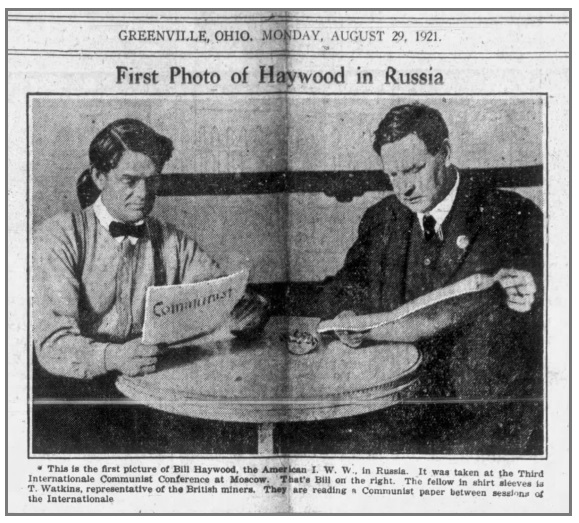
Wonderful words defending Haywood, convicted and sentenced to Leavenworth, after he jumped bail (put up by Mary E. Marcy) and secreted himself to Moscow, where he would live the rest of his days. Attacked by more than a few on the Left for ‘abandoning’ the U.S., including Victor Berger in a disgraceful editorial, Haywood’s escape was controversial. Falconer, a veteran of all the Colorado labor wars and comrade of Haywood’s for decades, says the real split in the Socialist movement was not 1919, but 1912 when Berger and Co. altered the constitution to bar revolutionary workers from Party ranks if they advocated ‘law-breaking’. Edinburgh-born George N. Falconer (1863-1947) was a central figure in the history of the Colorado left. A writer and editor, candidate for and leader of the Socialist Party of Colorado, he ran a bookstore in Grand Junction and was, like most of the Colorado S.P., a Red. He wrote extensively on the western class struggle and on debates within the movement. Comrade Falconer was also a member of the I.W.W., and would become a founding member of the Communist Labor Party in 1919 and the Workers (Communist) Party in 1921.
‘Bill Haywood—Rebel’ by George N. Falconer from The Toiler. No. 178. July 2, 1921.
“Courts for cowards were erected,
A fig for those by law protected,
Liberty’s a glorious feast,
Churches built to please the Priest.”–Robert Burns, Scotch rebel poet.
“THE EXIT OF HAYWOOD.”
“We must be able to trust one another.
“Any man who will deceive your enemy, will also deceive you.
“If you and other workers were to unite in practicing deception, sabotage, slugging, or any other foulness, upon the employing class, this would prove to each of you that the others could not be trusted.
“Such methods hurt the working class far more than they hurt the capitalist class. They undermine character.
“Look at some of the Russians, for example.
“Long years of underground activity against the unspeakable czar–where it would have been justified if ever–left them so used to underhanded methods that they have used such methods against the Socialists of other countries.
“Early in 1919 we American Socialists were enthusiastically defending the Russian comrades against all comers.
“To our grief and amazement we later discovered that, at the very moment, they were secretly undermining the Socialist party of America. They succeeded in splitting it wide open.” “Milwaukee Leader.”
“I was awakened by a thunderous pealing of church bells on March 24 and informed I was in Moscow, the capital of the workers’ republic. The dream of my life had come true.”
Wm. D. Haywood.
For the benefit of the illustrious members of the U.S. Secret Service be it said, Burns, the Scotch rebel poet, is no relation of Burns, the present head of the U.S. Secret Service. Robert died in 1796. Tho’ dead, however, the truth he announced still holds good:
“Courts for cowards were erected, Churches built to please the priest”–And all exploiters of labor.
One of these days all persecuted I.W.W., Socialist and Communist rebels will agree with Bobbie Burns and act accordingly.
HAYWOOD’S EXIT.
Berger’s editorial, relative to Haywood and the “wide open split” of the Socialist party calls for comment, in view of the fact that the capitalist “Milwaukee Leader” is still believed to be a socialist paper, or in some way a representative of labor. The Socialist party, Mr. Berger should know, was not “secretly” undermined in 1919 by “Russian comrades,” who had learned to work secretly under the “unspeakable czar.” The “split” actually occurred in the Indianapolis national convention of the party in 1912. There the dirty work was done, engineered by the Bergers, Hilquits, Spargoes and their kind. It was THERE the anti-sabotage plank was injected into the Party constitution, thus making it a crime for a member of the party to advocate industrial unionism, direct action or any real revolutionary tactic. It was THERE resolved to rid the Socialist party Executive Committee of Comrade Haywood, who was then a member. The referendum sent the membership, for the recall of Haywood, proved conclusively to many of the rank and file, that a Socialist politician was worse, tho’ NOT MUCH, than either a Democrat or Republican! Such action was of course natural to people wearing a ready made uniform of Socialist belief, but to many workers tinged with idealism, the surprise, the shock, was great. The “split” referred to, therefore, took place in 1912, not 1919. And the reason for the split is today self-evident: the revolutionary group, of which Haywood was one, sensed the coming danger to the workers’ cause; they desired to point the way to the American proletariat, and help them WIN at the point of production–in the mine, mill, field, factory and shop–where their interests lay.
The socialist parlamentarians frowned on this program; they forbade such action, and resorted to under-handed political methods of the cheapest kind to rid themselves of their fancied enemies, the red, or industrial element in the party. The reds tried to raise the workers (theoretically of course) to a higher level; the others blocked the way, as do all “defenders of the Faith”. They failed then as now to see that splitting up into new formations means a higher stage of development; that organizations based on wrong ideas are a menace, and are therefore doomed. The Socialist Party instead of being an “advance guard” of the workers, had generated into a mere “collective agency” to help finance certain political careerists of the Berger-Hillquit type. These gentlemen, however, should feel comforted: tho the Socialist party candle has been dimmed, the sun of the revolution still shines!
HAYWOOD AND DEBS.
“Contrast Haywood’s case with that of Debs,” moans Berger.
“Debs is setting an example of utter honesty and nobility of character which is an inspiration to the workers everywhere. It makes for optimism and encouragement.
Character is absolutely necessary in the working class movement.”
“Jesus on the cross and Debs in prison,” ecstatically exclaims Rev. J.H. Holmes. “What an inspiration!” What holy twadaddle, say we. Religious piffle, christian buncombe, patriotic sob-stuff; sterilized socialist baby-food for half-baked Henry Dubbs! “Jesus on the cross” has delivered few rebels from jail and has double-crossed thousands. This “inspiration” stuff is an opiate that has made many of our reds and wobs groggy, if not dippy. They should read Bobbie Burns more, the Milwaukee Leader less. A live rebel, free, is better than a prisoner behind the bars playing “martyr.” It may be noted in passing, that Berger prefers Milwaukee to Leavenworth. “Inspiration” for the Dubbs, but a good stein of beer for B. “Genius,” says Edison, “is 1% inspiration and 99% perspiration.” Substitute revolution for genius and you get the point.
CHARACTER?
Of course! Character is absolutely necessary in the working class movement. But what kind of character? Bandits or rebels? Capitalists or proletarian? Slave masters or slaves? Exploiters or laborers? Law makers or law breakers? Which?
Nearly all the big characters, lauded and admired to-day by our prosperous and ever-fed bourgeoisie were one time rebels, slaves, law-breakers! From Jesus to Debs–all disobeyed, broke the law, bucked the courts, cursed the priests and damned the law makers, and–suffered accordingly.
WILL HE REALLY?
Come back to these U.S.? Haywood says. “I will return to the U.S. without question.” Not right away, we hope. If Bill returns on schedule, we will ne’er forgive him. What! Exchange Red Russia for Leavenworth, twin hell of Kansas! Swap a “dream” for a nightmare? An “Earthly Paradise” in the making for a capitalist hell-hole? Surely not, Bill! You know, as do so many others, that prison is no place for a MAN, a rebel. You know it’s true that,
The vilest deeds like poison weeds
Bloom well in prison-air:
It is only what is good in Man
That wastes and withers there:
Pale Anguish keeps the heavy gate,
And the Warder is Despair.
…
And never a human voice comes near
To speak a gentle word:
And the eye that watches through the door
Is pitiless and hard:
And by all forgot, we rot and rot,
With soul and body marred.
No, William, don’t set a bad example; remain in the Red Land and help in the big change. Agitate, educate and organize the workers of the world, preparatory to their running the big show themselves. The capitalists have botched the job; it is up to you and others to rectify their mistakes. Help the workers of Europe to do, what Jack London dreamed of doing–cleanse the cellar of our present social hell-house. Build a new habitation for mankind, in which, there will be no parlor, in which ALL the rooms will be bright and airy, and where the air that is breathed will be clean, noble and alive. A good job this, Bill, a job worthy of a god! Many times in the past eleven years, from Copenhagen to Denver, did we hear you explain the class struggle, and you did it bravely and well. Again and again we heard you say: “My faith is in the working class.” And–“the stairway of time is ever echoing with the wooden shoe going up, the polished boot descending,” and “the workers must organize industrially, if they are ever to win.” It is quite easy to understand, Bill, why so many workers, everywhere, have come to look upon you as their loyal comrade and fellow-worker, their champion. And this is so because, as you might truly say of yourself—
And the forge of hardships wrought me,
Fashioned me, and taught me
That life’s flag of hope is Red!
To the utmost of my trying
I have kept in clean and flying,
May it cheer me when I’m dying,
May it shroud me when I’m dead.
The Toiler was a significant regional, later national, newspaper of the early Communist movement published weekly between 1919 and 1921. It grew out of the Socialist Party’s ‘The Ohio Socialist’, leading paper of the Party’s left wing and northern Ohio’s militant IWW base and became the national voice of the forces that would become The Communist Labor Party. The Toiler was first published in Cleveland, Ohio, its volume number continuing on from The Ohio Socialist, in the fall of 1919 as the paper of the Communist Labor Party of Ohio. The Toiler moved to New York City in early 1920 and with its union focus served as the labor paper of the CLP and the legal Workers Party of America. Editors included Elmer Allison and James P Cannon. The original English language and/or US publication of key texts of the international revolutionary movement are prominent features of the Toiler. In January 1922, The Toiler merged with The Workers Council to form The Worker, becoming the Communist Party’s main paper continuing as The Daily Worker in January, 1924.
PDF of full issue: https://www.marxists.org/history/usa/pubs/thetoiler/n178-jul-02-1921-Toiler-rsz-chronAM.pdf
 Revolution's Newsstand