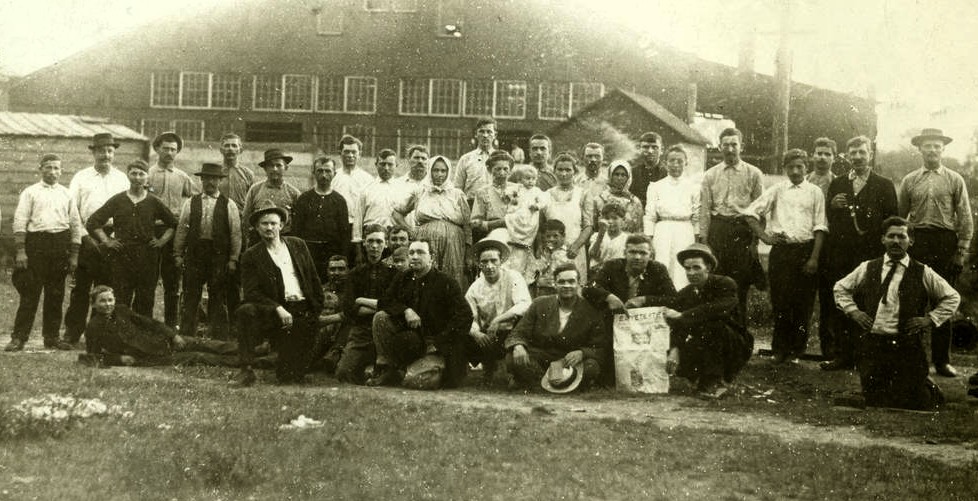
In 1909, strikes convulsed the Pittsburgh area towns of McKees Rocks, Butler, New Castle, and Presston as thousands of largely unorganized, immigrant workers–“hunkies”–took on the mighty Pressed Steel Corporation in a bloody fight for better conditions, wage increases, an end to inhuman housing, and the dignity of a union. The I.W.W. would come to lead this heroic strike, perhaps its most prominent to that moment, to victory. Those victories brought the wobblies to prominence and the attention of many Eastern workers. Soon, the weight of the I.W.W. would shift decisively west, but the Pittsburgh district would remain a seat of the class for for generations.
‘Second Convention of the Pittsburgh District of the I.W.W.’ by B.H. Williams from Solidarity. Vol. 1 No. 5. January 15, 1910.
Twenty-six delegates, representing five local unions, were in attendance at the second convention of the Pittsburg district union of the I.W.W., held in McKees Rocks, Sunday, January 9.
The convention was called together at two o’clock by the district organizer, Joseph J. Ettor, who explained the situation and the work done in the district during the past three months. Several new unions had been organized, and with the exception of one or two smaller organizations all the locals were in a flourishing condition. A great part of the work had been done among foreign speaking elements, and their numbers were increasing, especially in the iron and steel locals at McKees Rocks and Butler, Packing house workers in Allegheny had recently organized and their union gave promise of a large membership in the near future. Two branches of another steel workers’ local had just been formed in Pittsburg, and was forging ahead in spite of the efforts of the company to prevent the work of organizing. The A.F. of L. with all its noise has been unable to accomplish anything, as it has lost the confidence of the workers in the steel industry.
The convention with H.A. Goff in the chair and Herman Leftkowitz as secretary, then took up for consideration the different matters before it.
The question of finances and the per capita tax to the district union occasioned a great deal of discussion. A motion was finally carried to fix the per capita from the local unions at two cents per member per month, and to request the General Executive Board of the I.W.W. to remit five cents of the per capita to the general organization, in order that it might be used in the district to promote the work of organization. It was also voted to send an appeal to the locals of the district to raise funds for organization work.
A new district executive committee was elected for the ensuing three months, as follows: Williams, Goff, Spindler, Schmidt, Spunar.
It was moved and carried to elect a district organizer and an assistant organizer, it being necessary to secure someone for the latter office who could speak several languages. J.J. Etter and Jos. Schmidt were chosen for the respective positions. Salaries of the two organizers were fixed by the convention at a limit not to exceed $18.00 a week for each, and transportation in addition.
Herman Leftkowite was elected secretary of the executive committee, without salary. In view of this fact and that the secretary could not devote his entire time to the work, it was voted that the organizer should handle the funds of the executive committee during the next three months.
The question of the new paper, Solidarity, its policy, and its relation to the district union, were subjects of extended discussion. Delegate Williams, as a member of the Solidarity Press Committee explained in detail the situation with regard to the paper, and showed that it was entirely under control of the I.W.W. in New Castle, and that the impression that its affairs might be involved with those of the Socialist Party, was erroneous. The policy of Solidarity was not only to satisfy by its subject matter the membership of the I.W.W., but also to attract the larger mass of workers who are feeling their way toward industrial unionism; and that, judging by the responses coming from all elements and from all parts of the country, it was succeeding in its purpose. The discussion, participated in by a number of delegates, resulted in a better understanding, and the assurance from the delegates that each one would do all in his power to help make the paper a success.
The convention adjourned at six o’clock with the feeling in the minds of all delegates that the next three months would see a substantial growth in our organization.
B.H. WILLIAMS, Delegate Local 297.
The most widely read of I.W.W. newspapers, Solidarity was published by the Industrial Workers of the World from 1909 until 1917. First produced in New Castle, Pennsylvania, and born during the McKees Rocks strike, Solidarity later moved to Cleveland, Ohio until 1917 then spent its last months in Chicago. With a circulation of around 12,000 and a readership many times that, Solidarity was instrumental in defining the Wobbly world-view at the height of their influence in the working class. It was edited over its life by A.M. Stirton, H.A. Goff, Ben H. Williams, Ralph Chaplin who also provided much of the paper’s color, and others. Like nearly all the left press it fell victim to federal repression in 1917.
PDF of full issue: https://www.marxists.org/history/usa/pubs/solidarity-iww/1909-1910/v01n05-jan-15-1910-Solidarity.pdf
 Revolution's Newsstand