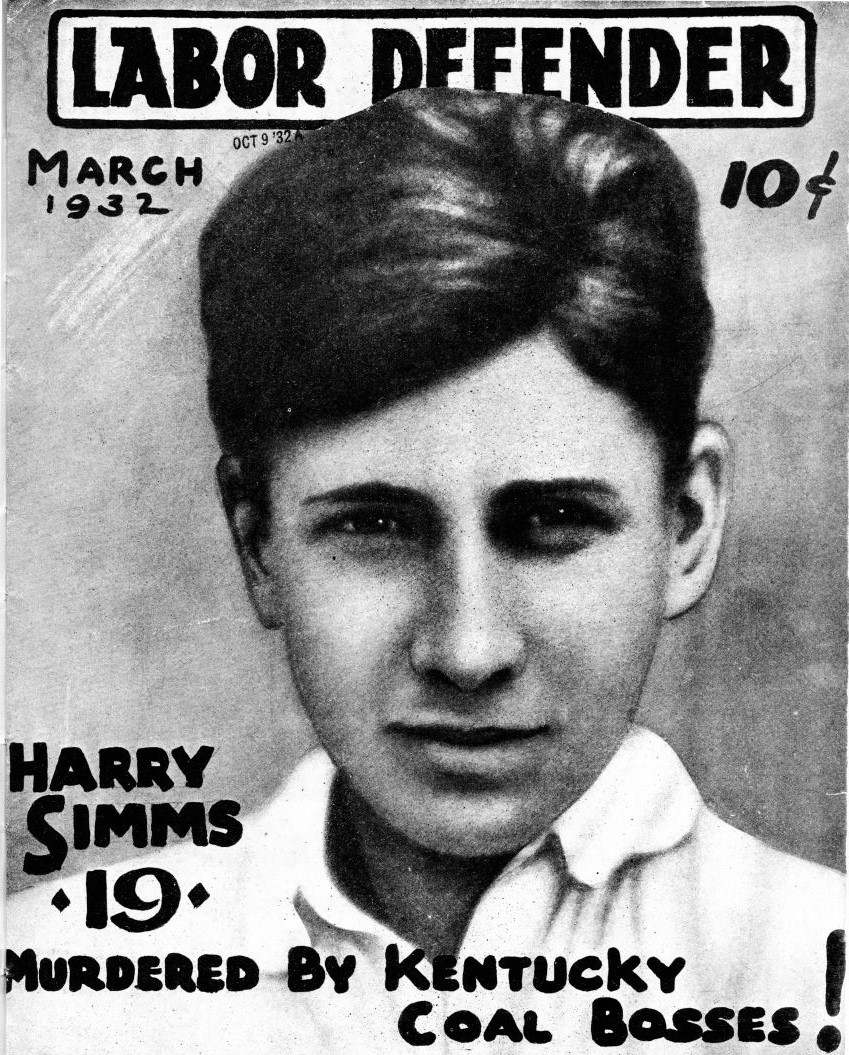
Comrade Harry Simms was a Young Communist League activist originally from Springfield, Massachusetts. Sent to the south to help organize the National Miners Union, he was in Harlan County, Kentucky during the 1931-1932 NMU strike there. On February 10, 1932, Simms was shot by a sheriff’s deputy and mine guard as he walked along the railroad tracks to a food and clothing distribution meeting. Badly wounded, Simms was left bleeding in front of the town hospital which refused to treat him without guarantee of pay. He died the following day; comrade Simms was 19 years old. 25,000 people attended his funeral in New York City. ‘The Death of Harry Simms,’ a folk song written by Jim Garland and ‘Aunt’ Molly, who knew Simms and were in the area when he was killed, was later made popular by Pete Seeger.
‘Harry Simms, Young Communist Leader, Murdered by Kentucky Gun Thugs’ from the Southern Worker. Vol. 2 No. 26. February 20, 1932.
Harry Simms, 19-year-old Young Communist League leader, was shot down by Arlin Miller, guard at the Tropser Mine on Brush Creek, Knox county, Kentucky, early Wednesday morning, while on his way to lead a group of striking miners to Pineville, to welcome the delegation that came from New York with three truck loads of food for the strikers, their wives and children.
The bullet from the thug’s gun pierced the body of the young strike leader through the side, penetrating the stomach and liver and shattering the kidney’s. Rushed to Dr. Logan’s. hospital at Barbourville, an operation was immediately performed but the bullet could not be extracted. Two blood transfusions were given in an effort to save his life during Wednesday night and Thursday. Nothing that could be done could save the fallen youth and he died at 9:25 o’clock Thursday evening.
New Murder Drive
The murder of Harry Simms followed immediately after a threat by one of the coal operators’ hirelings, Walter Smith, county attorney of Bell county, who threatened: “Inside of a few days there won’t be any Communists left in this country. We have decided to get rid of them once and for all.” Arlin Miller, the depraved gun thug deputized by the sheriff of Knox county and paid by the Tropser mine on Brush Creek, was the first to carry into action the threat of Walter Smith.
Harry Simms and Green Lawson a local miner, were walking along the railroad track to meet a delegation of miners that were to proceed to the demonstration at Pineville that was scheduled for 1:00 that afternoon. The professional murderer, Miller, accompanied by another thug called “Red” Davis, speeded by in a small railroad motor car, stopped suddenly when they recognized Simms, turned back and without a word of warning shot Simms pointblank. Lawson threw up his arms and was not hurt. Then the thugs dragged Harry Simms to the motor vehicle, arrested Lawson and went to Artemus, where they took Lawson to jail on a charge of carrying a gun, while leaving Simms bleeding on the ground. Later on other deputized thugs took the fatally wounded youth to the hospital at Barbourville.
Glad Others Escaped
Just as Harry Simms fought heroically in the class struggle in many places to which he was assigned, so he fought with grim determination for life up until the last second. When visited at the hospital late Wednesday by some of his comrades, he grasped them by the hands and told them he felt a great relief that they, at least, had escaped the bullets of the assassins. In reply to a question as to how he felt, he said he was “all right,” but that he had a pain inside and felt “very tired.” He anxiously asked about the other comrades who were engaged in mobilizing the strikers for the Pineville demonstration.
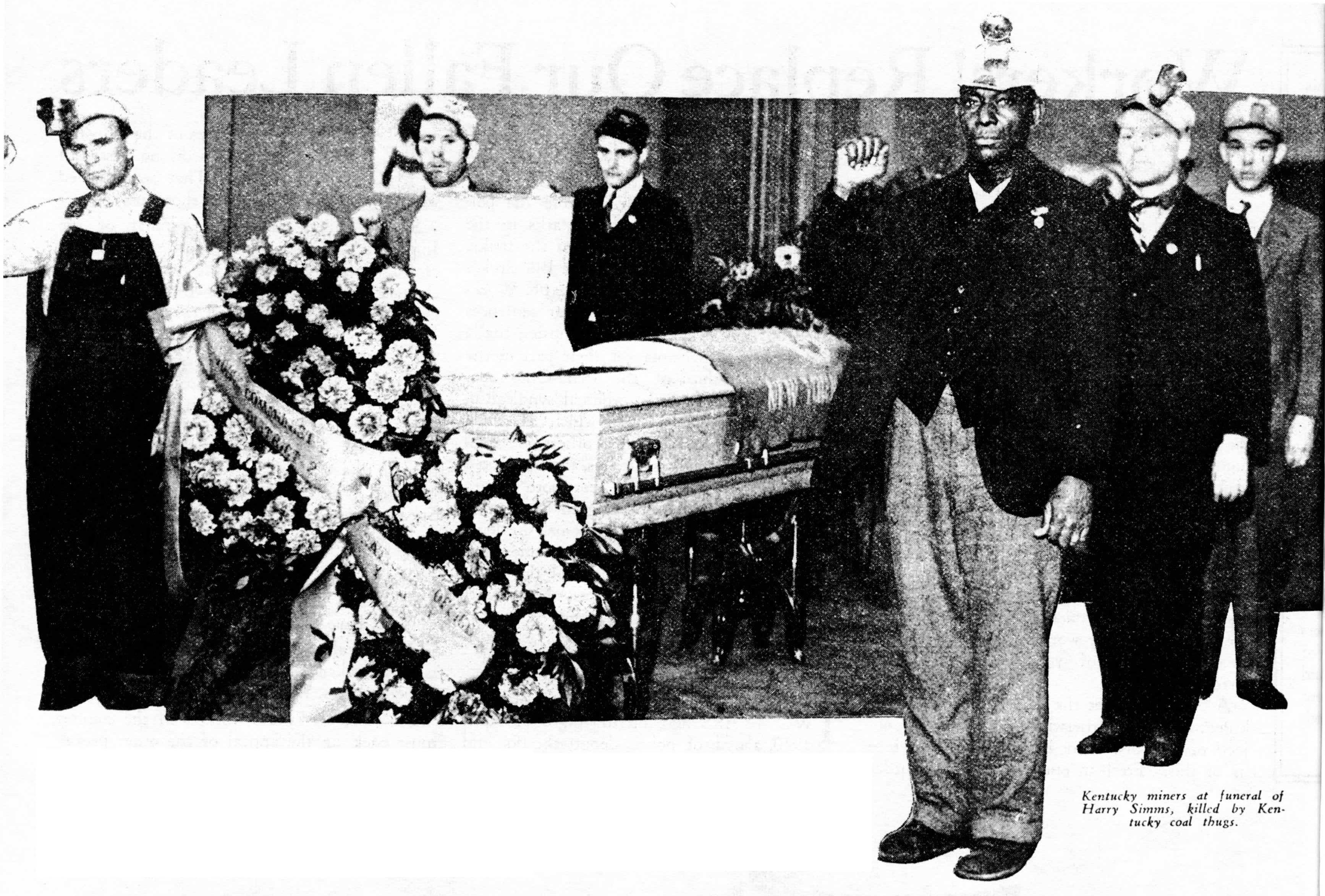
Besides the regular hospital nurse a special nurse was sent by the Workers’ International Relief, who remained with Comrade Simms to the end.
Plot to Steal, Destroy Body
When news of the bestial shooting of Harry Simms reached the miners a wave of mass indignation swept the thug-ridden hills. Angry men, with a grim look behind their tear-dimmed eyes, gathered in groups. The thugs took for cover and for hours not one of them was to be seen. When the death of the youthful leader became known, the foul murder gang at Pineville plotted to go to Barbourville, raid the undertaking establishment, steal the body of the 19-year-old martyr and destroy it. They feared. Harry Simms dead worse than they despised him alive. News of the plot reached headquarters of the union and the sheriff of Knox county, the chief of police of Barbourville and the coal operators’ governor of Kentucky, Ruby Laffoon, were called by phone and told Friday night that they would be held strictly responsible for any desecration of the body of Comrade Sims. The result was that that part of the vile terror plot had to be abandoned.
Worked In South

Harry Simms, since the fall of 1930 had been district organizer of the Young Communist League of District No. 17, with headquarters at Birmingham. He took a leading part in all the campaigns- Scottsboro, Camp Hill, the Willie Peterson case. While carrying on Young Communist League work he was also called upon frequently when the district organizer of the Party was out in the District field, extending from Kentucky to Florida and across to New Orleans, to carry on both Party and League direction. He had been arrested a number of times by the Birmingham police for his activity in organizing the employed and unemployed Negro and white workers for a struggle against the common enemy. In July, 1931, he was elected to the National Executive Committee of the Young Communist League at its 6th National Congress in New York. Returning South again he threw himself with still greater energy into the work.
From the first he worked tirelessly on the District Committee of District No. 17 in the preliminary work of the Kentucky strike. He was anxious from the beginning to go into Kentucky field. He was the first member of the District committee to be assigned to Kentucky during the period of the strike. Aware of the dangers that faced him, he was, because of such danger, more determined to go and help direct the Kentucky and Tennessee miners in their fight against starvation and terror.
Born In Massachusetts
Harry Simms was born in Springfield, Mass. His parents were workers. At the age of 14 he went to work in a textile mill, where he soon learned that in the class struggle the Communist movement alone is the means whereby the workers can defeat capitalism and strike off the shackles of wage slavery. He was elected Young Communist League organizer in Connecticut in 1929. On the following March 6th, in the great unemployed demonstrations, he was arrested and sentenced to jail, where he spent four months, before coming south. In Birmingham he worked under the pseudonym, “Harris Gilbert” because of the police activity against the Party and the League there, just as many another revolutionist has had to work and does have to work in similar conditions.
Begun in August, 1930, Southern Worker was a semi-legal regional newspaper of the Communist Party, USA (CPUSA) primarily aimed at building the Party in the South among Black workers and farmers. Pseudonyms of editors and writers, false publication places, illegal paper drops, and clandestine meetings were a necessary hallmark of the Southern Worker’s life. The paper extensively covered the campaign against lynching and southern unionization efforts. Originally a weekly, it went to a monthly in 1934 and ceased publishing in 1937. Editors included Solomon Auerbach (under the name “Jim Allen”), Harry Wicks, and Elizabeth Lawson.
PDF of full issue: https://www.marxists.org/history/usa/pubs/southernworker/v2n26-feb-20-1932-sw-ti.pdf
 Revolution's Newsstand