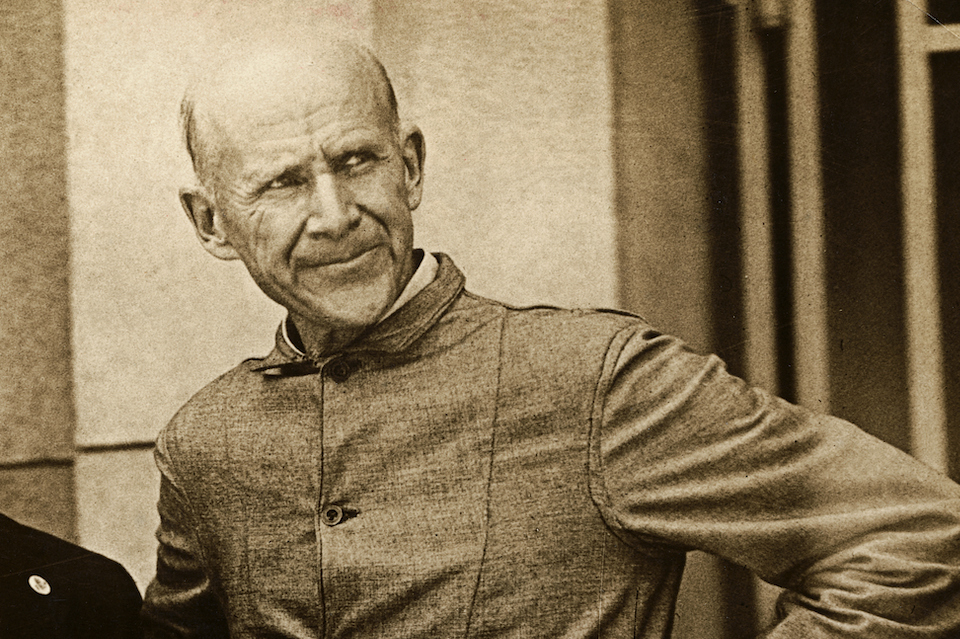
If there was one issue that consistently put Debs on the left of the Socialist Party and infuriated the Party’s right wing, it was Debs’ disdain for the often elitist, always exclusive, craft unionism that predominated in the United States and his determined focus on industrial unions and the organization of the ‘unskilled’. What made Debs such a powerful force in the Socialist movement was that his positions were both in line with the Party’s revolutionary ‘Industrial Socialists,’ and promoted by the foremost POLITICAL figure in a Party overwhelmingly focused on elections. Here Debs writes for a S.P. symposium on labor unions a year after the founding of the I.W.W.
‘The Socialist Party and the Trade Unions’ by Eugene V. Debs from The Worker (New York). Vol. 16 No. 16. July 28, 1906.
Industrial unionism, as I understand it, is an outgrowth of modern industrial development; it means, primarily, the unification of all the industrial workers within one comprehensive organization, divided and subdivided into departments corresponding to their various industries, each supreme within its own jurisdiction, yet limited by, and subject to, the constitution and other enactments of the general organization, the purpose being prompt and efficient action and mobility of power in every movement, offensive and defensive, of the organized workers, in part or as a whole, in all matters pertaining to their industrial interests.
Under this form of organization all the workers of a given employer, or in a given industry, however varied their trades or occupations, are compactly organized in the same body, while at the same time distributed among the various departments representing their several trades and occupations.
The superiority of this form of organization over the antiquated and impossible autonomic plan in this day of concentration is so apparent that argument would weaken rather than strengthen the proposition. Next, industrial unionism is class-conscious in character and revolutionary in aim, its mission being not only to mitigate the ills of the workers, but to abolish the wage-system and achieve complete emancipation. Without this character and ultimate end in view the mere solidarity of the trade amounts to nothing more than “pure and simpledom,” and cannot properly be called industrial unionism. This does not mean that each member must be class-conscious and revolutionary, but that the organization must be so as a whole and so declare, as the Industrial Workers has done, in its organic law.
With this general understanding of what industrial unionism is—to which, I do not doubt, exception will be taken—the Industrial Workers of the World is the only American labor union of a general character organized upon the principle of industrial unionism.
The Industrial Workers has no “patent” on this “scheme,” as some of its critics have facetiously charged, but it is so far the only union organized upon the industrial basis, with its militant character stamped upon it and its revolutionary aim boldly avowed and clearly stated in its fundamental law.
Up to this point I apprehend that there is but little difference of opinion among Socialists, in or out of the Industrial Workers or the Socialist Party. The trouble begins with the revolt of the progressive element of its membership against the American Federation of Labor and, curiously enough, the most violent critics of this industrial secession from the American Federation of Labor in 1897 (beginning with the withdrawal of the Western Federation of Miners) themselves, 2 years later, in 1899, organized the political secession form the Socialist Labor Party.
They persist in asking us why we did not remain in the American Federation of Labor and “bore from within,” and we ask them why they did not remain in the Socialist Labor Party and do likewise, instead of bolting and setting up a rival party.
They criticize and condemn us unsparingly for “dividing” the workers industrially and organizing “dual” unions. Then why did they divide the workers politically and organize dual locals?
Is revolt against a labor party a virtue and revolt against a labor union a crime?
Upon what principle of reasoning and by what rule of logic is the one commended and the other condemned?
The revolt and our secession from the American Federation was not only timely and wisely ordered, but simply inevitable, and in due time will be vindicated as a historic necessity.
Upon this point I feel strongly tempted to digress sufficiently to make clear my reason for justifying the break with the A.F. of L. and the necessary argument in support thereof, which I am presumptuous enough to believe is conclusive and unanswerable, but neither time nor space will allow at this writing.
The Industrial Workers is on the bedrock and occupies the correct industrial attitude of the labor movement, while the American Federation of Labor and its allied bodies are on the shifting sands and will be compelled to seek quarter in industrial unionism or go the way of the Knights of Labor and its defunct predecessors.
Compare these two organizations for but a moment. The I.W.W. is revolutionary; the A.F. of L. reactionary. The I.W.W. is committed to the overthrow of the wage-system; the A.F. of L. is its main support. The I.W.W. recognizes the class struggle; the A.F. of L. denies it and has its Civic Federation to gloss it over and reconcile the wage-slave to his exploiting master.
How is it possible for a Socialist to choose the A.F. of L., which violently opposes everything he stands for, and attack the I.W.W., which loyally supports his principles and program?
Such a Socialist embraces the enemy who has repeatedly treated him with contempt and, figuratively, spat in his face, while hurling his anathema at the friend who would dissolve such an unclean relation that a true union of industrial and political force might be consummated.
It has been claimed that the I.W.W. does not favor political action. To silence controversy upon this point all that is required is the reading of its preamble. What a few individual members may thing of the ballot is beside the point, the fact being, not only that the organization declares in favor of political action, but that a vast majority of its members are Socialists, if not party members.
For obvious reasons the organization had to declare against affiliation with any particular party. To have done otherwise would have entirely defeated the movement in its inception. When once there is but one working class party the I.W.W. will, without a doubt, assume the proper attitude toward it, but in the meantime it is not only vain and silly, but untrue that the Socialist Labor Party is “dead,” and the writer who makes that assertion does himself no credit by it. Quite sufficient proof that it is not dead is the attention given it by those who call it so, but if they really believe what they say it is hard to understand what satisfaction they find in kicking a corpse.
And now in the matter of recognizing and declaring in favor of the I.W.W., let me say that from the Socialist Party, as a party, the I.W.W. neither asks nor expects anything of the kind, and personally I am opposed to any such party action. It can result in no good to either and may, and probably will, cause harm to both.
This does not mean that I approve our party attitude toward the union movement. There is a mischievous interpolation in our declaration aimed at the A.L.U. and negatively endorsing the A.F. of L., and sooner or latter, the sooner the better, that clause, which never should have been inserted, will have to be stricken out. What right has the party to meddle with the union and decide for the union whether or not its members may revolt against the capitalist misrule of its affairs? The same right that the union would have to dictate to the party in a similar manner.
Suppose the I.W.W. were to resolve that the members of the Socialist Party have no right to break away from their party under any circumstances—would not our party members, the very ones who now support the same measure with reference to trade unions, resent it as mischievous, intermeddling, and uncalled for impertinence?
The members of the I.W.W. are, as a rule, seasoned old unionists; they did not drop from the skies, nor come up out of the seas; they are not interlopers nor new beginners, but they are of the very heart and marrow of the labor movement, and I think their records as fighters and builders in point of time and character of service will compare favorably with those of their reactionary critics; and when credit is claimed for what has been done in the past let it be remembered that the members of the I.W.W. figured in it all and are entitled to their full share of it.
In leaving the A.F. of L. after being long identified with it, we had good reason, and if time and space were not limited nothing would give me more pleasure than to go into detail upon this important point. A thousand evidences of the decadent state of pure and simple unionism appear on every hand, not the least of which is its abnormal growth under capitalissic patronage.
The United Mine Workers is dominated by the capitalist mine owners. The latter constitutes the financial agent of the former, collecting its dues and assessments, and if a member protests against this pure and simple arrangement he is expelled form the union and discharged by the mine owner.
A beautiful relation this is for a Socialist to sanction and the Socialist Party to endorse.
The grip of the mine owners upon the organized mine workers under the old regime will never be broken; only revolt will accomplish that end and revolt it will be in spite of the interposition of reactionists.
The railway unions specifically declare that their interests and those of the corporations are identical and only a few weeks ago their grand officers and committees were before the President and Congress protesting against legislation on the ground that “an injury to the corporation is an injury to its employees.” The railway unions are the auxiliaries of the corporations and do their bidding, and this relation is fixed and will never be altered or broken except by revolt. The same is true to a greater or less extent of all the unions affiliated with the A.F. of L. and they who support that body in its present attitude, honest though they be, are opposing and not advancing the true interests of the working class.
The Civic Federation is another excrescence in evidence of the rank growth of the A.F. of L. in capitalist favor, and of its alignment with capitalist interests, and this state of affairs is possible only at the price of treason to the working class.
The scores of separate national and international unions, the thousands of locals, the great army of big and little “labor lieutenants,” ward heelers, and petty grafters, the conflicting jurisdictions and interminable wranglings, the monotonous round of defeated strikes and depleted treasuries, all bear testimony to the moribund state of the A.F. of L.; and all of this vast array of officeholders, walking delegates, and local “leaders” who are fastened upon the union and feeding upon its body are opposed to any change, and the mere mention of the I.W.W. is sufficient to fan their hostility into a mad frenzy.
The workers, at least, are getting wise and “onto” the game, and if there are not some serious breaks and radical departures in the coming twelve-month I shall certainly miss my prediction.
Our opponents have no right to charge us with “dividing” the working class. We are guilty of no such offense against unionism. To divide the workers implies preceding unity, and this never existed. Instead of dividing them, we are arousing them from their slavish submission to capitalist domination under the form and in the name of unionism.
Better a thousand times that labor is divided fighting for freedom than united in the bonds of slavery.
I have been following with interest the interchange between Comrade Boudin and Comrade Untermann. Comrade Boudin is insistent upon proof, which is quite proper in a controversy, but some things are axiomatic and self-evident, and time spent in furnishing proof is simply wasted.
It seems to me that the essential points in Untermann’s contention for industrial unionism are self-evident. It is true, as Boudin says, that Untermann’s statements are mere assertions, but they are assertions of fact that cannot be successfully controverted.
I think it was Emerson who said that assertion is the highest form of agreement. If I say the sun shines, that is a mere assertion and at the same time a palpable fact. A man may be blind or shut his eyes and say: “Prove your assertion that the sun shines,” but that would have no appreciable effect upon the obvious fact.
Ben Hanford comes in for his turn at the I.W.W., but makes no attempt at argument and his effort hardly rises to the level of ridicule. Ben is usually clever and original and always interesting, but his last column and a half of nonpareil must have been a keen disappointment to his friends. Of course Ben had to remind us that DeLeon is a “liar” and a “blackguard,” but this added little, if anything, to the tone and force of his weak and ill-tempered diatribe.
It is not infrequent that we hear complaint from our members of DeLeon’s so-called blackguardism, but I observe that these same members are ceaselessly fulminating against DeLeon, and the language some of them use hardly qualifies them to take exceptions to billingsgate.
The fact is that most of the violent opposition of Socialist Party members to the I.W.W. is centered upon the head of DeLeon and has a purely personal animus and this attitude is so clearly wrong and so flagrantly at war with justice and common sense as to be not only weak, but pusillanimous and utterly indefensible. DeLeon is not the I.W.W., although I must give him credit for being, since its inception, one of its most vigorous and active supporters.
It may be that DeLeon has designs upon the Socialist Party and expects to use the I.W.W. as a means of disrupting it in the interest of the Socialist Labor Party, and if he succeeds it will be because his enemies in the Socialist Party, in their bitter personal hostility to him, are led to oppose and denounce the revolutionary I.W.W. and support the reactionary A.F. of L., thereby playing directly into his hands, and if the Socialist Party is disrupted in this clash of trade unions, it will be the result of their own deliberate acts and they will have to bear the responsibility for it.
I know there are members of the Socialist Labor Party who are using the I.W.W. as a weapon to strike the Socialist Party, but they will make little progress along that line unless our attitude is vulnerable and imparts to their blows the destructive force that of themselves are lacking.
I know, too, that there are members of the Socialist Party who would scruple at nothing to destroy the Socialist Labor Party, but we must be carried away by neither of these extremes.
Let us pursue the straight course and stick without wavering to the clear-cut revolutionary movement, and hew to the line of industrial and political unity for the overthrow of wage slavery.
As for myself, I expect to remain, as I have always been, a loyal member of the Socialist Party, but I shall continue to do what little I am able to unite all workers within one industrial union and one political party for the achievement of their emancipation.
The Worker, and its predecessor The People, emerged from the 1899 split in the Socialist Labor Party of America led by Henry Slobodin and Morris Hillquit, who published their own edition of the SLP’s paper in Springfield, Massachusetts. Their ‘The People’ had the same banner, format, and numbering as their rival De Leon’s. The new group emerged as the Social Democratic Party and with a Chicago group of the same name these two Social Democratic Parties would become the Socialist Party of America at a 1901 conference. That same year the paper’s name was changed from The People to The Worker with publishing moved to New York City. The Worker continued as a weekly until December 1908 when it was folded into the socialist daily, The New York Call.
PDF of full issue: https://www.marxists.org/history/usa/pubs/the-people-the-worker/060728-worker-v16n17.pdf
 Revolution's Newsstand