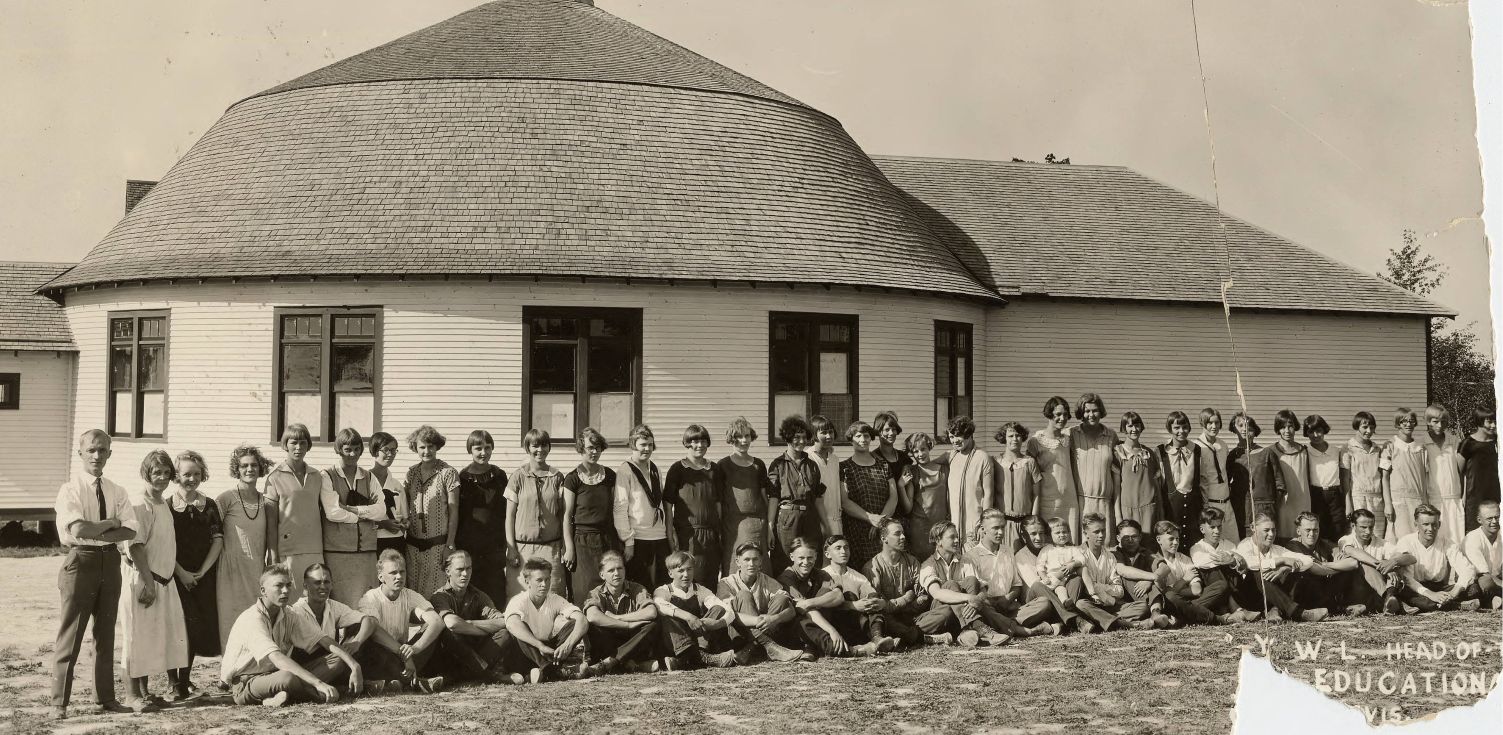
The Young Workers League held summer schools at their hall in the northern Wisconsin hamlet of Waino. Largely attended by Finnish comrades of the Great Lakes, the school was part of a larger program of summer activities–camps and colleges–that became a mainstay of Communist youth culture during the 20s and 30s.
‘Waino Days’ by One of the Students from The Daily Worker. Vol. 2 No. 197. August 29, 1925.
STUDENT OF YOUNG WORKERS LEAGUE SCHOOL AT WAINO, WIS. TELLS HOW COMMUNIST YOUTHS KEEP DISCIPLINE
The capitalist press bore scare headlines about our school announcing to the world that another nest of reds had been found. At the school this attack was expected for we had the honor to be interviewed by “our friend,” De Guire. “Our friend’s” report has aroused the curiosity of many as to how these reds lived at that “secluded camp.”
For the benefit of those whose interest has been aroused I will attempt to give a description of how we deported ourselves at Waino. The pleasure, the joy and the growth in body and mind by the students cannot be conveyed, however, they must be experienced.
Our school had fifty-seven students, two instructors, a cook and a lady helper. One can imagine the problem our director had. Fifty-seven active, young people on his hands to educate, feed, discipline, and provide lodging for for five weeks and then return them to their homes healthy and satisfied and ready to do Communist work. It is to the credit of Comrade Hayes that this he accomplished. The method used to accomplish this task is very interesting.
The responsibility of administration was given to the student body.
The first two days of school was spent in organizing for the work ahead and in getting settled at our various living quarters. The students were lodged at, fourteen different farm houses in the vicinity of the school. The farthest being two and a half miles away and the nearest a quarter of a mile. The two ladies and six boys stayed at the hall.
The student body organization was in two sections. One was the student branch of the league and the other was the student council with the working committees. The student branch was a model league branch with officers and committees. Much of its work was practice for branch training, that is, we went thru the formalities of branch functions and to gain experience. However, where there was a chance to do real work it was done. The officers and committees of the branch were as follows:
Organizer.
Recording secretary.
Membership secretary.
Treasurer.
Literature agent with a committee of two.
Educational director with a committee of four.
Social director.
Sport directors: One girl and one boy.
Yowlec committee of seven. (This was the staff of the Wall newspaper.)
The executive committee, composed of all officers of the branch.
New officers and committees were elected each week so as to give students experience in branch work. There was some exceptions to this however. The social committee was permanent thruout the course for it had the task of providing constant recreation and entertainment for the student body. Also the first educational committee was made permanent due to the nature of its work. A uniform record of our meetings was desired so the office of recording secretary was made permanent.
The other officers and committees performed their routine branch functions and whenever actual work was to be done they took it up. For example, the athletic directors organized two track meets and a track team that took part in the events at Superior. They raised money and bought balls and bats for the play grounds and conducted the drill during exercise periods. They lined up a student base ball team and played a local team. They also conducted swimming parties.
On July Fourth and fifth, the students held two street meetings at Superior, Wis., distributed five thousand anti-imperialist leaflets, sold twenty-five dollars worth of defense stamps, took part in a Finnish district track meet, disposed of a hundred DAILY WORKERS by selling them on the streets. In this work all the branch committee took active part. The literature committee handled the literature. A defense committee was created to supervise the sale of defense stamps. The educational committee furnished the speakers and so on. Beside establishing the Yowlec, newspaper, the educational committee organized group study circles, made an outline of the courses, and helped provide designs for posters.
With the exception of the student committee and those marked permanent, everyone took his or her turn at work. On the bulletin board was a chart with all the names of the students. Each morning one saw by that the chart if he was on a working committee for the day. Chairmen were appointed whose duty it was to see that all necessary work for the day was done by the committees. This was done to silence the confusion that resulted from the committees not knowing their particular tasks each day.
The work of these committees was routine. The kitchen committee washed the dishes and cleaned the kitchen after each meal. The clean-up committee swept out the large hall and dining room each day and kept things in order. The yard committee picked up the paper and refuse about the yard, repaired fences, fixed drive-ways, dug ditches to bury refuse, in other words took care of repair work and sanitation in general. The two boys on the fire wood committee filled the wood bin each day. The water committee hauled eighty gallons of water daily from a school house a quarter of a mile away with the help of a farmer’s Ford.
Every Monday there was a general clean-up in which every one took part. The floors would be scrubbed, the rubbish pile burned, or some improvement installed. In regard to this last, the boys built themselves an out-house for sanitation that was a real contribution of their proletarian dexterity. Voluntary work was also common. Many of the small irregular jobs were done by volunteer help, such as putting screen netting on the windows of the hall, repairing the board walks, or building racks for papers and books: This form of work was encouraged and the principle of it was one of the secrets of the success of the school. While on this matter of work it can be said that at the school work was never degraded. It was never used as a form of punishment, it was never condemned as a necessary evil.
The housing committee was one of those committees that took over much of that detail work that would otherwise have worried the school director. It had the task of providing comfort. All the complaints and needs of the students were handled by this committee. It procured water pails and dippers for drinking water, basins and pails for washing, lanterns and oil for lights, mattresses and hay for cots. It distributed the blankets so that no one had too much or too little covering. Students who entered late and over night visitors were provided lodging by the committee.
The health supervisors were Comrade Hayes and Comrade Helander. The most serious ailment at the school was a case of mumps. Beside all the necessary sanitary precautions, short talks on health and care of the body were given several times a week in class by the director.
At the school there were no major breeches of conduct such as stealing, fist fighting, etc. The labor discipline was remarkable in so far as no one intentionally evaded duty when his turn came. Large special work committees would be filled by volunteers at the first call. This achievement was not accomplished by a strict hand of authority being held over the students was just the opposite. The conduct and administration of student affairs was in the hands of a student committee, composed of ten members. The rules were few. No unnecessary restrictions were imposed on the students. No smoking in the hall, no trespassing thru the kitchen, everyone in his living quarters at ten o’clock except on special occasions when the student body would set the time to be in, these were three of the most important. When the committee brought these rules in for approval there was a long discussion before they were accepted. The nature of the discussion showed that the student body really felt that the committee was their representative body rather than an authority put over them. The concensus of opinion was in order to study we must have plenty of sleep; therefore, the ten o’clock rule was good; it insured us sleep against our natural inclination to stay out late at times.
What would happen if the rules were broken? Occasionally they were broken. Some young fellow would come rushing home five or ten minutes after ten. His clock had failed him, or else the road had deceived him. Now, such misdemeanors did not require action by the student committee. These belated and unfortunate homecomers would receive the necessary correction at the hands of his roommates. A cold duck in the creek would cool his heated brow. At each living quarter of the boys there was a code of house rules which the occupants themselves had drawn up, and for breaking of each rule there was the designated punishment. These rules also included the ten o’clock law of the school. Ducking was the universal form of punishment for it was both effective and enjoyable (for the duckers).
Thus our life at Waino was organized. This description is quite general and mechanical, but from it one can get an idea of how we spent our pastime, accomplished our routine work, and at the same time kept ourselves healthy and ready for study. There are other phases of our life that were not touched on; such as washing clothes, taking steam baths, receiving mail, etc. Each one of these items was done in a unique and interesting way–peculiar to Waino Hall. But these phases of our activities were not organized and therefore were not dealt with. Our social life conducted thru the above described organization was a big part of our education, outside of our activity and study in the class room. Thru it we learned self-discipline, responsibility to our or ganization, group living, and lastly, practical organization functions that we will use every day in our work in the league. I can say for the students without exception that we considered “Waino Days” the happiest days of our lives.
The Daily Worker began in 1924 and was published in New York City by the Communist Party US and its predecessor organizations. Among the most long-lasting and important left publications in US history, it had a circulation of 35,000 at its peak. The Daily Worker came from The Ohio Socialist, published by the Left Wing-dominated Socialist Party of Ohio in Cleveland from 1917 to November 1919, when it became became The Toiler, paper of the Communist Labor Party. In December 1921 the above-ground Workers Party of America merged the Toiler with the paper Workers Council to found The Worker, which became The Daily Worker beginning January 13, 1924. National and City (New York and environs) editions exist
PDF of full issue: https://www.marxists.org/history/usa/pubs/dailyworker/1925/1925-ny/v02b-n197-NYE-aug-29-1925-DW-LOC.pdf
 Revolution's Newsstand