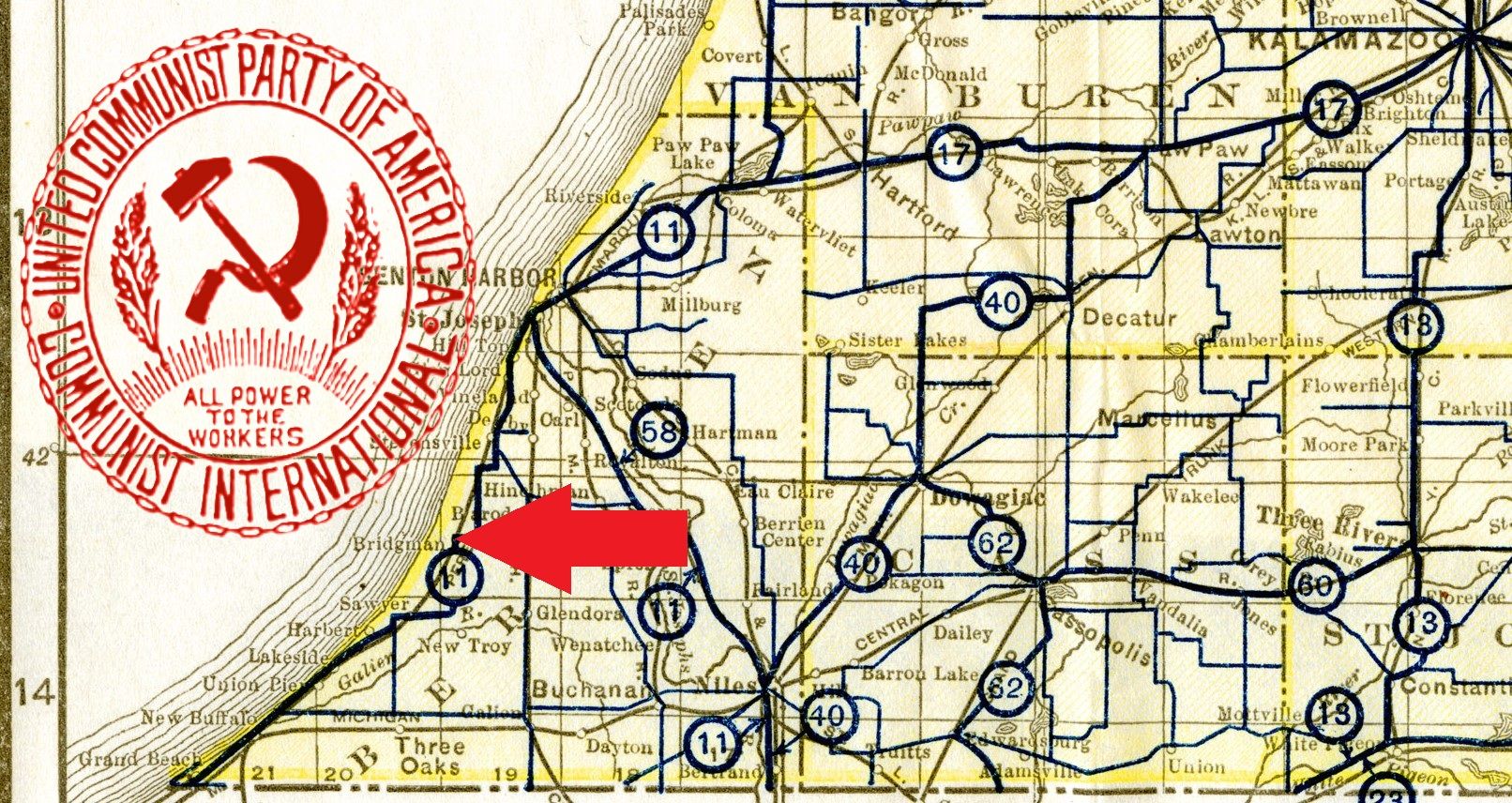
On the road to a Communist Party in the U.S., below is the definitive primary account of the first Bridgeman conference. In April, 1920 by Charles Ruthenberg, Isaac Ferguson, Jay Lovestone, and others–referred to as the Central Executive Committee group–split from the Communist Party over its reluctance to unite with the Communist Labor Party as mandated by the Communist International. That May delegates, thirty-two from the C.P. and twenty-five from the C.L.P. met in the dunes off Lake Michigan, two hours outside of Chicago, at a small resort in Bridgman, Michigan. After debate, at the end was formed the United Communist Party. Held in secret, pseudonyms were used, with those known being C.E. Ruthenberg (Damon, CPA), Louis Hendin (Delion, CPA), Isaac E. Ferguson (Caxton, CPA), Max Bedacht (Brown, CLP), James P. Cannon (Dawson, CLP), Ludwig Katterfeld (Klein, CLP), Edward Lindgren (Flynn, CLP), Alfred Wagenknecht (Meyer, CLP), S.M. Krunislav (Zemlin CPA), Abraham Jakira (Dubner, CLP) Schwartz (Kazbeck, CPA).
‘The Convention of Revolutionists’ by Isaac E. Ferguson from The Toiler (Cleveland). No. 125. June 25, 1920.
During the first week of September 1919, there were organized in the United States two Communist parties. Within two months both parties together had completed an enrollment of more than 40,000 dues-paying members. The prospects pointed to a quick increase to 60,000, perhaps 70,000—about three-fourths of the former Socialist Party membership.
Along came the Lusk Committee raids and arrests in New York; also sporadic arrests elsewhere in connection with the November 7th celebration. Organization of Communists was checked. Came an ominous lull then the avalanche of the New Year—the Palmer nationwide raids, arrests, brutalities.
At the end of January Secretary of Labor Wilson held that alien members of the Communist Party were subject to deportation. Communists—members of both parties—were branded as outlaws in the courts of New York and New Jersey. Like results appeared imminent in Massachusetts, Illinois, Michigan, California, Ohio, Indiana, in many other states.
No longer were there party headquarters, neither national, state, nor local. The active party officials were in jail or were fugitives. No meetings could be held without inviting arrests. Very little money could be raised even for defense and relief of prisoners.
By February 1920 the two thriving parties of October 1919 had vanished. The Luskers and Palmerites had done their work completely, perfectly. This country was immunized from the “red” terror—the terror which haunts the world…
Sometime recently, somewhere between the Atlantic and Pacific, between the Gulf and the Great Lakes, two groups of elected delegates assembled as the Unity Conference of the Communist Party and the Communist Labor Party. Of the former, 32; of the latter, 25, and one fraternal delegate; also a representative of the Executive Committee of the Communist International.
These 59 delegates came together from all parts of the United States, held sessions for seven days, debated every issue with absolute thoroughness, laid out the plan of work for the United Communist Party—all under the most perfect circumstances conceivable for such a convention.
One who holds in his hand the scroll upon which is inscribed the record of this mysterious gathering is amazed, for one thing, at the roll of delegates. Communist Party and Communist Labor Party—but all these strange names? Not one of the 1919 Communists present? Search the roll again—not one familiar name. Remarkable achievement of the Lusk-Palmer Inquisition—not one of the 1919 Communists in the list!
In spite of the fact that these delegates came together on a call for a “Unity Conference,” in spite of all realization of the fearful blow it would be to the Communist movement in this country if unity were not at once achieved, it was not until noon of the seventh day that this issue was decided conclusively.
Neither side was fully conscious of the undercurrent of sentiment on the other side. Factional controversies of nearly a year’s standing surcharged the atmosphere with suspicion—suspicion not only across the lines but within each camp.
None of the delegates were willing to surrender their reservations until after a long series of debates, some of little intrinsic importance, many on basic questions of Communist understanding and practice—questions which had never before been really faced in the United States.
One delegate hit upon the most salient truth about this convention in the remark that, in contrast to any other convention in which he had taken part either in Europe or America, this convention had met squarely every essential issue and debated it fully to its ultimate solution.
There were three separate advance sessions of the two parties. To each of these conventions was presented the tentative draft of a Program and Constitution previously prepared by a Joint Committee: Damon, Caxton, and Fisher, CP; and Brown, Klein, and Dubner, CLP.
During the second of these sessions, a message came to the CP convention that the CLP convention had accepted the agreements of the Joint Committee as a basis for unity, reserving all amendments for joint discussion.
At this moment the CP convention had under consideration a substitute Manifesto, Program, and Constitution presented by Ford for the New York District delegation. The debate quickly centered on the declaration as to “mass action,” it being conceded that the Joint Committee Program was more acceptable as an entirety. The main contention was that the Joint Committee had not used direct and unequivocal language as to force. It was answered that the criticism was only of words; that there could not possibly be any doubt but that the Program pointed clearly to armed revolt as the ultimate and inevitable form of “mass action.”
Personal suspicion stimulated this argument. The outside group of the CP the majority members of the Central Executive Committee had manufactured the issue of force as a dominant item in the CP split. There had never been such a factional issue. But the Eastern delegates particularly were determined to make certain that there would be nothing about the handling of this subject which might leave a loophole for the CP opposition.
Agreement was reached for the revision of the Program in a number of particulars, the CP delegates to support these amendments as a unit. The CP convention further bound its members on the issue of federations; also, to retain the CP name and emblem.
The first joint session opened with a spirited dispute as to election of committees. Some of the CP delegates insisted upon discussion of the Program as the first order of business. They said that they were not ready to commit themselves as to joint proceedings until the Program was disposed of. This brought forth angry protest; it served as a challenge to the group unity of the CLP. It was urged that unity had been achieved by coming together on the basis of the Joint Committee Program and Constitution; that every provision was open to amendment by the convention; that there might be a new division on the issues to come up, but that the old party division was gone.
A bolt of nine or ten of the CP delegates was started. Klein (CLP) reintroduced the motion to proceed with the discussion of the Program. Peace was restored.
The opening debates were sparring matches, with a strong undercurrent of nervousness. Three-score persons, engaged in a criminal conspiracy, spent two hours to decide whether capitalism breaks down in that it fails to “produce” the needs of life, or whether the collapse is due to the failure to “provide.” After considerable uncertainty the argument prevailed that capitalism, in spite of all its equipment, stultifies production; the wheels of industry turn only at the call of profit, regardless of all capabilities for production; crisis or nor crisis, capitalism has neve functioned to “provide” the needs of the masses…
In the playfulness of this debate was expressed relaxation and the forestalling of another premature clash. This was the safe way of “getting acquainted” the suppressed form of the struggle for unity.
Restrained resentment and suspicion broke loose into a furious storm during the next session. At the first statement in the Program concerning the overthrow of the capitalist system it was insisted that the word “forcible” be added. Likewise, at the first mention of “conquest of political power” it was demanded that there be added “by the use of armed force.” One amendment was piled upon another a veritable “force” panic.
In vain it was argued that this part of the Program contained only preliminary definitions, statements of the goal to be achieved; that the Program, under appropriate subdivisions, gave full attention to the methods of action; that the item of armed force does not stand by itself, but is the inevitable culminating aspect of “mass action”; that this tactic must be presented in its developmental character armed uprising as the unavoidable sequence of the advancing class conflict.
The CLP delegates, for the most part, were ready for a test of strength against the CP “irreconcilables.” They were conscious that this minority would have to accept defeat, since the point to be voted was only on what page something should be stated in the Program. Others sensed too much danger of misunderstanding behind such a vote, too much anger where agreement could easily be reached. Caxton moved to recommit this part of the Program, then to adjourn. There were some protests, but the motion prevailed. Meanwhile the tension was relaxed by the brilliant satirical speech of Sherwood, whose Yankee wit was the perfect antidote for passionate argument on an artificially stimulated issue.
The CP night caucus which followed, the amendments proposed by the Joint Committee, and a decision to dispose first of the section on “Mass Action,” gave the convention smooth sailing the next morning.
A spirited debate ensued on the proposition to limit nominations to legislative officers, according to the clause of the CP program. The issue was not clear-cut, since the anti-parliamentarians took the side of limiting nominations as one way of expressing opposition to all nominations. Brown (CLP) and some of the CP speakers argued directly against nominations of any kind. Damon (CP) contended that this clause was needed to discourage petty nominations by local units of the party. Raphailoff (CLP), Caxton, Malcolm (CLP) and others pointed out that the general proposition of parliamentary action was not involved in this debate; that to the extent we were to have any nominations at all it was indispensable, under the American system, to name the “head of the ticket,” the president, governor, or mayor; that this clause had been written into the CP program under the misconception that this was the proper method of meeting the “ministerial question,” the fact being that the Socialist ministers in Europe had all been elected as legislative candidates; that in this country the Socialists, whether elected to legislative or executive offices, had all behaved equally badly; that, finally, it was no occasion to worry about the actions of a Communist President, because the revolution would forestall this contingency, and that minor executive officers could serve just as well to be thrown out of office as the Communists elected to the legislatures.
By a close vote the paragraph was retained, but the limitation is of no immediate practical moment since the convention further went on record against all nominations during the 1920 campaigns.
On the third day occurred the longest and most stubborn debate of the convention, that on industrial unionism. This was another three-cornered affair. The CP convention had passed up the question of the IWW because it was apparent that this question could not be settled by agreement. Perhaps two-thirds of the CP delegates favored a direct endorsement of the IWW and a program of cooperation, reserving criticism of the IWW theorizing. The other CP delegates considered the IWW as essentially no better than the AF of L, citing the reactionary character of the IWW in some of the Eastern cities. All of the CP delegates were agreed upon an absolute stand against the AF of L as an inherently anti-revolutionary organization which must be destroyed.
On the other hand, there was a strong current in the CLP ranks for a treatment of the subject of industrial unionism from a general view-point which would neither include a direct endorsement of the IWW nor absolute condemnation of the AF of L. The lead in this debate was taken by Dawson, who argued that the AF of L must be considered not from the side of the Gompers officialdom; that industrial unionism was having a development in many fields aside from the IWW; that the need was for a call to a new general industrial union, a new One Big Union.
On both sides there was not only a close analysis of the proper function of a Communist party in connection with the unions, but also a wealth of illustrative material out of actual shop and union experience. Machinists, miners, and shipbuilders fused their practical understanding with the more abstract conceptions of those whose vision was focused on the ultimate revolutionary clash. The cleavage was not between “intellectuals” and “rank and file,” but between workers in the industries who had undergone contrasting forms of experience.
The original Joint Committee proposal on this subject had been taken over from a draft by the Chicago District Committee. Dozens of amendments and substitutes were brought before the convention, but finally the section was adopted as originally presented. As a result of the debate, however, the Committee opened the subject for reconsideration the next day, presenting two amendments which were accepted. In the sentence “A Communist who belongs to the AF of L, on account of absolute job necessity, should seize every opportunity to voice his hostility to this organization, not to reform it but to destroy it,” there was eliminated the phrase “on account of absolute job necessity.” The sentence, “A stronger IWW must be built,” was stricken out.
The unity issue flared up again on the question of party name. On the first vote there were 22 counted for “Communist Party,” 24 against. A roll call was demanded; the CP names were read first; 30 votes were recorded for “Communist Party.”
The CLP delegates resented what they considered a coercive vote without any chance for discussion. An indignation speech was made by Flynn which proved the moral power of effective minority criticism; with the opening of the next session came a ballot vote on “United Communist Party” or “Communist Party” with “united” written underneath. The vote was 33 to 22 for “United Communist Party.”
This appeared to be the real achievement of unity, the breakdown of the old party lines…But there were still the elections.
Two important debates came under the consideration of the Constitution, one on party centralization, the other on federations.
In the first instance the issue of centralization came up on the amendment making the CEC appointment and removal of organizers subject to the approval of the district executive committees. On the one side it was argued that this meant the substitution of autonomous districts for autonomous federations, a central executive shorn of real authority and real capability of action; that democracy was not to be obtained by decentralization but only by some effective means for control of the central authority; that district committees would lend themselves more easily to factional manipulation than the central committee elected in a national convention by delegates well known to the members. It was urged that an underground party must have the possibility of instant decision and action by a small committee; it must act as a single machine, else it can never strike a decisive blow.
Lack of confidence in officials was the central theme of the contrary argument. The party affairs, it was urged, must be brought nearer to the control of the rank and file. The central committees had been the breeding place of factional controversies. It was not asking much to give the district committees a veto in the choice of the organizers upon whom their work depended.
Upon the first vote the amendment was declared adopted. It then appeared that some of the delegates had misconceived the proposition to be one of appointing all organizers “from the top downward,” that is, sub-district, section, branch, and group organizers as well as the district organizers. A motion to reconsider was made and declared lost. Then followed a keen parliamentary battle, led by Damon, which finally resulted after three roll calls in a reversal of the original vote, 34 to 20.
On the federation question the Joint Committee had come to no agreement. In curious contrast to the history of last Summer, it was the CLP committee members who were loath to take a rigorous stand against federations. At the convention the CLP delegates took no group stand on this question. Two plans were presented, one for the CP delegates by Damon, the other by Dubner and Raphailoff for the federation members of the CLP. The debate was largely between the federation delegates on both sides. The principal controversy was as to the existence of national executive committees for the language groups, this proposal being decisively voted down.
Late in the afternoon of the fourth day of the joint sessions it was decided to proceed with elections of party officials. There had been many hours of caucusing on each side as to elections. Regardless of the sentiment of the convention expressed by a majority vote against further caucuses, neither side was willing to risk a surrender of its group strength.
A motion was made by (CP) that the CEC be composed of the five CP delegates and four CLP delegates receiving the highest votes, without contest as between the CP and CLP candidates. The motion was not supported.
Brown and Caxton were the nominees for International Secretary. Brown 30, Caxton 23.
With two to elect, there were four nominees for International Delegate. The vote stood Damon 30, Meyer (CLP) 28, Caxton 26, Barry (CLP) 26…The lines were not holding; four CP votes had been divided between Meyer and Barry.
Then came ten nominations for the nine places on the CEC. Damon, Scott, Reinhart, Delion, Zemlin, (CP); Meyer, Klein, Flynn, Brown, Dawson (CLP). These were the caucus nominations. Obviously the CLP caucus had determined to avail itself of the dissensions in the CP ranks and to attempt to elect a majority of the committee.
At the night session was announced the result of the balloting: Damon, Scott, Klein, Flynn, 29; Brown, 33; Dawson, 32; Meyer, 30; Reinhart, 26; Delion, Zemlin, tied at 24. Damon, Scott, and Reinhart quickly offered their resignations. A bitter discussion was precipitated. Both sides had played for “control” and the result had been a boomerang; for how, it was urged, could the CP delegates report back to their members that they had been outwitted in strategy in a way to give the minority control of the united party? Even though the fault was that of the CP delegates themselves, how could that remedy the outside situation?
The CLP speakers vehemently answered that what was done was the result of the will of the convention; that it was outrageous for members to resign from the CEC simply because they felt they could not boss the committee and the party; that, after all, the outcome of the election would be the best proof to the members that the old party lines had been forgotten.
A motion for a recess of half an hour was adopted. Then began the tug of war which went in the middle of the night, only to be resumed the next morning the two groups, apparently completely welded, now standing sharply apart as CP and CLP. The convention vanished; in its place were two caucuses, with committees for interchanges of offers and counterproposals.
The strained item in the CP camp had been an attack upon Caxton, based on the “majority” CP criticisms. In the CP caucus, after long discussion, he had been nominated for the CEC, 18 to 9. Later Caxton had withdrew his name. Now it was insisted that his name be reintroduced, making Zemlin first alternate. The CLP offered to substitute Caxton for Brown as International Secretary.
The last morning found the situation dead-locked. To open the convention again meant to give the CP the advantage of the renewed caucus pressure in favor of solidarity for CP control, all questions of personality aside. The issue of control having been precipitated by the turn of the elections, the CP delegates were in no mood to give up their demand for a majority of the CEC. The CP delegates made only one demand, reopen the convention. It was for the other side to make the next move…
There is nothing in the official record which suggests under what sort of surroundings these things happened. As a matter of fact the physical surroundings had a very important part in the struggle for unity which is not at all illuminating to the reader who is asked to wait a few years for a description of these surroundings.
Besides, how is one to visualize one group of delegates in heated argument, while the other group is engaged in the singing of revolutionary songs, mostly in Russian how is one to imagine all this without something in the way of spacial dimensions? The singing marches halfway toward the arguing group a challenge to unity, the song of the International–and reluctantly marches back to its own meeting place.
There is a committee conference. Before the report comes back the lines are formed for a new march, this time to go all the way. Agreement is reported a CEC of ten members, the five CLP candidates to sand elected, five CP members now to be chosen. The march proceeds; it is the only report to the anxious CLP delegates the two groups merge into one another, all singing the Internationale. There is the grasping of hands, the embrace of comradeship: nothing is said—there is too much feeling for speech…Unity is achieved…
Recapitulating, the CEC stands: Damon, Scott, Reinhart, Delion, Caxton, Brown, Dawson, Klein, Flynn, Meyer. Alternates in the following order: Zemlin (CP), Dubner (CLP), Stone (CP), Jones (CLP), Kerker (CP), Hill (CLP); Ford (CP), Malcolm (CLP), Kazbeck (CP), Logan (CLP).
For International Secretary, Caxton replaces Brown; Damon and Meyer stand as International Delegates: Scott, alternate for Damon: Barry, alternate for Meyer.
An American convention of Communists. Yet there was, more likely than not, a majority of “foreigners,” though the division was fairly even. But these were Communists who were vitally concerned about the class struggle in America, men and women who really expected to take part in this struggle; not those who toyed with the Communist movement here as a method of ingratiating themselves in Moscow.
It was one of the most inspiring things about this convention to hear delegates painfully struggling with the English language, no longer depending for expression on the artificial foreign-language caucuses of prior conventions, but making themselves one with all the other delegates in defiance of barriers of language or nationality. Perhaps this was the greater “unity” achievement of this convention…
Again and again the sentence was heard: “We have crossed the Rubicon.” Every delegate was in the hands of his fellows; all subject to imprisonment, deportation, social and economic displacement.
Yet most of the time—not without thanks to the irrepressible wit of the convention secretary, Smyth—the whole affair seemed like a jollification. Or perhaps it was the grim seriousness of it all that challenged relief in playfulness?…
A revolutionary movement driven “underground” is apt to be driven away at the same time from its petty animosities and quibbles. Forced to face the life and death character of the combat, it is likely to discard pretenses, evasions, purposeless quarrels about persons. Confusion gives way to clarity; hesitation yields to stern determination.
A convention of revolutionists–a convention which relentlessly searched the truth of every word and the heart of its every delegate…
The Toiler was a significant regional, later national, newspaper of the early Communist movement published weekly between 1919 and 1921. It grew out of the Socialist Party’s ‘The Ohio Socialist’, leading paper of the Party’s left wing and northern Ohio’s militant IWW base and became the national voice of the forces that would become The Communist Labor Party. The Toiler was first published in Cleveland, Ohio, its volume number continuing on from The Ohio Socialist, in the fall of 1919 as the paper of the Communist Labor Party of Ohio. The Toiler moved to New York City in early 1920 and with its union focus served as the labor paper of the CLP and the legal Workers Party of America. Editors included Elmer Allison and James P Cannon. The original English language and/or US publication of key texts of the international revolutionary movement are prominent features of the Toiler. In January 1922, The Toiler merged with The Workers Council to form The Worker, becoming the Communist Party’s main paper continuing as The Daily Worker in January, 1924.
PDF of full issue: https://www.marxists.org/history/usa/pubs/thetoiler/125-jun-25-1920-toiler.pdf
 Revolution's Newsstand