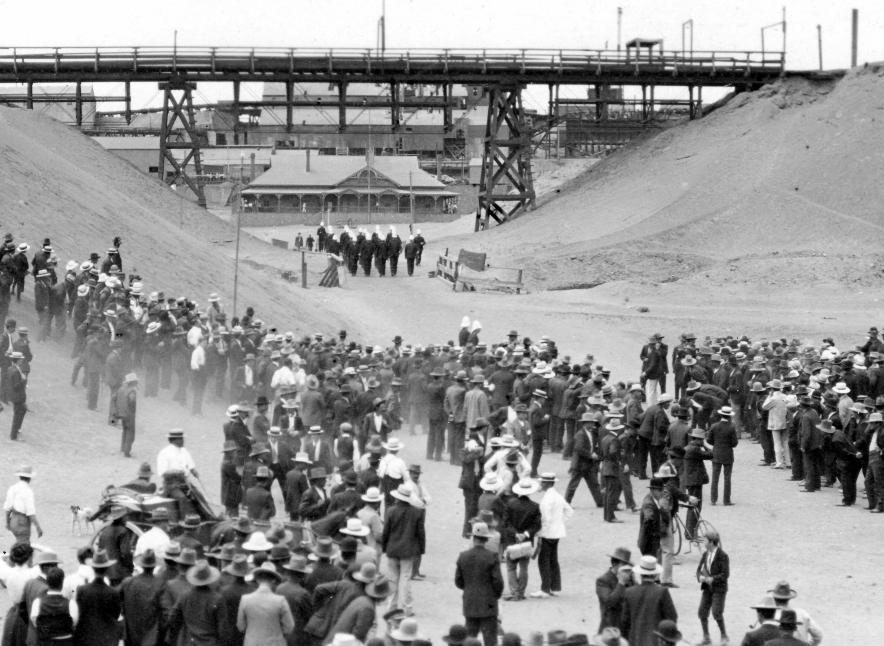
Thousands of New South Wales miners strike in a major battle of Australia’s class war that, while lost, greatly developed that country’s workers’ movement. Maud Thompson reports.
‘The Great Australian Coal Strike’ by Maud Thompson from Solidarity. Vol. 1 No. 9. February 12, 1909.
Australia has an elaborately constructed machinery to prevent strikes. It was created after the industrial life has been disturbed by a series of great strikes. The capitalists hoped it would preserve industrial peace. The labor party supported it on the ground that it meant government recognition of the labor unions and government guarantee of fair wages and good working conditions. The two main parts of this legal machinery are Compulsory Arbitration Courts and Wage Boards. The power that is supposed to make the machinery work lies in an Industrial Disputes Act, which forbids strikes and lockouts and makes it compulsory for employers and employes to submit industrial disputes to the appointed courts. The penal clause of the Act provides for a fine of $5,000 or six months imprisonment for the offenses of striking or locking out.
Many disputes have been settled by the industrial courts.
A minimum wage has been fixed by the Wage Boards in some industries. But oppression and discontent have not ceased, and, in spite of the law, strikes have come. The last strike has almost paralyzed industry, because it has stopped the production of the food of industry–coal.
In 1907, the coal miners of Newcastle, New South Wales, struck, but agreed to submit their differences to an Industrial Court and to go back to work pending the Court’s decision. The proceedings dragged out before the court for a year and when the settlement was finally announced working conditions and the wage scale had so changed in the mines that the award of the court utterly failed to meet the men’s needs.
In September of 1909 the men submitted a statement of their grievances to the employers and expressed their willingness to enter into a conference. The employers did not respond and from that time on the men, who had lost faith in the Industrial Courts, felt that a strike was inevitable.
The list of grievances published later by the strikers dealt with about 60 minor grievances presented by the workers of the different mines; but most of them came under the general heads: (1) The bad working conditions in the mines; (2) the cutting of wages below a living wage through the methods weighing and paying for the coal and through the unsteadiness of employment; (3) the discrimination against union men. The nominal wage was comparatively high, but the heavy fines for mixing dirt with the coal, the low rates paid for certain grades of coal and other devices made the nominal wage an almost impossible one. Worst of all, the efforts of the companies to raise prices by limiting the output so diminished the opportunity for employment that many a man had to live on what he could make in two days a week. Meantime, the owners’ profits were immense. The Newcastle-Wallsend mine, with a capital of $500,000, had in a few years trebled its capital and paid in dividends eight times its original capital. Men active in their union were dismissed on various pretexts, until the union funds were supporting from 1,000 to 1,500 of these victims at a cost of 25 per cent of the total wage The policy of the employing companies toward union men seemed to aim at depleting the union funds, and so preventing strike. The men endured, concealing their purpose and waiting for the right moment in industrial conditions. When they had reason believe that the coal supply on hand was low, the miners’ representatives in the Board of Delegates on Nov. 5th submitted a strike resolution to the lodges. Forty-one lodges of the Northern Federation, the Newcastle district, endorsed it, and the remaining mines came over in a few days. Almost immediately the miners of the Southern and Western Federations came out and 15,000 miners were on a strike.
The Queensland miners refused to cut coal destined for the Newcastle district. Almost as important as the support of all the miners was that of the coal handlers. A Strike Congress composed of delegates. from the miners and the Waterside Workers was called. The Waterside Workers offered to go out on strike at once, but the miners asked them to go n working in order to give their financial support to the, strikers. The miners of Broken Hill, who last year fought their own long strike, offered to go out when the Waterside Workers, should do so. They voted an immediate contribution of $5,000 and levied a weekly contribution, to be paid as long as the strike night last, of two shillings and six pence on each of their members. Many other unions voted the same kind of help to the strikers. The Co-operatives of Newcastle and Sydney agreed to furnish the strikers with the necessities of life on credit.
A general strike in New South Wales with a successful tie-up of industry which should speedily bring the coal companies to terms seemed possible. But from the formation of the Strike Congress there was a growing divergence of opinion in regard to tactics between the leaders of the two chief groups in the Congress.
Peter Bowling, president of the miners, was in sympathy with the principles and methods of the Industrial Workers of the World. He was also an advocate of the general strike. W.M. Hughes, president of the Waterside Workers and ex-Attorney General of the Commonwealth, declared that the I.W.W. was a curse to the land,” and he favored confining the strike to the Newcastle miners. He bent all his energies to the effort to secure a conference between the miners and the mine companies. When the Waterside Workers wanted to strike in sympathy he held them back by his great personal influence. When a ship load of Japanese coal was docked at Sydney the Strike Congress ordered the Coal Lumpers to unload it: The Coal Lumpers defied the Congress and refused to scab on the miners by handling foreign coal. The mine companies, the capitalist press, and the Parliament raged vituperatively against Peter Bowling, but waited hopefully for Mr. Hughes’ efforts to secure a settlement.
Factories shut down, ships could not coal, a gas famine threatened, the railroads had to cut down their schedule; 25,000, besides the miners were thrown out of employment. From press and pulpit and parliament rose the usual wall over the “wronged consumer,” the usual appeals to the strikers to consider the “community” and to save their own wives and children from starvation. The labor members of Parliament proposed that the government take over the mines and the rank and file seconded the demand.
From the beginning the miners had asked for an open conference to consider the following demands: (1) An 8-hour day; (2) a minimum wage; (3) a uniform sliding scale of payment. The employers had insisted on a secret conference, preceded by a resumption of work. The Prime Minister suggested as a compromise that work be resumed on the first day of the conference. But the miners had not forgotten the year in which they worked under increasingly bad conditions while the Industrial Court considered their complaints, and they refused to be caught again. The government’s answer was to threaten the miners with the enforcement of the penal clause of the Industrial Disputes Act.
At this crisis, Peter Bowling came forward with a scheme which was designed to relieve some of the worst features of the coal famine and also to increase the strike funds. He succeeded in making an agreement with the owners of two mines outside of the Coal Trust (the federated employers called “The Vend”). The terms made were that the mines should be worked under conditions prescribed by the unions; that no coal should be sold in the Newcastle district except to charitable institutions and the miners, and that part of the profits should go to strike funds. The co-operative mines were started on Nov. 29th and were making a good output when the government, apparently consenting to be the tool of the Trust opposition, attempted to block the union scheme. On Dec. 1st. the Railway Commissioner (the railways are owned by the state) declared that he would confiscate all coal mined in the state, i.e. the product of the two union mines. In the face of a storm of protest against this act of tyranny (from labor members and even from the capitalist press) the government was obliged to modify its demand. The Railway Commissioner refused to haul the union coal unless half of the output was surrendered to the state for use on the railroads, the coal to be paid, for at the Commissioner’s own price.
Balked in completely suppressing Peter Bowling’s co-operative mining scheme, the government fulfilled its threat of potting in force, the Industrial Disputes Act. On Dec. 9th a crowd of police followed the miners’ officials from Sydney to Newcastle and in the presence of a great crowd of union sympathizers arrested three officials, Bowling, Burns and Brennan. Later two other officials and 15 men who had acted as chairmen or as speakers at strike meetings were arrested. All were held on the charge of inciting to riot.
Although these men were all released on bail, the course of the strike seems to have been turned after their arrest. The influence of Mr. Hughes and the labor members of Parliament became predominant in the Strike Congress and all tendencies to extend the field of the strike were repressed. The Coal Lumpers defied the Congress and on Dec. 11th went on strike to the number of 900. The gas workers of Sydney struck in sympathy, but were induced to go back to work. On Dec. 8th some of the Industrial Workers of the World tried to swing the wharf laborers into the strike but the appeal of Hughes triumphed.
The next step of the government was to pass a new clause to the Industrial Disputes Act making union funds liable for the members’ fines. Finally the news has just reached us that the strike leaders have been sentenced to jail; Peter Bowling to one year at hard labor, the other officials to eight months and the speakers and chairmen to shorter terms.
So the strike is at deadlock. There is no disorder, and as yet no men have gone back to work. The strike funds are low and the distress is increasing, but the men are enduring. The employers are as unbending as ever, apparently content to wait until the demand for coal shall have raised the price and hunger has driven the men back to work. The labor members are. still clamoring for nationalism of the mines and Mr. Hughes is still striving to bring employers and employes together in conference.
A government lease on the coal lands, financial resources built from enormous profits, political influence over a subservient ministry and a bourgeois press, an Industrial Act that is enforced by the government against only one party in the dispute. These are the assets of the Coal Trust. Solidarity of feeling among the workers, such financial support as other unions can: give, a protesting labor minority in Parliament, several fearless and clever leaders and one uncompromising daily paper (the Barrier Daily Truth) and the necessity of resisting unendurable conditions.
So far the great Australian coal strike is chiefly important as an example of the failure of a capitalist government as an arbitrator in industrial disputes. Laws designed to serve impartially the conflicting interests of capital and labor have proven to be the best possible weapon in the hands of a capitalist ministry. It remains to be seen whether it is proved also that restricting the strike to the miners was a great tactical blunder on the part of the leaders.
The most widely read of I.W.W. newspapers, Solidarity was published by the Industrial Workers of the World from 1909 until 1917. First produced in New Castle, Pennsylvania, and born during the McKees Rocks strike, Solidarity later moved to Cleveland, Ohio until 1917 then spent its last months in Chicago. With a circulation of around 12,000 and a readership many times that, Solidarity was instrumental in defining the Wobbly world-view at the height of their influence in the working class. It was edited over its life by A.M. Stirton, H.A. Goff, Ben H. Williams, Ralph Chaplin who also provided much of the paper’s color, and others. Like nearly all the left press it fell victim to federal repression in 1917.
PDF of full issue: https://www.marxists.org/history/usa/pubs/solidarity-iww/1909-1910/v01n09-feb-12-1910-Solidarity.pdf
 Revolution's Newsstand