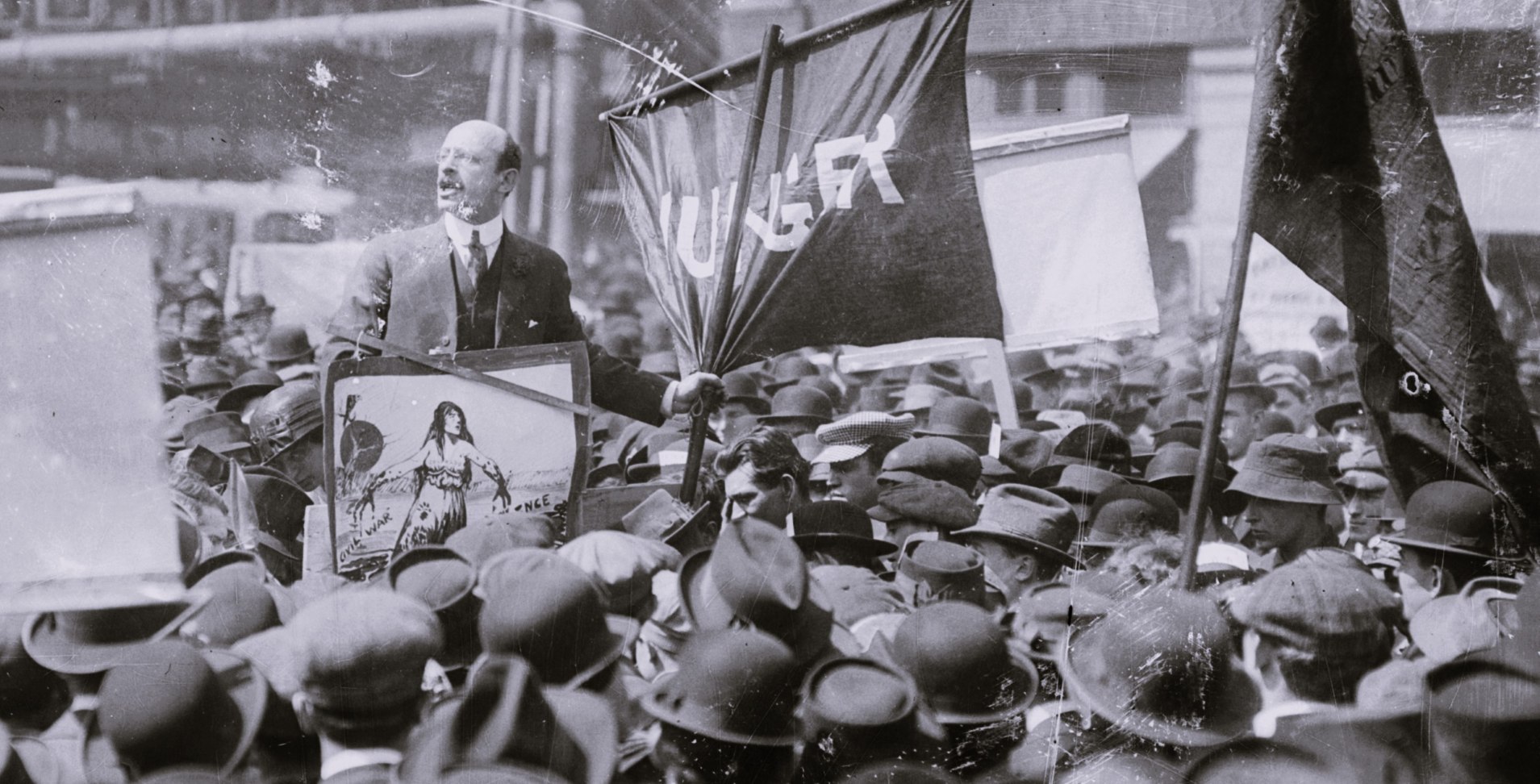
A series of unemployed and homeless demonstrations in New York’s Union Square were routinely assaulted by police in 1913-1914. Largely organized by anarchists and individuals in the I.W.W. with the Socialist Party and the union indifferent or hostile. Alexander Berkman playing a major role along with Frank Tannenbaum, Joe O’Carroll, and Arthur Caron. Just weeks after this article’s publication, Caron, along with others, would die in a premature explosion while (allegedly) constructing a bomb intended for John D. Rockefeller in revenge for the Ludlow Massacre of striking miners families. Berkman with the story of the fight, includes text of a leaflet distributed in the campaign.
‘The Movement of the Unemployed’ by Alexander Berkman from Mother Earth. Vol. 9. No. 2. April, 1914.
THE real situation in regard to the movement of the unemployed does not seem to be understood or appreciated even by some of those who pretend to stand in the forefront of the proletarian struggle.
The movement sprang from the spontaneous need of the moment. Thousands of men and women out of work, tramping the city in a vain search for a job, many of them homeless and penniless—what more natural than that such abject misery should crystallize itself in the cry for Bread.
To be sure, the demand was voiced by a small minority of the more intelligent and bolder spirits. Was ever any demand articulated first by the duller majority, however dire their need? But there are always people so constituted that their first impulse is to belittle and condemn everything that is small in numbers, whatever its quality. There are others again who taboo everything not inspired by themselves, for their own greater glory or that of their party. These are the sane and safe ones who in their supreme wisdom and scientific foresight have irrevocably mapped out the path of human progress, and who modestly insist on it that the “course of evolution” is inevitable and must proceed as mapped out. In their blind fanaticism they attempt to force every individual or social expression into the frame of their conception, and denounce and obstruct every phenomenon that refuses to conform to their canned program.
This may help to explain the storm of abuse and condemnation that broke over the head of Frank Tannenbaum and his fellow-unemployed when their demand for bread began to take definite form. The masters denounced them; the good Christians called the wrath of God upon their heads, the police persecuted them, and the greater part of the Socialist press—to the shame of its decent supporters be it said—first ignored, then ridiculed and vilified them.
And yet Tannenbaum’s crusade against the churches was a most significant thing, from whatever standpoint considered. So far as the Christian element in the unemployed army is concerned, it was a convincing argumentum ad hominem that the starving man could expect no help from the religious institutions or the official followers of the poor Nazarene tramp. And as to the public at large—the manner in which the Protestant churches sought to avoid the issue, their begrudging aid forthcoming only because of their fear of the desperately hungry men, and the brazenly open repudiation of “the beloved of Christ” by the Catholic church—the Tannenbaum raids have accomplished more in tearing off the mask of religious hypocrisy than the yearlong propaganda of freethinkers.
Then came the trial of Frank Tannenbaum. It is sad, very sad to confess that those who style themselves the spokesmen of the oppressed kept a most shameful silence, where they did not directly condemn and ridicule Tannenbaum. Instead of starting a wide-spread agitation against his persecution, “the working class party” remained dumb. Not a finger was raised to rouse the public to the evident conspiracy on the part of the authorities and the invaded Catholic church to “make an example” of Frank Tannenbaum, as the menacing gesture of the depths.
Any one familiar with the labor struggle knows the effect that an energetic public protest produces on the hand that holds the scales of capitalistic justice. Is it not sufficient to recall the cases of Moyer, Haywood, and Pettibone? of Ettor and Giovannitti? or the more recent instance of Alexander Salvanno, the Spanish marine fireman striker whom the multiple police charges threatened with imprisonment for life?
Not a word from the political party that allegedly exists only to further the interests of the downtrodden and disinherited. Indeed the conviction of Tannenbaum and the outrageous sentence imposed on him only called forth a malicious sneer against the victim in the columns of the New York Call, to the effect that Frank deserved a spanking.
After Tannenbaum’s arrest it became evident that the Socialist party and certain prominent ones in the I.W.W. sought by every means to limit and paralyze the movement of the unemployed. Therefore the Conference of the Unemployed, consisting of delegates of various labor and radical organizations, decided to hold a mass meeting at Union Square, the date set being Saturday, March 21. The Socialist party and its locals absolutely refused to cooperate. Aye, even the I.W.W. declared itself bankrupt by declining to take part, as an organization, in the so vital mass movement. Orders were even given to individual members of the I.W.W. not to participate in the Union Square meeting. It was thought “wiser and more practical” by the official leaders—with one or two manly exceptions—to remain in the safe retirement of sex o’clock boudoirs.
Notwithstanding the misrepresentations of the capitalist and Socialist press; which insists on labelling the unemployed movement with the name of I.W.W., the fact is that but a small minority of I.W.W. boys are active therein, and that only as individuals, most of whom are disgusted with the weak-kneed passivity of the leaders of that organization. It has been charged that the movement of the unemployed is conducted largely by Anarchists. We plead guilty. But the Anarchists stepped in only after Tannenbaum’s arrest, when neither Socialists nor official I.W.W. cared to risk their precious life and limb. Are not the Anarchists always the ones to face the fire when a situation becomes dangerous?
With tooth and nail the Socialist and I.W.W. officialdom opposed the mass meeting arranged for March 21. The Call even refused to print an advertisement of the planned meeting, to be inserted Saturday, March 21, though it had received payment and published the same ad on the day before. The animus of the Socialist politicians was so bitter that at their meeting at Cooper Union, March 19, arranged to discuss the unemployment problem, they refused the floor to the spokesmen of the unemployed, though the audience demanded to hear them. The treachery, but even more so the stupidity of the proceedings naturally resulted in disorder and the arrest of the intended speaker of the unemployed, Joe O’Carroll, subsequently discharged by the magistrate. The attitude of the priests of St. Alphonsus church toward Tannenbaum and his men was duplicated by the Socialist high priests at Cooper Union.
* * *
The mass meeting at Union Square, March 21, was as inspiring as it was dignified. The condition of the unemployed was put up to the public of the city, squarely and tersely, mostly by the unemployed themselves, who emphasized the right of the starving to satisfy their hunger by any means.
The great meeting resolved itself into a parade up Fifth Avenue, a march of the disinherited whose very appearance was a challenge to the guilty conscience of the exploiters and well-fed idlers. For the first time in the history of this country did the black flag, symbol of starvation and desperate misery, flutter a menacing defiance in the face of parasitic contentment and self-righteous arrogance. The demonstration in Millionaire Avenue was permeated with the spirit of revolt that has fired the hearts of the downtrodden in every popular uprising. It gave full vent to the accumulated misery and suppressed rage against injustice and wrong, the parade continuing up to 107th Street, where it closed in the generously opened headquarters of the Francisco Ferrer Association with a substantial meal for the unemployed who were also provided with tobacco and cigarettes and lodgings for the night.
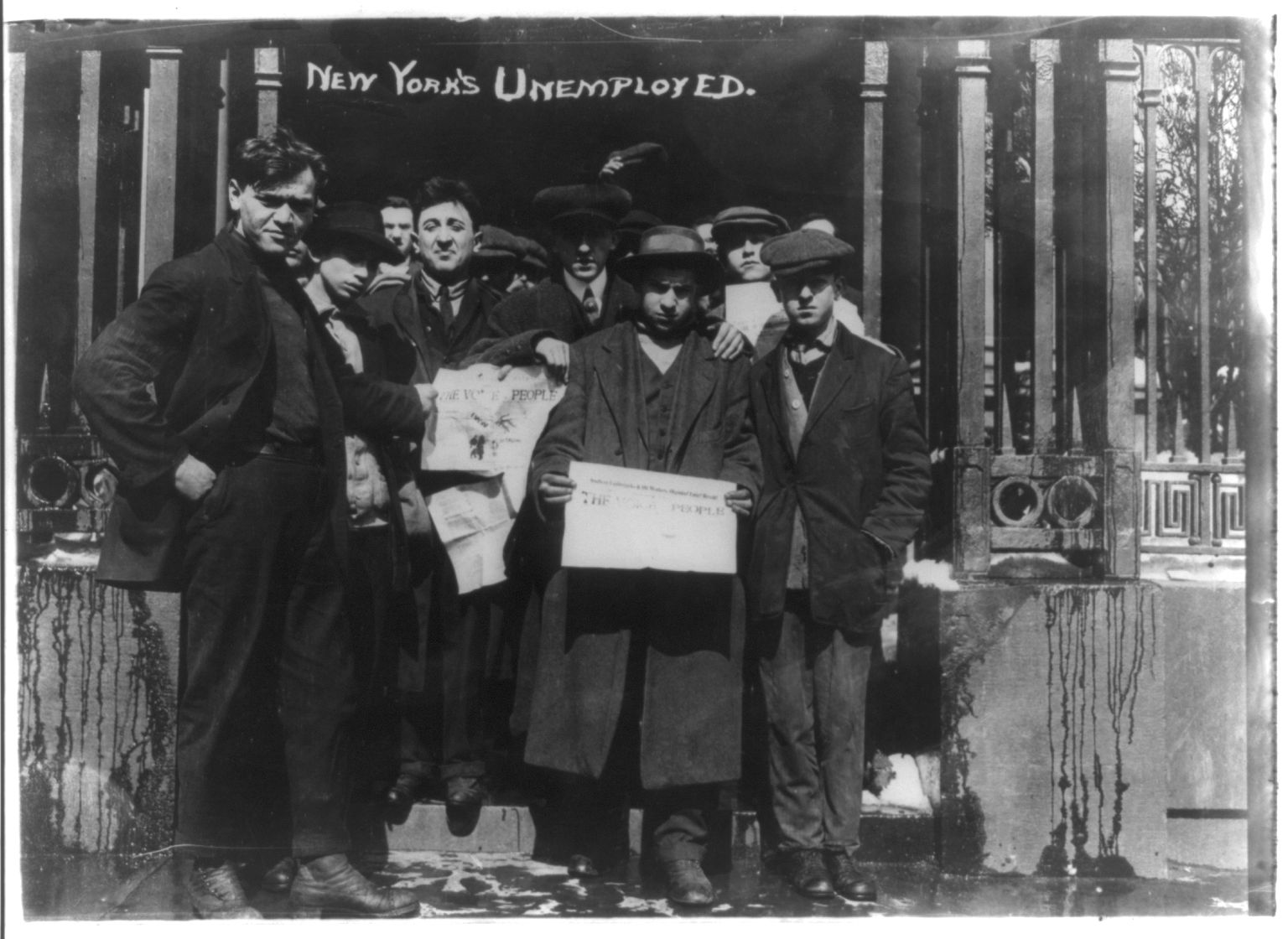
The masters and their hireling press frothed at the mouth. What! The starvelings to be permitted to parade their naked misery, to threaten the moneychangers in their very temple? The black flag of hunger and destruction to wave so menacingly in the wealthiest and most exclusive section of the metropolis, the fearful cry of Revolution to thunder before the very doors of the mighty! That is too much!
The masters trembled. The hounds of capital—the press and police—were unleashed.
***
The movement of the unemployed continued on its way. In spite of repression and numerous arrests the agitation kept up. Meetings took place every evening at Rutgers Square, the Conference, representing the executive body of the unemployed, multiplying its efforts and daily carrying on large open air meetings at Franklin Statue (“Printers’ Row”), on the East Side and at various points in Harlem. At the same time the city was circularized with leaflets and pamphlets, enlightening the public as to the causes of the wide-spread unemployment and suggesting ways of immediate relief and the ultimate abolition of the conditions of economic exploitation and social injustice. The Conference further initiated another phase of its constructive work, an educational campaign in the labor unions, by means of circular letters and committees, to gain the solidarity and aid of the organized and employed for the unorganized and unemployed, on the basis of their common humanity and mutual interests.
It is from the army of the unemployed that the exploiters recruit the most dangerous foe of labor in times of strikes—scabs and blacklegs, and this point, among others, received special consideration and emphasis in our campaign in the labor unions.
The value of the agitational and educational propaganda resulting from the movement of the unemployed cannot be overestimated. Good seed has been sown in fertile soil, and the harvest will ripen in due time.
***
The second monster mass meeting of the unemployed was scheduled for Saturday, April 4, at Union Square. The spirit of the movement being thoroughly revolutionary, this meeting, like the preceding one, was not arranged with the kind permission of the master class and its armed hirelings, The unemployed workers do not beg; they demand. If they do not at present enforce all their demands, it is only because they don’t as yet feel themselves strong enough to do so successfully. But in the matter of the mass meeting arranged for April 4, they were determined to assert their right of free speech, all the persecution and threats of the press and police notwithstanding.
I am confident that the determined attitude of the unemployed in refusing to call off their meeting at Union Square was the means of preventing bloodshed. The authorities faced a difficult dilemma; the executive Conference was not to be swayed from their position either by the threats of the enemy nor by the pleas of backboneless friends. Preparations for the mass meeting were energetically continued, when lo! the authorities hit upon a scheme to circumvent our meeting without the unpleasant necessity of an open conflict.
It was a Jesuitic cabal on the part of the heads of the police department and a few labor fakers representing the Central Federated Union. Two days before our meeting the newspapers suddenly announced that the C.F.U., through Ernest Bohm, its secretary, had secured a police permit to hold a mass meeting at Union Square on April 4, to be followed by a parade of the labor unions, to protest against the conditions in the copper mine strike region of Michigan. For the purpose of the parade Bohm was given seven different routes, covering practically the whole city of New York and thus excluding the possibility of any mass meeting or demonstration on the part of the unemployed.
The Executive of the Conference immediately communicated with various labor organizations, among them also the Women’s Trade Union League. Not a single union was aware of any meeting or demonstration in which they were to participate; none had been either consulted or informed of the action of Ernest Bohm. The Executive of the Conference thereupon got in touch by telephone with Bohm, who asserted the authenticity of the press report concerning the C.F.U. mass meeting. We assured him that the unemployed, considering their cause solidaric with labor at large, were willing to cooperate with the C.F.U., or even postpone their much previously arranged mass meeting in order not to conflict with the success of the labor protest against the masters’ brutality in the copper strike. Mr. Bohm eagerly agreed to our proposal to cooperate, promising to give us final answer after his consultation with the visiting representative of the miners.
Failing to hear from Bohm at the appointed time, the Conference mailed to him a registered letter, repeating our offer either to cooperate in his meeting or to postpone ours. Copies of the letter were also sent to the press.
Receiving no reply from Bohm up to the last moment, we printed a special throwaway announcing the postponement of our meeting because of our solidarity with labor.
The result has been reported in the daily press. The Bohm C.F.U. mass meeting proved a fake. Not a single union knew anything about it; not a single union put in an appearance. The audience assembled at Union Square on April 4 came in response to the call of the Conference of the Unemployed, issued two weeks previously. It became patent to everyone that Ernest Bohm, in the name of the C.F.U., and backed by the authorities, had played the miserable role of a stool pigeon for the police, in order to prevent the unemployed from holding their meeting.
The police used the occasion to revenge themselves for our successful revolutionary demonstration of March 21, by a show of brutality equaled only by Russian Cossacks of the Red Sunday days. The mounted officers savagely attacked the peaceful gathering in the Square, the foot police wielding their clubs with fiendish glee. Many were injured by the hoofs of the police horses and riot sticks, but the most dastardly outrage was suffered by our Comrade Joe O’Carroll, against whom the uniformed plug-uglies have a special grudge because of his tireless activity in the cause of the unemployed. Six detectives stealthily followed O’Carroll as he was leaving Union Square on his way home, in the company of two women friends. When he was fully three blocks from the meeting place, they suddenly attacked him without the least provocation or warning, raining their clubs upon his head with murderous violence. According to impartial eye witnesses—passersby on the street—the brutality of the assault was inspired by such evident hatred and revenge that O’Carroll would have been clubbed to death’ were it not for the presence of mind and wonderful courage of one of the girls accompanying O’Carroll—Rebecca Edelsohn—who threw herself between the detectives and their victim, protecting O’Carroll with her own body till they ceased clubbing him.
Similarly brutal and utterly unprovoked assaults were committed by the police upon other men active in the unemployed agitation, among them Arthur Caron, Joe Gans and G. Laricca. To justify their murderous assaults, the authorities arrested and brought charges against these and other prisoners, but the proof of police brutality was so overwhelming that the trial magistrate was moved to denounce the police scathingly, going even to the length of instructing counsel for the defense to prosecute the officers.
In the words of Joe O’Carroll, “they can’t club me out of the movement.” The agitation in the cause of the unemployed will continue. It will go on in spite of murderous police, in spite of persecution and imprisonment, in spite even of the dastardly denunciation by the Socialist Call in its editorial of April 7, so full of malice and venom that a stanch partisan like Abe Cahan, editor of the Socialist Forward, had to protest against the Call’s infamy.
The agitation will go on, inculcating intelligent discontent, spreading broadcast the gospel of revolt, and fanning the fires of revolution that will strengthen the heart and mind of the proletariat to defy and destroy the law and order system of starvation and murder.

TO THE HOMELESS!
Circular issued to the unemployed by the Conference of the Unemployed.
WHEN you have a job, you get paid just enough to keep body and soul together. When you lose your job, you soon find yourself on the street, and no one cares a rap whether you have sufficient food or a roof over your head.
Thousands of jobless men and women are now in just such a position, all over this land of ours that is supposed to offer everyone an opportunity for “life, liberty, and the pursuit of happiness.” In New York City alone there are thousands of unemployed, and many of them are hungry and homeless at this very moment, forsaken by God and man, and reduced to actual starvation.
Now, where is this opportunity to “life, liberty, and the pursuit of happiness,” so much prated about by every well-fed politician, every fat priest of Church and Capital?
This much-vaunted opportunity is a lie, invented and preached to keep the hungry slave patient and submissive.
Now, let’s reason a moment. Why all this poverty, misery and starvation?
There is plenty of food on hand, plenty of clothes and shelter. Why starve? Are these things made for men, or are men made only to produce things and then to go without them?
Every one of us, as members of the working class, has helped to produce these things, and now when our families need them, we haven’t got them, because our bosses, the masters, have robbed us of the fruit of our labor, and then thrown us out of work.
Unemployment is caused by the capitalist system under which one man is forced to work for another, and to give up the whole of his product for a part; whence it must inevitably result that masses of wealth accumulate in the hands of some. The longer the process goes on, the less the mass will have, and the more the accumulators.
That’s how present society is kept up. But—society is made for men, not men for society; society is, or should be, an arrangement for the mutual benefit of all its constituents. As it is, however, so far from being served by the social organization, the security, wellbeing, health, even the bare existence of its members, is destroyed wholesale, so that Society-as-it-is may continue to exist; so that bonds, banks, interest, rent, profit, and taxes may continue their course undisturbed. Beside these institutions, hoary with time and respectability, human flesh and blood are weighed as nothing, and men die in their hunger and despair that property may be preserved sacred. We sacrifice the living maker to the inanimate thing he has made. Rather than take the food which was made to be eaten, humanity dies of hunger gazing at it; rather than warm itself with the coal which was dug to be burned, a human being freezes to death in the secluded corner of a coal yard; rather than clothe itself with the garments which were made to be worn, a rag-concealed body shivers into final stiffness, while the unworn garments hang upon metal “dummies.”
Such a condition of affairs must not be permitted to continue. There is no need for all this unemployment, misery, and starvation.
The fruit of labor should belong to labor, and to labor alone. The workers, employed and unemployed, must unite their forces, and with their combined economic power expropriate the exploiters of the working class and take possession of the means of production and distribution, in order to continue production—not for profit—but for the use and well-being of all.
Only thus will the workers abolish their wage-slavery and with it unemployment and starvation,
Meanwhile, men and women, let us come together and decide how the food, the clothes and the shelter that are on hand a-plenty, are to be placed in the hands of those who need them.
LEARN HOW TO HELP YOURSELF!
No one else will help you.
Since the above was written, a monster mass meeting of the unemployed took place at Union Square, on April 11th. The attendance was fully 10,000, the gathering proving one of the most inspiring events in the annals of American labor, especially because of the revolutionary tone of the gigantic assembly. For the first time in the last twenty-five years (excepting the meeting of March 21st) was a mass meeting held in Union Square without a police permit. The event was a most striking demonstration of the power of revolutionary determination.—Ed.
Mother Earth was an anarchist magazine begin in 1906 and first edited by Emma Goldman in New York City. Alexander Berkman, became editor in 1907 after his release from prison until 1915.The journal has a history in the Free Society publication which had moved from San Francisco to New York City. Goldman was again editor in 1915 as the magazine was opposed to US entry into World War One and was closed down as a violator of the Espionage Act in 1917 with Goldman and Berkman, who had begun editing The Blast, being deported in 1919.
PDF of full issue: https://archive.org/download/mother-earth/Mother%20Earth%20v09n02%20%281914-04%29%20%28c2c%20Harvard%20DSR%29.pdf
 Revolution's Newsstand