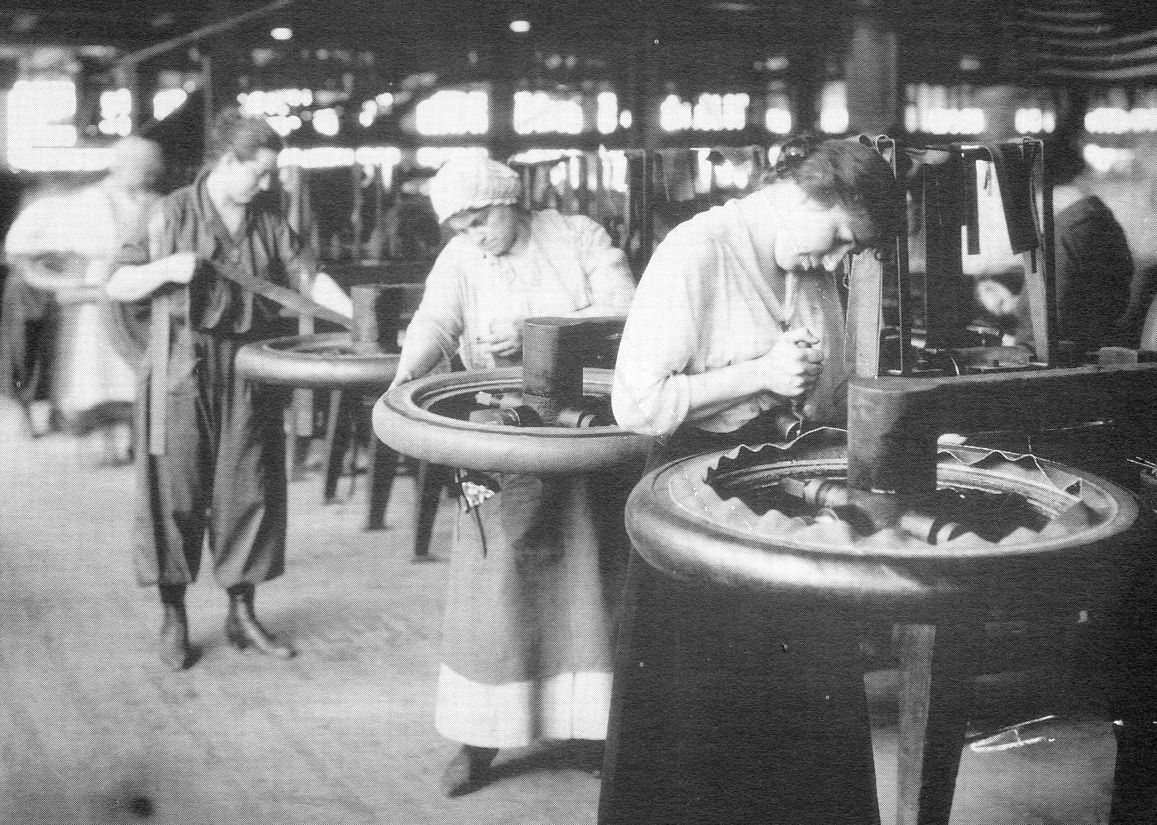
A fine look at the barbarous conditions in Akron’s rubber industry before unionization.
‘The Situation of the Rubber Workers’ by I. Amter from Workers Monthly. Vol. 5 No. 14. December, 1926.
FIVE concerns control the market of Akron: Goodyear, Goodrich, Firestone, Miller and Seiberling. Outside of these five, there are a few other large establishments in other parts of the country, especially the United States Rubber Company. The profits of the five companies in 1925 amounted to nearly $54,000,000. Goodyear “earned” $21,000,000, Goodrich $1,245,000. The remaining six companies earned a few millions together making a total for Akron of about $56,000,000 (U.S. Rubber “earned” $17,000,000). The wages of the Akron rubber workers in 1925 amounted to $66,460,705. In other words, for each dollar that the workers earned by their hard, exhaustive, killing work, they had to earn 88 cents for the rubber manufacturers.
Who are the workers in the rubber tire industry of Akron? About 80% of them are American, 20% foreign-born. There is a section of the workers who have been “in service” for five, ten, twenty or even twenty-five years. For their “loyal” service, they are presented with “service pins,” to distinguish them from the common rabble that travels in and out of the rubber shops, floaters and men from all over the country attracted to Akron by the abundance of work to be found.
In recent years, the rubber personnel has changed. The average number of workers is 43,391, but the number fluctuates. In season there are several thousand more in the shops, in slack periods, the number drops. These 43,391 workers include about 5,000 women, 3,000 Negroes, and several thousand young workers. Women and young workers can easily do the work in the rubber shops, for the process has been very much simplified, and is more laborious than heavy. The heavier work is left to the men—and even to young workers. For a man or woman must be physically strong to obtain work in the rubber shops. What is to become of the workers who have given their best to the industry and are no longer employable, has not been considered—nor do the rubber companies concern themselves very much with this problem. The “service pin” is the poor wretch’s reward and he is flung out into the world—on to the market of decrepits that fill the poor houses or depend on their sons, daughters or relations.
In some of the rubber shops, the applicants are obliged to strip naked, every part of their body being examined minutely. They must weigh so much and must be strong in every part, otherwise they will obtain no employment in the rubber shops of Akron, if this principle is to be applied in industry all over the country, there is no saying what is to become of underweights, deformed workers, and men and women exhausted within a few years by the toil of the mills!
What is to become of the men, women and young workers who suffer injury in the industry and may for a few years live on the compensation they receive through the workmen’s compensation law? The company hospitals are witness to the danger of the work—the danger due to the speed-up that the workers have to submit to, so that they become careless despite all “Safety First” signs and posters that decorate the walls of the rubber shops, For a worker must live—and if earnings threaten to decline, there is nothing left for the worker to do but to work at top speed, trusting to good luck— till one day he is killed or injured and his usefulness to the rubber companies is either impaired or completely destroyed.
The rubber shops work on a three-shift basis—but every rubber worker detests the third shift—from 11 p.m. to 7 a.m. Work in some of the departments is very dangerous to the health, and when there is added to it the work at night, a worker feels that he has been condemned for an offense. But work must be done, for money must be earned, hence many workers must submit to the process. Despite the three-shift plan, many men have to work overtime and double shift, receiving as a rule only the base rate (of which we shall speak later).
There is no “Sunday day of rest” in the rubber shops. Akron is a Ku Klux town, whose members boast of their saintliness, but who also do not hesitate to admit that they are a military organization, that each member bears a rifle—frequently under the “nightshirt” in which he parades about. They hold reviews and are prepared ai all times—according to the statement of one of the local leaders “under each robe there is a soldier.” Nevertheless, the workers have little choice as to whether they will work on Sunday or not. Only the militants have courage enough to tell the foreman or supervisor that they will not work. The penalty frequently is discharge.
Of late, in fact, one of the rubber companies has sent the men home on Saturday and ordered them to work on Sunday. In various departments of the other shops, men are worked seven days a week, The work is so devastating that the men want the day off, not in order to go to church and “observe the lord’s sabbath,” but in order to recuperate enough strength to go on with the crushing toil on Monday.
The wages in. the rubber shops are, on the average, steadily on the decline. There are some workers who earn $40 to $50 a week. There are others—women, young workers and Negroes—who earn far less. Some women earn $2.70 to $3.50 a day at laborious work. There is no hope of their pay increasing, for the base rate is such that when a certain level is reached by enforcement of the speed-up, the rate is lowered. The same wage can be equaled only by the worker producing more.
The average wage of the worker is $5.50—and although this sum does not seem low in comparison with the wage earned by textile workers, railroad section hands, and unskilled or semiskilled workers generally, on the railroads, unorganized miners, etc., when one considers the amount of energy that the worker has to put into his work, and the nerve-racking process that he has to labor under—the rubber worker may be considered one of the most exploited in American industry.
Pay is based on the day rate and the base scale. For miscellaneous work, the worker gets the day rate, which amounts to 25 cents for women and 45 cents for men. Production is on the base rate. The worker gets a certain amount for a given amount of production. This is exactly measured and timed, and all workers are obliged to meet the demands of production. If in the estimation of the rubber manufacturers or their efficiency personnel, the worker falls too far behind, he is discharged. The worker who prizes his job does not allow his job to slip out of his hands, for he knows that if he does not meet requirements in one shop, he will not be able to hold a job in another. Hence after the experiment has been tried on a fast man—one who is strong, steady and can produce well—the base rate is lowered and all workers have to speed up. The purpose is first not to allow the workers to earn more than the established maximum, and by constantly lowering the rate to compel him to produce on a lowering scale.
Cuts in the base rate have taken place with great rapidity in the past year. At the present time, one of the largest companies is considering reducing the scale about 30 per cent. The men will be driven to work faster if they wish to earn a decent wage.
Diminishing scales being based on speed-up, the rubber workers are the victims of one of the most vicious speed-up systems in the country. Stop watches are the commonest instruments to be found in all parts of the shops. After the efficiency man has figured out what can be done in a unit of time—a minute—and how much must be allowed for “personal wants”—blowing one’s nose, going to the toilet, eating lunch, getting a drink, etc.—a given amount of work must be done. This is determined in the following manner:
A day’s work—8 hours—is divided into 480 units (480 minutes). Five per cent is deducted for “personal wants.” Through experiments, it is found that a man can do a certain amount of work, the motions being scientifically established. It is tried out on a fast worker—and in order to compel him to do an adequate amount of work—with the hope of earning more, the speed-up is applied. All other workers have to meet the demand or they are discharged or shifted to a lowergrade job. The unit system, they call it—and the men will soon feel the curse of it.
Bedaux, the Taylor efficiency expert of the rubber industry, is the slave-driver of the rubber workers. To the workers, the limit has been reached, but the rubber manufacturers who are looking for every means of increasing production at a lower cost—regardless of the consequences to the employees—are raising the speedup to a higher notch.
What are some of the forms of mistreatment that the workers rebel against?
These are best illustrated by typical cases. Women working in one of the shops dare not miss flaps on the tires by 1-8 inch, or they may be sent home for three days. If it occurs more than once, they may be laid off for a week. In the lampblack department, where the lampblack is applied to the tires to color them, the conditions are so fearful that men are not able to work there very long. They go in clean in the morning, but after the eight hours of work, they are as black as coal. The lampblack penetrates their lungs and cuts into them. Women are allowed ten minutes’ leave twice a day.
To go to the lavatory at Goodyear’s, certain girls have either to take the elevator or run up three flights of stairs. A record of every Woman is kept as to her menses, so that if a woman asks permission “to leave more than twice she is confronted with her chart, which might show that she has no “reason” to ask such permission. Such slavery could exist only in the “civilized” United States.
Workers of one shift are not allowed to stand near the workers of the preceding shift. They must be ready to go to work immediately after the first shift finishes. The company, however, tries to keep the men apart, so that they may not exchange experiences and ideas. Men of the same shift have to go to lunch at different hours—the company wishing to preserve the “morale” of the workers. Thirty minutes is the maximum for lunch—the foremen trying to reduce it at all times.
“Flying squads,” “efficiency departments,” etc. are in every shop. These are composed of men trained to take the place of a worker in any emergency. They are trained for four hours every day, being given a somewhat higher scale and when working are not required to produce so much. Their function is spying—watching the men, reporting to the office whatever they say or do, and thus leading to the elimination of dissatisfied or rebellious workers.
At the Goodyear Tire and Rubber Company, there is a “university,” the “head-fixing industry,” as the workers call it. Workers are induced to study at night—to “improve themselves.” Lectures on patriotic subjects, “loyalty,” etc., are delivered, to inspire the workers with confidence in the company. News boards all over the shops bear such slogans as “A laborer is a man who earns a dollar. A capitalist is a man who saves a dollar. It is as impossible to separate the one from the other as to separate oxygen from air.” The purpose is clear: to ingrain “diligence,” “thrift” and “loyalty” into the minds of the workers and make them servile slaves. Company papers, containing nothing instructive—because they dare not deal with facts—but filled with persiflage, pictures of employees and their families, are the contribution of the company to the mental development of their employees
Every company has its sports—tennis, ball teams of every character—enhancing the fame and generosity of the companies. Some of the companies endeavor to induce these employees to purchase stock in the company. When obtaining a job at the Firestone Company, the applicant is compelled to buy stock. Refusal to do so means no employment. Firestone and Goodyear have large tracts of land on which they have erected homes, which they enable their employees to purchase on the installment plan. The purpose is to bind the worker for 10 or 15 years, and keep him meek. House furnishings, Victrolas and motor cars go along with the outfit, with the result that the worker is bound over on good behavior to the company and its lieutenants, the installment houses, for the whole term of his employment.
When the Community Fund is collected, the rubber manufacturers have a terroristic method of obtaining “voluntary” contributions from the workers. They call the weakest worker into the office and tell him that he must contribute, say $8, as at Miller’s. Knowing that his job depends on making the donation, he does so. This is put on a card, and the card put on the desk, One after another of the weaklings is admitted to the office, the number of cards facing the workers gradually increasing. The “tougher” fellows are introduced last, when the following conversation may be heard: “This is an $8 concern. If you want to donate only $6, you will be given a $6 job—which means a lower scale job.” If the worker refuses to contribute at all, he is told that the company adheres to the Community Fund and that his services therefore are no longer required.
“Voluntary contribution”—because the company has determined that a certain amount must be raised by the employees, which is then heralded throughout the community as the “Miller contribution,” “the Goodyear contribution,” etc., to the glory of the rubber manufacturers, who are praised as great philanthropists, and their employees, as “loyal.”
Goodyear has an “industrial assembly.” This is supposed to be “workers’ democracy and share in control.” It is the barest deceit. The “industrial assembly” consists of two chambers—the senate and assembly. The factory is divided into districts, wards and precincts, and primaries are held. The company electioneers for “its” candidates, even to the extent of procuring signatures on the petitions. The assembly elected, it might be presumed that it has some power or authority. This is not true. The assembly may discuss and decide about sports, social affairs, but dare not go beyond the discussion stage on questions pertaining to the conditions in the shops, wages, hours, etc.
Not very long ago, the question of “shift allocation,” as it is called, was discussed. The men were overwhelmingly in favor of the service system—men who worked longer for the company being given preference. The company is not interested in the years of service, but in whether the worker can produce or not. Therefore, the company had decided on the merit system. Just before putting the matter to a vote, the general manager rose and stated that the company had decided to adopt the merit system, regardless of the vote taken.
The unanimous decision of the assembly for an increase in wages met with the opposition of the general manager; the matter was referred to the board of directors of the company, who vetoed it. It was passed again, but remained a dead letter. So much for this “industrial democracy,” a company union of the most despicable sort.
One element in the working forces in the rubber shops, the rubber manufacturers count upon: they are the southerners. Many of them have come from far down south at the behest of their relations and friends who have found positions in the rubber factories. At the present time, they are coming in hordes to Akron, thus forming a reserve army for the industry. There is another element that the company depends on: the Negro workers. Although the Negroes do the heavy work, the company knows that the southerners hate the Negroes, and the Negroes lose no love on their white “friends” from the South.
But the rubber manufacturers do not realize that the southerners are not accustomed to the hard labor they must perform and that these men are individualists of the strongest type. The men do not know much about organization, but once aroused they will fight ferociously. There is a cleavage in the ranks of the workers— whites against blacks—Americans (primarily with Ku Klux inclinations) against foreign-born—men contemptuous of women. But above all, 80 per cent American from every state of the Union.
And be it said to the credit of these Americans—or the most forward section of them—they have seen through the torture of the industry and the misery that confronts the workers slaving away their lives, and have begun the formation of a union.
The Rubber Workers’ Union of America is the outcome of the strife that is going on in the shops. It is not an open strife, for the struggle has not yet reached that form. Last January a few thinking workers of the industry conceived the idea that it was necessary for the workers to be organized to fight against the organized power of the rubber manufacturers. The rubber manufacturers not only control the city of Akron—Akron is a one-industry town—but are organized in the Rubber Association of America. They are not independent concerns, but are part of banking systems of Wall Street. Theirs is a powerful industry, well-organized and controlled.
These rubber workers recognized that they could not organize openly; hence as good Americans, accustomed to the ways of this country, they organized secretly. The situation in the shops has helped them in their work. Although laboring under the greatest difficulties, against the terrorism and intimidation of the manufacturers and their flunkeys, facing the danger of discharge for the attempt to organize the workers, they organized and are moving forward.
There has been a Rubber Workers’ Union in Akron for some little time, affiliated to the American Federation of Labor. But the A.F. of L. has done little to develop the union, just as up to the present it has done virtually nothing to effect organization in the automobile industry, to which the rubber industry is related. The rubber shops will continue to produce tires whether new cars are built or not, because increased motor transportation necessitates new tires. The A.F. of L. union is stagnant and has not even been pulsed into life by the efforts of this new organization to gain a footing among the workers.
The Rubber Workers’ Union of America is publishing a weekly, the “Rubber Worker,” dealing with the situation in the shop and happenings in the labor world, and advocating a Labor Party. It has a fine department entitled “Shop News,” containing reports of conditions in the shops. Although in a few shops the workers are still afraid to buy or be detected taking or reading the paper, it is meeting with splendid response from the workers. One typical instance. A worker took the “Rubber Worker” into his department. It passed the round of the twenty-five men working in the department. Education of the workers is one of the main tasks of the rubber workers at the present time, and the union is admirably fulfilling this function.
The “Rubber Worker” has already voiced the demands of the rubber workers, which are as follows:
$40 a week minimum wage.
Equal pay for men, women and young workers for the same work.
Eight-hour day, 40-hour week.
No speed-up.
Guaranteed full year’s work.
Right of organization.
Basing their demand on the investigations of the U.S. Department of Labor, to the effect that a man requires from $1,800 to $2,300 to maintain a family in conformity with the American standard of living, the union demands $40 as the minimum wage per week. This minimum would not affect the workers who today are earning that amount, since all wages would be graduated upwards, but it would raise the level of the poorer-paid to a decent level. The demand that equal pay shall be given men, women and young workers for the same work, will enable many women who must go out to work, to remain at home to care for their children, The effect on the young workers will be obvious.
The 8-hour day, 40-hour week is the demand now being made by the American Federation of Labor, and although the rubber workers have 8-hour shifts, they frequently must work overtime. This, the union demands, shall be eliminated and by cutting out speed-up, so that production is carried on by ever fewer hands, and by demanding a guaranteed full year’s work, the work will be spread out and the iniquities of the system be abolished at least to a degree for the present.
The union, however, recognized that there is only one way that the rubber workers will succeed in achieving any of these demands and that is by organization. It is therefore making as its central demand the right of organization and recognition of the union by the rubber manufacturers.
The union will not be born in peace. The rubber manufacturers have exercised terror and will continue to employ more vigorous terror against the workers. But these American workers—not to speak of the foreign-born—have little fear. They know what they face and will face it courageously. In this fight, Americans—Ku Klux and otherwise—foreign-born, men women and young workers will break down the feudalistic regime that exists in the rubber shops and will try to introduce a little light into the darkness of this devastating, man-killing rubber industry.
The Workers Monthly began publishing in 1924 as a merger of the ‘Liberator’, the Trade Union Educational League magazine ‘Labor Herald’, and Friends of Soviet Russia’s monthly ‘Soviet Russia Pictorial’ as an explicitly Party publication. In 1927 Workers Monthly ceased and the Communist Party began publishing The Communist as its theoretical magazine. Editors included Earl Browder and Max Bedacht as the magazine continued the Liberator’s use of graphics and art.
PDF of full issue: https://www.marxists.org/history/usa/culture/pubs/wm/1926/v5n14-dec-1926-1B-FT-80-WM.pdf
 Revolution's Newsstand