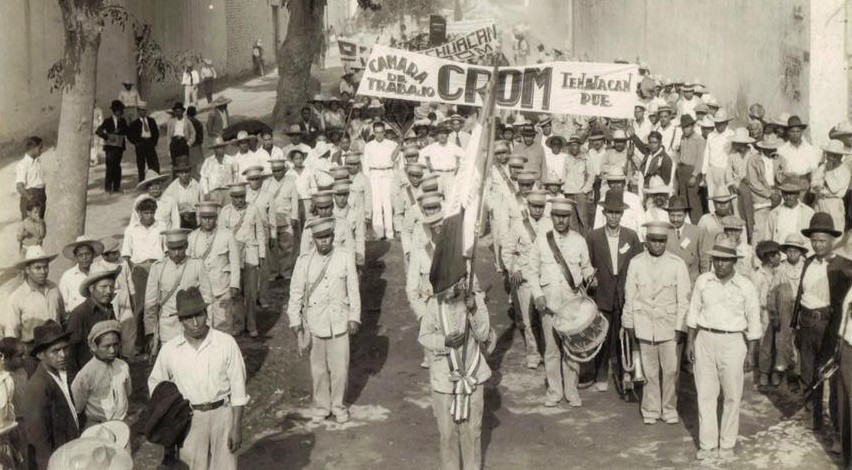
Veteran union activist and leading Communist labor organizer J.W. Johnstone with a valuable look at Mexico’s C.R.O.M. union federation in the mid-1920s–its role in Mexico and in providing U.S. imperialism’s labor project, the ‘Pan-American Federation of Labor’, with its Latin fig-leaf.
‘A Pan-American Fig Leaf’ by J.W. Johnstone from Workers Monthly. Vol. 4 No. 4. February 1925.
“THE world ought to belong to us–workers of hand and brain.
“We aren’t so revolutionary. All we want is to change an adjective, just one adjective. We want the Bourgeois order to give place to the Proletarian order. If this should be brought about, it would mean that those who toil would displace in authority the idlers who do nothing but own–that everywhere, in all factories, mines, offices and fields, the workers would rule. Workers would regulate the workshops and workers would make the laws of nations.”
One can imagine Gompers’ cynical smile as he read the above lines. They were sent to him by Enoch Adames V, of the Federation of Labor of Panama, as part of a letter of protest against the policy of the A.F. of L. in the Canal Zone, which is a policy of dividing the workers, of playing upon racial prejudices, of relegating the native Panamanian workers to the permanent status of common-grade labor, with wages 25 to 30 per cent lower than those paid to Americans.
The author of the letter was one of five Panamanian delegates to the recent convention of the so-called “Pan-American Federation of Labor,” held in Mexico City. Yet, in the midst of the labored apologetics on behalf of imperialism, in the midst of the long speeches in defense of the bourgeoisie and calling for class collaboration, the ardent apostle of change did not indicate that he wanted to change even a syllable. Not a word of protest did he utter. The Panamanian’s self-obliteration is easy to understand. He could not withstand close association with Gompers, Woll & Co. when they came face to face in Mexico City. In his aforementioned letter of protest, Senor Adames expresses what is, after all, only a vague revolutionary tendency; he and his colleagues lack real class consciousness. They are without experience. Their movement is half-formed. Gompers had only to whisper a few empty phrases in their ears and they were satisfied–or overwhelmed. Promises were gratefully accepted in lieu of deeds. Time and experience will line up at least some of these delegates in the fight against the imperialists.
The case of the delegates from Panama is typical. It might be duplicated in the instance of the delegates from Nicaragua, or Costa Rica. None of them represents an actual labor organization. There are only two regularly-constituted trade union bodies in the “Pan-American”: the A.F. of L. and the C.R.O.M. (Mexican Federation of Labor). Otherwise, the “Pan-American Federation of Labor” is a grandiose fake, its affiliated membership existing almost entirely on paper. The delegates to Pan-American Federation of Labor conventions are handpicked by the A.F. of L. bureaucrats, who control the purse-strings. If they have a spark of revolutionary feeling, it is soon dimmed; they find themselves helpless before the smooth working of the administration machine, operated by the A.F. of L. aces with the faithful support of Luis N. Morones and his fellow-fakers at the helm of the C.R.O.M. Thus we have the absurd spectacle of decidedly nationalistic Latin Americans passing resolutions in favor of the Monroe Doctrine, the Wall Street-owned “Pan American Union,” etc. The “Pan-American Federation of Labor” serves as an instrument of American imperialism.
The C.R.O.M. is the “Latin” side of the “Pan-American Federation of Labor machine–its only tangible claim to the name of Pan-American. Luis N. Morones is head and boss of the C.R.O.M., to an even greater degree than Gompers was boss of the A.F. of L. He is also secretary of commerce and labor in the Mexican government. It is Morones who, with the death of Gompers, becomes president of the “Pan-American Federation of Labor,” at least temporarily. Under his administration a continuance of the Gompers policy of class collaboration is assured.
In the light of this situation, it is worth our while to examine into the career of Morones, and the work of him and his associates in the C.R.O.M.
The C.R.O.M. was born of the Carranza revolution. It was organized by Morones, with government money, and Morones was its first general secretary. At the opportune moment, Morones deserted poor old Carranza and when General Obregon became president of Mexico, the ever-fortunate labor leader was placed in charge of the federal munitions works. As a side line, he organized the “Partido Laborista Mexicano” (Mexican Labor Party), again with government funds. The “Partido Laborista” has become the dominant political party in Mexico and recently succeeded in electing General Plutarco Elias Calles to the presidency.
Hailed by Gompers as a “labor government” and by Morones as a “socialist government” (?), the Calles regime is in reality a political sub-committee of Wall Street, dressed up in the outer garments of democracy. This political sub-committee of Wall Street also dominates and directs the “Partido Laborista” and the C.R.O.M. Both of the latter organizations are financed through government subsidies. They have the free use of government buildings and their leaders occupy positions in the government.
The C.R.O.M. is a political football of the “Partido Laborista.” However, the reader should not jump to the conclusion that the C.R.O.M. is not a bonafide union. It is. It has a dues paying membership of a little over 100,000–but Mexican trade unionists do not pay their dues with extreme regularity. Gompers used to say that the organization had over 1,000,000 members. Morones claims 500,000. The actual membership is probably somewhere around 350,000.
That Morones and his partners at the head of the C.R.O.M. have to wear a socialist cloak and make use of a revolutionary phraseology, may be taken as indicative of a strong, but very vague revolutionary tendency running throughout the membership. Even Sam Gompers, who hated the mention of all things radical, had to fall in with the socialistic pretense while in Mexico, and he, himself, was paraded to the Mexican workers as a socialist. Some sections of the C.R.O.M. lean very strongly to the left indeed.
Of late years Morones has accumulated fat and diamonds. He is rated as a millionaire. While head of the munitions works under Obregon, he had $15,000,000 a year at his disposal, ostensibly for armament and munitions. A goodly portion of this money went to increase Morones’ private fortune, or to create political jobs for officials of the C.R.O.M. When the De La Huerta uprising broke out, the army was insufficiently equipped to take the field and hurried orders had to be placed with munitions firms in the United States.
Now that Morones has been made secretary of commerce and labor, Celestino Gasca, another prominent leader of the C.R.O.M., has succeeded him as head of the munitions works. Ricardo Trevino, another leader, has taken Morones’ place in the Mexican Chamber of Deputies. The present general secretary of the C.R.O.M., Eduardo Moneda, was formerly head of the government printing establishment, a political job which has been held by various other labor officials, including Juan Rico and Ezequiel Salcedo. Lesser lights of the C.R.O.M. are taken care of through the medium of subordinate jobs in the munitions works, or in state or local governments. All these jobs are shifted around. Some of the “labor leaders” are on two or three government payrolls at the same time.
I give this brief, and wholly inadequate, survey of governmental financial and political ties with the leaders of the C.R.O.M., so that the reader will better understand the stories of treachery which are to follow.
If any proof were needed that Morones had not gone into “the trade union business” because of a desire to improve the conditions of the Mexican workers, it was furnished in the Tampico oil strike of 1920. This strike was led by Ricardo Trevino, at that time an anarchist and exceedingly popular among the strikers. Troops were sent into the strike zone, numerous arrests were made, and many of the strikers killed. Through the instrumentality of Morones, Trevino was arrested. Then Morones arranged for a conference with him. The upshot of it was that Trevino gave up all activity in connection with the strike and brought his influence to bear against his former followers, who immediately expelled him from the union. The strike was crushed. Trevino soon began to blossom forth as a full-fledged lieutenant of Morones, and in due course, was made general secretary of the C.R.O.M.
In the famous tenants’ strike of 1922, we see this whole band of “socialist” labor leaders in their governmental capacity, using armed force against a great popular movement. The tenants’ strike was unique. It started in Vera Cruz, but soon spread throughout the country, workers everywhere answering the exorbitant demands of the landlords by refusing to pay rent. The murdering of six strikers and the severe wounding of forty more was not sufficient to break the backbone of the movement in Mexico City; whereupon, the C.R.O.M. officials, acting in their accustomed role of disrupters, organized a dual union. When the tenants refused to join, they ordered all members of the C.R.O.M. to withdraw from the tenants’ league, under pain of expulsion and the loss of their jobs. In the end the strike was crushed, not only in Mexico City, but all over the country–with the exception of Vera Cruz. In Vera Cruz, despite an unparalleled reign of terror, during which 90 strikers were killed in cold blood and hundreds wounded, the tenants won a complete victory. A large proportion of the tenants paid no rent for two years; a settlement has lately been reached on the basis of nominal rentals.
Another act of treachery committed by the Morones gang was in connection with the strike against the British Light & Traction Co., which holds the street car franchise in Mexico City. The Red Trolleymen’s Union succeeded in completely tying up traffic. Victory seemed certain, until the C.R.O.M. officials resorted once more to their dual union tactics. Guate Rojo, then a leader of the Newspapermen’s Union, was picked to break the strike and he did a good job. Bringing together a handful of stool pigeons, he organized them into a dual union, accepted the company’s demands and ordered all men back to work. The strikers paid no attention to this order. Troops were called out, however, and the strike was broken at the point of the bayonet. It was later conclusively proved that Guate Rojo received $2,500 for his piece of treachery. After his exposure, Mexico became too hot for Rojo and he fled to the United States. The cancelled check is now in the hands of the Communist Party of Mexico.
Probably the most brazen attempt to defeat a strike by means of bribery, was that which came to light in the strike of the oil workers employed by the Mexican Eagle Company, owned by the powerful Royal Dutch Shell interests. The strike broke out in the Tampico district early last year, primarily as a move to bring about enforcement of the constitutional provision calling for an eight-hour day, minimum wage, etc. Other demands of the strikers were for wage increases, free medical attention, three months’ pay if discharged, accident compensation (including full wages for life in the case of workers totally disabled), full pay to widow or family during a period of four years in the case of workers killed on the job.
Morones, the great man of the C.R.O.M., head of the government munitions works and national deputy, rushed to Tampico to settle the strike. Meantime, the Communists had succeeded in bringing about a united front between the strikers, the local C.R.O.M. union, the C.G.T. (General Confederation of Workers) and some independent unions, the strikers themselves having been organized in the course of the conflict, under the leadership of Turrubiates, a striker belonging to the Communist Party of Mexico. Morones held conferences with the company, and finally offered the men $40,000 to be used in starting a workers’ co-operative, on condition that they would accept whatever settlement he could make with the company.
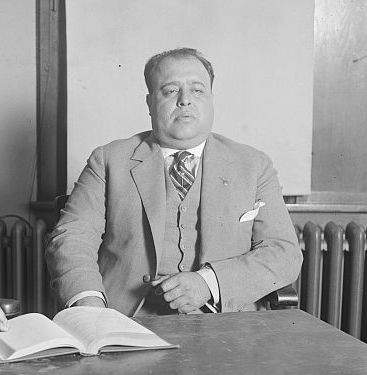
The strikers refused to consider the proposition without first hearing the proposed terms of settlement, which of course, turned out to be unconditional surrender. The strike committee, with Turrubiates as chairman, was instructed to assume entire charge of the negotiations. Morones flew into a rage and threatened to flood the oil fields with troops unless the workers accepted his proposal; three days later, federal soldiers were brought in. As a protest against this act of treachery, the strikers broke their alliance with the leaders of the C.R.O.M.
Through the able leadership of Turrubiates, the support given the strikers by the Communist Party, and the unit- ed front tactics pursued, the strikers won practically all their demands. Other workers in the Tampico district, encouraged by the victory, made similar demands upon their employers. A number of strikes have broken out since then, with the Communists playing a leading role, and a number of agreements favorable to the workers have been entered into. Turrubiates, who was blacklisted, functioned actively in all these struggles. He is now leading the strike of the workers employed by the Mexican Oil Company, an American concern owned by “Ed” Doheny, of “Teapot Dome” fame.
The Doheny strike began under the leadership of the anarchists of the C.G.T. Once again Obregon and Morones called out the troops. Two strikers were killed and eleven wounded. In the face of this government offensive the anarchist leaders gave way, abandoning the strikers precisely at the time when firm leadership was most needed. The Communists took charge. Instead of breaking the strike, the terroristic methods of employers and government only strengthened it. Notwithstanding the active opposition of the leaders of the C.R.O.M. and C.G.T., the united front still remains solid, the men are paying their 5-cent strike assessment, and victory appears certain.
These few examples serve to indicate the type of leadership which controls the policy of the C.R.O.M., the “Latin American fig-leaf” of the Pan-American Federation of Labor.
Is it any wonder then, that the C.R.O.M. leaders have been able to work in such close harmony with the bureaucrats of the A.F. of L. and that the so-called Pan-American Federation of Labor does not represent the attitude of the workers of Latin America any more than its list of affiliations represent any real affiliated organizations outside of Mexico and the United States? Is it at all surprising that at the last convention of the Pan-American Federation of Labor, December, 1924, a resolution was adopted urging the trade union movements of Latin America to demand representation for “their countries” in Mr. J.P. Morgan’s “Pan-American Union,” so that the interests of the workers and capitalists of the Western Hemisphere may be “consolidated?”
The aim of the “Pan-American Federation of Labor” is to enforce the Monroe Doctrine and to train the workers of the western world for their status as cannon fodder in the next world war, in the interests of American imperialism.
The only working class organizations which understand the forces working in this direction, and which are carrying on a determined fight against imperialism, are the Communist Parties and Young Communist leagues of both continents, the T.U.E.L. and the newly-formed Pan-American Anti-Imperialist League. The Workers (Communist) Party and the T.U.E.L. have launched a campaign to unite the revolutionary elements of America against Wall Street, and to fight against the domination of the A.F. of L. and C.R.O.M. bureaucrats over the Pan-American Federation of Labor. The needs of the workers demand that the class struggle be substituted for class collaboration as the policy to be pursued by the Pan-American Federation of Labor, and that the organization be made an instrument of effective struggle in the interests of the toilers of North, Central and South America, as expressed in the program of the Communist International and of the R.I.L.U.
The Workers Monthly began publishing in 1924 as a merger of the ‘Liberator’, the Trade Union Educational League magazine ‘Labor Herald’, and Friends of Soviet Russia’s monthly ‘Soviet Russia Pictorial’ as an explicitly Party publication. In 1927 Workers Monthly ceased and the Communist Party began publishing The Communist as its theoretical magazine. Editors included Earl Browder and Max Bedacht as the magazine continued the Liberator’s use of graphics and art.
PDF of full issue: https://www.marxists.org/history/usa/culture/pubs/wm/1925/v4n04-feb-1925.pdf
 Revolution's Newsstand