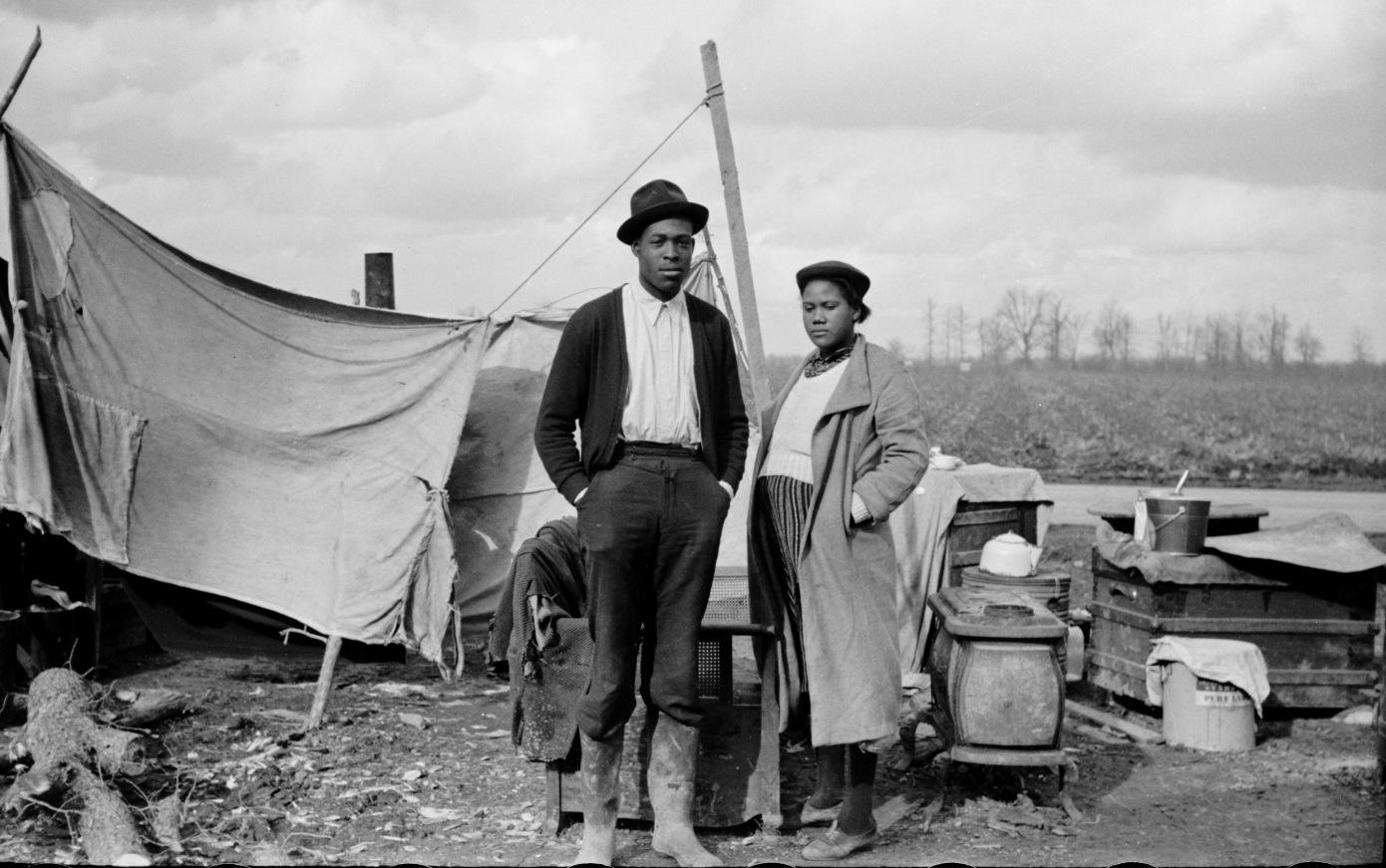
After a year on the road, more than 500 remaining sharecroppers evicted from the cotton plantations settle on 93 acres of hard-scrabble land near Poplar Bluff, Missouri bought for them by the St. Louis C.I.O.
‘“Lost Colony”—The End of the Cropper’s Trail’ by Robert L. Birchman from Socialist Appeal. Vol. 3 No. 91. December 1, 1939.
Cotton Kings Howl for Government To Cut Off Miserable Relief; Want To Force Croppers To Become Day-Laborers
Nearly 500 ex-sharecroppers face starvation and death in a colony near Poplar Bluff, Missouri. The colony is reminiscent of the worst Hoovervilles and Rooseveltburgs, but it is home to the men who were evicted last January when the planters decided to hire day laborers, so that they would not have to share federal subsidies with the croppers. There ninety-nine families live in rag tents and barrel-stave shacks.
“Relief” for Croppers
They live if one can call it living on relief. And what relief! Each family receives four pounds of corn grit, four pounds of meal, two pounds of beans for a month. No salt, baking power or grease. Many families number as many as ten. There is only spring water for drinking and cooking. Coffee is made from reboiled grounds, and drunk without sugar. There is no meat and all the milk is supplied by three poorly fed cows.
Most of the 160 children are under ten years of age, including 16 babies, three born at the camp. Most of the adults are over 40.
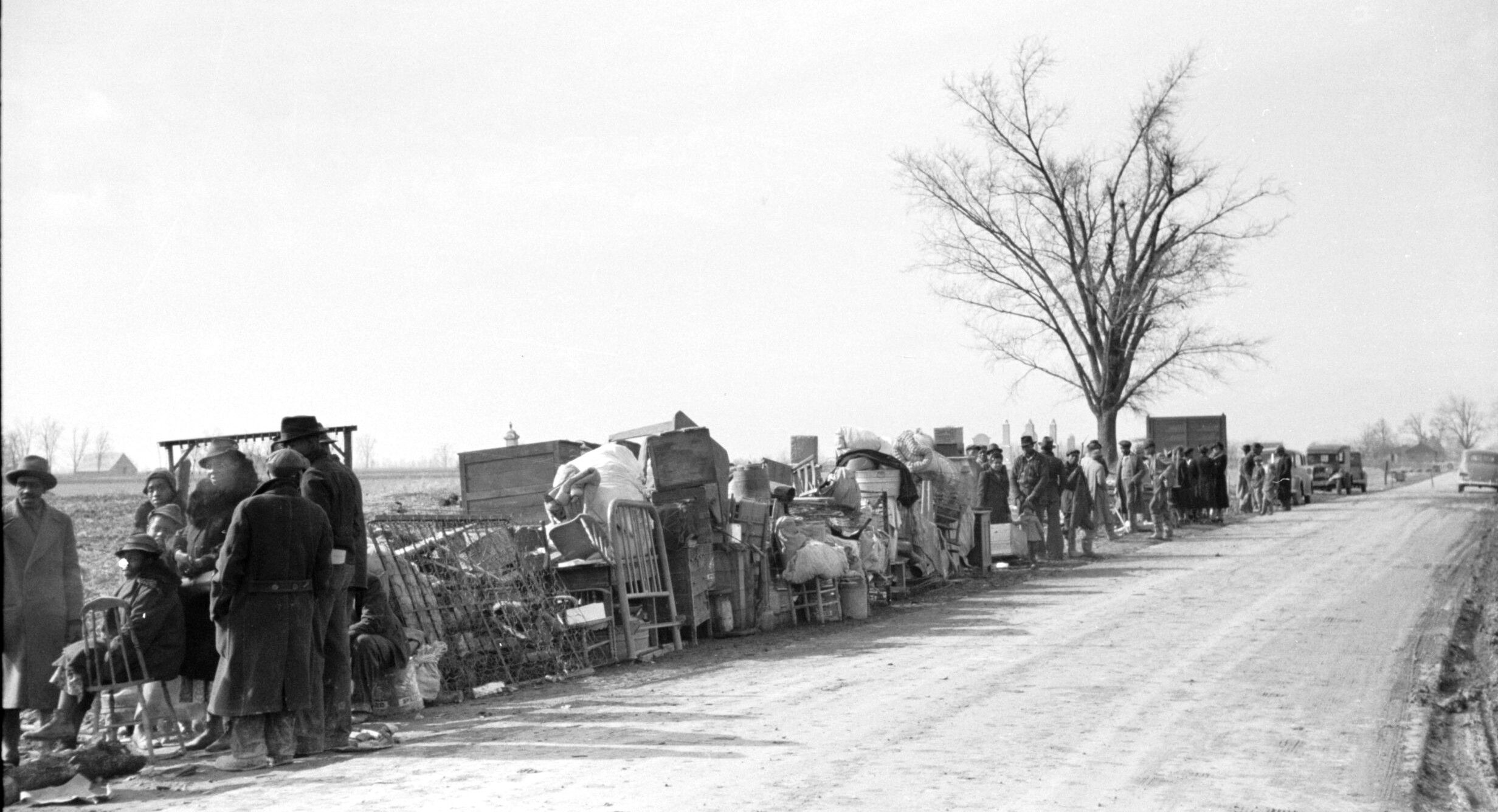
These homeless croppers took refuge on 93 acres of uncleared land good only for “squatting.” After having been hounded along the highways by the police and local authorities for months, they located at the “Lost Colony.” The land, hard-scrabble hill land, with a thin layer of soil over its gravel and rock bed, was purchased for $3 an acre by money donated by sympathizers in St. Louis. The land at the best could not furnish sustenance for more than five families.
Live in Rag Tents
Many of the families live in rag tents. A number of shacks have been built, using small logs for the frame and discarded barrel-staves from a nearby barrel mill for the roofs and sometimes the sides. Lack of nails has held up completion of many of these half-finished shacks. Holes have been chinked with mud, which the first heavy rain will wash out. Only a few have obtained lumber for doors. All have open windows, screened by paper, sacks, or clothes. The bare ground is the only floor. When it storms the rain sweeps down in gusts that often soaks the tents and they are overturned.
Not One Good Stove
There is not one good stove in the camp. The cooking is done in the open and such meals as there are, are eaten outdoors.
Many families, those with several children, run out of beans before the end of the month. Mothers feed their children at the breast for two and three years there is nothing else to feed them. A number of the families have adopted children and aged dependents. Some of the aged women had applied for old age pensions, but received such technically worded replies that they dropped the matter then and there.
Medical attention is impossible to secure. Mildred G. Freed reports in the New York Post that she saw a young Negro woman tossing feverishly in bed from a miscarriage her third within a year. When she asked if a doctor. had been called the reply was “Private doctor he won’ com’ ’cause we ain’t got money an’ county doctor he said he ain’t never gonna help us.”
Forbidden to Fish
While the river is at the edge of the camp and woods all around it, the colonists are forbidden by the sheriff to hunt or fish. One old man, who was deaf and had not heard the sheriff read the law went fishing and was arrested. A boy was shot and wounded when he was found hunting in the woods.
The “Lost Colony” is composed of the remnants of the 1500 vassals of King Cotton and the cotton nobility who were evicted last January from their miserable shacks when they refused to accept a change in status to that of day laborers. The plantation owners were making this change in order that they would not have to share the cotton reduction parity payments with the croppers.
In 1938 the cropper received parity payments of approximately $100, about one-third of their income. The laborer received from 75 cents to a $1 a day for 100 to 120 days and no advanced credit from the planter, which the cropper receives. The increase in day laborers would bring the day rate–down to as low as 40 cents for a 10 to 14 hour day.
Had Lived on Highways
Living under a tyranny often worse than under chattel slavery, the croppers revolted by the hundreds last January and advertised their plight and homelessness to the nation by camping in tents of rags on the Missouri highways. The local, state and federal authorities found one pretext after another for not supplying the croppers with relief or homes. After some days they gave meagre hand-outs to the croppers. The St. Louis C.I.O. Council sent truck loads of food on the third day of the demonstration.

The planters protested against giving relief to the croppers and blamed “agitators” for the “damnable scheme” and demanded an investigation. Owen H. Whitfields, local leader of the croppers and vice-president of the Southern Tenant Farmers Union was threatened by the planters Since then he has worked in St Louis to secure, aid for the croppers. J.R. Butler, president of the Union, was “escorted” to the state border by the state police when he sought to advise the croppers.
“Menace to Public Health”
The State Health Commissioner declared the croppers “a serious menace to public health” and forced them from the highways Twenty-three families were piled on the Mississippi levee; thirty-two families were dumped into a two-room abandoned building and twenty-five families were crowded into an unused church. Soon the owners of the buildings instituted proceedings against the “trespassers.” Friends of the croppers and the C.I.O. in St. Louis then bought them the strip of land where they now live.
Education Among Croppers
The few white children in the camp must walk two miles to a junction to meet a school bus. No provision has been made for the more than ninety Negro children of grade school age and they manage the best they can. Several of the high school students in the camp are making attempts after their school hours to teach the children. The Federal government has offered to provide W.P.A. teachers if the croppers will provide a school building. These people without resources are building a combined meeting hall and school. The work is held up for lack of nails, roofing and windows. And unless a heating system is provided, no school can be held.
The Southern Tenant Farmers Union has asked for Federal aid. The colonists have written to Washington themselves but are always referred back to the local authorities who do absolutely nothing.
“There are no jobs for them,” says Pres. J.R. Butler of the S.T.F.U., “and they can’t hold out until Spring unless they get relief from some place.”
No longer needed by the cotton nobility now seeking new ways to garner profits from cotton, the croppers are thrown on the scrap heap to starve and freeze to death.
 Revolution's Newsstand