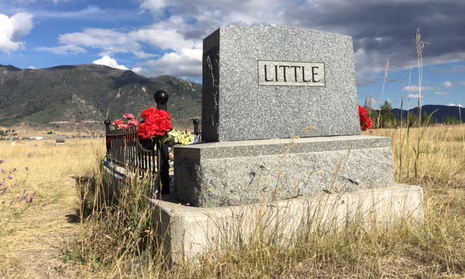
Three years after the lynching of Frank Little on Butte, Montana, a reporter from labor’s Federated Press revisits the scene, and names the names of the men who killed him.
‘Trestle Notches Mark Mob Murder of Frank Little’ by John Nicholas Beffel from Truth (Duluth). Vol. 4 No. 32. August 6, 1920.
Impressions of Ropes on Wooden Tie Stand Out as Grim Monuments of Brutality Against Crippled Organizer—Police Let Loose Murderer, Despite Evidence.
BUTTE, Montana. I went with an old-time copper miner to the trestle bridge where Frank Little was hung in the night, after he had been dragged from a sick bed by men who stood for “law and order”, the established order.
The road over which the mobmen dragged him behind their automobile curves down from the vast Anaconda hill through Placer Gulch and the flats to the trestle, over which the trains of the C.M. & St. P. back into Butte.
Two notches in the wooden guardrail indicate here the rope was tied. Carved into the hard wood are the words: “Frank Little Hung Here, August 1917.”
Little was murdered in cold blood. There is substantial evidence that the thing was planned carefully for days and that some of the lynchers were local business men who had been working hard at the business of being super-patriots.
There had been a strike on here since the Speculator Mine disaster on June 8. It was not an I.W.W. strike but had been sponsored by the newly-organized Metal Mine Workers’ Union.
Little Not Implicated
Little, an I.W.W. organizer from Arizona and member of the I.W.W. executive committee, had nothing to do with that strike He had come to Butte simply to look over the ground, as did other labor executives.
The miners demanded adequate safety provisions to prevent a reoccurrence of the Speculator holocaust, in which 164 men died; proper ventilation of mines; installation of a water system to lay the dust, chief cause of miners’ consumption; abolition of the black list system; $6 a day flat scale, and other reasonable conditions.
Copper production had ceased. The miners were peaceful. It was a strike of folded arms. Late in July the Anaconda Copper Mining Company tried to stampede the men back to work by an offer to modify the blacklist system and to grant an increase in wages on a sliding scale basis. But there was a wide gulf between the company’s offer and what the workers wanted. They didn’t take the bait.
Desperately the company tried to find some way to break the strike. Once more it fell back upon its favorite weapon—terrorism.
Little Picked as Victim.
Little was picked out as the victim. Among several others, he had made speeches to the miners, and in these speeches he uttered harsh truths about the Anaconda. He pointed out that the mines were being worked almost without timbers, so that for lack of sustaining framework the earth frequently caved in, killing or maiming the ore-diggers.
For years, he said, the inquests over men killed in tbs mines indicated that practically every miner was a suicide, and thus the company escaped paying compensation.
These inquests were invariably held by professional juries dominated by the Anaconda. And in one of these speeches Little referred to the militia as “uniformed scabs.” That had long been a common term in miners’ conversation here. Repeatedly, at the behest of the Anaconda, the state troops had been used against the mine workers throughout Montana.
Immediately the copper press set up cries of “sedition,” “enemy of the government,” “German influence,” “I.W.W.” “treason” and kindred accusations, although none of the miners nor their speaker had been guilty of any of these charges, admitted by United States District Attorney B.K. Wheeler.
Kidnappers Misrepresented
Next door to the I.W.W. hall on North Wyoming street, which climbs the hill toward the biggest of the Anaconda properties, is the old dark-red brick Steel boarding house where Frank Little roomed.
At 2 in the morning six men drove up in an automobile, entered the house and woke up the landlady.
Representing themselves as officers, they got Little’s room number, then broke in his door, and took him out. He was lying in bed with a broken leg when they got him, and had been on crutches for some time. He weighed only 125 pounds and suffered from a rupture.
Tying Little with a loose rope to the back of the automobile, they dragged him through the streets, heading for the Milwaukee trestle, where they strung him up by the neck. He fought back wildly; that was evidenced by bits of flesh found under his finger nails when his body was discovered at dawn by a railroad man.
Cold-blooded murder, but the authorities did nothing. They were given the number of the automobile by persons who saw portions of the ghastly spectacle. They knew, as many others in Butte know, who drove the machine out of a prosperous garage; knew the names of the Anaconda mine foreman and Anaconda gunman who were in the lynching party. But no effort was ever made to punish anybody.
Impostor Appears on Scene.
Let us turn the wheel of this narrative back a few weeks to the beginning of the strike. At that time a ragged man was turned out of his boarding bouse because he was broke and couldn’t pay his bill.
He used the name of Charles McCarthy, but (as it became known later) his real name was Charles Albright, and he had served a sentence in Deer Lodge penitentiary. Appearing at the hall of the mine workers’ union, he represented himself as a miner, in hard luck, expressed a great desire to help in the fight for better conditions, and got on the strike committee. Here he had access to all the of the strikers.
On the night Little was hung, Albright was seen in company with an Anaconda gunman. He visited police headquarters with the thug. Later, when questioned about this visit, he asserted that he was arrested that night for vagrancy. This was proved untrue. He was not arrested that night at all.
About 1 o’clock in the morning a woman who resides across the street from the Steele boarding house where Little roomed saw an automobile pull up in front of her home.
Recognizes Albright.
Under a city arc light she recognized Albright. The men in the car put out their lights. Albright walked away, returning in minutes with a bundle, which resembled a coil of rope. Presently the other men got out of the automobile and entered the boarding house, bringing their victim out struggling and beginning their torture which ended in his death.
Albright had received only a meal ticket from the union for his services on the strike committee, but on the second day after Little was hung, this ex-convict blossomed forth in a new suit of clothes, and put up at another boarding house, equipped with a new trunk full of fancy underwear, shirts, neckties and other luxuries.
And now he had plenty of spending money, with which he bought drinks for acquaintances. Evidence of all this was brought to the authorities by members of the Daily Bulletin staff. Under the pressure of threatened publicity, the local officials had Albright arrested— He was held a few days and then turned loose. The county prosecutor refused to prosecute him.
Ten thousand men, women and children marched for five miles behind the coffin in which the body of Frank Little lay, transported to one of the company-owned cemeteries out in the “flats”.
Death Multiplies Influence.
Alive, Frank Little was a man of ordinary talents, an organizer with his heart in the cause of labor, but one whose influence was comparatively small. Dead, says William F. Dunn, editor of the Bulletin, Little’s power is multiplied ten thousand times. Murdering this man gave new impetus to the labor movement in Montana. It expanded the passion behind the activities of the I.W.W. in the metal mining regions; it lends ardor to the organization work of the One Big Union, thee metal mine workers’ unit of which has gained large power in Butte.
In all the working of binding the metal miners solidly together for progress, the American Federation of Labor has no part. On the door of the One Big Union headquarters, on the auditorium floor of the old St. Paul’s M.E. Church, is the legend:
“The A. F. of L. Is dead. All it needs is a coffin. The O.B.U. is alive in all the glory of its youth.”
And the I.W.W. also is youthful and alert, with a great belief in its principle of industrial unionism as opposed to craft unionism, and with endurance to stand the onslaught no matter what the enemy may do. Its hall has been raided time after time, but it survives, and defies all those who would destroy it.
Truth emerged from the The Duluth Labor Leader, a weekly English language publication of the Scandinavian local of the Socialist Party in Duluth, Minnesota and began on May Day, 1917 as a Left Wing alternative to the Duluth Labor World. The paper was aligned to both the SP and the IWW leading to the paper being closed down in the first big anti-IWW raids in September, 1917. The paper was reborn as Truth, with the Duluth Scandinavian Socialists joining the Communist Labor Party of America in 1919. Shortly after the editor, Jack Carney, was arrested and convicted of espionage in 1920. Truth continued to publish with a new editor JO Bentall until 1923 as an unofficial paper of the CP.
PDF of full issue: https://www.mnhs.org/newspapers/lccn/sn89081142/1920-08-06/ed-1/seq-2
 Revolution's Newsstand