A report on Moscow in its N.E.P.-era social reconstruction, including its finances, industry and commerce, agriculture, education and hygiene, housing and municipal works.
‘Moscow in the Midst of Reconstruction’ by E. Baum from International Press Correspondence. Vol. 6 Nos. 3 & 10. January 14 & 21, 1926.
I. Finance.
Moscow received severe wounds during the civil war, so serious that at the end of it, the Moscow municipality was in a condition of complete exhaustion and pauperization.
Even in 1921, Moscow was still passing through crisis of provisioning. The town lacked fuel and the means of transport were entirely worn out.
In 1922/23, the end of the civil war and the transition to the “New Economic Policy” began to show its effect in Moscow with unexpected rapidity. The fight of the Moscow proletariat against the decay of its economic position was rewarded with considerable success as early as 1922, although just in this year a multitude of refugees and homeless children from the famine districts seriously endangered the commencing work of reconstruction.
The year 1925 has shown a progressive restoration in all spheres of economic life. The stabilisation of currency, a necessary preliminary, was finally achieved in 1924. Since that time, an unmistakable ascending tendency has been evident in the Moscow municipality and the economic position of the whole province of Moscow.
The restoration of finance manifested itself in the first place in a slight increase of the budget. Instead of the 137 million roubles which were estimated for in the budget of the Moscow Soviet for 1924/25, it amounted to 152 million roubles, whilst the budget of 1925/26 amounts to 196 million roubles, i.e. exceeds the previous year by 34 million roubles. The budget of 1926 will come up to 80% of the pre-war budget, which amounted to 240-250 million roubles. This improvement in the financial situation of the Moscow municipality has made it possible for it to raise the wages of the workers in almost all undertakings and to introduce a number of improvements in almost all fields of public life.
The budget of 1926 differs from that of the previous year in that apart from increasing the expenses for existing institutions, a number of new works are planned and an extra sum of 18 millions has been allocated for specially urgent purposes. Of this, 4 million roubles are set aside for the construction of workmen’s dwellings, 1 million for mending streets and roads, 3 million to the budget of the local Government for the construction of streets, 2 million for the support of industry, 1 million for the support of home industries, 1 million for the support of agriculture, a 2 million credit for the purchase of cattle and agricultural implements for poor peasant-holdings, 1 million for combatting conflagrations in villages, one million for a campaign against begging, distress among children and prostitution. 1 million for public works and a further million for public works from the budget of the municipal undertakings.
II. Industry and Commerce.
The economic boom is reflected especially strongly in the industry of the province of Moscow. Industry here is almost exclusively the property of the State, 92,5% of all workers are employed in State undertakings (including the building industry). The significance of the industry of Moscow as regards the economic position of the whole country, is revealed by the fact that last year it covered 20%, i.e. one fifth of all the industrial workers of the country.
The number of workers employed in the Moscow factories has increased by 50,000 in the current year.
Commerce also has shown great fresh activity in the province of Moscow. This is unmistakably manifested by the turnover. Whilst in 1923/24, Moscow’s commercial turnover amounted to about 1,723,000 roubles, it reached 4,700,000 roubles in 1924/25, that is to say it had increased to almost two and a half times as much. The Moscow Co-operative Stores can record enormous success; its membership is constantly increasing.
III. Agriculture.
Agriculture has kept pace with the general development in the province of Moscow; for the past few years it has exceeded the pre-war norm.
Side by side with the improvement of economic conditions in the towns and the revival of industry, a rapidly developing boom is evident in the villages. This is irrefutably proved by the fact that more land is constantly being taken under cultivation. According to official statistics, the area under cultivation in the Spring of 1925 amounted to 622,700 desiatines. In 1914, the existing area of arable land was only 451,200 desiatines, in 1916, on the eve of the revolution, only 439,100 desiatines. Thus the area under cultivation has exceeded the norm of the pre-war and pre-revolution period by more than a third. A further evidence of the rise of agriculture in the province of Moscow, is the remarkable improvement and increase in the stock of cattle. In comparison to 1916, the number of large cattle has been added to by 51%, and of small cattle by 71%. The following table proves by numbers that this improvement in the stock of cattle does not benefit individual farms or peasants, but means an improvement in the situation of the whole peasant population.
There were on an average
The improvement in the situation of farming is also shown by the following. Whereas for instance in 1917, among 100 peasant holdings 45%, i.e. about half had no horse, and about one tenth of the peasant-holdings (8,5 per 100) possessed two or more horses, the number of both had considerably decreased in 1924; not 45 but only 23% of the peasant-holdings possessed no horse and, instead of 8,5% only 5% of the farms had more than one horse, so that, to a certain extent, things had equalised themselves. The same is true with regard to the distribution of milch-cows; the number of peasant-holdings having no cow sank in the summer of 1925 from 32% to 10%. The number of those which had two or more cows in their stall, rose from 67% to 87%.
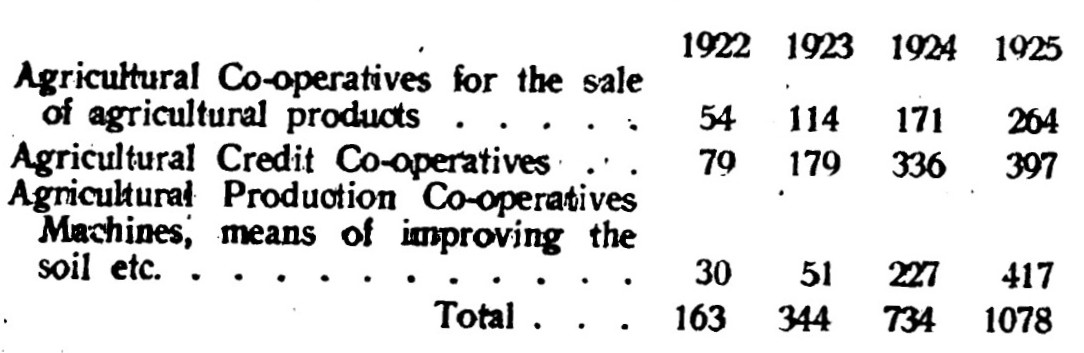
In spite of the considerable development of agriculture in the province of Moscow and the indisputable improvement in the situation of the peasants, the cultivation of the land does not produce sufficient to support the rural population and there is a steady increase in the number of peasants who are obliged to seek some subsidiary occupation, as well as of those who, as in pre-war times, migrate into the towns. The backward methods of cultivating the soil, its parceling out, the low level of means and methods of production and of culture, form a great obstacle as to a more rapid rise of farming in the province of Moscow, in the whole Soviet Union. They render more difficult but do not altogether prevent the course of development, the socialisation of the peasantry on the basis of the co-operatives. This process is supported in every possible way by the proletarian State. In the course of a year, about 30,000 new farms have been affiliated, so that among 345,000 peasant holdings 95,000, i.e. 27% are organised on co-operative lines. The turnover of the Agricultural Co-operatives has also undergone appreciable extension.
The Rural Departments established by the People’s Commissary for Agriculture, attach very great importance to the formation and support of the Co-operatives in the villages. Their development can be judged by the following table:

The Agricultural Co-operatives have, together with the Agricultural Department of the province, bought 40,000 ploughs (in 1924 only 23,000 ploughs), 60 tractors and 600 seeding-machines (in 1924 only 500 seeding-machines).
IV. Education and Hygiene.
In the domain of education, the province of Moscow by no means takes a back seat. It has deserved special merit in the Whereas in 1923, there were still liquidation of illiteracy. 120,000 illiterate persons in the whole province, reading and writing ahs been taught to 50,000 during the last two years. During the current year, 57,500 persons are to be taught to read and write. The Province of Moscow is determined completely to wipe out illiteracy by 1927.
The number of persons attending school has increased by 30,000 (18%) as compared with 1924. In the districts of the province of Moscow, an increase of 22,000 persons attending school can be recorded. The school attendance in the province of Moscow exceeds that of pre-war time by 40%. There are 10,000 children in the kindergartens 31,000 are being educated in children’s homes (in pre-war times only 3000 children could be admitted to the latter). In various agricultural training schools, 1500 peasants children are being educated, before the war there these did not exist were only 400. In the factory workshops at all before the war 6500 persons are being instructed. In 22 technical schools, 8884 persons are being trained. In Moscow, 90 professional schools are training 17,694 persons; this number is to be raised to 56,265 for 1925/26.
The number of libraries, reading rooms, lectures, lectures with lantern slides, cinematograph performances, in short the whole work of education in the villages cannot even approximately satisfy the awakening hunger for education, although more was spent on purposes of education by 60% than in the previous year. It is easy to understand that the educational work differs fundamentally both in content and character from that of former times.
An important change for the better in the health of the people is associated with the economic, financial and cultural improvement in the Moscow government. In Moscow, the rate of mortality has declined. Whereas in 1913, the mortality had reached 24,8 per 1000, only 15 per thousand died in the past year. Not only has the general mortality of the population fallen, but the distressingly high infant mortality of pre-war times is considerably reduced. In 1913, there were 28 deaths to 100 births under one year. In the last few years, this number has fallen to 17 and 14. The tuberculosis mortality rate has also decreased. Epidemics have also lessened.
The number of persons attending the out-patients clinics has increased by 21%, those attending the clinics for tuberculosis by 23%, maternity and child welfare centres by 77%, and dispensaries for venereal diseases by 219%. In consequence, the number of out-patient clinics has been increased by 15%, and that of doctors by 50%; 200 new beds have been established for general diseases and 725 for venereal diseases. The number of children’s beds has been increased from 1500 to 15,000.
There are many causes for these increased figures of sickness. Firstly, 60-70% of the workers in the factories suffer from chronic diseases which are the consequence of the long years of famine and of their many privations during the imperialist war and the civil war. Further the increase in the number of industrial workers who, with their families, are included in social insurance, contributes to the swelling of the numbers of sick persons officially registered. Another factor finally is the growing level of culture of the population, which is more and more forsaking quacks and faith-healers and seeking medical aid. The Moscow Board of Health is making the prevention of disease and the hygienic enlightenment of the people the centre point of its activities. It is devoting more attention than before to studying and combating social occupational diseases.
The workmen’s dwellings attached to the factories have been visited by sanitary inspectors and in 285 cases, help has been given. “First Aid” doctors were called in in 11,739 cases. The consequence of this increased attention to the workers in the factories is already visible; a number of measures for the improvement of the sanitary conditions in the factories have already been taken.
It is not however in Moscow alone but also in the districts of the province that the campaign for the improvement of the health of the people is being carried on. The department for health education has, in the course of six months, organised 7056 lectures with a total audience of 625,858 persons and 238 hygiene exhibitions which were visited by 78,714 persons. During the same time, 3130 persons attended 125 lectures on tuberculosis and on how it should be combated. On venereal diseases, 1226 lectures were held which were attended by 105,695 persons. A new institution, which was not known in the old Russia, is that of the so-called health nuclei which have been founded in the factories, the function of which is to control the sanitary conditions in the factories and workmen’s dwellings. Commissions composed of groups of representatives of the Party and of women, of women delegates and representatives of the village organisations have been affiliated to more than 120 Soviets in the province. More than 650 health nuclei already exist. For the prevention of disease, the Moscow Board of Health is extending the network of centres for medical consultation, dispensaries and convalescent homes, which are specially intended for workers in occupations which are injurious to health. In Moscow alone, They are organising dietetic restaurants. 115,782,460 roubles were spent on the maintenance of medical institutions. In 1925, 37,500 workers were admitted to concalescent homes (14 days), as compared with 12,500 in 1924. In the sanatoria, 12,400 persons received medical care and were restored to health this year, as against 9000 last year.
Another new institution which enjoys increasing popularity, especially among the rural population, is the Legal Advice Centre. Special consultation centres for women have been formed, in which the peasant women and women workers on the land receive pertinent answers to their questions from women, delegates from the maternity and child welfare centres.
V. Housing Construction and Municipal Undertakings.
One of the most burning questions round which interest centres, and without the solution of which most of the measures of the Board of Health remain ineffectual, is the housing problem. In Moscow it has reached catastrophic proportions. Even in 1912, before the war, the lack of housing accommodation was very serious, for at that time there were only 17.7 sq. sashas (1 sashas is about 2,10 metres) per head of the population numbering 1,600,000. When, in 1923, the number of inhabitants of Moscow amounted to 1,700,000, the number had fallen to 13.5 sq. sashas, and in 1924 there were only 11.7 per head; in 1925 every inhabitant of Moscow had, on an average, to be satisfied with rather less than 10.5 sq. sashas. For the provision of the necessary housing, 96 million roubles would be necessary. The Moscow Soviet however has only been able to allocate the sum of 52 millions. The expenses for building construction are increasing at a rapid pace. In 1923 3 millions were spent, in 1925 as much as 25 millions and in 1926, as has already been said, 52 million roubles are to be spent for building purposes. Whereas during the last two years, the work undertaken has mostly been that of repairs, the coming year is to be distinguished by new construction.
The electrification of the working class suburbs of Moscow is making progress. By the end of 1925, electric lighting will have been installed in about 3000 new houses. Electric plants are being constructed in villages also and “Iljitsch lamps”, as the peasants call the electric light, is penetrating the darkness of the most remote hamlets.
The upward movement of municipal undertakings (tramways, waterworks, gas-works etc.) is best reflected in the fact that their budget has increased fourfold in the three years 1922-1925. The expenses have increased from 19,8 million roubles in the financial year 1922/23 to 84 million roubles in the current financial year.
The traffic of the tramways, reckoned by the number of cars running, will, this year, slightly exceed that of 1913. As regards the length of the lines, about 70 km. have been newly constructed, chiefly with the object of connecting the working-class suburbs which, before the war were in every respect neglected by the bourgeois chief administration, with the centre of the city. As however the tramways are seriously overburdened, (the number of passengers carried amounted to 393,7 million in 1924/25 as against 257,4 million in 1913), the development of new means of transport is an urgent necessity. In this respect also, great progress has been made. Ten motor-bus lines are already running. It is planned to build an underground railway which should be working by 1930. Progress in the means of transport of the city is all the more important in Moscow because in 1920 the passenger traffic in the tramways had almost entirely ceased.
The pipes of the water-works and sewage are much increased since the war, the working class quarters especially having been joined on to the network of the water supply and drainage. The length of the network of water-pipes was 537.3 km. in 1913, and 677.1 km. in 1924/25. The length of the drainage-pipes was 445.6 km in 1913, and 568.4 km, in 1924/25. The development of the water supply and drainage is being continued; thus, during this year, about 6000 dwellings are to be joined on to the water-supply and sewage systems.
As a result of the improvement of the standard of living of the population, the consumption of meat is steadily increasing. An extension of the municipal slaughter houses is therefore planned. For this purpose, 10 million roubles have been set aside. Altogether, the greater part of the outlay of the municipal undertakings is being used for building construction. In the current year, 45% of its expenses are to be used for building purposes.
It was not until after the October revolution that the working class suburbs were incorporated in the municipality. Up to then, as has already been said, nothing was done for them. Now, extensive works are being undertaken for laying out new streets in them and supplying them with gas, water, electricity etc.
A further domain in which the municipal administration of Moscow can boast of success, is the laying out of parks and public gardens, which is particularly important from the point of view of public health. In each of the past two years, about 9 hectares of new public gardens have been laid out. Thus, an unmistakable upward movement is expressing itself in all fields of public life, a movement which cannot be checked because it is not called into being by artificial means, but is the work of all the forces of the working population in the service of the community. In all sections of the Moscow Soviet, 30,000 workers are engaged in this work. In the province, 30,000 peasants, men and women, are helping in the work of reconstruction. In this work, the Soviet organisations of the province of Moscow are increasingly employing women. Whilst their number in 1922 was only 8% of the whole, it increased in 1925 to 13%. The number of non-party women, which in 1922 was only 8%, has, in 1925 already reached 26%. This active participation in all the administrative work and social functions is a guarantee for a permanent rise in the socialist economic system of Moscow.
International Press Correspondence, widely known as”Inprecor” was published by the Executive Committee of the Communist International (ECCI) regularly in German and English, occasionally in many other languages, beginning in 1921 and lasting in English until 1938. Inprecor’s role was to supply translated articles to the English-speaking press of the International from the Comintern’s different sections, as well as news and statements from the ECCI. Many ‘Daily Worker’ and ‘Communist’ articles originated in Inprecor, and it also published articles by American comrades for use in other countries. It was published at least weekly, and often thrice weekly.
PDF of full issue: https://www.marxists.org/history/international/comintern/inprecor/1926/v06n03-jan-14-1926-inprecor.pdf
PDF of full issue: https://www.marxists.org/history/international/comintern/inprecor/1926/v06n10-jan-28-1926-Inprecor.pdf
 Revolution's Newsstand