A statement on the organized Communist Party discussion held in lieu of an annual conference (for fear of a split) from the majority of the Central Executive Committee. The C.E.C. of thirteen had eight majority members (Alexander Bittelman, Earl Browder, Fahle Burman, James P. Cannon, William F. Dunne, William Z. Foster, Martin Abern, Ludwig Lore) and five minority (Benjamin Gitlow, Jay Lovestone, John Pepper, C.E. Ruthenberg, J. Louis Engdahl), with the majority meeting a quorum and acting as the C.E.C. Fought over the Farmer-Labor Party debacle, but containing such weighty issues as notions of class independence, relations of the working class to farmers, the role of the Communist Party, ‘stages’ of development, a ‘labor aristocracy,’ and possibilities for revolution in an expanding empire, the debates are at times archaic to our ears, and at others extremely familiar and still relevant.
‘Results and Lessons of the Party Discussion’ from The Daily Worker. Vol. 2 No. 5. January 7, 1925.
OUR party has just passed through its first great discussion, and from this discussion some unmistakable conclusions have been established. The period of the discussion marks a turning point in the history of our party. Despite the intensity of the discussion, and the sharp tones with which it was carried on at times, the effects on the party have been beneficial. It was a symptom, not of decay, but of growth. These comrades who feared its effects and who became alarmed at its intensity, have missed the point. The discussion was a furnace from which the party is emerging strengthened and tempered, and better equipped for its historic task. A party which could stand such a severe discussion and grow stronger by it proves that it is maturing and developing into a genuine Communist Party.
Never in the history of our party was a minority given such full and free opportunity to put its case before the membership. There was absolutely no limit or restriction upon their rights. It was the aim of the C.E.C. from the beginning to widen and deepen the discussion and to draw the entire party membership into it. In this we were successful. Never before was the party so deeply stirred in the discussion of its tasks. “Bolsheviks do not fight over trifles.” So said Kamenev at a meeting of the Moscow party organization during the controversy with the opposition in the Russian Communist Party last year. These words of Kamenev apply very well to the discussion in our party. It should be clear now to all that the controversy which has shaken the party to its foundations, has not been over trifles. In the discussion, the party had to consider two questions of fundamental importance. First, the question of the main line of party policy, and, second, the question of leadership. The prevailing policy of the party is indissolubly bound up with the proletarian leading group of the C.E.C. Consequently, the attempt of the minority to reverse our fundamental policy went hand in hand with the attempt to undermine and discredit the C.E.C. To both questions, the party has given a decisive answer. That answer is, against the policy and leadership of the minority and for the policy and leadership of the C.E.C.
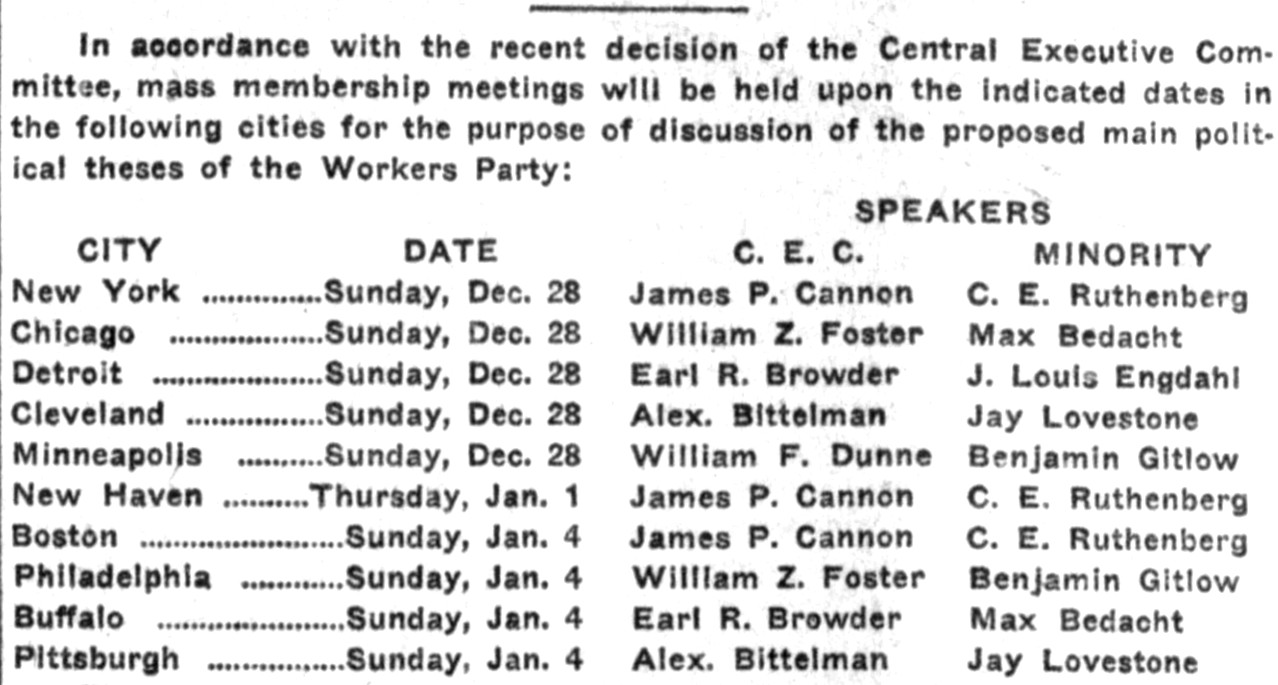
The final results of the discussion could already be foreseen in the first series of membership meetings held on Sunday, December 28. The failure of the minority to carry such important party centers as New York, Chicago, and Minneapolis, showed that their case was hopeless. Comrade Foster was quite correct when he said that the results of the first series of meetings spelled the defeat of the minority, and the repudiation of their policy. This analysis, however, was disputed by the minority. They placed all their hopes in the second series of meetings and made glowing predictions in regard to them. But these predictions did not materialize.
Boston, Philadelphia, Buffalo and Pittsburgh all gave majorities for the C.E.C. This was followed by decisive and overwhelming victories in such important party organizations as Los Angeles, San Francisco, Baltimore, Milwaukee, the mining sections of southern Illinois, the industrial towns adjacent to New York, and a number of other centers, until the question of the minority gaining a majority in the party passed out of the range of possibilities.
But the membership meetings, decisive as they were, do not fully indicate the strength of the C.E.C. To understand the full significance of its victory, one must go deeper than the surface indications. When we take into consideration the fact that the controversy revolved around the question of the farmer-labor party, it is of great importance to inquire what was the attitude of those party organizations and those party members who had been most involved in the work of our party in the farmer-labor movement. The results of the membership meetings show it was precisely those “party organizations in the centers of the farmer-labor movement and those party comrades who had been most active in our labor party campaign in the unions during the past two years which made up the vanguard of the C.E.C. support. The labor party centers, practically without exception, supported the C.E.C.
Most illuminating of all were the results of the membership meetings in New York, Boston, and Philadelphia. The minority passes over in silence the result in Chicago, the proletarian center of the party; but for their decisive defeat in New York they have brought forward a number of “explanations,” each one contradicting the other. The events in the New York district during the recent months are of profound significance to the party. The minority wants to attribute their crushing defeat there to an “alliance” of the C.E.C. with the Lore group. But in this, as in many other matters, the minority is substituting wishes for accomplished facts.
These “explanations” of the minority do not in any way change the fact that during the discussion, and thanks to the discussion, a new group came to the fore in the New York district, standing on the platform of the C.E.C. and that this group took over the leadership of the fight for the C.E.C. policy, and proved itself in the struggle to be stronger than either the Lore group or the minority. The Lore group could live and grow on the stupid tactics of the minority, but in conflict with the group of the C.E.C., which, in accord with the decision of the C.I., puts the question on a political and ideological basis, it will have no more success than the minority.
One of the most fruitful results of the party discussion has been the emergence and crystallization of the C.E.C. group in the New York district. The fight between the minority and the Lore group for the control of the New York district no longer occupies the center of the stage. The group of the C.E.C. has proved itself strong enough to conduct a struggle on political grounds against both groups simultaneously, and to defeat them both. The leadership of the New York district belongs neither to the minority nor to the Lore group. but to the C.E.C.
The weakness of the minority was nowhere so clearly demonstrated as in Boston. Here the party apparatus was completely in the control of the minority. Comrade Ballam has for months been using his office of district organizer as an instrument in the faction fight, even going so far as to compromise the party in the CP.P.A. conference, in order to make an “issue” against the C.E.C. The district executive committee, under his leadership has been occupying itself almost exclusively with the passing of factional motions which were used as a basis for the propaganda of the minority. Comrade Ballam used his well-known abilities as “caucus organizer” to the limit in preparation for the Boston membership meeting. But all these “preparations” came to nothing. The Boston membership meeting was a crushing blow to the hopes of the minority and to the factionalism of Comrade Ballam.
In Philadelphia, Comrade Jakira, who exceeded all bounds in his factional conduct of the office of district organizer, made an even poorer showing. The rank and file revolt in the Boston and Philadelphia districts should be a warning to Comrades Ballam and Jakira that the party members expect party discipline and party responsibility to be binding also for district organizers.
Pittsburgh and Buffalo, which had been thoroughly propagandized by the minority and which they relied on for big majorities, upset all calculations by their decisive support of the C.E.C.
Only in two cities, Cleveland and Detroit, did the membership meetings give any comfort to the minority, but those were “fluke” victories and will he short-lived. With more thorough consideration of the issues involved, the party organizations in Cleveland and Detroit are already beginning to swing into line with the rest of the party in support of the C.E.C. The campaign of the C.E.C. to reeducate the party and to purge it of farmer-laborism will have the same success in these centers as elsewhere. More thorough consideration by the party of the fundamental principles involved in the discussion will enable the C.E.C. to go to the next party convention with the support of at least ninety per cent of the party membership.
The membership meetings not only registered a complete defeat for the farmer-labor policy of the minority; their fight for leadership shared the same fate in an even more decisive fashion. The real aim of the minority, which they have pursued in a conscious and organized manner, for the past year, was to overthrow the C.E.C. To this end a nation-wide caucus organization has been maintained. The minority has confronted the C.E.C. as an organized opposition ever since the last convention and has resisted all our attempts to come to an agreement with them and to dissolve the factional organization. In violation of all principles of Communist organization, the smallest details of C.E.C. proceedings were transmitted, by means of the minority caucus, down to the branches and the party was literally flooded with anonymous “documents,” rumors, “issues,” etc. A number of federation secretaries and editors were incorporated into this caucus under the leadership of C.E.C. members of the minority, and it was attempted by this means to mobilize the support of the federation members for the minority.
The leaders of the minority could not by any means reconcile themselves to a situation where the party leadership was in the hands of “half-educated workers” and “syndicalists,” as they characterized the proletarian elements in the party, especially those who emphasized the importance of work in trade unions. They were not willing to recognize the validity of our mandate from the last party convention. They seemed to take it for granted that we would not be able to carry out our responsibility. They expected us to turn the party over to hem in desperation, since they were the self-acknowledged “Marxian trunk” of the party. Our efforts to formulate policies received no sympathy from them. And that we should actually presume to write theses, etc., was considered almost a personal insult
The party during the past year was confronted with the most difficult problems since its founding, which tested and tried the leadership of the party as never before. The wild exaggerations and overestimations of events, which had been committed by the C.E.C. last year, reacted against the party this year with full force. We were compelled to readjust ourselves a number of times and to adapt the party to an entirely new situation. Our party was sick with the fever of “high politics” and it was no easy task to lead it back to basic Communist work. The decision of the Communist International against the “third party alliance,” the collapse of the farmer-labor movement, the presidential candidacy of LaFollette, the necessity that we put up our own party candidates–all these events required a series of quick changes in policy and it was a real achievement to carry them thru without any serious disturbances or crises in the party. Coupled with these external difficulties, we constantly had the problem of the organized opposition fighting for control of the party, striving to distort every action of the C.E.C. to seize upon and magnify every little mistake, real or imaginary, and use it for factional purposes.
One of the greatest weaknesses of our young party in the past has been the lack of stable and authoritative leadership. There never yet has been, up to this year, a central executive committee which has been able to withstand an organized opposition. Continuity of leadership was a thing unknown.
“Overthrowing the C.E.C.” has hitherto been any easy “pastime.” There is a section of our party which still carries with it the traditions of “permanent opposition,” which grew out of the long fight in the socialist party and which was even a part of the philosophy of the syndicalist and anarchist movements. This hostility and prejudice against all leaders offered favorable soil in which to start an opposition and was fully exploited by the minority. Such comrades who have not yet assimilated the Leninist conception of proletarian leadership, who draw a line between the leaders and the party membership, and who do not understand their indissoluble connection, all rallied for the “raid” on the C.E.C.
But with all these factors in their favor, with a year-long caucus organization, and with a considerable amount of fundamental opposition in the party ranks to our main line of policy, the attack of the minority on the C.E.C. met with a decisive defeat.
This has an outstanding significance for the party. For the first time in the history of the party an organized fight against the C.E.C. has failed. The C.E.C. has proved itself fully able to lead the party thru the most difficult year of its existence, to execute a number of necessary changes in tactics, to adapt the party to the constantly changing political situation, to cope with an organized opposition, and at the same time to keep a firm hold on the party and to strengthen itself in the confidence of its most active and dynamic elements. These facts are the best augury that the party ranks will be unified and consolidated, and that factionalism will soon be liquidated.
In the course of the discussion, the opportunist and revisionist character of the farmer-labor policy of the minority was established beyond all question by the minority themselves; and the reactions of their rank and file supporters merely gave it the final confirmation. From the slogan raised in Comrade Pepper’s pamphlet, “For a labor party” of “A labor party or the capitalist dictatorship,” it was only one step further to Comrade Lovestone’s book “The Government-Strikebreaker” and his pamphlet “The LaFollette Illusion” in which the role of the Communist Party is completely eliminated from consideration. And from these deviations the proposals of many rank and file supporters of the minority, expressed at all the membership meetings, “to bore from within” the LaFollette movement and create a left wing there, followed naturally and logically.
The C.E.C. does not follow a policy of reprisal and has no desire to prolong or accentuate the bitterness of the controversy. Nevertheless, we feel duty-bound to call the attention of the party to the superficial and cynical attitude toward the party, manifested in the concluding article by Comrade Lovestone. In this article, which from beginning to end is filled with misrepresentations and perversions of facts, with flippant sneers and jibes, Comrade Lovestone even goes so far as to speak derisively of the party apparatus as the “state power.” We know of nothing more anti-Bolshevik and anti-proletarian than such a contemptuous attitude toward the party apparatus, and we believe that all that is serious, proletarian and revolutionary in the ranks of the minority will repudiate it. The proletarian movement is neither a game nor an adventure. The party apparatus is not something separate from the party. The party will find ways and means of making plain its point of view on these questions.
The central feature of the “opposition” in the Russian Communist Party was its attack on the party apparatus, made in much the same spirit as that of Comrade Lovestone, and in this, as in all else, it showed its fundamental departure from Lenin’s teachings. In this connection our whole party can profitably study the words of Comrade Varski, of the Polish Communist Party, who now joins the central committee of the R.C.P. in the struggle against Trotskyism.
In a recent article in the Inprec0rr, Comrade Varski says:
“We now know quite well that without the Bolshevist organizatory conceptions regarding the role of the leading circles in the party (central committee, district committee, local committee, or of the so-called party apparatus in general) and in the revolution, there can be no revolution of the proletariat whatever, and no dictatorship of the proletariat.”
The leading group of the C.E.C. is a group of the proletarian class struggle, that grew out of the struggle, and whose whole aim and conception is to build and develop the party, according to the teachings of Lenin, in the process of struggle.
Nevertheless, during the discussion, the minority was constantly reproaching us with the charge that we had “done nothing” during the past year, that there were no new “grand maneuvers” undertaken, that there was no “action.” If one is familiar with the conception of the minority, such an attitude is understandable. Their conception of politics is “high politics.” It is noisy spectacular undertakings. It is bluff and exaggeration, and bombast. The day-by-day work and struggle which builds the party firmly and solidly and drives its roots into the labor movement, appears to them to be mere “sectarianism.” They do not understand the admonition of Lenin to build the party by “quiet, patient, persistent, not noisy, but deep work.” The real and solid achievements of the past year have escaped their attention. They had no answer whatever to our statement on “A year of Progress,” in which these solid achievements were set forth in detail. They did not answer because they could not answer in any way, except with stereotyped sneers at the Communist “trade unionists” and other proletarian elements in the party, who have borne the brunt of this work.
The policy which guided all our work for the past year was wholly the policy of the majority of the C.E.C. The minority have not made a single important contribution to the solution of our problems and the development of our work. The minority have had such little connection with this basic work, that they are hardly aware of what has been done. They do not know about the “quiet, patient, persistent, not noisy, but deep work” which has been done during the past year by the most active and dynamic elements of the party under the leadership of the C.E.C. It is apparently a matter of small moment to theorists of “politics on a grand scale,” that the beginnings of a hard and firm left wing movement have been crystallized in a number of important unions, under the leadership of the Communists; that we have made at least a beginning with systematic party educational work; that our party, for the first time, has made an election campaign under its own banner, and that we are learning how to develop concrete struggles and agitation on the basis of the united front.
The appearance of a revolutionary left wing–although a small and weak one–in such a reactionary union as the gigantic Brotherhood, of Carpenters, for example, and the strong movement we are leading in the United Mine Workers, represent nothing to the minority; and the tremendous energy, sacrifice and courage embodied in these achievements of our party, brings no commendation from them. For them it is merely another example of “syndicalism.” It is time to say frankly to the party and to the Communist International that we are losing all patience with this superficial and condescending attitude towards our work in the trade unions and towards the comrades who do this work.
The year behind us has been a year of basic work and struggle and steady, if slow, achievement, accomplished in spite of all difficulties. Our party work was less spectacular than the year before, but all the more substantial; and the work for the coming year must proceed along the same line. Without in the least giving way to sectarianism, without making one single concession to routine conceptions of party work, the party must learn how to build and strengthen itself by struggle and in the process of struggle, according to the teachings of Lenin, “brick by brick.”
The C.E.C. will exert all its energy to lead the party along this path. The C.I. will help us in this determination and strengthen and equip us for this task.
For two whole months the party discussion has absorbed almost the entire attention of the party. We must now turn our energies toward the constructive external task of broadening its scope and drawing ever wider masses of workers into united front actions. The whole party, down to its last member, must rally to the support of our comrades in the Michigan case. The party must become a dynamo of activity over this burning question and must rouse the labor movement into action. Our party must come to the front in the fight against wage reductions. It must put life and power into the child labor campaign. It must take the lead in the fight over unemployment It must prepare to launch a wide united front movement to defend the foreign born workers against new persecutions. The party must go deeper and ever deeper into the trade unions, and draw them into the political struggle. Every struggle of the working class must find the Workers Party in the vanguard, for it is only by active participation in the struggle that our party can live and grow.
The giant tasks confronting the party make it mandatory that we call forth all our constructive energies for the speedy liquidation of factionalism. The C.E.C. has already taken the first step to this end by appointing a special committee to work out special and detailed methods of facilitating it. The C.E.C. calls upon all the party comrades to assist in the endeavor. The basis for comradely cooperation of all party members must be established without delay. The ground for unity and co-operation must be laid so securely that the party, as one man, will be prepared to accept the final decisions of the Communist International on the problems of our party and to carry them out.
American capitalism, the most powerful and relentless in the world, is planning new and more terrible oppressions for the American workers and poor farmers and for the people of the colonies and smaller countries of Central and South America which it has brought within its sphere. History has set for our party the colossal task of leading the workers and exploited peoples into the struggle which can only end in the destruction of this imperialist monster and the liberation of the masses who suffer beneath its rule. We must go forward with full consciousness of our great responsibility, and with the firm and unshakable conviction that only a united, disciplined Bolshevik party will be equal to this task. We are on the way to becoming such a party. Let us hasten the process by all means. Let us put the stamp of our party on every struggle of the workers and show to the workers, in actual practice, that it is the only party that fights for and with the working class. In the struggle and by the struggle, our party will grow and become hardened, and will develop into a mass Communist Party capable of leading the exploited masses to the final victory.
Central Executive Committee, WORKERS PARTY OF AMERICA.
The Saturday Supplement, later changed to a Sunday Supplement, of the Daily Worker was a place for longer articles with debate, international focus, literature, and documents presented. The Daily Worker began in 1924 and was published in New York City by the Communist Party US and its predecessor organizations. Among the most long-lasting and important left publications in US history, it had a circulation of 35,000 at its peak. The Daily Worker came from The Ohio Socialist, published by the Left Wing-dominated Socialist Party of Ohio in Cleveland from 1917 to November 1919, when it became became The Toiler, paper of the Communist Labor Party. In December 1921 the above-ground Workers Party of America merged the Toiler with the paper Workers Council to found The Worker, which became The Daily Worker beginning January 13, 1924.
PDF of full issue: https://www.marxists.org/history/usa/pubs/dailyworker/1925/1925-ny/v02b-n005-supplement-jan-17-1925-DW-LOC.pdf
 Revolution's Newsstand