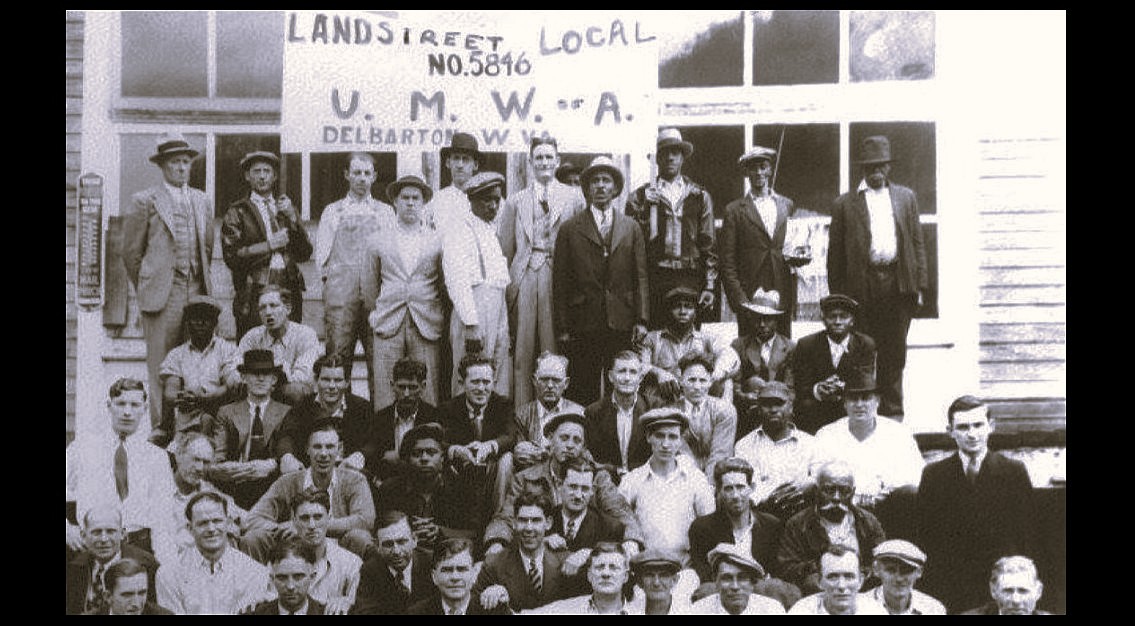
Life in mining communities was brutal enough with a union, but carried dignity with it–priceless and irreplaceable to a working-class life. As this valuable expose shows, without a union it was hell on Earth. Today West Virginia has one of the lowest life expectancy rates in the country (2nd to Mississippi), and after decades of slowly rising, it has now fallen back to the 1970 level–no more damning statistics of ‘progress.’ Life in mining communities was brutal enough with a union. Without a union and it was hell on Earth. West Virginia is not unique, but it is special. All the baleful expropriative, extractive, exploitive, and oppressive processes that are capitalism’s regular practice were both experimented on, and perfected there. By happenstance, and by design much of the state was an officially policed forced labor camp, with limited services, education, and infrastructure. With all the social rot, unemployment, personal and social hopelessness, and inevitable self-destruction that is the lot of discarded and despised people. The state is still in the death-grip of the coal industry with their gas wells and toxic runoffs, dead streams and mountaintop removal, a purposefully starved education system, the most corrupt, industry-bought politicians in a country full of them, with some boot-licking suckers from the working class and even labor movement happy to assist.
‘Slavery Exists in West Virginia’ by Edward Lloyd from Industrial Pioneer. Vol. 1 No. 12. April, 1924.
STATE OFFICIALS BOW TO COAL BARONS AND SHUT EYES TO SUFFERING THOUSANDS
On February 11, 1924, the opening day of the Miners’ wage conference, Mr. R.H. Jones, of the Cleveland Press stated:
“Sixty-one years ago, West Virginia split from the Confederacy because its people would not stand for slavery. But today the same state endures a more brutal form of bondage. It once fought to free the Negro, but today it does not even turn its hand to free the white.”
Correct, Mr. Jones, the State will make no effort to free the white, for as you state further on in your article: “I asked the Governor what the attitude of the powers-that-be in West Virginia, public officials, politicians and capitalists—is toward union labor. ‘Very unfriendly’, he answered.”
For two years nearly five thousand men, women and children—striking union miners and their families—have been living in tents in the Cabin Creek Valley, about fifteen miles from Charleston, the State capital, and even the Governor of the State did not know about it until a few weeks ago.
Governor Morgan in conversation with a Cleveland Press reporter remarked:
“I was driving along a road on my way to address a Sunday School meeting when I saw a lot of tents with women sticking their heads out and children playing in the mud nearby. I asked what the tents were there for and was told they contained striking miners.”
“Did you ask him to tell you any more about it?” the Press reporter inquired.
“No,” replied the Governor.
“Did you do anything about it?”
“No” was his answer again.
The Governor was not interested, he knew better than that. He knew where his bread and butter came from. He should worry.
The Governor was then asked: “Don’t you think that scene—hundreds of women and children hungry because those men are out of work—would have been worth mentioning in a religious address where you would emphasize the Golden Rule?”
“Those men don’t want to work,” the Governor retorted sharply.
You are wrong, Governor, and you know it, you deliberately lie. Those men do want to work, but they want something in return for their work. They are tired of carrying a lot of useless parasites like yourself on their backs. These men do not like to see their loved ones slowly starving to death before their eyes, yet you and your masters, the coal hogs, force them to it.
Hypocrites and Pharisees
The Nazarene mentions you and your masters in the Scriptures; he refers to you as “hypocrites and Pharisees.” Not content with hiding your slavery tactics under the cloak of “patriotism” and “flag waving,” you have the supreme gall to preach Him who said: “In as much as ye (you, Gov. Morgan, and your masters) have done it unto one of the least of these, ye have done it unto me.” And in this world there is nothing “slimier” than a hypocrite, unless it is a “stoolpigeon,” or a scab.
The coal hogs fix the price on their coal, but the Governor (the coal hogs) will not allow the miners who produce all their wealth to have anything to say in regards to the price they shall receive for their labor.
The miners’ union, such as it is, is the only thing which kept their wages at or near the point where they could exist during the past years. But contracts with the boss have even rendered the union helpless. The soft coal miners will remain at work and scab on the hard coal miners while they are on strike, and vice versa, owing to the “sacredness” of contracts. Each district is jealous of its “rights” as a district, there is no solidarity amongst them, and in consequence they are impotent.
How different things would be if all the miners, soft and hard coal, as well as all persons engaged in the mining industry: clerks, timekeepers, checkers, skinners, etc., were organized into One Big Union of Miners. If an injury to one was the concern of all, what would be the result? Let me tell you: Mr. Coal Hog would be digging coal himself, and you would not be feeding him and his brats and keeping them in luxury while you and your children are starving.
Mine War Renewed
The war on unionism in the mines—what little there is left of it—has been renewed by the operators, and the Kanawha field is again non-union. Wages have been reduced to the non-union level that prevails in. other fields, a cut of thirty-five per cent.
Thousands of miners in both the union and nonunion mines are idle because the operators have shut down or the miners are striking to resist a wage cut. Some have not worked since 1922, and others, thousands of them, are working only three days a week at the most.
The scab miners receive only about sixty-six per cent of the wages they received before the operators renewed their war on the union scale. The same conditions are found in Kentucky, as the miners’ union never amounted to more than a tinker’s dam there, although the mines of the Brotherhood of Locomotive Engineers are located in Kentucky.
Consider, then, the plight of even the most fortunate miner, who can obtain work only one-third of the time at a 35 per cent wage reduction. Let us put it into figures. Assume that, in normal times at normal wages, he could work six days a week at $6 a day. His weekly pay would be $36. Now reduce his working days to two a week and cut his pay to $4 a day. He then has $8 as his total income for the week.
Out of that comes his expenses. Without mentioning other items, just one keg of powder at $3.50 reduces his income to $4.50. His board and lodging, if he is a single man, costs $9 a week. So he is $4.50 behind. If he is married, with the average miner’s family of a wife and five children, his situation is even worse. And he cannot run away from it like the unmarried man. He must stick it out, come what may. And, believe me, just about everything comes except enough to eat and wear.
Yet, with starvation wages and a famine of employment, these distressed miners make grave charges of dishonesty against many operators.
A Rotten Proposition
The coal miners are sure up against a sweet smelling proposition. Here is one of the ways they are robbed by these Sunday School preaching, flag-waving, hundred-percenters as described by Mr. Jones in his report of February 12th, to the Cleveland Press:
“When the mines were unionized, the union paid for a check weigher at each mine. Under non-union conditions, the operators do not permit a check weighman at the scales. The miners must take the operator’s word for the weight of their coal.
“If the operators really want to pay the miners for all the coal they dig they could not fairly object to having the weights verified “It is ho secret among the non-union miners of West Virginia and Kentucky that the smallest ton they are compelled to load contains 2240 pounds—a long ton—but they are helpless to protect themselves from being cheated out of the extra 240 pounds.
“The State law of West Virginia requires that a check weighman shall be stationed at every mine. But the operators ignore this law. And the State officials pay no attention to the protests of the miners.
“For the operators who own the mines also own the public officials, just as they own the human slaves who dig coal for them for starvation wages.”
Own Public Officials
Another “mouthful,” Mr. Jones, “The state officials pay no attention to the protests of the miners.” That is, state officials pay no attention to anything which would better the conditions, but let the situation be reversed, and see how quickly they would act, as witness the Child Labor Law, and how quickly it was declared “unconstitutional” by the Supreme Court of the USA. The slave owners must not be deprived of their rights, these children must be made to keep these useless parasites in luxury, but you never hear of one of the brats of the parasites being at work.
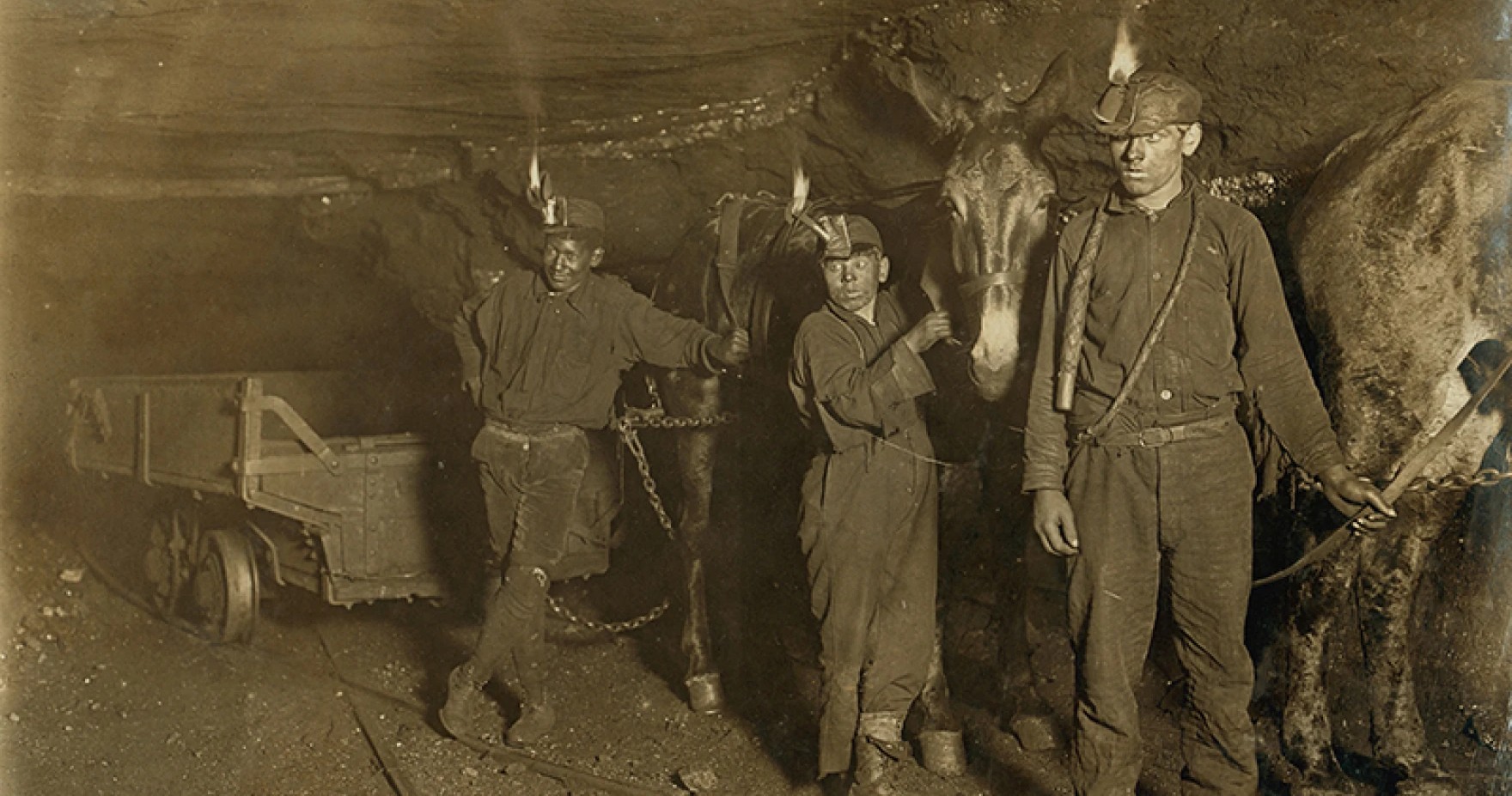
How quickly the law steps in when the workers try to remedy the evils for themselves. San Quentin Prison and other prisons are full of workers who tried to organize the slaves, and better their conditions, but you don’t notice any of the “officials” being in jail for disregarding the “law,” or the sons of any of the Federal or State Officials whose names become linked with murder. Such cases are “hushed up.”
Mr. Jones further states:—”Many mines in the distressed fields of West Virginia have not run for months. Others run from one to three days a week. Thus pay envelopes, even of those who work at all, are very thin.
A Free Land?
“Yet the operators compel their miners to buy all their food at the mining company’s stores where prices are the highest.
“All the clothing I saw in several stores was overalls for men and boys, and calico wrappers for women.”
Conditions at Eskdale, in the Cabin Creek Valley, will speak for the entire field. Here five thousand persons—striking miners and their families—were ejected from houses which are owned by the coal operators, and are now living in tents. Each striker receives a few nickels from the union weekly for a little food.
At Eskdale the miners’ union established a store to take care of its members. Anyone, though, may buy at its counters, even the strikebreakers were accepted as customers, but the coal hogs stopped this practice and made their employes buy everything they needed at the company store.
In conclusion, to give you an idea of how much the employer “has the welfare of his employes at heart,” and how much “the working class and the employing class have in common,” I will quote the prices of goods at three different stores in Eskdale as given by Mr. Jones.
The following are the prices:
Coal-hog’s store–Private store—Union store
Flour 24 1/2 Ibs.: $1.55–$1.40–$1.00
Soap: .08–.07–.05
Sugar per Ibs.: .13–.12–.10
Milk quart: .23–.20–.17
Everything else is in proportion.
Read and Reflect
The first two paragraphs of the Preamble of the Industrial Workers of the World say:—”The working class and the employing class have nothing in common. There can be no peace so long as hunger and want are found among millions of working people and the few, who make up the employing class, have all the good things in life.
“Between these two classes a struggle must go on until the workers of the world organize as a class, take possession of the earth and the machinery of production and abolish the wage system.”
MORAL: Align yourself on the side of the working class. Join the union of your class. Take out a card in The Industrial Workers of the World.
The Industrial Pioneer was published monthly by Industrial Workers of the World’s General Executive Board in Chicago from 1921 to 1926 taking over from One Big Union Monthly when its editor, John Sandgren, was replaced for his anti-Communism, alienating the non-Communist majority of IWW. The Industrial Pioneer declined after the 1924 split in the IWW, in part over centralization and adherence to the Red International of Labour Unions (RILU) and ceased in 1926.
PDF of full issue: https://www.marxists.org/history/usa/pubs/industrial-pioneer/Industrial%20Pioneer%20(April%201924).pdf
 Revolution's Newsstand