
Vital and experimental, the early 1930s saw professional and lay dance become a leading vehicle for artistic, political, and revolutionary expression, with new forms and elaborations of old performed in both theater and in union hall. How rich our world was…Edna Ocko, lead dance critic of the avantgarde, on one of the most important schools of that emerging world, the New Dance Group of New York City.
‘The New Dance Group’ by Edna Ocko from New Theatre. Vol. 1 No. 10. November, 1934.
THE New Dance Group–four years old–two times winner of the annual competition sponsored by the Workers Dance League, originally composed of six genteelly pink dance students who found in the revolutionary movement the vitality and perspective they wanted in their dancing grew to practically unwieldy proportions when it organized classes for laymen and students. The charge being ten cents a class (bourgeois schools–$1.50), hundreds joined. Present membership is 239, of which 16 are members of two performing groups. The slogan and goal of the New Dance Group is: Towards Performing Groups, to create and perform dances bearing the message of the fighting, class-conscious proletariat–to perform wherever it can before bourgeois audiences as well as mass meetings, trade unions, the waterfront, picket lines, etc.
We approach then our first distinction warranting discussion and analysis. Two hundred and thirty-nine members–16 performers. The New Dance Group has a double function. There are classes to be taught and performances to be given–teachers and a method are needed for one, dancers and direction for the other. How is this work carried on?
Classes are three hours long; divided in three periods, one hour for technique, one for creative work on subject matter suggested by the Educational Committee which has representatives in each class and to which the teachers also belong, and one hour for a meeting which includes discussion of technical and political problems, reports based on theme work of the class and suggestions for further activity. There are children’s classes and a men’s class. Mass dance and folk dance evenings are planned for the entire membership and guests.
Prospective performers are chosen from the advanced class. This group meets for additional technique with the performing group. Those who are ready for performance meet twice a week for rehearsals on their own dances, directed for the time being by an experienced director from the first performing group. Most of the teachers are members of the first performing group. The additional technique classes and the men’s class, however, are led by those not closely affiliated with the group (first–because since no specific thematic work is allotted to those classes, an outsider can conduct them competently; second–by thus encouraging experienced dancers and teachers from bourgeois circles to work for the group, the group increasingly activizes them into a movement with which originally they might have had little sympathy).
The second performing group of four members is only a few months old, and as yet undistinguished. The first group in its comparatively brief period of existence has performed before several hundred thousand workers and intellectuals in both bourgeois and proletarian circles. The personnel consists of an experienced dance accompanist and composer, and ten dance students (so called because they are still studying in bourgeois schools). Four of them are scholarship pupils at the Mary Wigman School, two have scholarships with Fe Alf, and the others study more or less regularly. All, however, support themselves by outside work, C.W.A. jobs, posing, teaching, etc.
IT is perhaps this broad and catholic dance background that the German pedagogic method so unfailingly gives its pupils, in addition to the intelligent and sensitive leadership of its directors, that has made the New Dance Group the most experimental and richly inventive of the groups in the Workers Dance League. Under collective leadership, this group has experimented with many forms of dancing and dance accompaniment. It has not hesitated to use whatever means available to aid it in putting forward its ideas; it has been amazingly quick to profit by criticism, to shift its artistic or ideological course, to re-direct its policies, in order to achieve artistic clarity and significance in its dances. First among its experiments, let us list its stress on collective leadership. There is no one dance choreographer, or director. Each member may direct dances, and these dances are subject to change through creative improvisations on the motif by other members of the group. From general agitational subjects–Awake, Revolt, Uprising–it shifted progressively to specific issues: German Fascism, the N.R.A., etc. Group dances, solo dances, mass dances, American and other national folk dances as well as revolutionary folk dances have been created by the group: dances without music, with percussion, with verbal accompaniment (an der Lubbe’s Head, second year prize winner was danced to a poem); also agit-prop dances (using stage props and based on specific contemporary themes, viz., The Blue Eagle, New Theatre Skit), joyous dances, satires. Among the subjects dealt with in their repertoire are a War cycle, the Scottsboro boys, the N.R.A., Charity, etc. Plans at present call for work on a full length revolutionary ballet.
Still, the New Dance Group has failed to evolve what seems most imperative in organizations of this sort–a Shock Troupe–a troupe to live and work collectively and be able to go into action anywhere, anytime, in the service of the cause it espouses. This absence of a shock troupe has resulted in serious deficiencies in the actual program of the professional group:
1. There is not enough rehearsal time for the creation of new dances to meet the insistent demands for performance.
2. Dance directors and choreographers are developed only with great difficulty to assume responsibility for dances, since intensive work is impossible at this time.
3. In their failure to cover all requests and needs for performance, contact with the working class has been considerably curtailed, and the group has not as yet achieved complete identity and sympathy with the day by day struggles of the working class. For this reason, their, dances at times have been vague and their style too abstract for workers’ audience…
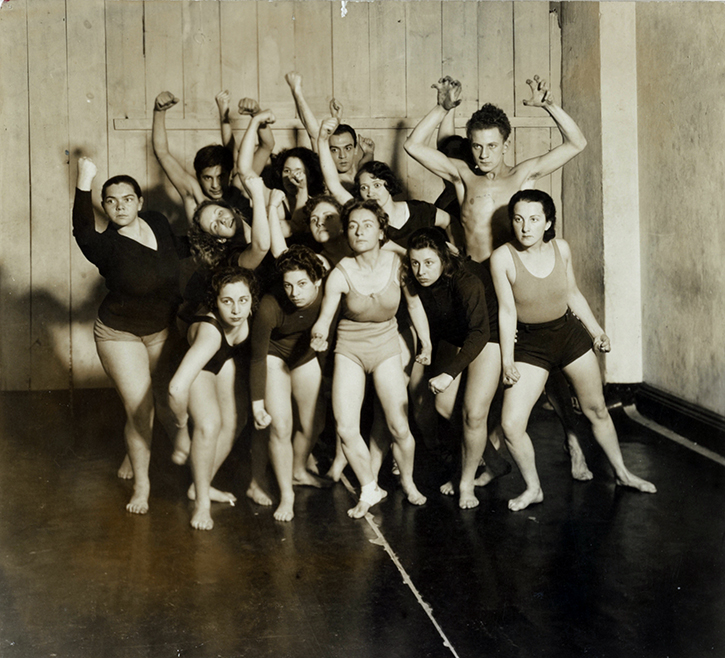
THE New Dance Group is a house divided. Its performing members have the problems and responsibilities not only of their immediate activity, but the activity of the dancing classes also. Were these classes really the recruiting ground for new members to be activized into performance, or at least into participation in other phases of the class struggle, there would be no doubt of the validity of the school. A tabulation of membership shows, however, that very few dancers join; there are office workers, school teachers, shop workers, unemployed, housewives, college students. The attraction for these people is recreation at cheap rates. (500 a month to all members).
In order to attain its goal therefore, the New Dance Group must make one of two decisions. Either it must raise the price of membership according to the paying ability of the pupils, and in this manner gain support for a professional shock troupe, or it must send all members who are studying for relaxation to dance groups formed by the Workers Dance League in other organizations (Office Workers Dance Group, etc.), and retain only those people showing definite talent or interest in the dance. In order to do this, the Group must attract young dance students by the excellence of its technical training and its clearly defined point of view. These students would eventually become members of the shock troupe or else form individual units to cover more performances. The organization should therefore appeal immediately for young dancers, male and female, to work with the group either as teachers, performers, or prospective participants along these lines. It is important to reorganize its structure immediately so that the first Performing Group can become a shock troupe and new performing groups can be enlisted from the advanced membership. The entire membership should be activized into more conscious participation in the class struggle (demonstrations, marches, picket lines, attendance at the Workers School. etc.), so that whatever dances are done derive coloring and life from the revolutionary struggle.
PDF of dull issue: https://www.marxists.org/history/usa/pubs/workers-theatre/v1n10-nov-1934-New-Theatre-NYPL-mfilm.pdf
 Revolution's Newsstand