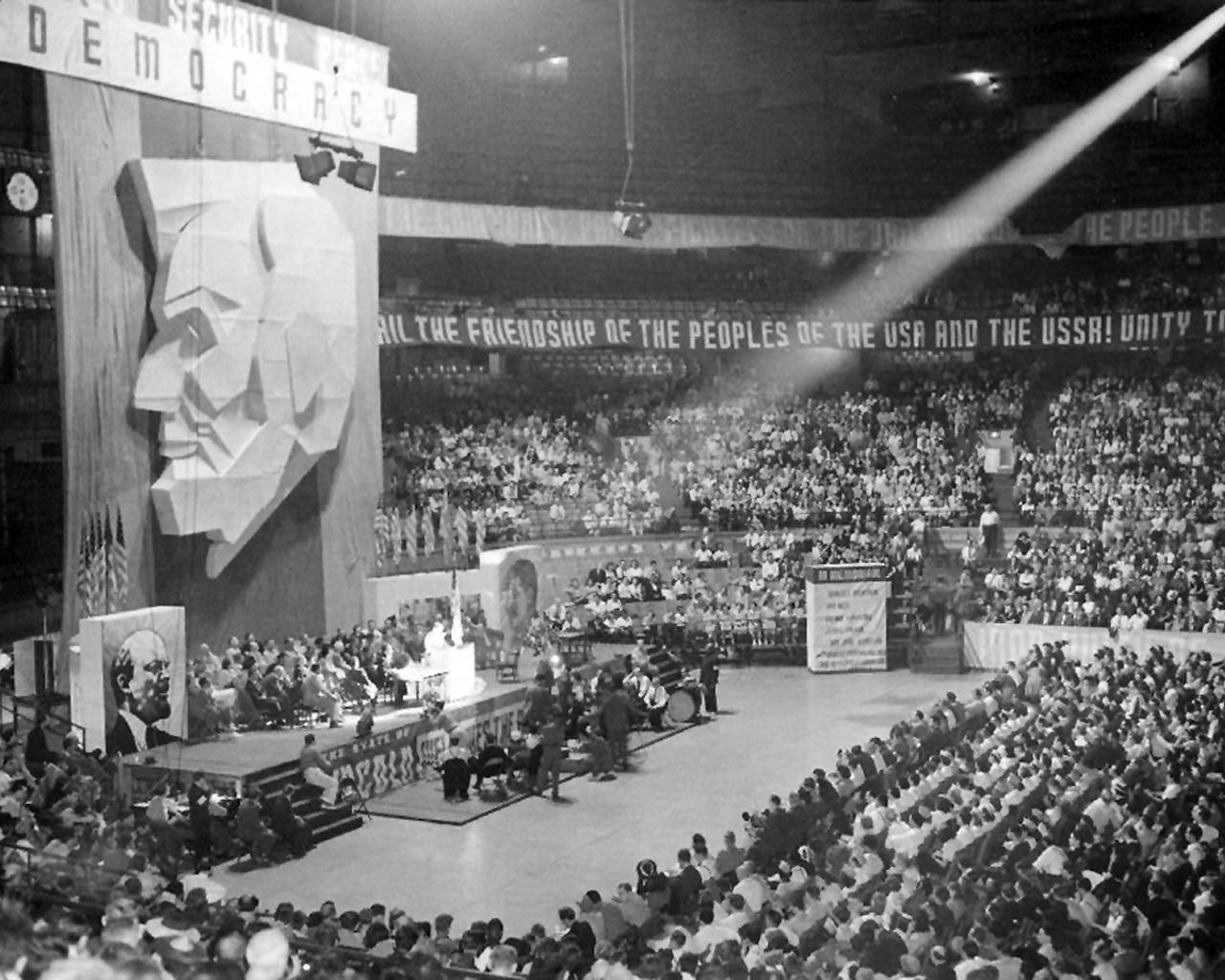
The C.P.U.S.A. leadership resolution conforming to the ‘Popular Front’ codified at the Comintern’s Seventh, and last, World Congress in 1935. The mid-30s saw a abandonment of the ‘class against class’ politics of the Third Period toward alliances with non-working class forces in an attempt to fight fascism through a ‘democratic’ coalition.
‘The Seventh World Congress of the Communist International and the Tasks of Our Party’ from The Communist. Vol. 14 No. 12. December, 1936.
THE Central Committee of the C.P.U.S.A. endorses fully and wholeheartedly the decisions of the Seventh World Congress of the Communist International. These decisions are already proving the most powerful weapon for building the united front and the people’s front against fascism and war, in the struggle for peace, for trade union unity, and for one working class political party.
It is vitally necessary that the decisions of the Seventh World Congress be made the property of the widest masses of American toilers. The Central Committee therefore greets the popularization campaign initiated by the Political Bureau through such means as open membership meetings, public symposium and debates, mass distribution of Dimitroff’s report, etc. The enthusiastic reception given to the Browder reports, and the reports of the other comrades, by wide circles of workers, non-Communists as well as Communists, at such large gatherings as the memorable Madison Sq. Garden meeting and others throughout the country, proves the possibility for the widest mass popularization of the united front message of our Party.
The Central Committee urges the Party organizations to prosecute further this campaign with the utmost energy. We must strive especially to stimulate fraternal, comradely discussions with Socialists, trade unionists and farmer organizations, through symposiums and similar means, on the practical tasks of building the united and people’s front. A most vital phase of this campaign is the popularization of the decisions of the Sixth World Congress of the Young Communist International to help build the widest anti-fascist youth front throughout the world. The Party press can and must play a most important role in this work.
The Central Committee approves wholeheartedly the work of the Party’s delegation. The Central Committee notes especially the prominent part taken by the delegation—Party and Young Communist League—in the Congress deliberations and decisions, the coming forward of the C.P.U.S.A. as a major party in the world organization of the Communists and the harmonious working of the delegation as a body. From this arises a great responsibility, namely, the responsibility of making the united and people’s front in the United States an example and a fortress of the world united front against fascism and war.
The Central Committee takes this occasion to send fraternal and revolutionary greetings to the Executive Committee of the Communist International, to its helmsman, Comrade Dimitroff, and to the great leader of the world revolutionary movement, Comrade Stalin.
Our chief task at present is to reorientate the work of the Party in accord with the tactical line of the Seventh World Congress. This line rests upon the central idea that the working class is now in a position to exercise a decisive influence upon the affairs of its own country as well as upon world affairs. The final and irrevocable victory of socialism in the Soviet Union strengthens immeasurably the positions of the workers all over the world. The inability of the bourgeoisie to overcome the collapse of capitalist stabilization and the increasing urge of the Socialists and trade unionists to the united front enable the workers of every capitalist country to carry on an active revolutionary policy of weakening the positions of the bourgeoisie and of strengthening the positions of the proletariat and its allies. It is the policy of thwarting the imperialist designs of the bourgeoisie and its contemplated attacks upon the U.S.S.R. It is the policy of frustrating the offensive of the bourgeoisie upon the toilers and of checking its attempt to introduce fascism. It is a policy that is profoundly hostile to the policy of reforming capitalism which makes the working class the tail end of the bourgeoisie.
In order to help the American workers to pursue such an active revolutionary policy, the Communists must break with the remnants of the old methods of mere general propaganda, must eradicate all remnants of the old traditions of functioning as revolutionary oppositions to the Socialist Party, to the mass trade unions and other mass organizations of the toilers. The bankruptcy of reformist policies, the greater opportunities for winning the masses to revolutionary policies, and the growing urge to the united front—these developments are creating a condition where Communists can and must assume responsibilities for the fate and well-being of the working class and of all toilers today and everyday. We must seek to become an important political factor in the daily life of our country and in the life of the world.
To strengthen the positions of the proletariat in the United States, the Communists must carry on their daily work in such a way as will contribute most effectively to the organization of the millions of unorganized workers into industrial unions and to the building up of the people’s Farmer-Labor Party. This means also the organization and unification of the unemployed, much more serious work among the toiling farmers, the rendering of the most active assistance to the development of the people’s liberation movement among the Negroes, the widest mobilization of the toiling women and youth, Only in this way will we enable the American working class to combat the capitalist offensive, to frustrate the incipient fascist movements, to fight effectively for peace and for the defense of the Soviet Union, to combat American imperialism and to render the utmost assistance to the national liberation movements especially in China, in the Caribbean and South America.
Our main weapon for accomplishing the above aims is the united front, trade union unity and trade union democracy. Despite the desperate opposition of the “Old Guard” in the Socialist Party and of the reactionaries in the American Federation of Labor the possibilities are growing more favorable every day for the realization of the united front between the Communists and Socialist Parties as well as for the struggle to realize trade union unity and trade union democracy. The Central Committee calls upon the Party organizations and every Party member to prosecute the struggle for the united front with the utmost determination and flexibility in the new way pointed out by the Seventh World Congress.
Every Party member must realize that in fighting for the realization of the united front of the working class we are fighting for the establishment of “the decisive link in the preparation of the toilers for the forthcoming great battles of the second round of proletarian revolutions”. This is the link that will fuse the proletariat into a single mass political power and “will ensure its victory in the struggle against fascism, against the power of capital, for the dictatorship of the proletariat and the power of the Soviets”. This gives us the line and methods to infuse the masses with the ideas of Communism, the principles of Marxism-Leninism, in the present period. This gives us the true weapon for the building and strengthening of the Communist Party, for the realization of the political unity of the American proletariat—one party—and for building the transition to the revolutionary struggle for a Soviet America.
The Central Committee calls upon the Party to do all in its power to help the Young Communist League to accomplish successfully the change in its character indicated by the Sixth World Congress of the Young Communist International. The cause of uniting the toiling youth is of the most vital importance for the successful struggle against fascism and war. Consequently we must help the Young Communist League to carry through its reconstruction in such a way as will make it most effective in the creation of a genuine mass non-Party youth organization “which will include in its ranks not only Communist youth but also Socialist, national revolutionary, pacifist, religious and other youth, which will educate all its members in the spirit of Marxism-Leninism”.
The Central Committee places before the Party the important task of studying and devising the best ways of adjusting the Party organization and its structure to the practical tasks confronting us at present. The Central Committee especially urges the Party organizations to improve radically the quality of its cadres by promoting to responsible activity and leadership mass workers, leaders and organizers of mass struggles in the trade unions, among the unemployed, among the toiling farmers, among the youth and women, straining all efforts to enable these cadres to strengthen their theoretical and political education.
Realizing that sectarianism is the chief obstacle to the rapid reorientation of our work along the above lines, the Central Committee calls upon the Party to eradicate all vestiges of sectarianism, all stereotyped and mechanical approaches and methods, uprooting every resistance to effective mass revolutionary work and policies, and guarding vigilantly against Right opportunist tendencies. The Central Committee calls upon the Party membership to cultivate and display the utmost initiative, the ability to apply in a living way the teachings of Marx, Lenin, Engels and Stalin, political alertness and tactical ability inseparably linked with firmness in the prosecution of our revolutionary aims and boundless loyalty to our revolutionary principles and program.
There are a number of journals with this name in the history of the movement. This Communist was the main theoretical journal of the Communist Party from 1927 until 1944. Its origins lie with the folding of The Liberator, Soviet Russia Pictorial, and Labor Herald together into Workers Monthly as the new unified Communist Party’s official cultural and discussion magazine in November, 1924. Workers Monthly became The Communist in March,1927 and was also published monthly. The Communist contains the most thorough archive of the Communist Party’s positions and thinking during its run. The New Masses became the main cultural vehicle for the CP and the Communist, though it began with with more vibrancy and discussion, became increasingly an organ of Comintern and CP program. Over its run the tagline went from “A Theoretical Magazine for the Discussion of Revolutionary Problems” to “A Magazine of the Theory and Practice of Marxism-Leninism” to “A Marxist Magazine Devoted to Advancement of Democratic Thought and Action.” The aesthetic of the journal also changed dramatically over its years. Editors included Earl Browder, Alex Bittelman, Max Bedacht, and Bertram D. Wolfe.
PDF of full issue: https://www.marxists.org/history/usa/pubs/communist/v14n12-dec-1935-communist.pdf
 Revolution's Newsstand