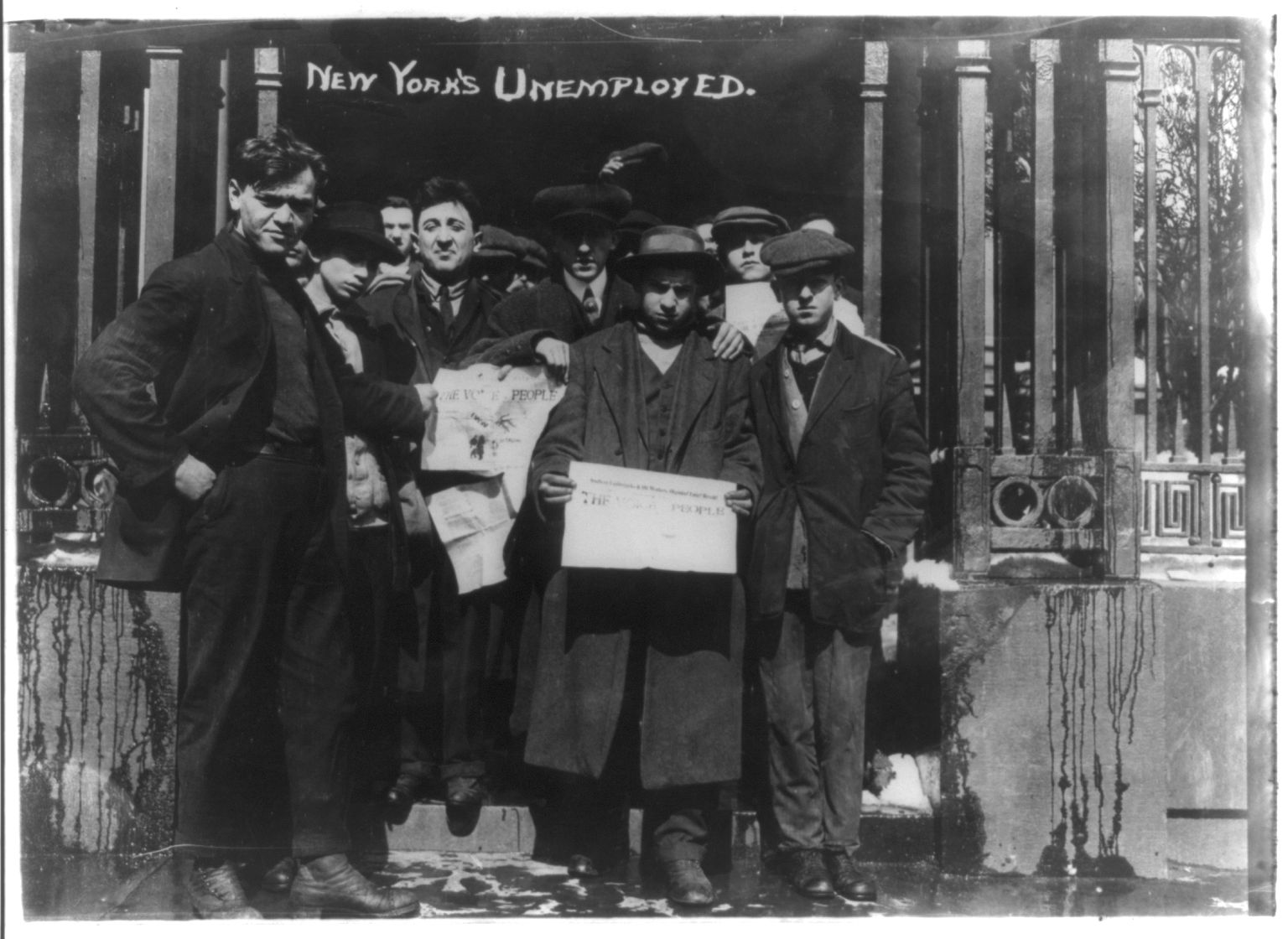
Editorial, probably written by James Wilson, responding to the ‘charge’ that the I.W.W. was made up of the ‘slum proletariat.’
“The Slum Proletariat” from The Industrial Worker. Vol. 1 No. 28. September 23, 1909.
The I.W.W., especially in the West, has been accused of being a “slum” or “bum” organization, as distinguished from those labor organizations which are largely composed of the meek and tractable home-guard. While we cannot be accused of having more pride in one part of the country than in another, in a land we don’t own, it should be noticed that the true slum or degenerate class is less in evidence in the newer parts of a country than in those older and more settled. That there is an element in all Industrial centers who are incapable of organization, and who have long since lost all power of resistance, goes without saying, but the principles and organization of the I.W.W. do not appeal to those who have thus lost all elements of fight and desire for better conditions. The transient workingman who comes to town to spend his money is “an honest workingman,” a hard worker, and is well received as long as he is content to lead the life of a bird of passage, and is willing to submit to any conditions either in town or out of town to earn an existence. Only when he becomes discontented, and has the energy and resolution to unite with his fellows to wring concessions from the masters, does he become the “dangerous clement,” the “unemployed menace,” etc. Little is said by the respectable citizens about the permanent dens of vice which smell to heaven, and which line the streets of the tenderloin quarter, and which need a thorough fumigation like that dealt out to Sodom and Gomorrah. For the man who is steeped in intemperance, who has lost all respect for himself and his fellow workers, and who has become so degraded that he is impossible to arouse, there is little social hope. The man whose only ambition is booze, and who is too lazy even to keep clean when he can, is a dead loss to himself, and a detriment to those unfortunate enough to come in contact with him. But such persons as these are in a very, very small minority in any industrial center. They are subject to the process of elimination, and rank socially together with idiots, and other defectives. The ranks of the slum element are not made up necessarily of former members of the working class, but the most dangerous portion of the “down and outs” are recruited from the ranks of the employing class–the broken-down business man, the lawyer who has made a failure of his profession, and the ex-sky pilot, etc. This is the kind of people who will resort to any crime rather than work for wages as a rule, so that the worst element even among the slums is the employing class element, and if labor unions of the old-fashioned kind are corrupted by the agents of the employing class among them, the slum element is preyed on and misled by the one-time respectable thieves, who now resort to thievery of a more disreputable kind. While we throw no bouquets at ourselves, it would be fair to ask where can be found a more vigorous, energetic body of men than the average laboring class, who, whatever their faults, have still much independence among them, and who will tramp or suffer, rather than be the servile tools of those who are counted as good masters and kind bosses by the church-going and weak-kneed “citizen.” A tramp is a thousand times better than a scab, even if the tramp never worked a day. “Proletariat” is a foreign word and sounds bigger to some of the parlor socialists than “working people.”
The same terms of abuse have always been used against any body of working people who really meant business, and who propose to depend on themselves alone. The love of the master class, especially such samples as those in Spokane, would be an insult to every working man worthy of the name. A strong organization can, however, compel their respect. The time is rapidly approaching when the working people will no longer submit to be driven from pillar to post, to be vagged and drilled from one town to another, and then told that a lousy bunkhouse is good enough for them, and that garbage grub is all they deserve.
There are enough first-class groceries and meat, enough good warm clothes in Spokane alone to feed an army, and plenty of railroads to haul more. When the workers are organized in one revolutionary union, that has sense and discipline enough to be successful, and courage enough to take a few chances, there will be less talk of slums and the slums themselves will be abolished. The church members and sky-pilots, and the whole crowd of grafters live off the rents of houses of prostitution and the liquor traffic, besides a thousand other grafts. The employing class is responsible for the slums–not the workers. Only the organized working class can and will abolish the conditions that allow the foul haunts which pollute the very air. In the meantime, don’t be afraid of the slums nor of the people who make and fill them. Clean ’em out!
The Industrial Union Bulletin, and the Industrial Worker were newspapers published by the Industrial Workers of the World (IWW) from 1907 until 1913. First printed in Joliet, Illinois, IUB incorporated The Voice of Labor, the newspaper of the American Labor Union which had joined the IWW, and another IWW affiliate, International Metal Worker.The Trautmann-DeLeon faction issued its weekly from March 1907. Soon after, De Leon would be expelled and Trautmann would continue IUB until March 1909. It was edited by A. S. Edwards. 1909, production moved to Spokane, Washington and became The Industrial Worker, “the voice of revolutionary industrial unionism.”
PDF of full issue: https://www.marxists.org/history/usa/pubs/industrialworker/iw/v1n28-sep-23-1909-IW.pdf
 Revolution's Newsstand