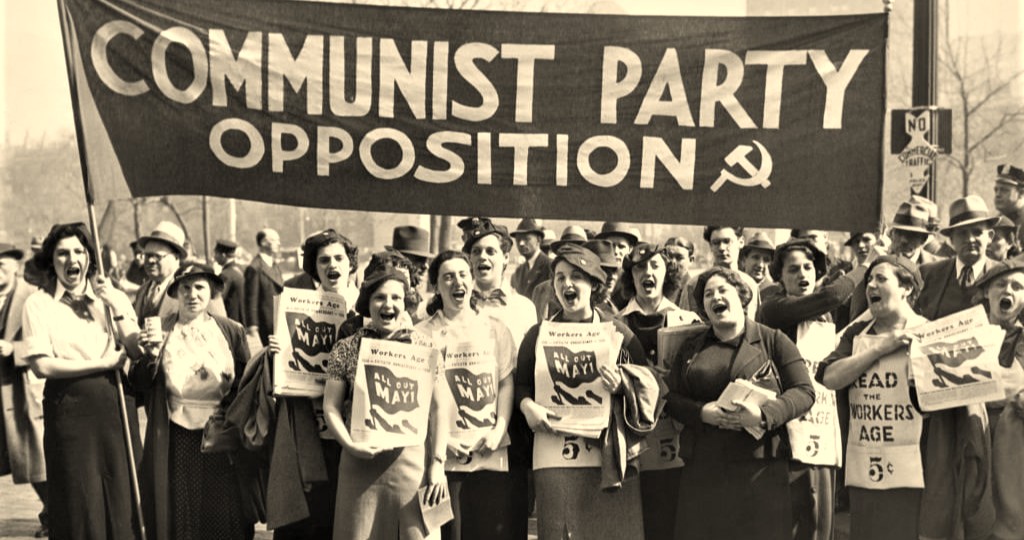
After the victory of Nazism in March, 1933, the ‘Third Period’ was quickly abandoned, in practice if not in theory, and many of the ‘ultra left’ criticisms of Lovestone’s International Communist Opposition were being assuaged. Crucially, the ‘Red Union’ position was dropped, with Lovestone’s Communist Party (Opposition) heavily involved in leadership of AFL unions at the time. The abandonment of the ‘class against class’ politics of the Third Period toward alliances with non-working-class forces in an attempt to fight fascism through a ‘democratic’ coalition, the ‘Popular Front’, was codified at the Comintern’s Seventh, and last, World Congress in 1935. And while the so-called international ‘Right Opposition’ felt their old critiques vindicated, they already flagged an opportunistic, cross-class direction as its own ‘right’ danger. Previously we posted the official C.P.’s resolution on the Congress, here the C.P.O., (Lovestoneites) also pass a resolution on the shift in policy, and direction.
‘C.P.O. Convention Resolution On Seventh C.I. Congress’ from Workers Age. Vol. 4 No. 36. September 14, 1935.
The resolution printed below, adopted by the Fifth National Convention of the Communist Party (Opposition), supplements the theses presented by the National Buro (printed in Workers Age of July 13, 1935). It brings up to date all evaluations and decisions of the C.P.O. in the light of the deliberations and actions of the Seventh Congress of the Communist International.
The Fifth National Convention of the Communist Party U.S.A. (Opposition) herewith adopts the following evaluation of the Seventh Congress on the basis of the material at hand to date in regard to its deliberations and decisions. We propose this declaration to the Buro of the International Communist Opposition with a view of aiding in the adoption of a unanimously agreed upon final resolution by the International Communist Opposition and all its sections.
1. The Seventh World Congress marks the definite collapse of the ultra-left course of the Comintern. (Carried Unanimously)
2. While the ultra-left course has broken down completely, thanks to objective experience and the constructive criticism and activity of the I.C.O., it cannot be said that it This already been replaced by a correct line of strategy and tactics. (Carried Unanimously)
3. The Seventh Congress has laid a basis for the adoption of the tactical and strategical course proposed and fought for by the I.C.O. in the following fields: a) trade unions; b) united front; c) so-called theory of exceptionalism; d) Farmer-Labor Party; e) discarding theory of third period and social-fascism; f) revolutionary transition slogans. But it must be understood that to make a real new turn without at the same time recognizing and acknowledging the falsity of the old, is impossible. It is not at all a question of who was right, far more is it a question of winning the confidence of the workers in the genuineness of the change of policy. It is likewise a question of re-educating large sections of the Party membership, corrupted by years of preaching of the sectarian dogmas. Neither task can be accomplished unless it is frankly and clearly acknowledged that the old sectarian course has proved completely bankrupt and must be scrapped and replaced by more effective tactics. (Carried Unanimously)
4. The Congress has further adopted a resolution for the democratization of and the establishment of a more collective leadership in the C.I., in many respects along the lines of the demand of the I.C.O, for the re-organization of the Comintern. (Carried Unanimously)
5. Because of the long period of ultra-leftist sectarian sm, because of the hero cult and the rigid bureaucratic regime gripping the Communist International for years, because of the very methods thru which the break with ultra-leftism has been launched and extended, the adoption and execution of a completely correct tactical course and the establishment of a genuine democratic inner-party regime can be accomplished only thru sharp political struggle on the part of the I.C.O. and, for the C.I. must necessarily be a drawn out process. steeped in vagueness, confusion, hesitation and vacillation. (Carried Unanimously)
6. Precisely because of this situation the Congress suffered from very inadequate self-criticism and evasion of responsibility for the past ultra-left errors initiated and directed primarily by the E.C.C.I. Herein also lies a contributory reason for the creeping in of very serious opportunist errors in the attempt to break completely with the old ultra-left course (participation in peoples front governments, etc.). (Carried Unanimously)
7. The new and real menace of opportunism in the C.I. accompanying its break with leftism is most painfully indicated in the beginnings of serious deviations on such questions of principle as bourgeois democracy and revolutionary strategy for Communist Parties in countries momentarily lined up on the side of the U.S.S.R. in war. The basic cause for error and confusion setting in here is to be found in “the mechanical transference of tactics from the C.P.S.U. (a party in power) to the Communist Parties in the capitalist countries.” (Convention Theses, II, 4). (Carried Unanimously)
8. Here we underline the fact that these beginnings of deviations in no wise afford even the slightest basis for declaring that the CI. has become Social-Democratic and social chauvinist. In the sense that August 4, 1914 represented a culmination in action of the fundamental concepts of social reformism, ingrained in the Second International, there can be no talk of August 4th for the C.I. It must be recognized, however, that if the present policy of the C.I. in France, Czechoslovakia, etc., on the problem of a mixed war, and on bourgeois democracy, is continued it is bound to lead to outright social chauvinism and reformism, even though this course is pursued with the most sincere desire of defending the Soviet Union.
A sound differentiation of the erroneous position of the C.I on the war question for parties in countries momentarily aligned with the U.S.S.R. from the already definite social chauvinist or social pacifist position of the Labor and Socialist International, is an absolute pre-requisite for the success of our fight against the opportunist excesses of the C.I. and for overcoming these inadequacies, confusion and deviations. (Pravda Editorial, expressions of policy in France, Czechoslovakia, U.S.)
The report of Pieck at the 7th Congress, lending blanket approval to the policy and work of the French C.P. gave international endorsement to the beginnings of opportunistic deviations that had lately raised their heads in the C.I. The declaration of Ercoli and Dimitroff on this question, while indicating improvement, still suffer from equivocation, suffer not so much from an expression of a positively wrong course as from their failure to declare definitely that “the basic Communist slogan of transforming the imperialist war into a civil war remains unchanged but assumes a new, concrete form for Communist Parties in countries having an alliance with the Soviet Union.” (Thesis, II, 4). (Carried Unanimously)
9. The C.P.O. pledges itself to fight, jointly with the I.C.O., against whatever remnants of ultra-leftism may still linger and for speeding up the process of the C.I.’s return to a completely Leninist tactical course, against the serious opportunism now manifesting itself in the C.I. (due to the continued resort to mechanical transference of tactics in certain fields and aggravated by the E.C.C.I.’s inability to cope in a Leninist manner with the consequences of the collapse of the ultra-left line and the problems of its replacement by a sound, Leninist, strategical course). (Carried Unanimously)
10. The Convention categorically rejects any idea aiming at the organization of a new International, on the grounds outlined in the decisions of our Fourth Convention. These grounds have since been fortified by a whole series of events. (Carried Unanimously)
11. We declare that at this time there is no basis for the organization of a new Communist Party or for the transformation of our group into a new Communist Party. (Carried Unanimously)
12. The breakdown of the ultra-leftist course itself, the mere indication of its replacement by a sound strategic course along the lines laid down by the I.C.O. without a complete and clear substitution of this character having been achieved yet, the fact that the decision for the re-organization is still only on paper, the continuation of the system of mechanical transference of tactics, the persistence of the hero cult, the developing serious menace of opportunism in the C.I. ranks, all of these lead us to reject categorically any idea of giving up or at all weakening our political struggle for the replacement of the course of the C.I. On the contrary, our struggle must be continued on a new basis with even greater energy. (Carried Unanimously)
13. Precisely to the extent to which the I.C.O. is able to improve its organization and work, to strengthen its position particularly in basic mass organizations of the working class, will it be able to emerge victorious in this struggle and to help insure the Comintern’s speedily overcoming the remnants of its old errors and the avoidance of the new opportunist deviations, as well as to hasten the realization of healthy unity of the I.C.O. with the C.I. thru a complete restoration of party democracy and a complete return to the Leninist course. (Carried Unanimously)
14. We, therefore, reaffirm our objective and perspective, both the favorable and the unfavorable results ensuing for us from the Seventh Congress necessitate a marked increase in the emphasis to be placed by us on building up the C.P.O. as an independent force engaged in constructive revolutionary mass activity. This is the best way of securing the strength we need for restoring the unity of the world party of Communism. (Carried, 80 For, 2 Abstentions)
Workers Age was the continuation of Revolutionary Age, begun in 1929 and published in New York City by the Communist Party U.S.A. Majority Group, lead by Jay Lovestone and Ben Gitlow and aligned with Bukharin in the Soviet Union and the International Communist (Right) Opposition in the Communist International. Workers Age was a weekly published between 1932 and 1941. Writers and or editors for Workers Age included Lovestone, Gitlow, Will Herberg, Lyman Fraser, Geogre F. Miles, Bertram D. Wolfe, Charles S. Zimmerman, Lewis Corey (Louis Fraina), Albert Bell, William Kruse, Jack Rubenstein, Harry Winitsky, Jack MacDonald, Bert Miller, and Ben Davidson. During the run of Workers Age, the ‘Lovestonites’ name changed from Communist Party (Majority Group) (November 1929-September 1932) to the Communist Party of the USA (Opposition) (September 1932-May 1937) to the Independent Communist Labor League (May 1937-July 1938) to the Independent Labor League of America (July 1938-January 1941), and often referred to simply as ‘CPO’ (Communist Party Opposition). While those interested in the history of Lovestone and the ‘Right Opposition’ will find the paper essential, students of the labor movement of the 1930s will find a wealth of information in its pages as well. Though small in size, the CPO plaid a leading role in a number of important unions, particularly in industry dominated by Jewish and Yiddish-speaking labor, particularly with the International Ladies’ Garment Workers’ Union Local 22, the International Fur & Leather Workers Union, the Doll and Toy Workers Union, and the United Shoe and Leather Workers Union, as well as having influence in the New York Teachers, United Autoworkers, and others.
PDF of the full issue: https://www.marxists.org/history/usa/pubs/workers-age/1935/v4n36-sep-14-1935-WA.pdf
 Revolution's Newsstand