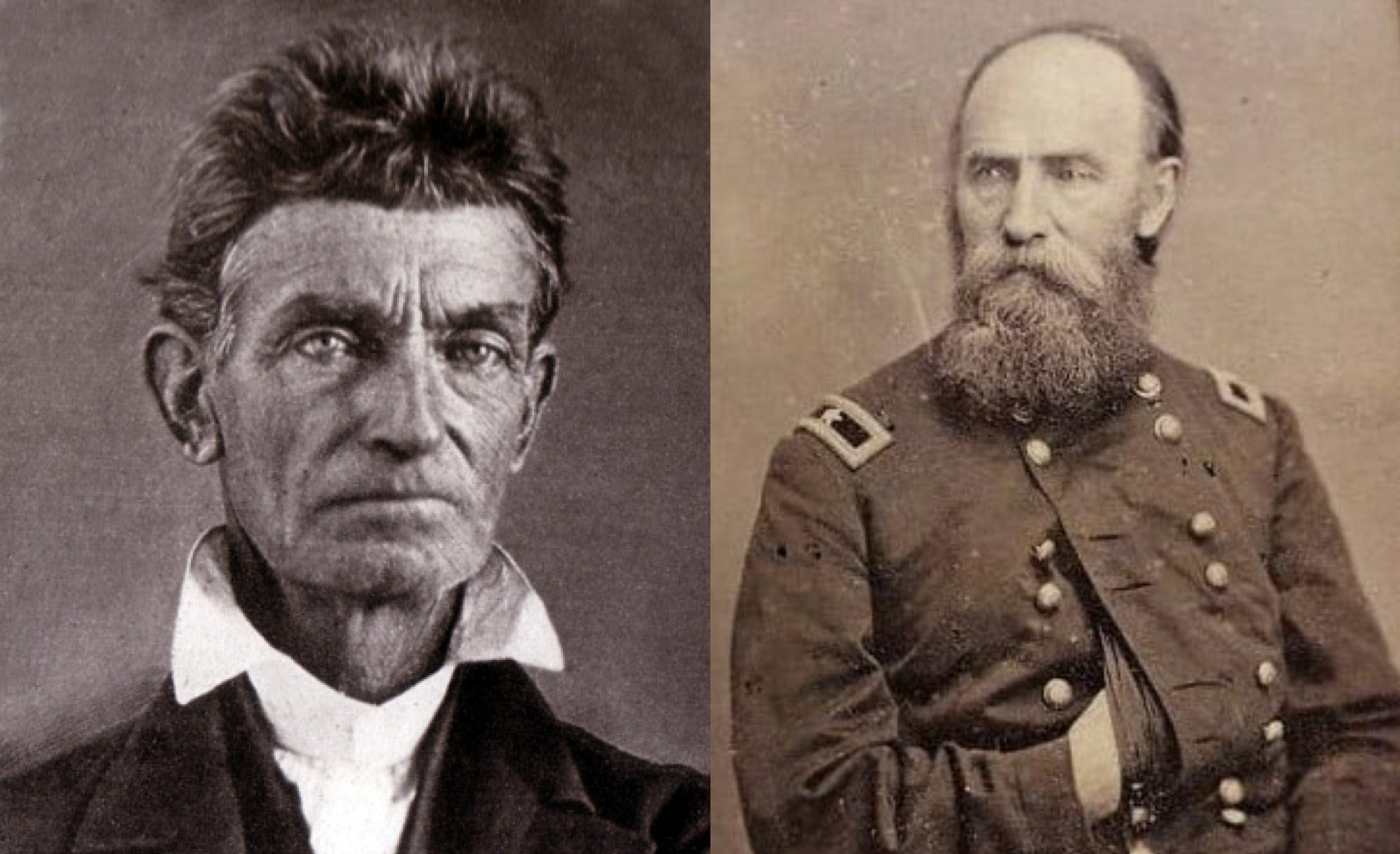
A milestone in the constitution of a modern U.S. left. William Lloyd Garrison translates an editorial of the Cincinnati ‘Republikaner’ almost certainly penned by editor August Willich on John Brown shortly after the Harper’s Ferry assault and his capture. The first daily communist paper in U.S. history, the ‘Republikaner’ followed and had connections to John Brown well before Harper’s Ferry in October of 1859. The Cincinnati Republikaner marks the beginning of radical left publications in the US as we would understand them and is deserving of wider recognition and awareness. The first communist daily newspaper in the United States, it was the organ of Cincinnati’s Social German Workingmen’s Association, Der Socialer Arbeiter-Verein, representing the city’s large German-speaking Red 48er immigrant population, including comrades of Marx and Engels. It would be edited by Marx’s one-time foe in the Communist League August Willich, who quickly rose to leadership among Cincinnati’s German-speaking and foreign-born workers. Though Willich promoted Marx’s work here; in this issue he enthusiastically presents Marx’s 1859 Kritik der politischen Oeconomie (Critique of Political Economy) just as it was released in Europe. This is the first publication of that work in the United States. The Republikaner gave voice to supporters of Garibaldi and the European Revolution, to local workers and Turner societies, to scientific and cultural debate, to the communist movement, as well as to the growing struggle against slavery. Willich’s Republikaner joined forces with militant Black Cincinnati in mobilizing support for John Brown and his army in the aftermath of Harper’s Ferry, including a multi-racial rally complete with torches and red flags at Cincinnati’s Arbeiter Hall on December, 4 1859. German revolutionary immigrants uniting with Black radicals, Peter H. Clark who possibly the first Black socialist in the US was co-organizer, in a multilingual, multi-national, working class gathering over the very American struggle against slavery at the martyrdom of John Brown may well said to be the real birth of the US left. The Republikaner would later be instrumental in raising two of the most left wing units in the Civil War, the German-speaking 32nd Indiana and the 9th Ohio. While in the field Willich distributed the proclamations of the First International and would have an extraordinary military career in the Civil War, rising to General and leading in incredible feats of battle the units he organized in a war to destroy slavery.
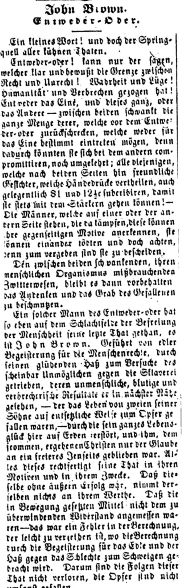
‘John Brown’ by August Willich from The Liberator (Boston). Vol. 29, No. 52. December 30, 1859.
Translated for the Liberator from the Cincinnati [German] Republican, Oct. 22.
JOHN BROWN.
Such a man, in the person of John Brown, has just performed his last exploit on the battlefield of human emancipation. He was influenced by a noble enthusiasm for the rights of man, and by a thorough hatred of the specious attempt to perform impossibilities against slavery,–an attempt whose unmanly, bloody and criminal results he had witnessed in the closest proximity–to which the life of two of his sons had fallen a sacrifice in the most horrible manner–which had ruined all his happiness in life here on earth, and had left him, the pious, devoted Christian, only the belief in a freer world hereafter. All this vindicates his act in its motive and in its purpose. That it had no apparent result detracts nothing from its merit. That the means employed in the disturbance were not adapted to overcome opposition, was an error in calculation, which it is easy to forgive, when the calculation is induced by a generous enthusiasm, and by aversion to keep silent in regard to wickedness. The consequences of this act, therefore, are not lost; the victims have not fallen in vain.
When Orsini had thrown his bomb at Napoleon, and no one perished because of it except himself and his confederates, thereupon a shriek of condemnation arose from the entire press, which represented the undecided multitude, namely, the Anglo-American press. Then Napoleon was supposed to be more firmly established than ever, because of this deed. And yet it was otherwise; by that bomb he was frightened into the Italian war; still in his troubled dreams he hears it exploding, and he is pushed forward by the sound on the road at the end of which lie the liberty of the people and his own grave. So it is with this act of Brown’s; it has sounded the death-knell in the hearts of those whose prosperity is built upon crime, and it will find an echo in the hearts of the men forcibly held in bondage. It will remind the Republicans that progress cannot be made in easy chairs, but that it can be made only so far as opposition is overcome.
It is abominable, with what levity and with what fear of compromising themselves, so many editors of American newspapers, the Republican even, allow themselves to condemn the fallen MAN, in order to keep far from themselves the suspicion that they, perhaps, might also be MEN. We can say with satisfaction, that the German Republican newspapers have acted decidedly and honorably in recognizing the historical significance of Brown’s exploit. Brown has done as every champion of human freedom has done, since the beginning of the race. By the motive and the purpose of his action, he has secured himself a place among the martyrs of mankind. This, and the full recognition of all free men, are his reward. The violated, absolute Law, his material weakness in the defence of Nature’s law against the absolute,–this he will atone for with all that his adversaries can take from him. But you the dogs that bark after the noble game has fallen–over you the scourge is hanging, to speak to you in the only language that you understand!
The Liberator was founded by abolitionist William Lloyd Garrison in 1831 and was published regularly for the next 35 years. The foremost anti-slavery paper in U.S. history, though the circulation never rose much above 3000, was widely read and discussed. Its position of immediate emancipation and non-resistance placed it in the vanguard of the struggle against slavery. It’s pages are an invaluable record of one of history’s most profound struggles for human freedom.
PDF of full issue: https://www.loc.gov/resource/sn84031524/1859-12-30/ed-1/?sp=1&st=image&r=-1.039,-0.046,3.077,1.514,0
 Revolution's Newsstand