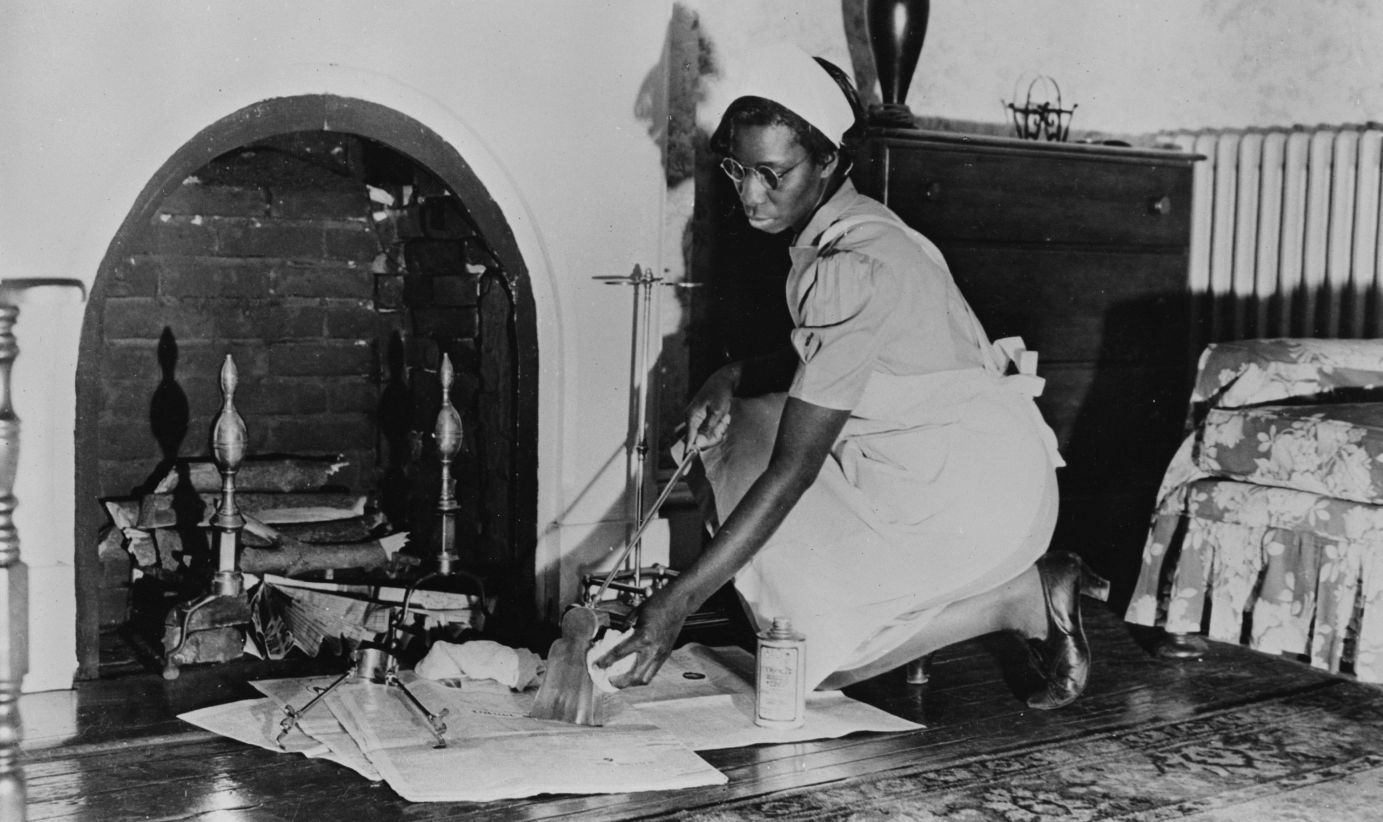
As late as 1910, nearly two million workers (over 91% of them women) were employed in domestic service. Constituting 8.5% percent of the workforce, and 2% of the entire population. With immigrants and Black women over-represented and therefor under-counted, those numbers are certainly higher. Dismissal of homework, Black and immigrant women, and women in general by the labor movement left these millions of proletarians ignored and unorganized by the official labor movement. Given that employment was often lone and for disparate private families, conditions were agreed upon individually, and masters were notoriously arbitrary, plus other issues made organization of domestic workers rare and difficult. The first real attempt, unsurprisingly, came from the I.W.W. and had some relative success, particularly in Denver and Seattle. Here is the section on the domestic worker from the I.W.W.’s campaign booklet on the H.R.D.W.I.U.
‘The Servant Problem’ by L.S. Chumley from Hotel Restaurant and Domestic Workers: How They Work and How They Live. I.W.W. Publishing Bureau, Chicago. 1918.
We hear a lot of talk nowadays about the “Servant Problem.”
The masters are having trouble with the workers they dub, the Serving-Class. They can’t understand why servants should complain about their conditions. What matters it, if servants are abused and insulted, if they work twelve to fourteen hours a day, for damn near nothing? The masters are like the Queen who said, “if the people have not bread, let them eat cake,” they do not understand the situation. They cannot grasp the simple fact, that servants really belong to the species of man, that they have the five senses, a brain and a heart, and that they love and hate, like any other being.
I shall waste no time in trying to educate our ignorant masters. My argument m with my fellow workers, we have the power to do away with masters, if we use it intelligently. Therefore I will address my reasoning to the workers, in the hope that it will enable them to solve the” “Servant Problem” to their own satisfaction.
The causes of discontent among servants are manifold and universal. Take for instance, the household or domestic servant, the condition of these workers is deplorable. Taken as a whole, the wages are lowest and the hours are longest of any workers.
Their duties are undoubtedly degrading. Servility and obedience are essential qualities in servants.
Their labors consist in doing the things their masters consider too degrading to do for themselves. They scrub, sweep, and clean their homes. They prepare, cook and serve their meals. They are, both nurse and plaything of the master’s children. They are gardener and coachman, and groom to dogs and horses. The servants wash and iron the master’s clothes, shine their shoes, clean cuspidors, polish silver, exercise the dog, and humiliate themselves in a multitude of ways. All this is done with the meekest of servility. They are truly menials, or 1 should say they have been, for fortunately servants are being to feel the ignominy of their position.
The master’s household is becoming more discordant daily, and the reasons are apparent to the thoughtful observer.
The children of rich families usually treat the servants of the house with domineering words, names of contempt, and imperious carriage; as if they were of another race or species beneath them. The example of the masters, the advantage of fortune, and vanity inspires this haughtiness.
William Penn, in “Fruits of Solitude” says, “The least thing out of joint or omitted, makes us uneasy and we are ready to think ourselves ill served, about that which is of no real service at all. Let not thy children domineer over thy servants…When the poor Indians hear us call any of our family by the name of servants, they cry out, ‘what call thy brethren servants! we call our dogs servants, but never men.’ But the Indians had not been cursed with a religion that teaches that servility and meekness are virtues in those who toil.
And if the Indians were here today, they would hear the rich call their servants names that would make an Indian’s dog blush with shame.
Emerson saw the evil results of menial labor, when he wrote: “We allow ourselves to be served by them. We live apart from them, and meet them without salute in the streets. We do not greet their talents nor in the assembly of the people vote for what is dear to them. Thus we enact the part of the selfish noble and king from the foundation of the world. See, this tree always bears one fruit. In every household the peace of a pair is poisoned by the malice, slyness, indolence, and alienation of domestics. Let any two matrons meet, and observe how soon their conversation turns to the troubles from their ‘Help’ as our phrase is.”
To say that the rich are enacting the part of the selfish noble and king, is putting it mildly. For these plutocrats are “but a rotten imitation of the Middle Ages.” They treat us like chattel slaves. They compel us to work long hours, feed us poorly, and inflict personal abuse upon us.
These soulless parasites call us the “Serving Class.” They make scrub women of our mothers, and take our sisters and daughters into their mansions as servants, to do the bidding of their pampered and sybaritic daughters, and to be subject to the lustful advances of their degenerate, bestial, brainstormed scions. With the whip of want and hunger they beat our sons and brothers into submission and servility, to become their lackeys, to serve as valet, butler, etc. And if we should complain they accuse us of ingratitude and viciousness, they stigmatize us as ungrateful, discontented, disobedient servants.
Why should servants be grateful for the crumbs that fall from the rich man’s table? They should be seated at the board and they know it. As for being discontented, a man who would not be discontented with such surroundings and such a low mode of life would be a perfect brute. It is through disobedience that progress has been made, through disobedience and rebellion. Disobedience in the eyes of any one who has read history, is man’s original virtue.
A servant ungrateful, discontented and rebellious, is probably a real personality and has much in him. The obedient and servile servant cannot be admired, even the master, who may be glad to have such a servant, cannot possibly respect him.
I have inferred that girl servants in the homes of the rich are used for immoral purposes. It is a fact that some rich parents select the healthiest and prettiest maids, as an inducement to keep their sons at home and out of the rowdy houses of the district. Recently, Miss M.L. Carpenter of Chicago, made the startling statement, that 75 per cent. of the women of the tenderloin of the cities in the United States are recruited from domestic service. Miss Carpenter who spent nine months in the kitchens of Chicago for the purpose of making a study of the situation, declared that the women of America were dormant to a condition which has existed for years, and upon which disorderly houses throughout the land flourish. Girls who come from the country and get employment in private homes are unsafe. They are menaced by the heads of families, or older sons, and this, together with long hours, late dinners in the houses where they are in service, and often orgies, lead to their ultimate degradation.
Such is the morality of the rich. Volumes might be written on this one phase of servant life. This crime, against the sisters of the workers, is being exploited by the modern dramatist. I refer you to John Galsworthy’s significant play “The Eldest Son” and Henrik Ibsen’s masterpiece “Ghosts.” Also Leo Tolstoi’s powerful novel “Resurrection.”
The maid in the homes of the rich who has not been approached or insulted, is indeed the exception. It is a waste of time and energy to try and patch up the differences between masters and servants, they have no common ground. No self-respecting human being will ever be satisfied to remain the menial servant of another. We must organize to make better the condition of servants now, and, finally do away with menial labor.
WHERE DO YOU BELONG?
Do you belong in somebody’s kitchen, attic or basement, doing their dirty work, attending to their most intimate personal needs, hiring out for all the time you are awake into the services of others who treat you as an inferior being?

Do you belong there? Are you satisfied with your lot? Are you content to be a slave?
Or do you wish to have shorter hours, higher wages and respectful treatment from your employers?
If so, do you belong to the Domestic Workers Industrial Union, an organization of domestic slaves who have broken away from the monotonous drudgery of their existence, who have rebelled at outrages imposed on them, and have banded together in a determined effort to better their conditions.
They realize that their only hope lies in arousing the workers to a knowledge of their own power, and that their only strength lies in organization. They invite you to join them, knowing that your wrongs are their wrongs, and that an injury to one is the concern of all. Don’t hold back and allow them to fight your battles. Don’t sit idly by while they struggle against the enemy, which is your enemy, and then step forward in the end and reap the benefits you don’t deserve.
Endorse them, support them, join them. That is where your interests lies. Have you served others so long you have forgotten you have interests of your own? Join the Domestic Workers Industrial Union. They need you and you need them. THAT IS WHERE YOU BELONG.
It includes housemaids, cooks, second girls, nursemaids, laundresses, seamstresses, and all workers engaged by the hour, day or month in private families.
 Revolution's Newsstand