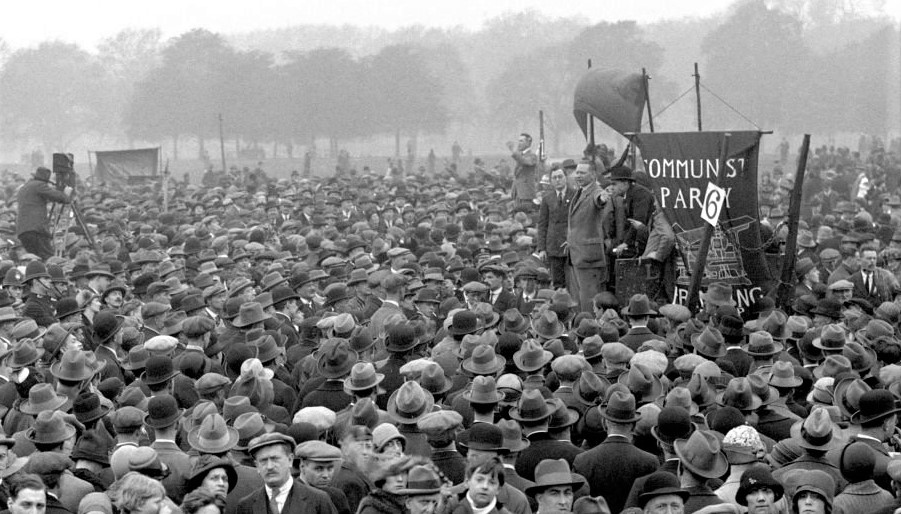
Charles Ashleigh joins 270 unemployed Welsh miners on their trek from Newport to London in November, 1927 and files this magnificent piece of proletarian reporting.
‘The Miners March on London’ by Charles Ashleigh from New Masses. Vol. 3 No. 9. January, 1928.
Down the long narrow streets of the South Wales mining valleys, they came marching. Mostly they sang a tune called Stick It, Welsh!, a marching tune without words, a good swinging tune which they had used during the lock-out, when marching from colliery to colliery to oust the few scabs. Sometimes, however, it was the Internationale, sometimes a hymn in the Welsh language, and now and again they tried to adjust their crisp marching steps to the dragging measure of the Red Flag.
Red banners waved above them. They carried haversacks upon their backs, with their scanty belongings. Their boots were old, or badly fitting, their clothes worn. Their caps were worn at the jaunty angle affected by the miner, and they carried their pit-lamps in their hands. A British miner carries his lamp in his hand—or in his teeth—when working; not in his cap, as does his American brother.
From their cottages, miners and miners’ wives cried farewell. These were their emissaries, carrying the story of their woe, and the bitter weight of their protest, to London. London is the centre. When a man is cut off the unemployment benefit, the clerk says: “I’m sorry; it’s orders from London.” When parish relief is refused also to the unemployed collier, the guardians say: “It’s not our fault; the ministry of health in London makes us do it.” What more obvious, then, than that the unemployed miner, destitute and desperate, should resolve: “Well, by Christ, if London’s the seat of my trouble, I’ll go to London!” They’re going to London, threading the valleys, in their contingents, converging on Newport, where the march is to start on November 9. I am marching with them, the only press representative who is marching, feeding, sleeping with the miners, all the way. The Sunday Worker picked me for the job; and I’m glad of it. Ex-hobo, ex-convict, ex-wobbly, as my editor said, I was just the technical expert for the assignment.
There are 60,000 unemployed miners in the South Wales field; and 300,000 in all Britain. Many of the Welsh pits are closed forever—they are what are known as “uneconomic workings.” In some villages, all the pits, four or five, have been closed down already for a year or more; and the village is derelict, rotting slowly while the miners starve on bread and tea, with an occasional bit of bacon.
When volunteers for the march were called for, thousands responded. But they had to be weeded out. No man receiving national unemployment benefit could come, because he would thus forfeit his “dole.” Every man on the march has already been disqualified for both national unemployment benefit and for local parish relief. They are those who have reached the ultimate suffering. Their wives still receive a few shillings, to keep life painfully alive. And the men are on the march. Even then, we could have had more but we could not support a larger number.
Two hundred and seventy-three men left Newport. Two hundred and seventy men marched into Trafalgar Square, London, on November 20. Since then one man has had the life crushed out of him, in London, in a street accident.
Everything was against us. The capitalist press proclaimed the march a “Bolshevik stunt.” The official Labor movement—the Trades Union Congress General Council—took up this cry, and circularized the local Trades Councils to that effect, hoping thus to starve the men en route. The Secretary of the London Trades Council, A.M. Wall, who himself had recently left the minority movement—he is a Labor Party candidate for Parliament, and wanted to remain such—stigmatized the march vehemently as a Communist recruiting manoeuvre. There was a united front, you will note, of official Labor, the capitalists and the Tory government, against the march. But the march took place, and the march has gone through!
This march was no out-wandering of a nomadic mendicant rabble. Within one day, the marchers had formed themselves into a machine—or, as we preferred to call it, into an army. The lowest unit was the detachment of twenty men, headed by a Detachment Leader. Two detachments formed a company, with its Company Leader. At the head of the march was the Marchers’ Control Council, with eight members, all tried class-conscious workers. One of them, Wall Hannington, National Organizer of the National Unemployed Workers’ Committee Movement, was Commander of the march. Hannington was the only non-miner in the march, except myself. He is a bulky broad-shouldered young man, with a turbulent past. This is the third march he has led. He is an engineer, a machinist, and is an active Minority Movement leader. He is enthusiastic, humorous and imperturbable. He is a cockney, with the quick jovial wit of his kind, and he has been something of a pugilist, as| one cauliflower ear testifies.
Down the highroads of Wiltshire, one of the most beautiful counties of England, came our march. Here, the villagers had never seen miners; and they crowded to watch the Army as it swung by, the men marching four abreast, six paces between each detachment, marching in perfect step, singing and sometimes cheering.
Sometimes a man falls out on the arduous trek. One of the Red Cross squad—which is captained by an ex-sergeant of the Army Medical Corps—at once attends to his blistered feet. If he cannot proceed, he is carried on the covered truck, whose sides bear a large red cross, which accompanies the march. There is another truck as well, which carries the two army field-kitchens and provisions, under the command of the cook —a one-legged ex-army cook, who rules his kitchen squad with an iron hand and a wide winning smile.
At one o’clock, the men reach the place where the cooking squad has prepared the mid-day meal. The whistle blows, and they fall out, sinking onto their haversacks by the wayside, weary and hungry. Detachment orderlies bring the steaming kettles of soup, which the men eat, with huge chunks of bread, in their tin plates.
The Second-in-Command, Tom Thomas, a Welsh miner with seven years’ military experience, again blows shrilly upon his whistle. And again we are marching. On to London. Left, right, left—left—left; two hundred and seventy-odd men, tramping implacably on, footsore, weak from long periods of under-feeding; but ever on, each day nearer, through sweet insanitary old-world villages, smug country towns and industrial cities, to London, the center of oppression. There is something of iron, something which cannot be answered with politicians’ soft excuses, something primal and menacing, in this monotonous music, which I heard every day, in my place in the ranks—left, right, left—left—left—left. It was pain welding itself into a weapon, mass force arising rhythmically out of uncentered discontents—it was Revolution being born upon the highways.
At night, the hall—provided by the local Labor Parties or Trades Councils, in defiance of the T.U.C. edict—would be crowded with sleepers. Lying in rows, close together for warmth, with overcoats and blankets for cover, and haversacks for pillows. A multitudinous breathing in the darkness around us, as the Control Council sat late in whispering session. The stirrings and murmurs of men sleeping. The air heavy with breathing, and heavy with foreboding, I thought. These are men with nothing to lose—the dynamics of subversion.
Between executive meetings and other engagements, A.J. Cook, the General Secretary of the Miners’ Federation, met us on the road, marched with us; and slept on the floor with us for three nights. He spoke to immense crowds at Swindon and Reading when we arrived there. He is rightly beloved of his men, this fighting leader, member of the General Council of the T.U.C., a lone militant there, hacking his way through the jungle of trade union reaction.
Arthur Horner, a member of the Miners Executive, was a member of the Marchers’ Control Council. He also marched with us. Tom Mann, vigorous as ever, seventy-two years young, came to Reading, met us on the road, marched with us into the town, spoke for us; and that night, insisted on sleeping on the planks.
For twelve days it continued, this march. And then London. London in a driving rain that went pitilessly on the whole day. But rain did not stop the cheering thousands of London workers who met us. And, during two hours of speaking, singing and cheering in Trafalgar Square, the rain did not send them away. It was one of the greatest demonstrations ever held in London. And the collection was the biggest ever made in Trafalgar Square. Here was a fire the rain could not quench.
The men are staying in Bethnal Green Town Hall, awaiting the Premier’s decision as to whether he will receive their deputation. (*The Premier refused to meet the deputation.) Not that they expect relief from a Tory premier, office-boy of the coal-owners. But here is a chance to let the world know. Thousands of workers greeted us in the various towns, and mighty meetings were held. They are making known the objects of the march: to publish the tragedy of the minefields, to demand repeal of the Eight-Hour Act, and a return to the seven-hour day; to press for pensions for miners over 60; to demand adequate maintenance for unemployed miners; in short, a series of demands which no capitalist government could concede in this time of capitalist decay. But millions will hear of these demands; through the press, millions will have the miners’ problem brought home to them. And millions will realize the impotence of capitalism, in this crisis, to do anything but increase the terrible burden upon the miners and upon all the workers of Britain.
The march is the definite symptom of the British workers’ emergence from the apathetic reaction which followed upon the betrayal by their leaders of the general strike. It is a new call to action. It marks the uprising of the rank and file, not merely against unemployment and all capitalism’s evils, but also against the comfortable, slinking leadership of the British labor movement.
The New Masses was the continuation of Workers Monthly which began publishing in 1924 as a merger of the ‘Liberator’, the Trade Union Educational League magazine ‘Labor Herald’, and Friends of Soviet Russia’s monthly ‘Soviet Russia Pictorial’ as an explicitly Communist Party publication, but drawing in a wide range of contributors and sympathizers. In 1927 Workers Monthly ceased and The New Masses began. A major left cultural magazine of the late 1920s and early 1940s, the early editors of The New Masses included Hugo Gellert, John F. Sloan, Max Eastman, Mike Gold, and Joseph Freeman. Writers included William Carlos Williams, Theodore Dreiser, John Dos Passos, Upton Sinclair, Richard Wright, Ralph Ellison, Dorothy Parker, Dorothy Day, John Breecher, Langston Hughes, Eugene O’Neill, Rex Stout and Ernest Hemingway. Artists included Hugo Gellert, Stuart Davis, Boardman Robinson, Wanda Gag, William Gropper and Otto Soglow. Over time, the New Masses became narrower politically and the articles more commentary than comment. However, particularly in it first years, New Masses was the epitome of the era’s finest revolutionary cultural and artistic traditions.
PDF of full issue: https://www.marxists.org/history/usa/pubs/new-masses/1928/v03-09-jan-1928-New-Masses.pdf
 Revolution's Newsstand