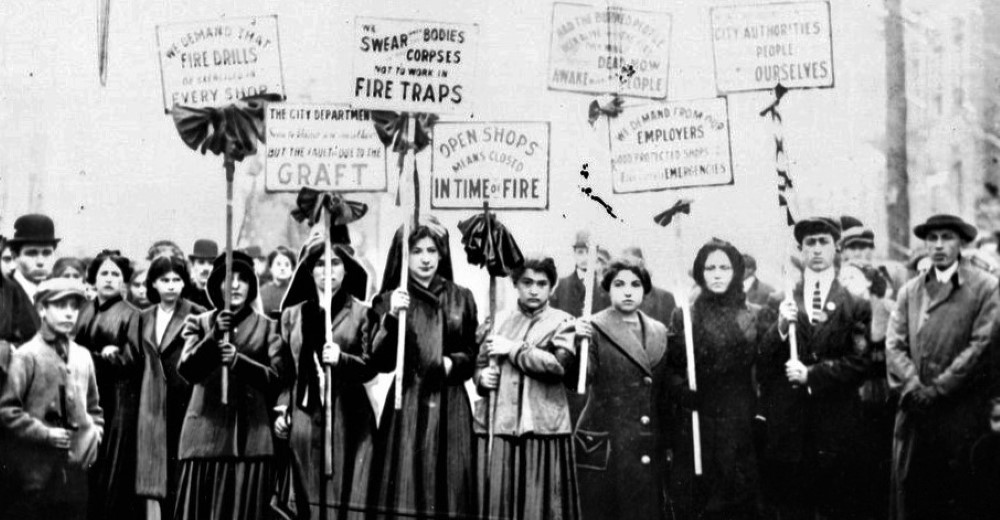
One of the defining events in U.S. working class history was the Triangle Shirt Waist fire of March 25, 1911 in which dozens of workers, mainly immigrant women, were killed. The fire gave huge impetus to union organizing in the textile industry as well as the larger movement of working class women.
‘The Triangle Fire and After’ by Elias Tobenkin from Coming Nation (Girard). No. 31. April 15, 1911.
IN the closing days of November, 1909, about a thousand girls employed in the shop of the Triangle Shirt Waist Company in New York went on strike. The conditions under which they were compelled to work the girls declare were intolerable. Before the end of a week nearly 40,000 girls and men, shirt waist makers, joined the striking employes of the Triangle Waist Company in what proved to be one of the bitterest and hardest fought labor battles in recent years. The Shirt Waist strike dragged for months. The papers, the capitalist papers all over the country, sided with the girl strikers. They devoted page after page to descriptions of the pitiable conditions under which, the girls who make shirt waists live and toil for a wage ranging on the average from $2.50 to $6 a week.
The strikers, girls in tender years, were arrested by the hundreds. They were dragged to court, Night Court, where they were lined up with the lowest criminals and after being duly lectured by the magistrates they were fined and warned that the next time they were arrested they would be sent to the workhouse.
They were arrested again. They had to be arrested, for they had to picket their shops if the strike were to be won. The magistrates kept their word and sent the striking shirt waist makers to the workhouse by the score. They were locked in the same cells with hardened criminals, with mental and moral degenerates.
The firm which fought the strikers hardest was the Triangle Shirt Waist Company, the firm where the strike began. The Triangle Waist Company is one of the largest waist manufacturing concerns in New York which means in the entire world. It supplies waists to the American public from Maine to California. Its profits are figured in millions. It could afford to fight the strikers hardest, therefore. And it did.
For 28 weeks its employes were out. During that time the Triangle Waist Company had over 350 of the strikers arrested and fined or sent to the workhouse. After 28 weeks the strikers returned to work in the Triangle shop under the old conditions. The employers triumphed. They have shown their employes that “the union cannot run” their shop.
Saturday, the twenty-fifth of March, 1911, at 4:45 o’clock in the afternoon, just as the girls, 750 of them, employed in the shop of the Triangle Waist Company were getting ready to lay down their work and go home, fire broke out in the first floor of the Triangle shop which was located on the eighth floor, of a ten-story loft building. On that floor above the heads of the workers hung paper patterns. About the walls and on racks in the middle of the room hung hundreds of waists of light inflammable material. On tables, machines, in boxes, lay heaps of garments or uncut cloth. On the floor there lay strewn piles of waste and clippings, all inflammable. The second and third stories of the shop which were the ninth and ten stories of the building were in the same identical condition, with the exception, perhaps, that on the ninth floor the congestion was even more acute, more horrible than either on the eighth or tenth floors.
In an instant the eighth, ninth and tenth floors of the building were a blazing furnace. The police and firemen later described the fire as a “mushroom” fire. Tongues of flame leaped up on every side. The flames swept through the room in sheets. It was a blizzard of fire.
Before the fire engines arrived about twenty girls jumped from the eighth, ninth and tenth stories to the street and dashed their brains out against the cement sidewalk or granite pavement. When the firemen came they spread out a life net. By that time, however, the flames were already scorching the heads, faces and bodies of the girls and they began leaping in groups, of two and three; as if finding it easier to face death in company the girls would take each other by the hand or put their arms about each other and leap down together. By the time each body reached the life net, it had an accumulated weight of something like 1,200 pounds. Several bodies coming down in succession soon weighed down the life net to the ground, and every girl that jumped, jumped to her death.
In less than fifteen minutes there lay strewn about the sidewalk of the Triangle shop about eighty splintered, battered bodies. The firemen had no time to pick up the dead. They were trying to reach the burning top floors of the huge factory building, hoping to be able to save some of girls that were there. Hours later, when the fire was out, the firemen found a heap of about fifty charred bodies lying on the ninth door in front of the burned door. Twenty-odd bodies were found in the elevator shaft. When the elevator could no longer make its way to the burning floors the burning girls flung themselves down the shaft and were dashed or smothered to death there.
The full extent of the horror was first realized past midnight Saturday night when the gates to the Charities Pier, which was converted into an emergency morgue because the morgue could not hold so many bodies, were thrown open to relatives and friends of the dead who came to identify them. On both sides of the dock stretched 120 coffins. About 40 of the bodies in the coffins were burned beyond recognition. Hands, feet and shoulders, and here and there the face or most of the head, were missing.
At noon Sunday hearses began to come to the morgue with monotonous regularity and they kept coming during the rest of the week. By Friday the number of dead whose bodies were found was 147. Fourteen of the bodies still remained unidentified on that day, the seventh day after the fire. During the entire week the East Side was dotted with funerals of the fire victims.
Official figures of the number dead, however, did not tally with the number of missing for whom relatives and friends came to inquire. While nobody of those who knew most about the fire and the victims cared to admit it openly, they all felt convinced that the number of dead was more than the 147 bodies or the remnants of bodies that were found.
A number of working girls and men, they believed, were burned to ashes, and the relatives will not even have the mournful consolation of knowing where the ashes of their dear ones rest.
Such was the work of the fire.
Was anybody arrested for it? No. The city authorities decided to proceed cautiously. They would investigate first. An investigation was begun and the following facts were authenticated about the fire: First, at the time of the fire the only exits of the buildings were two passenger elevators and two stairways. The stairways, like stairways in most buildings of that type, were so narrow that two men could not walk up or down the stairs side by side.
Second, one of the doors, the front door, was locked. It was always locked during working hours, as survivors of the disaster testified. Locking the door made for efficiency. But when the fire came it cost scores of lives.
Third, there was one fire escape which led into a blind alley. And even this fire escape was out of commission. The passageway to it was blocked by tables piled with goods. There were no signs in the shop telling of the fire escape.
Fourth, there was an iron door, or partition, obstructing the passage to the door. The iron door was there for the purpose of making it impossible for a girl to leave the shop without the knowledge of her superiors whose duty it was to scrutinize every girl to see that she did not steal a piece of goods from the shop.
The investigation brought out startling facts about congestion in the shop. Girls were sitting back to back at their machines. There was no space to turn about. The shop was constructed and maintained with a murderous disregard for human life.
Still the city authorities found no law upon which to base the arrest of Max, Blanck and Isaac Harris, proprietors of the Triangle shop.
The owner of the building. Joseph J. Asch, likewise could not be deprived of his right to liberty and the pursuit of happiness. There were no grounds for arresting him-at least to the city authorities of New York there were no such grounds.
The Asch building was declared to be of the “fire- proof” kind, and such buildings are not required by law to provide fire escapes on the outside. True, such a building is not really meant to be used as a factory. A waist shop on the eighth, ninth and tenth stories of such a building is inviting danger But it is not against the law.
The proprietors of the shop, the investigators found, did not violate the law because they were never told to make any improvements to introduce safeguards by either the fire department, building department, sanitary department, or the factory inspection department.
The law was not broken. They are not guilty. The 130-odd girls and eleven men who perished, who were murdered by the greed of their employers, can blame no one for their death. For greed, which murders, is not illegal.
The fire in New York–cruel as such a prediction may be–is only the forerunner of many worse holocausts to come. They must come. They are inevitable.
Why?
Because in the last ten years the clothing trade, New York’s chief industry, has moved from the consumption-breeding tenements of the East Side to the nicer-looking, but infinitely more dangerous, more murderous ten, twelve and sixteen-story buildings on the West Side of the city.
For the first time in history we find today men and women, boys and girls working amid inflammable material on the eighth, tenth, twelfth and fourteenth stories. Machinery and hands have been lifted up twelve stories in the air. Stairs and elevators in these modern shops are provided for normal conditions for normal going and coming. In case of an accident in case of panic, the normal exits are hopelessly inadequate. In case of a fire in any one of the thousands of garment shops in New York City, go per cent of which are located above the fifth floor in “fire-proof” firetraps like the building where the Triangle fire occurred, the identical thing which happened in the Triangle shop must happen there.
And if it should happen not late on a Saturday afternoon, when the five thousand employes on the floors below the eighth have already gone home, the catastrophe will surely be more appalling.
Reformers of all shades and hues are now clamoring for fire escapes on the outside of all the “fire-proof” loft buildings used as shops. They ask for better fire protection inside the shops, such as fire drills, fire extinguishers and sprinklers. All this is very well. But it is not all. It is not the real issue.
The real issue is the abolition of factories in the air, and the bringing of factories back to earth where they belong.
In a recent article in the Survey, McKeon, an engineer, who is an expert in fire prevention, pointed out that New York factories are fire traps. The best of them are fire traps. There are in New York 30,000 factories, he said, employing close to a million people. They are distributed among 12,000 buildings. Only 1,000 of these buildings are fire-proof.
In that article Engineer McKeon predicted that the so-called fire-proof factory may prove a worse death trap than non-fire-proof factory. The advantages of fire-proof construction, he pointed out, are offset by the great height to which these fire-proof buildings are constructed. Such buildings, he said, are apt to contain 5,000 or more employes. In case of a fire, a panic is sure to break out, for the fire-proof buildings invariably have narrow stairways and inadequate exits because of the very fact that they are fire proof. In case of a fire, he argued, a panic may kill as many as the worst fire would kill.
Fire Chief Crocker, of New York, characterized the fire-proof buildings where thousands of workers are herded together at machines way above the earth even more gently than Engineer McKeon did. These buildings, he said, are fire-proof, but they are not “death-proof.” The Triangle fire with the tremendous loss of life proves the truth of the statement that the fire-proof building is not death-proof, because of its very height, and congestion and abnormal surroundings hundred of feet above the street level.
The greatest warning to the working class which the 150 charred bodies in New York cry out is:
“Bring down industry to earth again. Let us have shops on earth and not ten stories in the air. Give us shops in plain buildings close to the ground, and not in skyscrapers with fancy fronts and fire traps on the inside.”
If the Triangle fire should impress this lesson upon the minds of the working people, if industry should be brought back to earth, if, for the sake of cheaper rent for the manufacturers, the workers will not be made to clamber up ten or twelve, stories in the air to their work and be in perpetual danger in case of any accident or panic, then the innocent girls that were slaughtered in Triangle fire will not have died in vain.
But if this lesson is not heeded, if, for the sake of cheaper rent and bigger profits inflammable material and men will continue to be carried twelve stories in the air then the Triangle fire is the forerunner of many others and more ghastly fires to come. If the skyscraper shop is not abolished by law, more than a million workers in New York City alone cannot tell when their turn might come to choose between death in flames or death by dashing out their brains against the sidewalk ten or twelve stories below them.
The Coming Nation was a weekly publication by Appeal to Reason’s Julius Wayland and Fred D. Warren produced in Girard, Kansas. Edited by A.M. Simons and Charles Edward Russell, it was heavily illustrated with a decided focus on women and children.
PDF of full issue: https://www.marxists.org/history/usa/pubs/coming-nation/110415-comingnation-w031-trianglefire.pdf
 Revolution's Newsstand