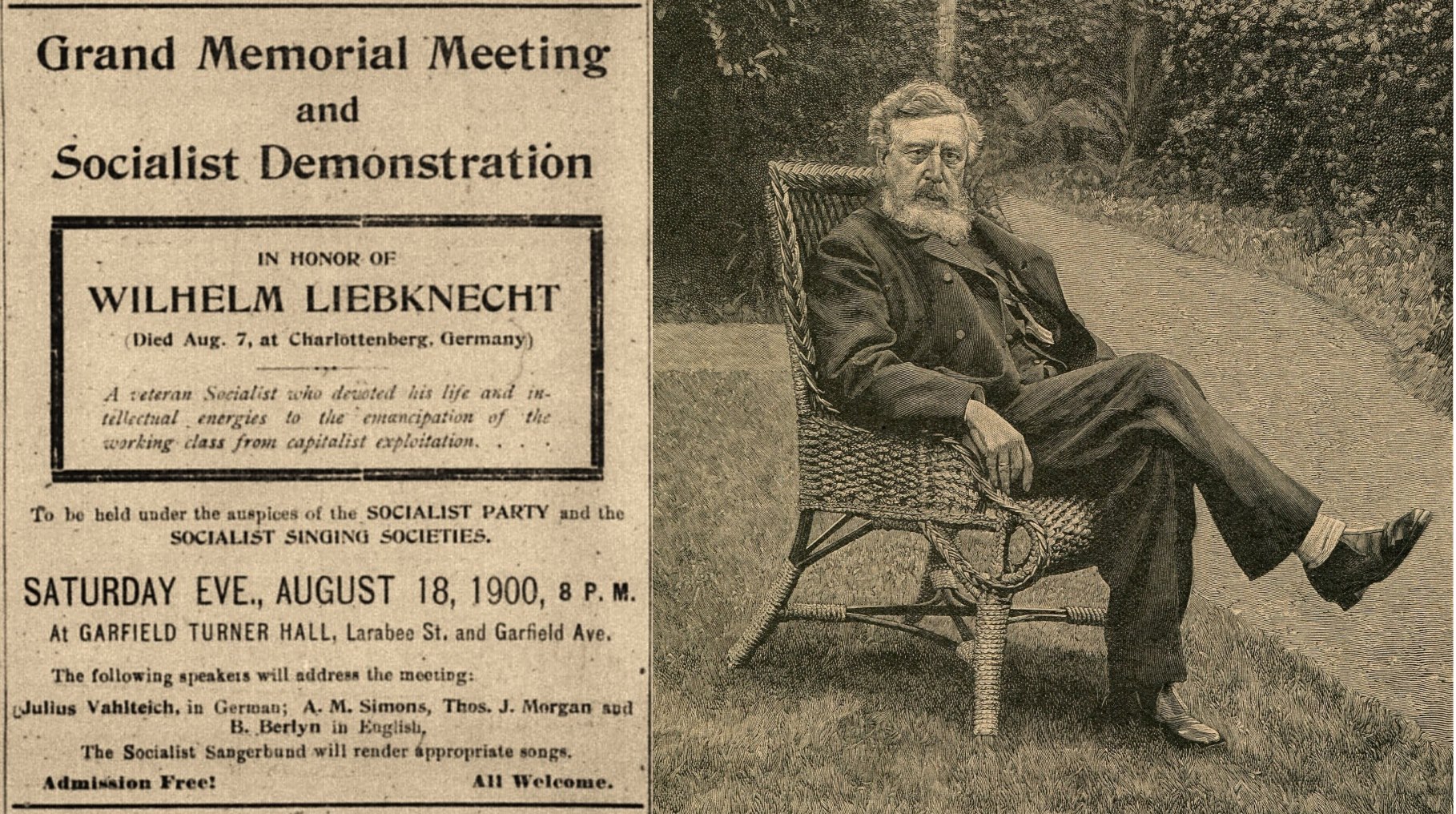
Chicago mourns Wilhelm Liebknecht.
‘Liebknecht Mass Meeting at Garfield Turner Hall’ from Workers Call (Chicago). Vol. 2 No. 77 August 25, 1900.
Workingman Gather to Commemorate the Death of the Champion of Their Class.
A mass meeting of Socialists, numbering some 1.500, assembled at Garfield Turner Hall. Garfield and Larrabee streets, to honor the memory of our late comrade. Wilhelm Liebknecht. who died in Charlottenburg. Germany. August 7th. In spite of the excessively warm weather the meeting was an unprecedented success and evinces the interest taken In socialism by the toilers as the economic stress presses harder.
The chairmen were Mr. Hunter In English and Frits in German. Mr. Hunter Introduced Comrade B. Berlyn, who presented a glowing tribute to the late comrade, and particularly, dwelt upon the fact that Liebknecht wrote the book entitled “No Compromise” and lived “No Compromise.” He scathingly arraigned Millerand of France fur accepting a position as minister of commerce, and said such a man was an opportunist and a compromiser. The speaker stated the basis of socialism was the class struggle, that our strength lay In our antagonism to capitalism, and that the gulf between capital and labor could never be bridged by palliatives and reforms, but only by socialism.
The German Singing Societies were then introduced and rendered some excellent singing of Socialist songs. The next speaker was Jules Valteich, in German, who was a member of the German Reichstag at the same time with Liebknecht. and he gave an outline of the life and struggles of Liebknecht, his exile to London, and stated that while the late comrade was editor of the “Nordeutsche Allgemeine Zeitung” Bismark had the stock of the paper bought up and offered bribes to Liebknecht to run the paper as a BIsmark’s organ, which attempt was repulsed, and forced him again into poverty. The speaker repudiated the action or Bernstein and classed him as a stool pigeon of capitalism, and also arraigned the newspapers of Chicago for classing Liebknecht as a reformer, which we must attribute to their ignorance of economics or deliberate lies. The speaker finished with a fervent appeal to all Socialists to stand for what Liebknecht fought and suffered for.
The next speaker was Comrade Simons. who spoke of the struggles of Liebknecht to educate the proletariat, of his exile, his sufferings, and urged every Socialist to be a Liebknecht himself, and that the cause will grow stronger as every toiler endeavors to emulate the character of the dead comrade. The Singing societies again assembled on the stage and rendered another Socialist song which was greeted with rounds of applause. The last speaker. Comrade Morgan, was introduced. and la a tribute to Liebknecht compared Bismark and the late comrade. one as a man of “blood and iron,” the other as a man of “loving service.” Lieb, love, and knecht as service. He contrasted the life of the late comrade with the lives of Astors, Vanderbilts, Carnagies. Pullmans, and stated they were all the product of capitalism, the capitalists the worst product, and the Liebknecht the best.
He said Liebknecht was not dead, he still lived in the hearts of the toiling workers who understood and are fighting for socialism, and that long after the memory of this meeting and the audience present had passed away that Liebknecht would still live on. and that we paid no tribute to the dead clay but to the thoughts and acts of the mighty dead. The resolutions were then introduced and read. They were endorsed by a standing unanimous vote, and ordered to be sent to the widow of our comrade.
Workers Call, predecessor to the Chicago Socialist, was published from 1899 as a dissident Socialist Labor Party publication edited by AM Simons. It became a voice of the Springfield Social Democratic Party after splitting formally with De Leon in July, 1901 and was a major voice of the new Socialist Party founded that same year. It became the Chicago Socialist Party paper with the SDP’s adherence to the Socialist Party of America and changed its name to the Chicago Socialist in March, 1902. In 1906 it became a daily and published until 1912 by Local Cook County of the Socialist Party and was edited by A.M. Simons of the International Socialist Review. A cornucopia of historical information on the Chicago workers’ movements lies within its pages.
PDF of full issue: https://www.marxists.org/history/usa/pubs/workers-call-chicago-socialist/000825-workerscall-v02w077.pdf
 Revolution's Newsstand