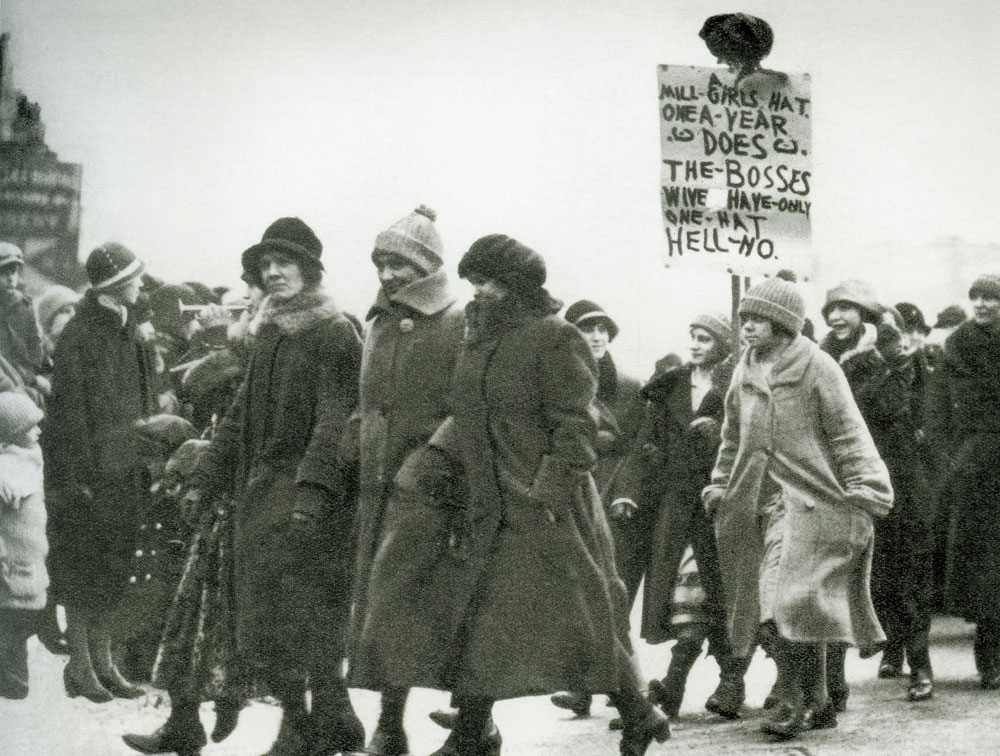
One year in, and how the strike impacted a single street next to the Botany Worsted Mills at Passaic, New Jersey.
‘Mattimore Street in Passaic, N.J.’ from The Daily Worker. Vol. 4 No. 8. January 22, 1927.
ADJOINING the Botany Worsted Mills in Passaic is a block known as Mattimore street. On one side of the street is a row of neat little brick cottages with fenced-in lawns, screened-in porches and flower gardens. On the other side of the street stretches an irregular line of ugly, run-down, drab-colored houses and tenements. Broken steps lead to the sidewalk. The roofs sag and the porches, where there are any, look on the verge of collapsing.
Stark Hostility.
These two rows of houses stand and stare hostilely at each other across the street which divides them. In the evening groups of people gather on the steps and porches in front of the houses on both sides of Mattimore street. They too stare across the street contemptuously. Occasionally a few jeering words fly thru the air.
THIS block of houses and tenements on both sides of the street is owned by the Botany Worsted Mills. Huge and formidable, the mills can be seen standing just in back of the neat brick cottages of the foremen. To the right of the strikers’ side of the street and in back of the mills runs a canal. To the left and in front of the mills is Dayton avenue.
Just One Block.
Mattimore street is only one block long, yet in this one block are concentrated many of the important elements of the textile strike now in its thirty-eighth week. These same elements can be found in almost any average strike ever held in this country, for that matter.
That narrow, one-block street presents a dramatic picture fit for the stage in its compression. On one side the dingy, ruined homes and tenements of the striking workers. On the other the spruce, red-brick cottages of the foremen, and in the background, the great belching chimney of the Botany mills. All this packed into one Block.
COMPANY-OWNED houses, pampered foremen, poorly-paid workers striking for the right to have their own union, “scabs” who have gone back to work or who refused to leave their jobs at all–these things too are found in the one block of Mattimore street.
Recently a fresh “wave of excitement rippled down Mattimore street. There have been many such ripples since the strike began. The latest one started with the appearance of a number of notices to move, served on residents on the strikers’ side of the street. They were signed by Arthur Hughes, agent for the Botany Worsted Mills. The first ones to receive these notices were those behind in their rent payments.
Tenants Blacklisted.
Then a rental agent appeared with a list of names covering two pages. Word went out that the whole street was to be cleared on the strikers’ side, whether rent was paid or not. A family from out of town moved into one of the houses across from the foremen’s homes, and went to work in the Botany mills. Other families were to be imported from out of town by the management of the mills, and the street was to be swept clean of strikers and strike sympathizers to make room for the “scabs.” This was the explanation the strikers living on the street gave for the blacklist of the rental agent.
AT number seven Mattimore street is a butcher shop. On the Botany agent’s list the name of the butcher appeared. The agent showed It to him. “What is the matter?” he asked. “What is your name doing on this list?”
“Search me,” replied the butcher.
“You know I always pay my rent promptly in advance.”
He knew.
But the butcher did have some idea of why his name was on the list. He told it to an agent of the union. “My brother-in-law lives upstairs,” he said. “In the evening he and his family and maybe some striker friends sit out in front of my shop and the foreman cross the street sees it. They’re the ones who are back of this list, of course. Certainly I’m for the strikers. I belonged to the miners’ union for 28 years myself. It was the strike in Pennsylvania that brought me into this town several years ago. I was put out of a company-owned house in Pennsylvania during the strike, just like they’re trying to put out these people on this street. It was a little different there, because we had leases saying we had to get out when we stopped working for the coal company. But it comes to the same thing here with these people.”
All up and down the street, notices have been served on the strikers, offering them to move in three days. None of them have gone yet, and they assert they don’t intend to, without putting up a fight first. After eight months and more of successful strike, they are not so easily cowed.
THE strikers who live on the street say that there are only about 15 “scabs” scattered up and down the street, among the several hundred residents on the strikers’ side. The foremen’s side, of course, they consider entirely “scab.” A few of these fifteen have moved into the neighborhood recently. Some of the others have dribbled back to the mills gradually. The rest never went out on strike at all,
The Reason.
This strike has been on since January, 1926. Why is it that the Botany Mills have waited nearly nine months before trying any drastic means to realize at last that the strikers intend to stick it out to the end. The Botany mills management is not anxious to drive these strikers living across the street out of the mill-owned houses. They are skilled workers and needed in the mills.
So they were allowed to stay month after month, on the continual expectation that each month would see them back. But now the ninth month is well started and there is no sign of weakening yet. And so as part of a renewed campaign of violence, comes the eviction notices of Mattimore street, Passaic.
The Daily Worker began in 1924 and was published in New York City by the Communist Party US and its predecessor organizations. Among the most long-lasting and important left publications in US history, it had a circulation of 35,000 at its peak. The Daily Worker came from The Ohio Socialist, published by the Left Wing-dominated Socialist Party of Ohio in Cleveland from 1917 to November 1919, when it became became The Toiler, paper of the Communist Labor Party. In December 1921 the above-ground Workers Party of America merged the Toiler with the paper Workers Council to found The Worker, which became The Daily Worker beginning January 13, 1924.
PDF of full issue: https://www.marxists.org/history/usa/pubs/dailyworker/1927/1927-ny/v04-n008-NYE-jan-22-1927-DW-LOC.pdf
 Revolution's Newsstand