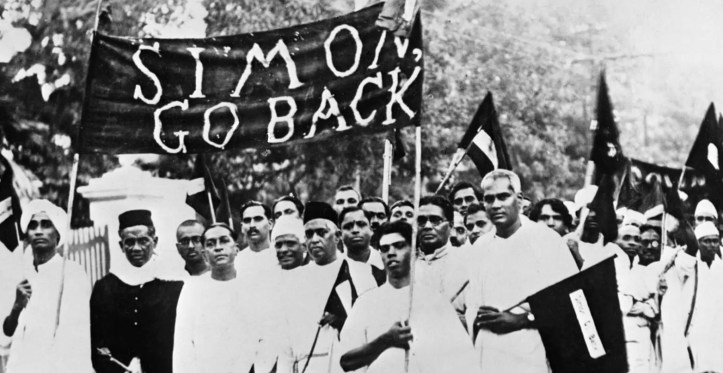
One of those interminable commission established by British Imperialism to obfuscate, delay, and deny taking any responsibility for its own actions. Luhani on 1927’s Simon Commission meant to investigate conditions in India.
‘The Protest Movement against the Simon Commission in India’ by G.A.K. Luhani from International Press Correspondence. Vol. 8 No. 8. February 16, 1928.
Some days before the Parliamentary Commission appointed to investigate the question of the Indian Constitution arrived in Bombay, the semi-official Anglo-Indian organ, the “Times of India”, appearing in Bombay, wrote regarding this Commission that “it does not inspire that degree of confidence necessary in order that its work shall be fruitful and its decisions acceptable”. This confession of the semi-official organ of the British government is very significant.
So far as the majority of the Indian population is concerned, the question does not consist in the “degree of confidence” towards the Commission, but in the strength of the active opposition not only towards the Commission but also towards the great Power which stands behind it, i.e. the British government. The mass protest demonstrations and strikes which took place in Bombay, Madras and Calcutta on the day of the arrival of the Commission compelled the British government to resort to arms. Some demonstrators were killed and wounded and several were arrested. In Calcutta “order” has been restored with the aid of armoured cars which drove up and down all the streets.
These events prove very clearly that the Commission had a very “warm” reception. Even the burning of the effigies of the Chairman of the Commission, Sir John Simon, as well as of Birkenhead, Baldwin and Ramsay MacDonald, do not exhaust with their popular symbolism the entire significance of the events of February 3rd. That which took place in the streets of Bombay, Madras and Calcutta means that the masses have flung their challenge not only to the Commission, but to the Power by which it was created. The demonstrators marched through the streets with the slogan: “Down with British imperialism!” This was to some extent a repetition of that slogan which was to be heard in the streets of the Foreign concession in Shanghai about three years ago, on 30th May, 1925.
At its meeting in December The Indian National Congress recommended “mass demonstrations” as a part of the programme of action for the boycott of the Commission. With reluctance and solely under the pressure of the iron law of development of the national revolutionary struggle, the Congress had inserted in its resolution on the boycott of the Commission, “mass demonstrations” on the day of the arrival of the Commission in India and appropriate demonstrations in the various towns of India which are to be visited by the Commission. In this manner the way was opened for the entry of great social forces into the political arena.
The more the events develop the more open and definite becomes the character of the intervention of the masses. In any event their action will not be confined to mere street demonstrations or to a one day’s demonstration strike.
The attitude of the bourgeois nationalists is sufficiently clear. This attitude is determined by their class aspirations in the literal sense of the word. They wish to make use of the mass actions to the extent which will suffice to intimidate British imperialism and compel it to fulfil their most important political demands, which consists in their being accepted as equal partners in the “British Commonwealth”. In all stages of their fight against British imperialism, no matter how hard. it may be, they will never decide to hazard their future role as the ruling social class which guides the development of the productive forces of India in a capitalist sense. Therefore they do not go beyond the demand for the organisation of street demonstrations and one day’s strike. In this they are helped by the leaders of the national trade unions who have entered the Labour movement in order to keep the ever growing masses of the organised workers under the yoke of the bourgeoisie.
The Congress proposed that, in place of the Commission appointed by the British Parliament, a National organ be created to which will be entrusted the drawing up of the Constitution for India. The concrete proposal of the Congress consists in the convocation of a National Assembly, the members of which could be: a) the members of the Committee of the All-Indian Congress; b) the representatives of other political, “workers”, commercial, and municipal organisations; and c) elected members of the Central Legislative Assembly and the Legislative Provincial Council. In this way the masses will not be represented in the National Assembly planned by the Congress. This Assembly will be convened mainly in order to betray the cause of the national revolution and in order, at a suitable moment, to conclude a compromise with British imperialism.
One can form a judgment regarding the rate of development of the national struggle and the fundamental shifting of its centre of gravity by the fact that during the present crisis the leadership of the revolutionary actions has passed into the hands of the politically organised advance-guard of the proletariat and of the peasantry. The Communist Party of India is taking steps in order that the broad masses of the entire country shall take part in all phases of the national struggle as an organised and concentrated force, which will convert this fight into a fight against the imperialist power, into a decisive fight by means of revolt throughout the whole country.
An excellent illustration of the approaching events in India is the attitude of the peasants in the Punjab. The peasants of the Punjab have in the last few years taken a very prominent part in the national revolutionary movement. They were the chief target of General Dyer’s machine guns in the historical blood bath at Amritsar in the year 1919.
The peasant movement in the Punjab is now so well organised that it possesses its own press organ, “Kirti” (The Toiler). It is written in the local dialect and has a wide circulation among the masses. On the first page appears the sign of a red flag with a sickle and hammer. “Kirti” wrote in its last number, in discussing the question that during the last imperialist war from 1914-1918 advantage was not taken of the opportunity to win freedom:
“The possibility which the Royal Commission now offers must be made use of for our “organisation”, and if a war should break out we must make use of it in order to obtain our freedom.”
In another number, in replying to numerous inquiries by workers’ and peasants’ correspondents as to what should be the attitude of the working masses of India “in the event of a war between India and Russia, “Kirti” states:
“If England commences a war against Russia, the workers will fight against this war and say to all their follow workers that they must not in any case help the English but fight against them with all means. The Russian government is a workers’ government and encourages us to fight for own rights. A blow directed at the Russian government is a blow directed against us. For this reason we must, if a war commences between England and the Bolsheviki, fight against this war, no matter how great the difficulties may be which we thereby encounter.”
If one listens to the cry: “Down with British imperialism!” which sounds in the streets of industrial Bombay along with the chorus of peasant voices from the revolutionary Punjab, then one has the key which will reveal how events in India will develop in the near future.
International Press Correspondence, widely known as”Inprecorr” was published by the Executive Committee of the Communist International (ECCI) regularly in German and English, occasionally in many other languages, beginning in 1921 and lasting in English until 1938. Inprecorr’s role was to supply translated articles to the English-speaking press of the International from the Comintern’s different sections, as well as news and statements from the ECCI. Many ‘Daily Worker’ and ‘Communist’ articles originated in Inprecorr, and it also published articles by American comrades for use in other countries. It was published at least weekly, and often thrice weekly.
PDF of full issue: https://www.marxists.org/history/international/comintern/inprecor/1928/v08n08-feb-16-1928-Inprecor-op.pdf
 Revolution's Newsstand