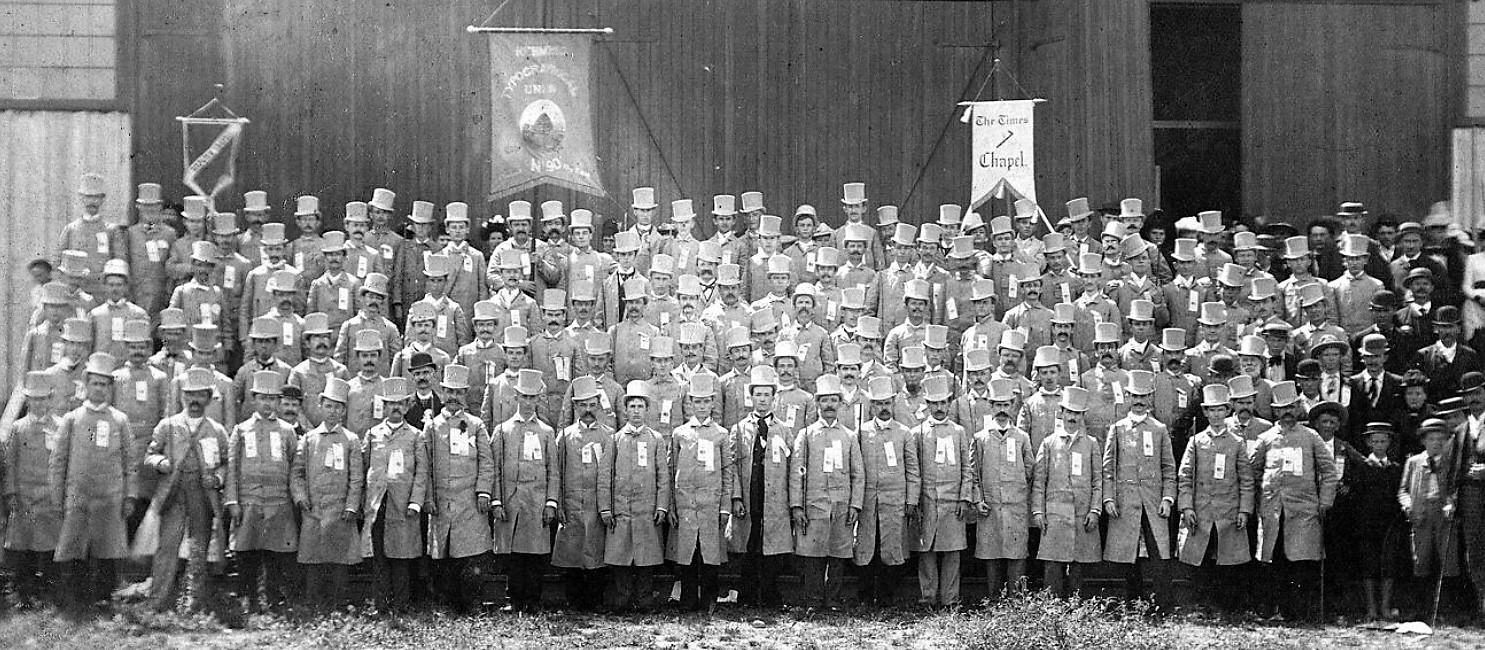
Labor Day since its inception as a national holiday in 1894–the state holidays have a different tradition–has been rightly seen as a conservative, pro-capitalist, imposed alternative to May Day–a holiday born in Chicago less than a decade previous.
‘What is Labor Day?’ from The Workers’ Call (Chicago). Vol. 1 No. 26. September 2, 1899.
The Significance of This Holiday to American Workers.
NOT A DAY FOR LABORERS.
Too Often an Opportunity for the Riveting of the Chains of Labor Yet Tighter.
Labor Day in the United States has come to mean a day when the workers of the land lay down their tools and at the command of their union gather in long processions with plays of their master’s products in the line and march to some picnic grounds where they are addressed by a number of “prominent” citizens representing one or the other of the great political parties and they at last go home at night after having received a lot of first class “jollys” thinking themselves pretty fine fellows, their union officers very much finer fellows and the men who addressed them as about the finest things that ever happened.
How different this from the European May Day. The one is a gift of bourgeois rulers, the other a privilege wrenched from the master’s hands. The one is utilized to express the rebellion of labor against the oppressing condition it is compelled to endure, the other to display his chains to his masters and secure their fastening for another year. How do you say that this is done? You deny that Labor Day is in any way a means to the enslavement of labor. Well let us reason together. When you get ready to go to work tomorrow morning where will you go? Will you just walk out to any particular place where there is work of the do and go to work? Or will you go around until you find a man owning the things you have to have to work with and that will buy your labor power? And when you have found someone to whom you can sell yourself day by day will he give you all that you are able to produce, or will be give you just about what he knows he can get the poor starving devil for that stood beside of you when you went in and tried to get a chance to do “your” work? In other words do you not get, taking year in and year out, just what the chattel slave got–your “keep,” while all the rest goes to your owner?
But you say, what has all this to do with Labor Day, with its bands, its picnics, its processions and its orators? We will be to that in a minute and you will see that it is quite an important link in the chain, The power which the employer has over the employee rests upon the fact that he has legal ownership in the tools with which the laborer works. But he secures that legal ownership through the votes of the laborers. The important link in the chain then is to see that the laborer votes right. To do this he must be kept contented and made to divide his vote among those political parties that take this state of affairs for granted and are only divided upon minor points that are of no interest to the laborer.
Here is where Labor Day looms up big. The first link in the chain is to flatter the laborer with big press accounts of his fine appearance in the parade the long line of “honest toilers,” the “magnificent display of union workers,” etc. Many a man who would not be bamboozled by such taffy about himself individually will swell with pride when it is applied to his union. The result is that the laborer is made to feel that he is pretty well off anyway. Then the next step is to capture his leaders. This is easy and the rank and file seldom catch on because they have been told that there should be no politics in the trades union and so are not suspicious. Besides are not speakers to be chosen from “both sides?” You poor fool, there will be none chosen from the LABORER’S side, if the fakirs and bosses keep hold. So the workers meekly follow their “leaders” to the seat of the festivities. On arriving there they receive some more “jollying” and are amused with games, prizes, races, etc., until the speaking begins. Then it is that the last link is forged and the last rivet driven that fastens their fetters for another year. One after another of the “prominent citizens” and great “statesmen” tell them of the tremendous “issues” that are dividing them. They point out the horrible danger of “trusts,” but are always a little hazy on what they are going to do about it and completely silent on what effect their remedy will have on the laborer. They rage about expansion and anti-expansion, and free silver and gold standard, with high tariff and low tariff thrown in and the whole mess well-seasoned with some more about the “dignity of organized labor” and the “brotherhood of toil” and the laborer goes home secure in the position that he will vote for one or the other of his master’s parties next election, and the deed is done.
Workingmen of America, can you not see that the whole thing is a tremendous game which you are paying a frightfully high price of admission. Can you not see that they have talked about everything except the one thing that is of interest to you. They have not said a word about your being a wage- ]slave and being compelled to give up the larger portion of what you produce to the man who buys your labor-power. They have kept very, very still about the fact that millions of men must at frequent intervals be thrown out upon the street to look for masters, a condition worse than the chattel slave ever knew. They say nothing to you about the fact that those who produce nothing receive the lion’s share of the products of labor. Above all they were scrupulously silent on the point that if the laborer would but use his vote solidly as a class he could easily enact his interests into law instead of continuing to vote for the interests of his employers. In fact, under the pretense of keeping politics out of the union they have filled the day with the most definite partisan kind of CAPITALIST politics. The only kind of politics that were not mentioned were laborer’s politics. The only party which is scrupulously and carefully omitted from representation at all ordinary Labor Day celebrations is the only party of the laborers–the International Socialist Labor Party. Here and there there are beginning to be exceptions and the laborers are beginning to discuss the questions that concern them and not those of the capitalists. But these instances are still the exception and in the most of cases the position is still true with which we started, that Labor Day has become a day on which to tighten up the fetters of enslaved labor.
The Chicago Socialist, sometimes daily sometimes weekly, was published from 1902 until 1912 as the paper of the Chicago Socialist Party. The roots of the paper lie with Workers Call, published from 1899 as a Socialist Labor Party publication, becoming a voice of the Springfield Social Democratic Party after splitting with De Leon in July, 1901. It became the Chicago Socialist Party paper with the SDP’s adherence and changed its name to the Chicago Socialist in March, 1902. In 1906 it became a daily and published until 1912 by Local Cook County of the Socialist Party and was edited by A.M. Simons if the International Socialist Review. A cornucopia of historical information on the Chicago workers movements lies within its pages.
PDF of full issue: https://www.marxists.org/history/usa/pubs/workers-call-chicago-socialist/990902-workerscall-v01n26-CIRCFIGS.pdf
 Revolution's Newsstand
Excellent piece I will share it on IST…..chuq
LikeLike