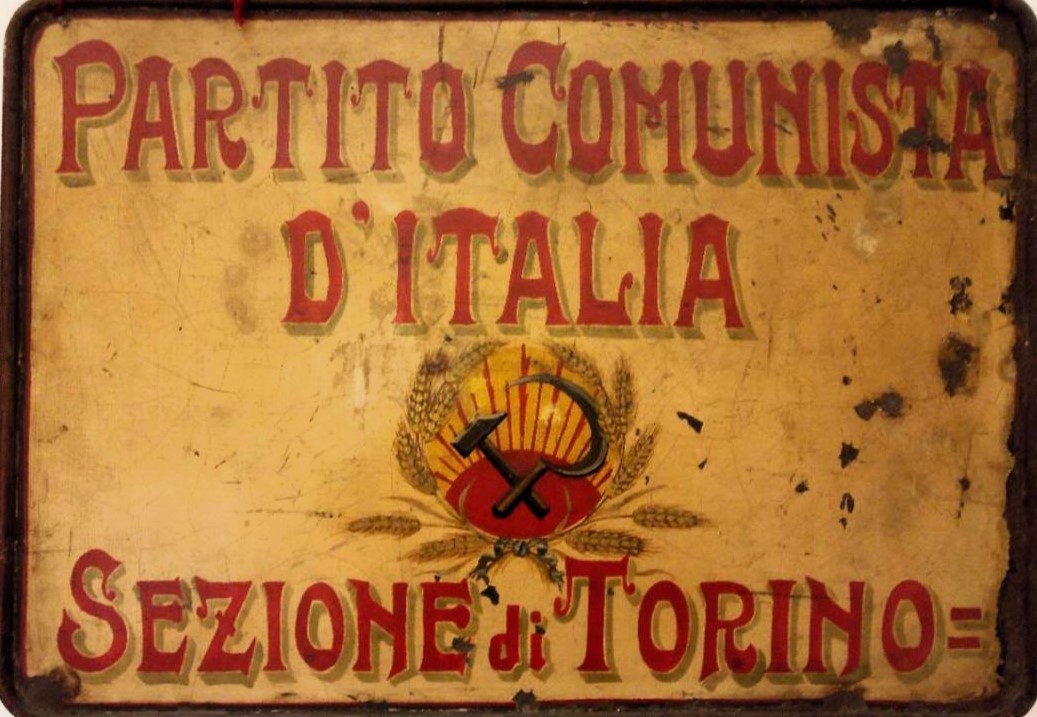
A valuable summary of the situation in the Italian labor movement in the period just before Mussolini’s Blackshirt takeover. Repossi was a veteran revolutionary and internationalist who was a central leader of the Italian Communist Party. Associated with Bordiga’s positions in the Comintern, he was expelled in 1928 while in serving years in prison. He remained a Left Communist after his release.
‘The Trade Union Movement and the Communists in Italy’ by Luigi Repossi from International Press Correspondence. Vol. 2 No. 25. March 31, 1922.
Immediately after its breaking away from the Italian Socialist Party the Communist Party began a systematic work in the trade-unions. In February 1921 a Propaganda Committees was appointed by the Party for the purpose of carrying on this work.
At the Congress of the General Federation of Labor held (C.G.L.) at Livorno (February 26th-March 3rd 1921) the Communist workers received over one-third of the votes cast by the Trade Union Councils and about one-seventh of those cast by the Federations (i.e. 288,000 Communist votes given by the Trade Union Councils against 556,000 Socialist votes und 136,000 Communist votes from the Federations against 798,000 Socialist votes) These figures can only be taken as an expression of the relative strength of the two tendencies in the Italian trade-union movement so far as the trade-union councils are concerned, whilst as regards the Federations owing to the way these bodies are constituted the figures do not convey a correct impression, so that we may take it that something like 580,000 trade-union councils are concerned, whilst as regards the Federations, owing to the way these bodies are constituted the figures do not convey a correct impression, so that we may take it that something like 580,000 trade-union organized workers stand behind the party.
Immediately following the Trade Union Congress there was formed, in addition to the Central Committee of the Communist Party, a Trade Union Committee with the its headquarters at Milan. In March, however, a ruthless police persecution of the Communist Party took place; in consequence of which and partly as a result of the Parliamentary elections which demanded every exertion, the activity of the Party in the trade-unions was for the time being almost suspended. But since June 1921 we have carried on a systematic activity within the trade-unions. The Trade Union Councils of Livorno, Salerno, Trieste, Tarante, etc., have already come over to our side.
Already at the time of the Parliamentary elections the Trade Union Committee had in agreement with the Party Executive, promulgated the slogan of the united proletarian battle front. On the 15th of August, however, the Trade Union Committee addressed a formal proposal to this effect to the C.G.L., the Italian Syndicalist Union and the Railwaymen’s Union. Over a hundred thousand copies of the letter dealing with this together with the accompanying manifesto, were distributed among the workers. While the trade-union bureaucracy of the C.G.L. as unblushing demagogues rejected our proposal with regard to the united front and the general strike as a defensive weapon against the capitalist offensive, and whilst the leaders of the Syndicalist Union and of the Railwaymen’s Union gave lip service to the proposal but did nothing to prove their desire for its realization, the broad masses of the workers have very sympathetically responded to our slogan and have in several places compelled the leaders to endorse our proposal.
In all, the following labor organizations have endorsed our standpoint on the question of the general strike: The Federation of Wood Workers, 23 local unions of the Metal Workers’ Federation, 4 Provincial Federations and 7 local groups of the Building Workers, 3 Provincial Federations of the Agricultural Workers, 46 Trade Union Councils including Turin, Trieste, Naples, Florence, Cremona, etc. and 42 local groups of various other industrial federations. In addition to this, Communist groups have been formed in almost all other trade-union organizations and embrace a very considerable minority of the membership.
On the 7th of September 1921, a conference was convened in Milan of all the organizations affiliated to the Communist Trade Union Committee. Although this conference was obliged to meet together and confer illegally for reaction was rampant in the city, over 100 delegates from all parts of Italy representing more than 500,000 Communist trade unionists took part in the proceedings. At the conference a report on the First World Congress of the Red Trade Unions was delivered and after an animated discussion affiliation to the Red Trade Union International was decided on. The decisions of the Moscow Congress were approved and a series of resolutions were adopted concerning the building up of our organization and the improvement of our propaganda. Among other things it was decided to publish a special organ for the propagation of Communism among the trade-unions. This organ “Il Sindicato Rosso” appears weekly in Milan.
In November 1921 the leadership of the C.G.L. found it necessary to call a national conference in order to consider its attitude with regard to the question of trade-union tactics and the International. As is known the Amsterdamers on this occasion had the upper hand and on the question of the general strike. 246,402 votes were given by the Trade Union Councils for the Communists while 612,653 were given for the Socialist resolution, whilst from the Federations 169,310 votes were given for the Communists and 813,868 for the Socialist resolution. One must remark that these figures cause the comparative strength of the two movements to appear unfavorable to the Communists merely because they are derived from these trade-union organizations which are controlled by the Socialists, and the reports as to memberships are only as appear on the books though they may often have shrunk considerably. (For example the Federation of Agricultural Workers which at present has only 200,000 members was in the vote credited with 850,000),
Our organization work has gone forward ever since. Almost everywhere local organizations, district unions, etc., of Communist bodies have been formed. In certain industries special propaganda committees have been establish. Of these we number in all 13, the 14th comprises the Union of War Invalids. In December 10,000 copies of our trade-union organ were printed.
The Communist Trade Union Committee has devoted itself recently to the Syndicalist Union. There are certainly between us and the old section within the Syndicalist Union certain points of contact; there are, however, certain differences of opinion. In particular the Syndicalists demand of us that we leave them free to split unions away from the C.G.L. For the rest, one has to admit that the Syndicalist Union, although Borghi and his friends prate of its hundreds of thousands of affiliated members, does not actually at the present time possess more than 100,000 and perhaps even only 80,000 members. The Syndicalist Union possesses no record of its sections, no statistical bureau, no proper secretariat; it will not and cannot yet discriminate between the Rede Trade Union International and the Communist International.
Within the C.G.L, a systematic propaganda is being carried on as heretofore. At present there is proceeding an agitation for the calling of a Confederation Congress. In these efforts we are supported by the Lazzari section which opposes the reformist tendencies in the C.G.L. and advocates affiliation to the Red Trade Union International. On the other hand the Social Democrats in order to check our progress have recourse to the weapon of expulsions.
With regard to the newly formed notorious “Allianza del Lavoro” (Alliance of Labor) there can be no doubt that the alliance was brought about in order to allow D’Aragona and the Serrati party to exercise pressure upon the government in a reformist direction. On the other hand the creation of this alliance is partly the result of our agitation for the united front. We have on this account joined the alliance and are carrying on propaganda therein in the direction and spirit of our program according to the decisions of the Trade Union Congress of Moscow.
International Press Correspondence, widely known as”Inprecorr” was published by the Executive Committee of the Communist International (ECCI) regularly in German and English, occasionally in many other languages, beginning in 1921 and lasting in English until 1938. Inprecorr’s role was to supply translated articles to the English-speaking press of the International from the Comintern’s different sections, as well as news and statements from the ECCI. Many ‘Daily Worker’ and ‘Communist’ articles originated in Inprecorr, and it also published articles by American comrades for use in other countries. It was published at least weekly, and often thrice weekly.
PDF of full issue:https://www.marxists.org/history/international/comintern/inprecor/1922/v02n025-mar-31-1922-inprecor.pdf
 Revolution's Newsstand